A Guide to Enterprise Learning Management Systems
Let’s get right to it. Imagine your company trying to operate its own private, digital university. That’s what an enterprise learning management system (LMS) makes possible. It’s a powerful software platform that becomes the central hub for managing, delivering, and tracking every single training program across your organization.
What an Enterprise LMS Really Is
This isn’t just a glorified shared folder for training videos. A true enterprise LMS is built from the ground up to handle the messy, beautiful complexity of a large organization. It’s designed to manage wildly different training paths for every department, navigate global compliance standards, and plug seamlessly into the other critical business tools you already rely on, like your HR software.
Your enterprise LMS is the engine that powers your entire learning and development strategy. It’s what ensures a new hire in Berlin gets the exact same high-quality onboarding as a senior manager taking a leadership course in Boston.
And this technology is becoming more critical every single year. The global corporate LMS market was pegged at around USD 9.57 billion in 2024. But get this, it’s projected to explode to nearly USD 27.43 billion by 2030. That’s a compound annual growth rate of roughly 19.4% in just a handful of years. It’s clear why so many companies are making this investment.
Beyond the Basics of Training Software
So, what really separates an enterprise LMS from a standard, off-the-shelf training tool? The biggest difference boils down to one word: scalability. An enterprise-grade system is architected to support thousands, or even tens of thousands, of users spread across different countries and time zones without breaking a sweat.
Think of it like this. A small business might get by with a simple tool to share a few onboarding videos. But a large corporation needs a system that can handle much heavier lifting:
- Automate Compliance Training: Automatically enroll thousands of employees in mandatory courses for certifications like GDPR or HIPAA and meticulously track their completion.
- Create Personalized Learning Paths: Serve up specific training modules to the sales team about a new product, while the engineering team gets a deep dive into its technical specs, all at the same time.
- Integrate with Business Systems: Talk to your HR software to automatically update employee profiles when they get promoted, or connect with a CRM to link sales training directly to performance data.
- Support External Learners: Go beyond your own employees to train partners, resellers, and even customers, making sure everyone in your business ecosystem is on the same page.
To really grasp what an enterprise LMS does day-to-day, it helps to break down its primary responsibilities. These are the core jobs it’s hired to do for a large business.
Core Functions of an Enterprise LMS
| Core Function | What It Means for Your Business |
|---|---|
| Centralized Content Management | A single, organized library for all training materials like videos, documents, and interactive courses. No more hunting for the “latest version.” |
| Automated Administration | Handles the tedious work of enrolling users, sending reminders, and assigning courses based on roles or departments, freeing up L&D teams for strategy. |
| Advanced Reporting & Analytics | Delivers deep insights into who is learning what, tracking progress, and measuring the direct impact of training on business goals. |
| Integration & Interoperability | Seamlessly connects with other essential business software (HRIS, CRM, SSO) to create a unified tech stack and automate data flow. |
| Scalability & Performance | Built to handle massive user loads, diverse content types, and global access without performance drops or system crashes. |
These functions work together to transform training from a scattered, manual headache into a streamlined, strategic business operation.
An enterprise LMS pulls all learning activities into one place, giving you a single source of truth for skills development across the entire organization.
Why It’s More Than Just a Nice-to-Have
In today’s business world, standing still is the same as falling behind. Continuous learning is a survival strategy. An enterprise LMS provides the essential framework to make that a reality. It helps organizations onboard new hires faster, close critical skill gaps before they become a problem, and ultimately improve employee retention.
When people see a clear path for growth and have easy access to the resources they need to get there, their engagement and job satisfaction skyrocket. This system helps you build a smarter, more agile workforce that can adapt to whatever comes next.
While there are many different types of learning management systems, the enterprise version is specifically built for this level of organizational complexity and strategic impact. It’s an investment in your people that pays real dividends in productivity, innovation, and long-term success.
The Core Features of a Modern Enterprise LMS
When you start looking at different enterprise learning management system platforms, you quickly realize they aren’t all created equal. A true enterprise-level system goes way beyond being a simple file repository for courses. It needs a core set of features that are absolutely non-negotiable if you want it to work at scale.
These features separate a basic tool from a strategic asset that grows with your business and delivers a real, measurable impact. Let’s dig into the must-haves for any enterprise LMS you’re seriously considering.
Robust Reporting and Analytics
You can’t improve what you don’t measure. It’s an old saying, but it’s the absolute truth in corporate training. A top-tier enterprise LMS has to give you deep, meaningful insights into how your training programs are actually performing. This means so much more than just checking a box to see who completed a course.
Think bigger. You need to know which courses are truly effective, pinpoint where learners are getting stuck, and connect training outcomes to bottom-line business goals, like a jump in sales or better customer satisfaction scores. Powerful analytics give you the hard data to make smarter L&D decisions and prove the value of your work.
A great LMS turns raw data into a clear story. It should show you not just what happened, but why it happened, so you can fine-tune your training strategy.
Look for systems that offer:
- Customizable Dashboards: So you can see the metrics that matter most to your team at a single glance.
- Scheduled Reports: Automatically send progress updates to key stakeholders, saving you from hours of manual spreadsheet work.
- Business Impact Metrics: The ability to link training data with performance data from other systems, like your CRM or HR platform.
Scalability and Performance
This one is a dealbreaker. An enterprise learning management system has to be built for growth. The platform you choose today must be able to support your company not just now, but three, five, or even ten years down the road.
Scalability means the system can handle a massive number of users from a few thousand to hundreds of thousands without slowing down, glitching, or crashing. It also needs to support a huge, growing library of content and gracefully handle spikes in activity, like when you roll out a major company-wide training initiative. Get this wrong, and you’ll be shopping for a new system right when you need your current one the most.
Seamless Integrations
Your LMS doesn’t live on an island. It has to play nicely with all the other software your business depends on every single day. Strong integration capabilities are essential for automating workflows and creating a connected, efficient tech stack.
For example, integrating your LMS with your Human Resource Information System (HRIS) means you can automatically enroll new hires in their onboarding programs. Hooking it up to Salesforce can tie training completion directly to sales performance metrics, showing a clear line between learning and revenue.
A few key integrations to look for include:
- Single Sign-On (SSO): For easy and secure user access without juggling a dozen passwords.
- HRIS and CRM systems: To sync employee and customer data automatically.
- Video Conferencing Tools: Like Zoom or Microsoft Teams for live, virtual training sessions.
- Content Authoring Standards: Support for formats like SCORM and xAPI is crucial for using a wide range of e-learning content. If you’re unsure which is right for you, check out our guide on SCORM vs xAPI.
Mobile and Social Learning
Today’s workforce is more mobile and collaborative than ever. A modern enterprise LMS has to meet them where they are. That means offering a stellar mobile experience that allows employees to learn anytime, anywhere. This could be on their commute, between meetings, or whenever they find a spare moment.
Social learning features are also quickly becoming standard. These tools foster a culture of collaboration and knowledge sharing. Think forums, discussion boards, and peer feedback tools that let learners connect with each other, ask questions, and learn from their colleagues’ experiences.
Advanced Learning and Security Features
Finally, look for advanced capabilities that truly elevate the learning experience. Many platforms are now weaving in features like adaptive learning, which personalizes content paths for each user, and automated feedback. In fact, these types of intelligent features are found in roughly 47% of modern systems, boosting both engagement and efficiency.
Just as critical is security. An enterprise LMS will house sensitive employee and company data, so it absolutely must have rock-solid security measures. This includes data encryption, role-based access controls to ensure people only see what they’re supposed to, and compliance with standards like GDPR and HIPAA to keep your information buttoned up and safe.
The Business Case for an Enterprise LMS

So, is an enterprise learning management system really worth the hefty price tag? It’s a question every leader asks, and the short answer is a firm yes, when you find the right one. The business case for a great LMS goes way beyond just having a digital filing cabinet for training videos.
The most immediate win I’ve seen companies get is simply getting organized. Imagine waving goodbye to training files scattered across shared drives, different versions of the same content floating around, and trying to track who’s done what on a nightmarish spreadsheet. Bringing all your learning into one central hub is a massive efficiency boost right out of the gate.
This centralization creates a consistent learning experience for every employee, whether they’re in the main office or working from a home office halfway across the world. Everyone gets the same high-quality, up-to-date information, which is a game-changer compared to the usual chaos.
Freeing Up Your Most Valuable Resources
One of the biggest returns you’ll see comes from automation. An enterprise LMS takes on the tedious, time-sucking administrative tasks that bog down your Learning and Development (L&D) team.
Think about all the hours spent manually enrolling new hires into onboarding programs, sending out reminder emails, and pulling reports. A good system does all of that for you. This frees up your L&D pros to stop being administrators and start being strategists. They can focus on creating better learning experiences and aligning training with actual business goals. A crucial first step here is running a training needs assessment to figure out where to point those strategic efforts.
By automating routine tasks, an LMS allows your L&D team to shift their focus from managing logistics to driving genuine performance improvement.
This operational efficiency doesn’t just save time. It translates directly into cost savings and lets you scale training programs without having to hire more and more admin staff to keep up.
Nailing Compliance and Reducing Risk
For so many industries, compliance training is a make-or-break activity. It’s mandatory, heavily regulated, and comes with a mountain of tracking and reporting requirements. This is where an enterprise learning management system becomes absolutely essential.
An LMS simplifies the entire compliance headache. You can:
- Automate Enrollment: Automatically assign required training based on an employee’s role, department, or even hire date.
- Track Progress: Get a real-time dashboard showing who has completed their training and who is falling behind. No more chasing people down.
- Generate Reports: Easily pull audit-ready reports with a few clicks to prove compliance and avoid costly fines or legal troubles.
- Manage Certifications: The system can automatically track expiration dates and re-enroll employees in recertification courses.
Instead of a frantic, manual scramble every time an audit looms, the process becomes smooth, automated, and practically stress-free.
Connecting Learning to Growth and Retention
Perhaps the most powerful argument is the direct link between a great LMS and your people. A well-implemented system does more than just train employees. It helps them grow. By providing clear and accessible learning paths, you show your team a real future at the company.
When employees see opportunities for career advancement and have the tools to actually pursue them, their engagement and loyalty skyrocket. This directly impacts your retention rates, which is a huge cost-saver for any business.
The data backs this up. Knowledge retention rates for employees using an LMS can increase up to 60%, a massive leap from the 8-10% seen with more traditional training methods. When people actually remember and apply what they learn, your business sees tangible benefits in performance, productivity, and innovation.
How to Choose the Right Enterprise LMS for Your Company
Picking the right enterprise LMS feels like a monumental decision, but it doesn’t have to be overwhelming. I’ve walked dozens of companies through this exact process, and I can tell you there’s a clear path to finding the perfect fit. It all starts with getting brutally honest about what you actually need.
Before you even glance at a single vendor website, you need to do some internal homework. What specific pain point are you trying to eliminate? Are you looking to slash new hire onboarding time, finally get a handle on compliance training, or educate customers on how to use your products?
Knowing your primary goal is step one. Next, think about who you’re training. The needs of a global, always-on-the-move sales team are worlds apart from those of factory floor workers or your external channel partners. Get specific about your audience and their comfort level with technology.
Define Your Core Requirements
Once you have the big picture, it’s time to drill down into the must-haves. I always recommend creating a simple checklist of your non-negotiables. These aren’t a wish list of cool features. They are the absolute deal-breakers.
Your list should cover three main areas:
- Functional Needs: What must the LMS do? This could be anything from mobile learning and social features to robust reporting or the ability to sell courses to external audiences.
- Technical Needs: How does it need to play with your existing tech stack? Think about critical integrations with your HR software, Single Sign-On (SSO) for easy login, or specific data security protocols you have to meet.
- Support Needs: What level of help will you require from the vendor? Do you need 24/7 phone support, a dedicated success manager, or extensive hands-on help during the implementation phase?
Getting this on paper first will save you from being dazzled by flashy demos of features you’ll never actually use. It keeps you laser-focused on what truly matters for your business.
Evaluating Vendors Like a Pro
With your requirements list in hand, you can start vetting potential partners. The process of selecting an LMS can feel a lot like figuring out how to choose an ERP system. It’s a major investment that demands careful consideration.
Don’t just take the sales rep’s word for it. Dig into real customer reviews on sites like G2 or Capterra to get an unfiltered view of their reputation. Pay close attention to any comments about customer support, because that relationship can make or break your entire experience long after you’ve signed the contract.
Another critical step is to get total transparency on their pricing model. Are there hidden fees for extra data storage, support tickets, or adding new integrations down the line? A reputable vendor will be completely upfront about the total cost of ownership.
A vendor’s product roadmap is a window into their future. Ask them what features they are building next to see if their vision aligns with your company’s long-term goals.
One of the biggest forks in the road is deciding between a system you host yourself (on-premise) and one that lives in the cloud. This infographic breaks down the typical differences in time and cost.
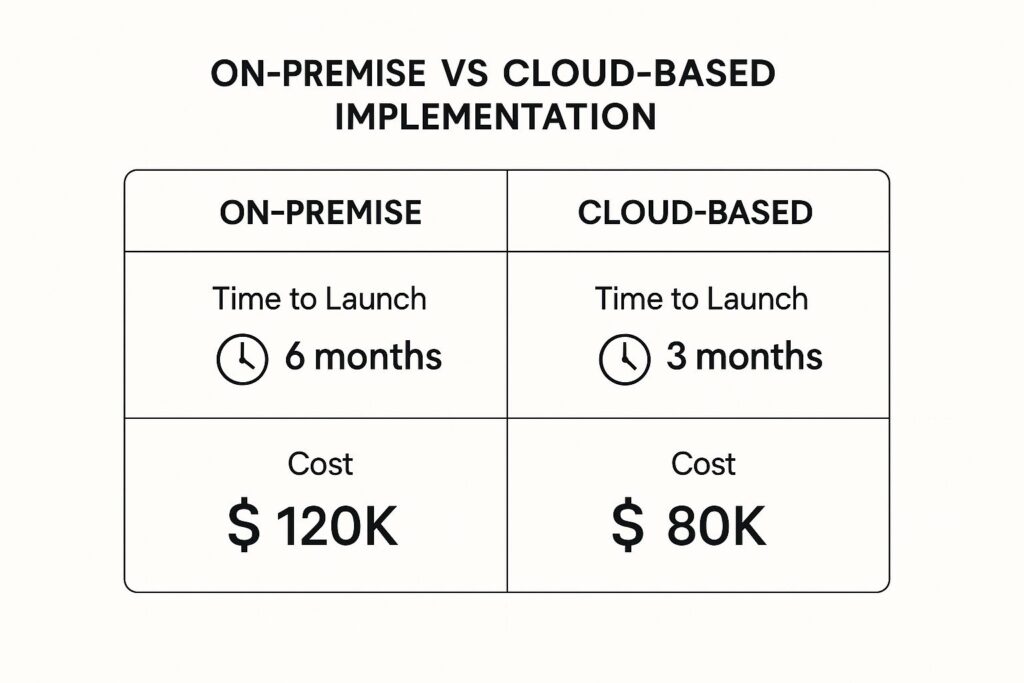
As you can see, cloud-based systems generally offer a much faster and more affordable path to getting started, which is a big reason why they’ve become the go-to choice for most companies.
To help you stay organized during this stage, I recommend using a simple scoring matrix. It’s an effective way to compare vendors side-by-side against the requirements you already defined.
Key Vendor Evaluation Criteria
| Evaluation Criteria | Vendor A | Vendor B | Vendor C |
|---|---|---|---|
| Meets Core Functional Needs | |||
| Key Integrations Available | |||
| User Experience (UI/UX) | |||
| Mobile Learning Capability | |||
| Reporting & Analytics Strength | |||
| Scalability for Future Growth | |||
| Customer Support Reputation | |||
| Transparent Pricing Model | |||
| Security & Compliance | |||
| Implementation Support |
Using a checklist like this ensures you’re making an objective decision based on data, not just on which salesperson gave the slickest demo.
The Ultimate Test: User Experience
Finally, and this might be the most important piece of the puzzle, you have to nail the user experience. You can buy the most powerful enterprise learning management system on the market, but if it’s clunky, confusing, or just plain ugly, your employees won’t use it. Plain and simple.
During demos, put yourself in your learners’ shoes. Is it obvious how to find courses? Is the interface intuitive? Does the mobile app work just as seamlessly as the desktop version? If you can, get a free trial and have a small group of your actual employees test-drive it.
Their feedback is pure gold. A system that people genuinely enjoy using is one that will see high adoption rates, and that’s how you’ll get the real return on your investment. A confident, informed decision comes down to this blend of rigorous technical vetting and a sharp focus on the human side of the software.
Your Practical Guide to LMS Implementation
So, you’ve picked your enterprise learning management system. That’s a huge step, but now comes the part where the rubber meets the road: the implementation. This is the phase where many ambitious projects can unfortunately lose steam. But with a clear plan, we can make sure yours is a massive success.
A great implementation is so much more than just flipping a switch on new software. It’s a carefully choreographed project that involves smart planning, clean data migration, and open communication with everyone who will be using the system.
Getting this right sets the stage for everything that follows. A smooth launch builds trust and excitement, which are crucial for getting your employees to actually adopt and use the new platform for the long haul.
Building Your A-Team
First thing’s first: assemble your project team. This is not a one-person job. You’ll want to pull together a small, dedicated group of people with clearly defined roles.
Think about who really needs to be in the room for this to succeed:
- Project Manager: This person is the captain of the ship, keeping everyone on track, on schedule, and on budget.
- IT Specialist: They’ll handle the technical heavy lifting, like system integrations and data security. You need them on your side.
- L&D Lead: Your learning expert will own the content strategy, making sure all the training materials are ready to go and make sense for your learners.
- Department Champions: These are enthusiastic employees from different teams. They provide real-world feedback and help get their colleagues genuinely excited about the launch.
Having this core group in place from day one ensures all your bases are covered.
The Great Content Migration
Next up is one of the most critical, and often underestimated, steps: content migration. This is the process of moving all your existing courses, videos, documents, and quizzes from their old home into your shiny new enterprise LMS. It sounds straightforward, but this is a perfect opportunity to do some house cleaning.
Don’t just copy and paste everything over. Use this moment to review your content library with a critical eye. Is it still accurate and engaging? Is it even relevant anymore? This is your chance to archive outdated materials and ensure only your best, most effective content makes it into the new system.
A clean content migration is a fresh start. It ensures your new LMS launches with high-quality, relevant material that learners will actually want to engage with.
For a practical guide to LMS implementation, understanding the technical side of connecting with existing platforms is crucial. A good learning management system integration guide can be a lifesaver here.
Don’t Skip the Pilot Program
Finally, before you go for the big, company-wide launch, you absolutely must run a pilot program. Think of this as a dress rehearsal for your LMS rollout. You’ll select a small, representative group of users to test the system in a real-world setting.
This small-scale test is invaluable. Your pilot group will uncover any weird bugs, confusing navigation, or content issues you might have missed. Their feedback allows you to iron out all the wrinkles and make critical adjustments before you launch to the entire organization.
A successful pilot program builds incredible momentum. It not only ensures a smoother official launch but also creates a group of early advocates who can help champion the new platform when it’s time for everyone to jump in. This thoughtful approach transforms implementation from a technical task into a strategic launchpad for long-term learning success.
How to Measure the ROI of Your Enterprise LMS

So, you’ve invested in a new enterprise learning management system. Sooner or later, you’re going to have to prove it was worth the money. Talking to leadership about the value of your LMS requires a rock-solid business case. And that means measuring your return on investment, or ROI.
The trick is to look at both the easy-to-count numbers and the less obvious benefits that are just as critical to the business. We can break this down into two simple buckets: hard metrics and soft metrics. Thinking in these terms helps you build a compelling story that really connects.
Crunching the Hard Numbers
Hard metrics are the tangible, quantifiable wins you can drop right into a spreadsheet. Think direct cost savings and clear efficiency gains. This is usually the best place to start because the math is straightforward and the impact is undeniable.
You can begin by calculating the most direct savings:
- Reduced Training Costs: How much did you save on flights, hotels, venue rentals, and printed binders by moving training online? If you trained 1,000 employees remotely instead of flying them to headquarters, the savings are massive and easy to prove.
- Faster Onboarding Time: Measure the time it takes for a new hire to become fully productive. If your LMS shaves two weeks off that ramp-up period, you can calculate the value of that extra productivity across every single new hire.
- Improved Compliance Rates: Track the reduction in fines or penalties because the LMS ensured everyone completed mandatory training on time. This is a direct risk reduction with a clear dollar value attached.
A powerful way to frame ROI is to show how the enterprise LMS is a performance engine. Connect every learning outcome directly to a key business goal.
Valuing the Soft Metrics
Soft metrics are a bit trickier to pin down, but they’re incredibly important. These are the benefits that touch your company culture, employee morale, and the overall health of your talent pipeline. While you can’t always put an exact dollar figure on them, you can absolutely track their movement and link them to business success.
Some of the most crucial soft metrics include:
- Higher Employee Engagement: Use your regular employee pulse surveys to track engagement and satisfaction scores. A 15% lift in engagement for teams that heavily use the LMS is a statistic that gets attention.
- Better Retention Rates: Look at your employee turnover rate. If you see turnover drop among employees who complete specific career development paths in the LMS, you can calculate the savings from reduced hiring and retraining costs.
By combining both hard and soft metrics, you paint a complete and powerful picture. You show that the enterprise learning management system doesn’t just save money. It builds a stronger, more capable, and more loyal workforce that drives real growth for the business.
Common Questions I Hear About Enterprise LMS
Over the years, I’ve had hundreds of conversations about choosing and implementing an enterprise learning management system. A few questions come up again and again, so I wanted to tackle them head-on. If you’ve been wondering about any of these, you’re in good company.
Is an LMS Really Worth the Investment?
This is the big one, isn’t it? My honest answer is absolutely, but only if you’re feeling the pain of trying to scale your training without one. If you’re struggling with inconsistent delivery, wasting hours on manual admin, or watching new hires take forever to get productive, then an LMS isn’t just a purchase. It’s a solution.
Think about the real costs you’re already paying in lost time, frustrated customers, and employee churn. A solid LMS is an investment that pays you back, both in hard dollars and in having more capable, confident people across the board.
How Do I Actually Measure the ROI of an LMS?
Great question. It’s easy to see the upfront cost, but the return is just as measurable if you know where to look. I tell people to track a mix of hard numbers and performance improvements.
- Hard Metrics: Start with the easy stuff. Calculate your savings from reduced travel for in-person training, faster onboarding times (40% faster in many cases!), and lower employee turnover costs.
- Soft Metrics: Then, look at performance. Are employee engagement scores ticking up? Are customer satisfaction ratings improving? Is product adoption climbing after people complete your training courses?
A modern LMS gives you the analytics to draw a straight line from your training programs to these critical business outcomes. It’s all about connecting learning to real-world results.
Will This Thing Even Work With My Existing Tools?
It’s 2024. It absolutely has to. Any enterprise learning management system you seriously consider should integrate seamlessly with the tools your team already lives in every day.
The goal is to weave learning directly into the flow of work, making it a natural part of your business operations.
For example, connecting your LMS to your HR system automatically handles user accounts, which is a huge time-saver. Integrating it with Salesforce can link training completion directly to customer health scores, giving your success team a powerful leading indicator of retention.
Bottom line, before you commit to any vendor, dig deep into their integration capabilities. This isn’t a “nice-to-have” feature. It’s a non-negotiable for any true enterprise solution.