How Do You Write a Curriculum: A Practical Guide
Writing a curriculum is about building a thoughtful educational journey. It starts with figuring out who you’re teaching and what you want them to achieve, then moves into mapping out logical lessons and meaningful activities.
Think of it as crafting a roadmap that guides a learner from their starting point to a specific destination.
Building a Strong Curriculum Foundation

Before you write a single lesson plan or create a single slide, you need to pour a solid foundation. This is the “why” and “who” behind everything you’ll do.
Skipping this part is like trying to build a house without a blueprint. You might end up with something, but it probably won’t be sturdy or serve its purpose well. I’ve learned that the most effective curricula are born from a deep understanding of the learners. You have to know who they are, what they already know, and what they need to know.
Starting with a Needs Analysis
The first real step in this process is conducting a needs analysis. It’s just a structured way of asking critical questions to identify the knowledge or skill gaps you need to fill. This discovery phase is what keeps you from making bad assumptions.
For instance, if I’m designing a corporate training program for a new piece of software, I need to find out:
- What is the current skill level of the employees?
- Which specific features are causing the most confusion or support tickets?
- What business outcome is this training supposed to achieve? (e.g., reducing support tickets by 20%).
Answering these questions ensures your curriculum is relevant from day one. If you want to dive deeper into this process, we have a helpful guide with a training needs assessment template that can get you started.
Defining Your Curriculum’s Core Purpose
Once you know what your audience needs, you can lock in the curriculum’s core purpose. Is it designed to get someone job-ready for a new career? Is it meant to teach a hobby, like photography? Or is it for a global classroom with diverse backgrounds?
Defining this purpose early on becomes your North Star for every decision that follows.
This focus on purpose is crucial, especially when you think about the global scale of education. Many curriculum developers are working to create inclusive frameworks to address massive educational access issues.
For example, UNESCO estimated that 272 million children were out of school in 2023, a staggering number that presents a huge challenge for global curriculum development efforts. Understanding these kinds of real-world challenges helps shape more inclusive and impactful educational frameworks.
Beyond just the content, a strong curriculum also considers how to foster an optimal setting for learning. This includes things like creating a productive learning environment for advanced students. With a well-defined purpose and a clear picture of your audience, every other decision, from lesson planning to assessment, becomes much, much clearer.
Defining Clear and Measurable Learning Objectives
Once you know who you’re teaching and why they’re there, it’s time to get brutally honest about what they’ll actually be able to do when they’re done. This is where we write learning objectives. Think of them as the constitution for your curriculum. Every single piece of content, every activity, and every assessment has to answer to them.
A classic mistake is to write fuzzy goals like “learners will understand social media marketing.” What does “understand” even look like? How do you know when someone has achieved it? It’s a recipe for a course that feels aimless and is impossible to measure. We need to trade those cloudy ideas for concrete, observable actions.
From Vague Goals to Actionable Objectives
The secret is focusing on action verbs. These are words that describe something you can actually see or measure. Instead of “understand,” you’d use verbs like “list,” “explain,” “build,” or “compare.”
This is where a tool like Bloom’s Taxonomy comes in handy. It’s a practical toolbox full of these action verbs, organized by the level of thinking they require. It helps you decide if you want someone to simply remember a fact or if you need them to create something entirely new. You can dive deeper into using Bloom’s Taxonomy for writing learning objectives in our detailed guide.
Let’s look at how this transformation from vague to valuable plays out in the real world. A wishy-washy goal can be sharpened into an objective that leaves no room for doubt.
Transforming Vague Goals into Actionable Objectives
This table shows how to turn unclear goals into specific, measurable learning objectives that guide your curriculum design.
| Vague Goal | Specific Learning Objective | How You’d Measure It |
|---|---|---|
| Know about social media marketing. | Create a three-month social media content calendar for a small business. | Review the completed content calendar for strategic coherence and completeness. |
| Understand basic Python. | Write a Python script that scrapes and saves the headlines from a news website. | Run the script and verify that it successfully extracts and stores the correct data. |
| Learn public speaking skills. | Deliver a five-minute persuasive speech with a clear introduction, three supporting points, and a conclusion. | Observe the speech using a rubric that scores structure, clarity, and delivery. |
See the difference? These specific objectives tell you exactly what content to create and how you’ll know if your learners have mastered it. There’s no guesswork involved.
Why This Specificity Is a Game-Changer
Crafting strong learning objectives isn’t just a box-ticking exercise. It’s the moment you force yourself to define the real-world value your course delivers. Every video, quiz, and handout should directly help a learner achieve one of these objectives.
If a piece of content doesn’t map directly to a learning objective, you have to ask the tough question: Why is it even here? This discipline is what separates a focused, effective curriculum from a bloated content dump.
For instance, if an objective for a sales training is to “demonstrate the five steps of a customer discovery call,” you know you absolutely need to include role-playing activities. If another objective is to “analyze a competitor’s sales strategy,” then a case study activity becomes non-negotiable.
Your objectives become the ultimate filter. They ensure every element of your curriculum serves a purpose. This creates a lean, powerful learning experience that actually delivers results.
Structuring Your Content and Sequencing Lessons
With your objectives locked in, it’s time to play architect. This is where you start building the actual structure of your curriculum, deciding how to organize and sequence everything to create a logical, flowing learning journey. There’s no single right way to do this. The best approach really hinges on your subject matter and who your learners are.
You could go with the classic simple-to-complex model, which is perfect for subjects like math or programming. Or maybe a historical timeline makes more sense for a history course. You could even structure the entire curriculum around a series of hands-on projects.
Choosing Your Sequencing Strategy
The order in which you present your lessons has a massive impact on how well your students connect the dots. A poorly sequenced course feels disjointed and confusing. It leaves learners with frustrating gaps in their knowledge that can kill their motivation.
Here are a few common and effective sequencing methods I’ve seen work time and again:
- Simple to Complex: Start with the foundational building blocks and gradually introduce more advanced topics. This is a must for skill-based subjects where each lesson depends on mastering the previous one. Think learning guitar chords before tackling a full song.
- Chronological: Arrange your content based on a timeline. This is the obvious choice for history, but it can also be surprisingly effective for teaching the evolution of an idea, a piece of software, or a technology.
- Thematic: Group your lessons around central themes or big ideas. This approach is fantastic for subjects like literature or social studies, where you want learners to see the connections that span across different topics.
I once made the mistake of structuring a digital marketing course chronologically, starting with the dial-up-era history of the internet. Big mistake. While it was interesting to me, my students were bored and disengaged. A thematic approach, organized around concepts like “customer acquisition” and “brand building,” would have been far more practical and immediately useful. It was a tough lesson, but a valuable one.
Mapping the Learner’s Journey
Once you have a general sequencing strategy in mind, it’s time to map out the specific path a learner will take. This process helps you visualize how each module and lesson builds on the last, ensuring a smooth and intuitive progression. Think of it as creating a clear, marked trail through a forest instead of just dropping someone in the middle of the woods and hoping for the best.
This infographic really nails the fundamental process of turning a fuzzy idea into a clear learning objective, which is the very first step in mapping any content.
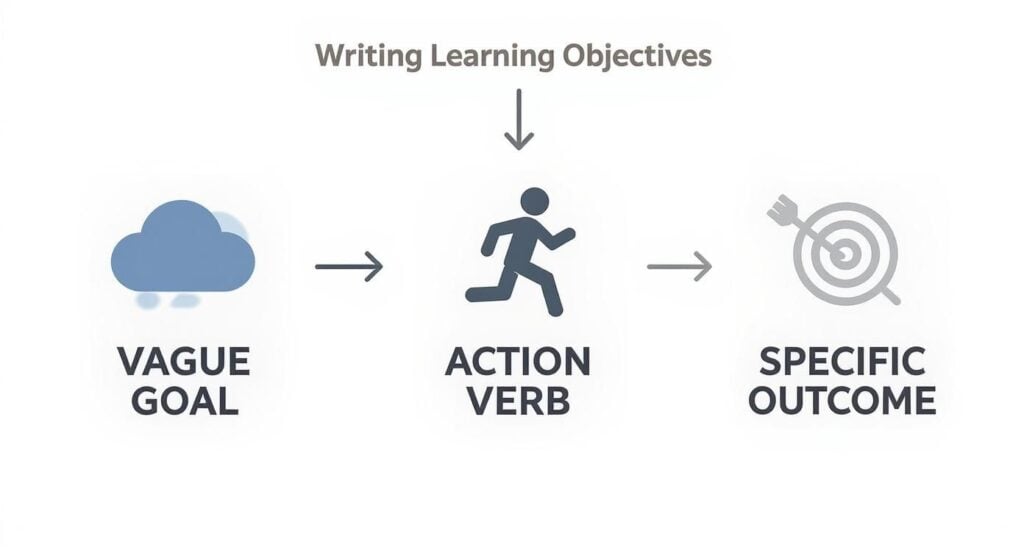
This flow, from a vague goal to a specific, measurable outcome, is exactly what your curriculum’s structure should mirror for the learner. Every single step should feel clear and purposeful.
When you’re trying to break down complex topics into understandable parts, it’s also worth exploring how AI for clarifying complex ideas in content creation is becoming incredibly useful. These tools can help you simplify and organize your own thoughts before you even start building out the lessons.
The real goal of sequencing is to make learning feel natural and effortless. You want learners to feel a sense of momentum, where each new piece of information feels like the logical next step rather than some random fact pulled out of thin air.
Ultimately, a well-structured curriculum respects the learner’s time and cognitive load. By carefully considering the flow, you create an experience that not only teaches effectively but also keeps students motivated and engaged from the first lesson to the last.
Designing Engaging Activities and Meaningful Assessments
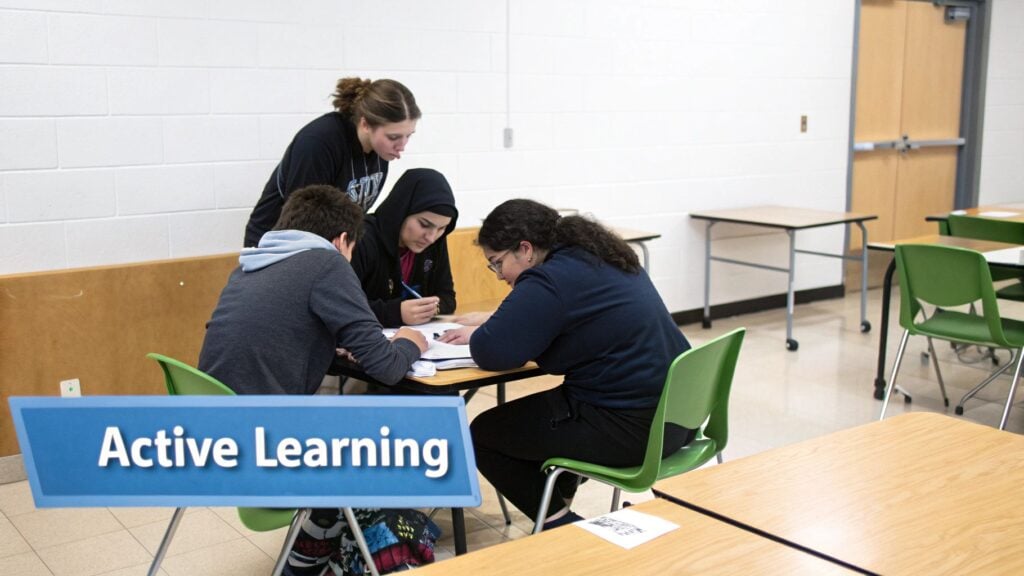
This is where the curriculum starts to breathe. With your learning objectives mapped out and a solid structure in place, we can now get to the fun part: designing the actual learning experiences. Let’s face it, nobody gets excited about a string of dry lectures and a final exam.
The goal here is to create activities that are more than just busywork. Each one should be a bridge, connecting your content directly to your learning objectives. It’s all about getting learners to actively wrestle with the material, not just passively soak it in.
Crafting Activities That Stick
The best learning activities are the ones that get people doing something. Think hands-on projects, lively group discussions, real-world case studies, and interactive simulations. The secret sauce is a mix of variety and alignment.
For instance, in a graphic design course, you might have learners create a brand logo for a fictional company. For a leadership program, a group activity could involve role-playing a difficult feedback conversation. It’s about application, not just theory.
Here are a few ideas to get you started:
- Case Studies: Drop a real-world problem in their lap. Have them analyze it, pitch solutions, and defend their reasoning.
- Problem-Based Learning: Present a messy, open-ended challenge that forces learners to research and collaborate to even define the problem, let alone solve it.
- Simulations: Use software or role-playing to create a safe space where learners can practice new skills, like navigating a tricky sales call without risking a real client relationship.
- Peer Teaching: Ask learners to teach a small piece of the material to each other. It’s one of the fastest ways to solidify their own understanding.
Thinking about how people learn is just as crucial as what they learn. It’s also worth noting that the world of education is always changing. Curriculum development is expanding beyond just academic chops.
For example, social-emotional learning (SEL) has become a huge priority in how educators design content. This reflects a more holistic approach to education, one that helps students with life, not just their studies. You can see how these trends are shaping curriculum design over on EducatorForever.com.
Making Assessments More Than Just a Test
Alright, let’s talk about assessments. The word itself can sound pretty formal and intimidating, but it doesn’t have to be. Good assessments are simply a way to check for understanding and see how learners are progressing toward the objectives you set.
They are your proof that the learning is actually happening. Assessments are for more than just assigning a grade. They provide invaluable feedback to both you and the learner.
Assessments should feel like a natural part of the learning process, not a final judgment. They should measure what truly matters. This means the skills and knowledge you outlined in your objectives.
This means we need to think beyond the classic multiple-choice quiz. While those are fine for checking basic knowledge recall, they don’t tell you much about higher-level skills.
To get a clearer picture, mix it up:
- Performance-Based Tasks: Ask learners to do something that demonstrates their mastery. This could be anything from giving a presentation or writing a report to building a working prototype.
- Portfolios: Have learners collect their work over time. This is a fantastic way to showcase their growth and development from start to finish.
- Self-Assessments: Encourage learners to reflect on their own progress. This helps them identify their strengths and pinpoint areas where they still need some work.
By combining different assessment types, you get a much richer, more accurate picture of what your learners can actually do. The ultimate goal is to make both the learning activities and the evaluation process feel valuable and empowering, not like a chore to be endured.
How to Refine and Revise Your Curriculum
Here’s a little secret I’ve learned from years of designing courses: no curriculum is perfect right out of the gate. That initial draft is your best guess, but the real magic happens when you start refining it based on actual human interaction. The final piece of the puzzle is building a feedback loop for constant improvement.
A curriculum should be a living document, not something you carve in stone and never touch again. It needs to breathe, adapt, and evolve. This mindset of constant, thoughtful revision is what separates a decent curriculum from a truly great one.
Piloting Your Course to Find the Flaws
Before you launch your curriculum to the full audience, I can’t recommend this enough: pilot it with a small, trusted group. Think of it as a dress rehearsal. This is your chance to catch any awkward phrasing, confusing instructions, or technical glitches in a low-stakes environment.
What you’re looking for here isn’t just praise. You want honest, critical feedback on what actually works and what doesn’t.
- Observe Directly: If you can, watch them go through the material. Where do they get stuck? What parts make their eyes glaze over? The non-verbal cues are often more telling than the verbal feedback.
- Ask Specific Questions: Don’t just ask, “Did you like it?” That’s useless. Instead, dig deeper with questions like, “Which activity was the least helpful, and why?” or “Was there any point where the instructions weren’t totally clear?”
- Test Your Tech: Make sure every single link works, videos play correctly, and quizzes load properly. A small technical snag can completely derail an otherwise great learning experience.
This initial feedback is gold. It allows you to smooth out the rough edges and fix problems before they affect a larger group of learners.
If you notice a lot of students are struggling with the same quiz or assignment, don’t automatically assume it’s their fault. More often than not, it’s a sign that the material leading up to it wasn’t taught as clearly as it could have been.
This kind of pattern directly points you to the lessons that need a rewrite.
Gathering Feedback for Long-Term Growth
Once your curriculum is live, the feedback process doesn’t stop. In fact, it’s just beginning. You need a system for gathering ongoing insights from your learners. Simple surveys, brief interviews, or even just observing discussion forums can tell you a lot. Learning to measure the real impact of your teaching is a vital skill. To get a deeper understanding, you can explore more strategies for how to measure training effectiveness.
This continuous improvement is especially critical in today’s fast-growing education market. The global education sector is projected to hit nearly $10 trillion by 2030, with workforce education being one of the fastest-growing segments. You can discover more insights about these educational market trends on HolonIQ. To stay relevant in such a dynamic field, your curriculum has to evolve based on real-world results and shifting needs.
By treating your curriculum as a dynamic tool, you ensure it remains effective, engaging, and valuable for years to come.
Answering Your Most Common Curriculum Questions
When you’re first figuring out how to write a curriculum, a ton of questions pop up. It’s a big process, and it’s natural to wonder about timelines, terminology, and the most common pitfalls. I get asked these all the time, so I’ve put together some answers based on what I’ve seen work in the real world.
How Long Does It Take to Write a Curriculum?
Honestly, there’s no single answer here because it all comes down to the scope of your project. The difference is massive. Are you building a short, one-day workshop or a full, semester-long university course?
A simple workshop might take a week or two of dedicated effort, from the initial needs analysis to the final review. A comprehensive academic program or a major corporate training initiative could easily take several months to get right.
My best advice is to break the project down into the phases we’ve discussed. Block out specific time on your calendar for needs analysis, for writing objectives, for structuring content, and for revision. Whatever you do, never rush the foundation work. A solid plan upfront will save you countless hours of headaches later on.
What Is the Difference Between a Curriculum and a Syllabus?
This is a fantastic and very common question. It’s easy to use the terms interchangeably, but they mean very different things in practice.
Here’s an analogy I like to use:
- The Curriculum is the entire building. It’s the complete, big-picture plan for a subject, including all the learning objectives, content, activities, and assessments that make up the whole educational experience.
- The Syllabus is the blueprint for a single room in that building. It’s the summary or outline you hand out to learners for one specific course within that larger curriculum.
The syllabus is the day-to-day guide for the student. It lists topics, deadlines, and grading policies for that one class. The curriculum is the overarching strategy for the entire educational journey.
What Are the Biggest Mistakes to Avoid?
Over the years, I’ve seen a few recurring mistakes that can really derail an otherwise promising curriculum. If you can steer clear of these, you’ll be in great shape.
The number one mistake is creating content before you define clear learning objectives. It’s so tempting to just start writing about what you know. But you almost always end up with a pile of interesting information that doesn’t actually lead learners to a specific, measurable outcome. It feels unfocused because it is.
Another major issue is not thinking deeply enough about your audience. A curriculum designed for total beginners needs a completely different tone, pace, and support structure than one built for seasoned experts. Always start with who you’re teaching, not what you want to teach.
Finally, avoid treating your curriculum as a “finished” product the moment you launch it. The most effective curricula are dynamic. They evolve based on real feedback and tangible results. Thinking of it as a final draft is a recipe for a stale and outdated learning experience.