Unlocking the benefits of LMS for business

The benefits of an LMS are pretty straightforward. They bring all your training into one place, put tedious admin tasks on autopilot, and give everyone a consistent learning experience. A good Learning Management System doesn’t just save you time and money. It makes your training programs way more effective.
What Are the Real Benefits of an LMS?
You’ve probably heard the term LMS thrown around, but what does it really do for your organization? I like to think of it as the mission control for a company’s training and professional development. It’s a single software platform where you can build, deliver, and track all your learning materials.
Instead of juggling scattered spreadsheets, endless email chains, and files saved who-knows-where, everything lives in one organized hub. This is a total game-changer for consistency. Whether you’re onboarding new hires in different time zones or rolling out a critical compliance update, an LMS ensures every single employee gets the same high-quality information.
Before we dive deep, here’s a quick overview of how an LMS helps different parts of your business.
A Quick Look at Key LMS Benefits
Here’s a summary of the core advantages an LMS brings to different parts of an organization.
| Benefit Area | What It Means For You |
|---|---|
| Centralized Learning | A single, organized home for all training materials. No more file-hunting! |
| Automation | Puts admin tasks like enrollment and reminders on autopilot, freeing up your team. |
| Scalability | Deliver consistent training to 10 people or 10,000 without extra logistical work. |
| Data & Analytics | Get real numbers on learner progress and course effectiveness to prove ROI. |
| Consistency | Ensures everyone gets the same high-quality information, every time. |
| Accessibility | Learners can access training anytime, anywhere, on any device. |
This table just scratches the surface. Now, let’s get into the specifics of why these systems have become so essential.
Why Businesses Are Adopting LMS Platforms
The shift toward these systems isn’t just a trend. It’s a fundamental change in how companies approach employee growth. Today, over 83% of businesses globally use LMS platforms to deliver employee training. It’s become a cornerstone of modern business operations.
This isn’t a small-time investment, either. The global LMS market is valued at around USD 23.35 billion in 2024 and is projected to grow substantially. You can explore more about these LMS statistics and their impact to see the full picture.
The reason for this massive adoption is simple. Companies are recognizing the powerful, bottom-line advantages that come with a structured learning environment.
An LMS moves training from a logistical headache to a strategic asset. It allows you to focus on the quality of your content and the growth of your people, rather than getting bogged down in administrative work.
The Core Value Proposition
At its heart, an LMS offers a powerful solution to the most common training challenges. It brings a structured, scalable, and measurable approach to learning and development that was nearly impossible to achieve before.
Let’s break down the primary value it delivers:
Centralized Learning: It creates a single source of truth. No more hunting for the latest version of a document or wondering who has completed which course. Everything is in one place, easy to find and manage.
Automation of Admin Tasks: An LMS handles the mind-numbing work like sending reminders, enrolling users, and tracking completions. This frees up your L&D team to focus on creating great content and strategy, not paperwork.
Scalable Training Delivery: You can deliver the exact same training to ten employees in your office or ten thousand spread across the globe. It doesn’t require any extra logistical effort, making growth seamless.
Data-Driven Insights: Finally, you can see what’s working. An LMS provides clear analytics on learner progress, quiz scores, and course effectiveness. This data is crucial for proving the return on investment (ROI) for your training programs.
2. Boosting Learner Engagement and Personalization
Let’s be real. A lot of workplace training feels like a chore. Employees click through slides just to get it over with, and half the information is forgotten by the next day. This is where a modern LMS can completely flip the script. It can turn a passive task into something people actually want to do.
Modern platforms are designed to hold a learner’s attention, moving far beyond the old-school model of just uploading a PDF or a video. We’re talking about creating a learning environment that pulls people in.

Making Learning Fun and Interactive
One of the coolest ways an LMS drives engagement is through gamification. This is all about borrowing game-like elements to motivate learners and make progress feel rewarding.
Imagine your team members earning points for finishing a module, unlocking badges for acing a quiz, or seeing their name on a leaderboard for completing a learning path first. These small rewards create a sense of accomplishment and friendly competition, which can dramatically boost participation. When learning is fun, retention improves significantly. You can dive deeper into these concepts in our guide to gamification in eLearning.
Another powerful tool is social learning. Many systems include features like discussion forums or integrated chat channels where learners can ask questions, share insights, and collaborate. This builds a sense of community and allows people to learn from each other’s experiences, something that’s often more impactful than learning in a vacuum.
An engaged learner isn’t just a happier employee. They are more likely to complete their training, retain the information, and successfully apply their new skills on the job.
Creating a Learning Journey for Each Person
The one-size-fits-all approach to training is officially dead. An LMS allows you to deliver a truly personal experience that adapts to each individual’s needs, role, and career goals.
Think of it like a personalized content feed. The system can automatically recommend specific courses based on an employee’s job title, their performance data, or skills they’ve shown an interest in developing. A new sales hire gets a completely different learning path than a senior marketing manager, and both feel the training is directly relevant to their world.
This level of personalization shows your team that you’re invested in their individual growth. It makes the training feel valuable, not like some generic corporate mandate. When people see a clear line between the training and their own career goals, their motivation to learn skyrockets.
How Personalization Drives Better Outcomes
Personalized learning paths do more than just make employees feel seen. They deliver tangible business results by targeting specific knowledge gaps and opportunities for growth.
Here’s how it works in the real world:
- Targeted Skill Development: You can assign courses to address specific skill gaps you spotted in performance reviews.
- Role-Based Onboarding: New hires get a curated set of courses tailored to their exact role, helping them get up to speed much faster.
- Career Pathing: Employees can see a clear track of courses they need to complete for a promotion, giving them ownership over their career development.
Of course, for any of this to work, the platform’s interface must be intuitive and easy to navigate. Exploring broader principles for improving website usability and accessibility can offer great insights here. Ultimately, when the platform is easy to use and the content feels like it was made just for them, you create a powerful combination that keeps learners coming back.
Saving Time and Money with Automation

Let’s be honest, trying to manage a training program manually can feel like a full-time job in itself. You’re juggling spreadsheets, firing off reminder emails one by one, and spending hours grading quizzes. For any L&D or HR team, it’s a massive, soul-crushing time drain.
This is where you see one of the most immediate benefits of an LMS. It takes all that repetitive, tedious work right off your plate. I think of it as a tireless administrative assistant, one that handles the heavy lifting so you can focus on what actually matters, which is creating fantastic training and supporting your learners. Instead of getting lost in spreadsheets, your team can finally put their energy into strategic initiatives that drive real growth.
Putting Administrative Tasks on Autopilot
Automation is where the magic really happens. A good LMS handles countless tasks in the background, ensuring nothing ever falls through the cracks. It helps you reclaim entire workdays, not just shave a few minutes off your day.
Here’s a glimpse of what this automation looks like in the real world:
- Automatic Enrollment: The moment a new hire joins the company, they can be automatically enrolled in their full onboarding path. No manual setup needed.
- Course Reminders and Notifications: The system sends out automated nudges to learners about upcoming deadlines or new course assignments, so you don’t have to.
- Instant Grading: Quizzes and assessments get graded instantly. This gives learners immediate feedback and saves your instructors from hours of manual work.
- Report Generation: Need to know who completed the latest compliance training? You can pull detailed reports in seconds instead of spending half a day compiling data.
By putting routine administrative work on autopilot, an LMS allows your training department to shift from a reactive, task-based function to a proactive, strategic partner in the business. It frees up resources to focus on improving learning outcomes, not just managing them.
This unleashes your most valuable resource, your people, to work on high-impact projects. Instead of chasing down completion records, they can be designing the next leadership development program or refining course content based on actual learner feedback. The efficiency gains are enormous and contribute directly to the bottom line.
Scaling Your Training Efforts Without the Headaches
Beyond the day-to-day tasks, a huge financial benefit of an LMS is its scalability. Just think about the logistics and costs of old-school, in-person training. You have to book venues, print out materials, and maybe even fly instructors and employees to a central location. Training ten people might be manageable, but trying to train a thousand becomes a logistical and financial nightmare.
An LMS completely vaporizes these barriers. It lets you deliver the same high-quality, consistent training to hundreds or even thousands of employees across different offices or time zones, with virtually no extra effort. You create a course once, and you can deploy it an infinite number of times.
The Real-World Impact of Scalability
This ability to scale has a direct and significant impact on your budget. Whether you’re onboarding a single new employee or rolling out a critical company-wide policy update, the cost and effort stay pretty much the same.
Consider these scenarios:
- Global Onboarding: A company with offices in New York, London, and Tokyo can give every single new hire the exact same high-quality onboarding experience from day one. This builds consistency in company culture and core knowledge without the massive expense of travel and coordination.
- Product Updates: When a new software feature is released, the entire sales team across the country can be trained on it simultaneously. They get up to speed faster, which leads to quicker sales cycles and smarter customer conversations.
- Compliance Rollouts: For mandatory annual training, like cybersecurity or workplace safety, you can deploy the course to the whole organization with a few clicks. The LMS tracks completion automatically, ensuring you meet regulatory requirements without the administrative chaos.
Ultimately, this level of automation and scalability means you can do more with less. You can train more people, more effectively, without needing to expand your L&D headcount or your budget. That’s a powerful advantage that makes an LMS one of the smartest investments a growing organization can make.
5. Get Powerful Insights with LMS Analytics
So, you’ve rolled out a new training program. How do you actually know if it’s working? In the past, this was a tough question to answer, often relying on gut feelings, happy sheets, or simple attendance logs. This is where LMS analytics completely change the game.
These platforms provide deep, actionable data that moves you from guesswork to certainty. It’s like turning on the lights in a dark room. You can finally see what’s happening with your training efforts and make smart, data-driven decisions based on real numbers, not just hunches.
Moving Beyond Simple Completion Rates
The real power of an LMS goes far beyond just checking who finished a course. You can dive into specific metrics that tell a much richer story about how your people are learning and where your content is hitting (or missing) the mark.
Think about it. You can track things like:
- Assessment Scores: See not just the final grade, but which specific questions learners struggled with. This instantly highlights confusing topics or poorly worded questions in your material.
- Time Spent on Modules: Are learners zipping through a critical safety module in two minutes? Or are they spending an hour on what should be a ten-minute lesson? This data points to content that might be too easy, too difficult, or just plain confusing.
- Drop-Off Points: Find out the exact moment learners are losing interest and abandoning a course. This is pure gold for pinpointing weak spots in your content that need a rewrite.
With robust analytics, you’re no longer just managing training—you’re optimizing it. The data tells you precisely what’s working, what isn’t, and where you need to focus your attention to improve the learning experience for everyone.
Using Data to Prove Your Impact
One of the biggest headaches for L&D departments has always been proving their value to the C-suite. It can be tough to draw a straight line from a training initiative to a business outcome. LMS analytics provide the hard evidence you need to show the real business impact of your work.
You can generate reports that demonstrate improvements in performance, identify skill gaps across entire teams, and even calculate the financial return on your training investment. This is the kind of data that gets attention in the boardroom. For a deeper look, check out our guide on how to calculate the ROI on training programs and make a compelling case to stakeholders.
The infographic below highlights just a few of the ways an LMS drives cost savings, which is a key part of that ROI story.
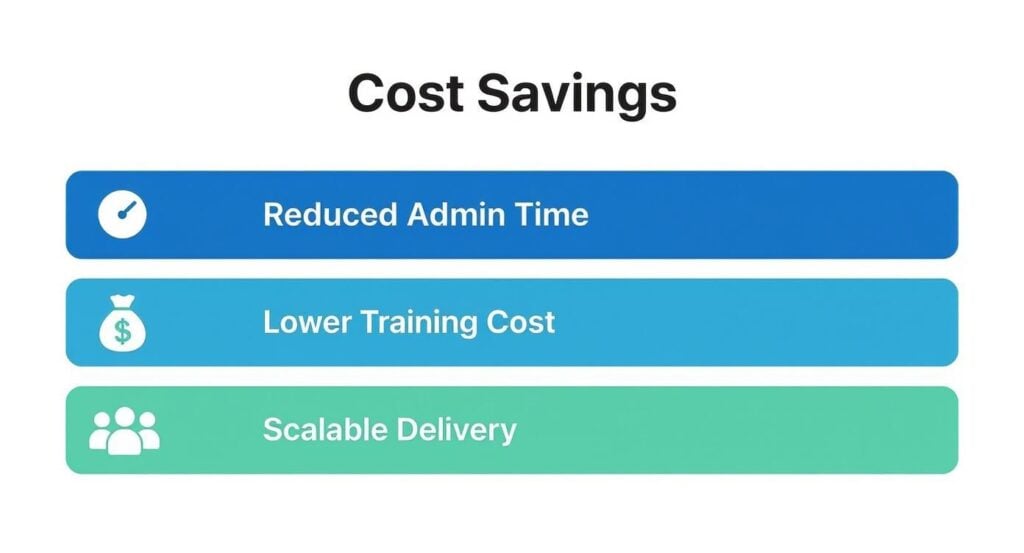
This visual breaks down how an LMS translates into tangible financial gains by automating tedious tasks, slashing traditional training expenses, and letting you train more people without a proportional increase in costs.
A Clearer Picture of Performance
Let’s be honest. The reporting from traditional, in-person training can be pretty limited. You might know who showed up, and maybe you have some post-event survey data. But what about actual knowledge retention or on-the-job application? An LMS gives you a completely different level of insight.
Key Metrics LMS vs Traditional Training
| Metric | LMS Reporting | Traditional Training Reporting |
|---|---|---|
| Engagement Data | Detailed logs of time on task, clicks, interactions, and video views. | Attendance sheets and maybe some anecdotal observations. |
| Assessment Results | Granular data on every question, identifying specific knowledge gaps. | A final score, often manually graded and compiled. |
| Progress Tracking | Real-time, automated tracking of individual and group progress. | Manual tracking, often based on verbal check-ins or milestones. |
| Learner Feedback | Integrated surveys and feedback tools tied directly to specific content. | End-of-course “happy sheets,” often disconnected from the content. |
This stark contrast shows why so many organizations have made the switch. The ability to track and report on learning in such detail is a major reason for such widespread adoption. Globally, the LMS user base includes around 73.8 million people across all kinds of industries. This massive number shows that organizations everywhere see the value in a system that can measure and prove its own effectiveness.
Making Smarter Decisions with Data
Ultimately, the true power of LMS analytics lies in the ability to make better, more informed decisions. The data provides a clear roadmap for continuous improvement, turning L&D into a strategic, proactive function.
With these insights, you can:
- Refine Course Content: If quiz data shows everyone is failing a certain section, you know exactly what material needs to be rewritten or clarified. No more guessing.
- Identify Top Performers and Those Who Need Help: Easily spot employees who are excelling and those who might need extra support or coaching. This allows for timely, targeted interventions.
- Justify Your Budget: Present leadership with clear, data-backed reports showing how training is closing skill gaps and contributing directly to company goals.
By using these analytics, your L&D efforts become more strategic. You can allocate resources more effectively, create training that truly resonates, and demonstrate a clear, positive impact on the entire organization.
Streamlining Compliance Training
Let’s be honest, compliance training can feel like a necessary evil. It’s often dense, always mandatory, and usually comes with a mountain of paperwork just to prove it got done. In many industries, from healthcare to finance, this isn’t just a good idea. It’s a legal requirement with serious teeth if you get it wrong.
This is where a good LMS truly earns its keep. It transforms what is often a massive organizational headache into a smooth, manageable, and automated process. One of the most significant benefits of an LMS is how it grabs the reins on managing and tracking mandatory training, from start to finish.
Automating the Entire Compliance Workflow
Imagine you have 500 employees, and you need to manually track who has completed their annual cybersecurity training. It’s a recipe for disaster, a nightmare of spreadsheets, endless email chains, and the constant fear that someone will slip through the cracks. An LMS takes that entire burden off your shoulders.
You can set up rules to automatically assign the right courses to the right people. When a new person joins the finance team, for example, the system can instantly enroll them in all the necessary anti-money laundering and data privacy courses without you lifting a finger.
The real win here is moving from a reactive, manual tracking system to a proactive, automated one. An LMS provides an airtight, audit-ready trail that proves your organization is meeting its legal and regulatory obligations, all with just a few clicks.
This frees up your team from the soul-crushing admin of chasing down employees. Instead, they can focus on what actually matters, which is creating better training content. The system becomes your single source of truth for everything compliance-related.
Never Miss a Recertification Deadline Again
Compliance isn’t a one-and-done deal. Many certifications have an expiration date, whether it’s an annual renewal or a refresh every three years. Trying to keep track of hundreds of individual deadlines manually is not just impractical. It’s incredibly risky.
This is another area where an LMS provides a huge leg up. You can set it and forget it, letting the system handle recertifications automatically.
Here’s how that usually plays out:
- Set Expiration Dates: When an employee finishes a course, the LMS logs the completion date and knows exactly when that certification expires.
- Send Automated Reminders: As the deadline gets closer, the system automatically nudges the employee and their manager, letting them know it’s time to renew.
- Re-enroll in Courses: The system can also re-enroll them in the latest version of the course, ensuring they have everything they need to stay compliant without any manual intervention.
This proactive approach helps you sidestep dangerous compliance gaps. It ensures your entire workforce stays current and protected, saving you from the tyranny of monitoring calendars and spreadsheets.
Generating Audit-Ready Reports in Seconds
Maybe the most stressful part of compliance is facing an audit. An auditor doesn’t care about your good intentions. They want cold, hard proof that every required employee completed the necessary training on time. Trying to pull that information together from scattered records is a nightmare.
With an LMS, generating these reports is almost laughably easy. You can instantly pull detailed, time-stamped records showing:
- Who was assigned the training.
- When they started and finished it.
- Their assessment scores.
- A complete recertification history.
This ability to produce comprehensive, audit-ready reports on demand is one of the most powerful benefits of an LMS. It gives you peace of mind, knowing that if an auditor ever comes knocking, you can hand over all the documentation they need in minutes. That simple function can save your organization from hefty fines and legal headaches.
How to Choose the Right LMS for Your Team

So, you’re ready to see how an LMS can work for your team. Picking the right platform is a big decision, but it doesn’t have to be a painful one. I’ve found it’s far better to start with a clear set of questions focused squarely on what your people actually need instead of getting bogged down by brand names and flashy demos.
The whole point is to find a system that feels like a natural extension of your company, not some clunky piece of software everyone actively avoids. A great place to begin is by thinking about how any new tool will play with the ones you already use every single day.
Start with Your Must-Have Features
Before you even book a single demo, grab a notepad and list out what you absolutely, positively cannot live without. This simple step will save you countless hours down the road. Every organization’s list will be unique, so don’t just copy a generic template.
Here are a few questions to get the ball rolling:
- Integration Needs: Does it need to connect smoothly with your HR software, like your HRIS or payroll system? What about collaboration tools like Slack or Microsoft Teams?
- User Experience: Is the interface clean and intuitive for learners to navigate? If it’s confusing, people simply won’t use it. End of story.
- Reporting and Analytics: What specific data do you need to track? Make sure its reporting features align with the metrics your leadership team actually cares about.
- Customer Support: What kind of help will you get when things go sideways? Look for vendors that offer robust support, especially during that critical initial setup and rollout phase.
Choosing an LMS is about finding the right fit for your culture, your budget, and your future goals. Don’t get distracted by shiny features you’ll never use. Focus on the core functionality that will genuinely make life easier for both your learners and your admins.
Think About Your Budget and Long-Term Goals
Once you have your list of must-haves, it’s time to talk money and vision. Where do you see your training program in the next two or three years? LMS pricing can vary wildly, from per-user fees to flat annual licenses, so it’s crucial to understand the total cost of ownership, not just the sticker price.
Also, think about scalability. The system that works perfectly for 50 employees today might buckle under the pressure of 500 employees next year. A good platform should be able to grow right alongside you. For larger organizations, it’s worth exploring an enterprise learning management system that’s built from the ground up to handle that kind of complexity and scale.
Ultimately, the right LMS becomes a true partner in your company’s growth. By taking the time to ask these tough questions upfront, you can find a solution that not only meets your needs today but also supports your vision for the future.
Still Have Questions About LMS Benefits?
We’ve covered a lot of ground, but I know a few questions might still be bubbling up. That’s perfectly normal. Let’s tackle some of the most common things people ask when they’re considering an LMS.
How Quickly Can We See the Benefits of an LMS?
This is a great question, and the answer is a bit of a mix. You’ll actually see some benefits almost immediately.
Right out of the gate, you’ll feel the impact of administrative automation. Tasks that used to eat up hours, like enrolling new hires or chasing people with course reminders, are suddenly handled for you. That frees up your team’s time from day one.
Other, bigger benefits take a little longer to mature. Seeing a major boost in learner engagement or getting clear ROI from your data analytics doesn’t happen overnight. Typically, you can expect to see meaningful engagement metrics and initial cost savings within the first 3 to 6 months as your team gets comfortable with the new system.
Can a Small Business Really Benefit from an LMS?
Absolutely. There’s a persistent myth that an LMS is only for giant corporations with thousands of employees. Honestly, small businesses can see massive benefits, sometimes even more so because every single hour and every dollar counts.
For a small team, an LMS can:
- Standardize Onboarding: It ensures every new hire gets a consistent, high-quality introduction to the company. This is absolutely critical for building a strong, unified culture right from the start.
- Save Precious Time: With a smaller team, automation isn’t a luxury, it’s a lifeline. It lets your people focus on revenue-generating activities instead of getting bogged down in manual admin work.
- Offer Professional Development: You can provide top-tier training that helps you attract and keep great talent, even if you don’t have a massive L&D budget.
An LMS levels the playing field. It gives small businesses the tools to train their teams just as effectively as their larger competitors, making it a powerful investment in scalable, sustainable growth.
Is It Difficult to Get Employees to Use a New LMS?
Getting buy-in is everything, but it doesn’t have to be an uphill battle. The single biggest factor is choosing a system with a clean, intuitive user interface. If the platform is easy and even enjoyable to use, you’re already halfway there.
My best advice? Involve your team in the selection process and be crystal clear about the “why” behind the change. Show them exactly how it will make their jobs easier and help them build their careers. A little internal marketing and genuine enthusiasm can go a long way.
For a deeper dive into other common questions, this page of Frequently Asked Questions offers some really useful insights.