
The Real Advantage of Learning Management System Platforms
The biggest advantage of a learning management system is how it centralizes every single piece of your training material into one organized, easy-to-access hub. It’s a total game-changer. It replaces that messy web of spreadsheets, scattered files, and random cloud folders with a single source of truth for all your learning content. This one shift creates massive efficiency for both you and your learners.
What Is an LMS and Why Does It Matter?
You’ve probably heard the term “LMS” tossed around, but what does it really mean for your organization? Think of a Learning Management System as the digital command center for all your training. It’s a single, organized platform where you can create, deliver, and track all your learning materials.
This means you can finally say goodbye to juggling spreadsheets, endless email chains, and video files stored in who-knows-what folder. An LMS brings everything together under one roof, transforming a disorganized process into something that actually works.
The Digital Library and Classroom Combo
I like to think of an LMS as a digital library and classroom rolled into one. It serves as an active, dynamic environment for learning, not just a dusty storage closet for your content. This system is what turns messy, disorganized training into something that delivers real results.
Instead of your team hunting for the right document or the latest version of a training video, they can just log in and find everything they need, right where they expect it to be. This foundational concept is key before we dive into the specific advantages that make an LMS so powerful.
At its core, an LMS is a software solution that lets you create, manage, and deliver training programs. It simplifies the administrative grind and gives you clear reporting to track everyone’s progress.
A solid LMS should help you:
- Organize Content: Structure all your courses, documents, videos, and quizzes in one logical place.
- Deliver Training: Assign courses to individuals or groups automatically, without the manual back-and-forth.
- Track Progress: See who has completed what, monitor assessment scores, and pinpoint knowledge gaps.
- Report on Outcomes: Generate reports that show the impact and ROI of your training efforts.
Moving Beyond Manual Methods
Traditional training often relies on paper-based materials and an enormous amount of manual admin work. This old-school approach makes it incredibly difficult to get a clear picture of how well your team is retaining information and applying it to their roles. You’re left guessing if the training is even working.
This is where understanding the different types of learning management systems becomes crucial, as each is built to solve specific problems, whether for corporate training or selling online courses.
An LMS addresses these gaps by automating the tedious tasks and providing clear, actionable data. It helps make your training more efficient, measurable, and ultimately, more impactful for everyone involved.
How Centralized Training Creates Ultimate Efficiency
If I had to pinpoint the biggest headache in corporate training, it would be pure, unadulterated disorganization. Before we got a proper system in place, our training content was scattered to the digital winds. Important documents lived on shared drives, critical videos were parked on third-party sites, and key updates were buried in a mountain of employee emails. This chaos is the default setting for so many organizations, and it’s a massive drain on time and energy.

The primary advantage of a learning management system is how it brutally and effectively solves this problem. It pulls all of your learning materials into one single, organized hub. This “single source of truth” saves an incredible amount of time for both administrators and learners, creating efficiency you can feel across the entire company.
One Hub to Rule Them All
Think about onboarding a new team of ten people. In a disorganized environment, you’d spend hours sending dozens of separate links, documents, and instructions. Your new hires get overwhelmed, and it’s almost impossible to track who has actually completed what. It’s a logistical nightmare.
Now, picture that same scenario with an LMS. The new team gets a single login. They open their dashboard, and every required course, policy document, and welcome video is right there, laid out in a clear learning path. This is a fundamental shift in how you manage training, not just a minor tweak.
An LMS acts as the central library of knowledge for your staff. This makes training materials a breeze to find and helps employees get quick answers to common questions, ensuring everyone has the same shot at success.
This centralized approach does more than just save time. It also guarantees consistency. Every single person receives the exact same, up-to-date information, which is absolutely non-negotiable for critical areas.
- Compliance Training: When regulations change, you can update one course in the LMS and instantly push it out to everyone. This ensures your entire organization remains compliant without the risk of someone using an outdated document they found on the shared drive.
- Brand Messaging: For sales and customer service teams, consistent messaging is everything. Centralizing product training ensures every employee is telling the same story to your customers.
- Procedural Updates: When a key internal process gets an update, the information is changed in one place. You eliminate the risk of team members following old, inefficient, or just plain wrong procedures.
Beyond Simple Storage
Having everything in one spot also makes your training programs smarter. Modern LMS platforms are powerful databases that give you a high-level view of your entire learning ecosystem. You can quickly see which courses are most popular, where learners are getting stuck, and which departments are crushing it in skill development.
This is a massive step up from the old way of just guessing. Instead of wondering if your training is actually working, you have the data to prove it. For anyone looking to build a more strategic L&D function, understanding the full capabilities of training management software is a great next step in harnessing this power.
The efficiency gains are undeniable. Administrators spend less time chasing down files and manually enrolling users, freeing them up to focus on creating better, more engaging learning content.
Learners, on the other hand, waste less time searching for what they need and more time actually learning. They can access training materials anytime, anywhere, turning downtime into productive learning opportunities. This simple act of organizing your content is the first and most impactful advantage of a learning management system that you’ll experience.
Boosting Learner Engagement and Knowledge Retention
Let’s be honest. Passive learning is a waste of time. How often have you clicked through a training PDF or sat through a webinar, only to have the key points vanish from your memory by the next morning? People don’t learn by just consuming information. We learn by doing. A huge advantage of a learning management system is its power to transform passive viewing into active participation.
An LMS gives you the toolkit to crank up engagement and make learning actually stick. It helps you build an experience that feels less like a mandatory chore and more like an interesting challenge. When learning is interactive and genuinely fun, people can’t help but remember more.
Making Learning an Active Experience
The goal is to get learners off the sidelines and into the game. An LMS is packed with features designed specifically to pull people in. Think about quick quizzes that pop up mid-video to check for understanding, or forums where team members can hash out a new concept and see it from different angles.
These aren’t just flashy bells and whistles. They’re grounded in how our brains work. When we actively engage with material, by applying it, questioning it, or discussing it, our brains forge much stronger neural connections to that information. This process is what turns flimsy, short-term knowledge into durable, long-term skills.
A great LMS creates a dynamic learning environment where people are doing, not just watching. This active involvement is the secret sauce for making knowledge last well beyond the training session.
Unlocking Motivation with Gamification
One of the most effective tools in the engagement arsenal is gamification. This is simply applying game-like elements to the learning process, and it works like a charm for motivation. With an LMS, you can build these features directly into your courses with just a few clicks.
For instance, you can award badges for nailing a tough module or put learners on a leaderboard for acing their assessments. This taps directly into our natural drive for achievement and a bit of friendly competition. Suddenly, training shifts from a box-ticking exercise to a personal challenge. I’ve seen teams get genuinely fired up about earning the next badge or climbing the leaderboard.
These small rewards offer immediate, positive feedback that encourages learners to keep pushing forward. It’s a simple concept, but it’s incredibly effective at keeping motivation high. To really get into the weeds on this, you can learn more about how to apply gamification for elearning and make your courses way more compelling.
Some of the most popular gamification features include:
- Points and Badges: Awarded for completing courses, passing quizzes, or jumping into discussions. They provide a clear, immediate hit of accomplishment.
- Leaderboards: Foster a sense of friendly competition between teams or departments, nudging everyone to stay on top of their training.
- Progress Bars: Give learners a visual cue of how far they’ve come and how close they are to the finish line, which is a surprisingly powerful motivator.
The Power of Personalized Learning Paths
Another game-changing advantage is the ability to create personalized learning paths. We all know that one-size-fits-all training is a recipe for boredom and disengagement. A new sales hire needs a completely different onboarding experience than a senior engineer who’s learning a new programming language.
An LMS lets you tailor the journey to the individual. You can design specific paths based on a person’s role, their current skill level, or even their long-term career goals. The system can automatically assign the courses they need and skip the ones they don’t, making sure their time is spent on what actually matters.
This level of personalization is a massive motivator because the content always feels relevant. Learners aren’t slogging through introductory material they mastered years ago or advanced topics that have nothing to do with their job. They get the right information at precisely the right time, making the whole process more efficient and a lot more engaging. This targeted approach is a cornerstone of any modern, effective training program, not just a nice-to-have.
Measuring Your Success with Powerful Analytics
How do you know if your training is actually working? For a long time, we were just guessing. We’d launch a course, cross our fingers, and hope people learned something useful. It was a massive blind spot. The single biggest game-changer for us was replacing that guesswork with real data, a core advantage of any good learning management system.
An LMS gives you a direct line of sight into what’s happening behind the scenes. It’s the difference between flying blind and having a full dashboard of instruments telling you exactly where you’re going and what’s working. This is what separates good training programs from great ones.
Moving Beyond Guesswork
The analytics you get from an LMS go way beyond just tracking who finished a course. Sure, completion rates are nice to know, but the real magic is in the details. You can dive deep into performance metrics to see how learners are doing on specific questions or even entire modules.
This level of detail is a goldmine. If you see that 80% of your team keeps getting the same quiz question wrong, you don’t have a learner problem, you have a content problem. It’s a clear signal that the material on that topic isn’t landing, giving you the insight you need to go back and make it better.
An LMS turns vague feelings about training effectiveness into hard data. It allows you to pinpoint exactly where learners are succeeding and where they are struggling, so you can make continuous, targeted improvements.
The features that drive engagement, like gamification, quizzes, and discussion forums, are also what generate the data you’ll be measuring.
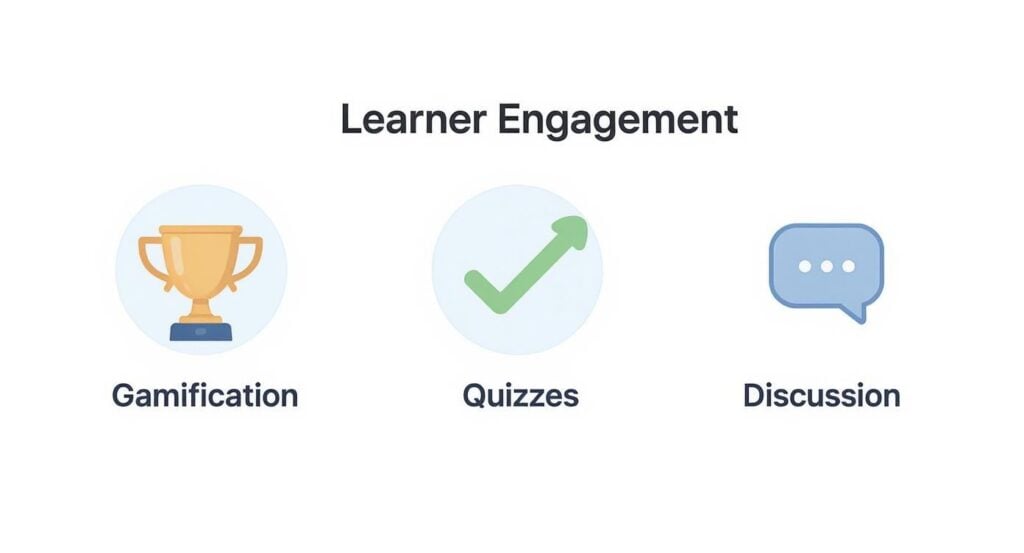
Each of these tools creates data points that help you build a complete picture of your training’s impact.
The trend is clear: organizations can’t afford to guess anymore. In fact, over 83% of businesses worldwide now use an LMS for employee training. Adoption rates in large and midsize companies have hit a staggering 98% and 96%, respectively. You can find more insights about these LMS statistics and what they mean for corporate education.
Proving Your Training ROI
One of the toughest jobs for any training department is proving its value to leadership. It’s one thing to say a program is good, but it’s another thing entirely to show how it directly impacts the bottom line. This is where an LMS gives you the data you need to connect the dots and demonstrate a clear return on investment (ROI).
Let’s say you roll out a new product training course for your sales team. With an LMS, you can track completions and then compare sales figures for those who finished the course against those who didn’t. When you can walk into a meeting and show that reps who completed the training had a 20% higher sales volume, you’ve just made a powerful, undeniable case for your program’s value.
This isn’t a hypothetical, either. We’ve used this exact approach to secure more budget and buy-in for future projects.
Here’s how you can tie LMS data directly to business outcomes:
- Sales Training: Correlate course completions with sales performance, deal size, or how quickly deals are closing.
- Customer Support: Link training on new product features to a drop in support tickets or a jump in customer satisfaction scores.
- Compliance Training: Show a 100% completion rate on mandatory safety training to prove the company is reducing risk and avoiding potential fines.
- Onboarding: Track the time it takes for new hires to become fully productive after they complete their onboarding path.
Without an LMS, trying to collect this data is a messy, manual nightmare that’s often too inaccurate to be useful. With an LMS, it’s all right there in your reporting dashboard, ready to go. This analytical power is what helps you build a smarter, more effective, and more respected training department.
How an LMS Slashes Costs and Makes Training Scalable
Let’s talk about the elephant in the room with traditional, in-person training: it’s wildly expensive and incredibly difficult to scale.
Once you start adding up the costs for instructor travel, venue rentals, printed workbooks, and pulling employees away from their jobs for a full day, the numbers get scary, fast. This is where an LMS completely flips the financial equation on its head.

Instead of paying for the same workshop over and over again, you build your core training content once. That single investment can then be delivered to ten, a hundred, or even ten thousand employees for virtually the same cost. The scalability is almost infinite.
This shift lets you train a globally distributed workforce consistently and affordably, something that’s just not feasible with in-person methods. Everyone gets the same high-quality training, whether they’re at headquarters or working from a home office halfway across the world.
A Practical Cost Breakdown
To make this real, let’s put some numbers to it. The difference between training 100 employees in person versus using an LMS isn’t just noticeable, it’s staggering.
In-Person Workshop for 100 Employees:
- Instructor Fees & Travel: You have to fly an expert in, cover their hotel, and pay their daily rate. This can easily run $5,000 – $10,000.
- Venue Rental: Finding a space for 100 people isn’t cheap, often costing $2,000+ for the day.
- Printed Materials: Workbooks and handouts for everyone could add another $1,000.
- Lost Productivity: Pulling 100 people from their jobs for a full day has a massive hidden cost.
Now, compare that to the LMS. You invest upfront in creating a fantastic online course, and from there, the delivery costs are minimal. You’re looking at a predictable monthly subscription, but that one fee covers unlimited training for your entire team.
An LMS transforms your training budget from a recurring, unpredictable expense into a stable, predictable investment. You stop paying for logistics and start investing in quality content that can be reused indefinitely.
This financial advantage is a major reason the LMS market is booming. The global market is projected to soar from USD 24.05 billion to a massive USD 70.83 billion by 2030. This rapid growth reflects a fundamental shift in how organizations think about efficiency and scale. You can dig into more LMS statistics and market trends to see just how widespread this change has become.
Automating the Administrative Grind
The savings go way beyond just cutting out travel and venues. Think about all the administrative time that gets poured into managing training. An LMS automates the soul-crushing tasks that used to eat up hours every single week.
This automation directly translates into money saved. Your training or HR team is freed from the logistical grind, allowing them to focus on what really moves the needle: creating better, more impactful learning experiences.
Here are a few of the key tasks an LMS takes right off your plate:
- Automatic Enrollment: New hires can be automatically enrolled in their onboarding path the moment they join. No one has to lift a finger.
- Progress Reminders: The system can automatically nudge learners who are falling behind on required training, so you don’t have to chase them down.
- Certification Management: When a compliance certification is about to expire, the LMS can automatically re-enroll the employee in the refresher course and notify them.
- Reporting: Forget manually wrestling with spreadsheets. The LMS generates detailed reports on completion rates, assessment scores, and engagement with just a few clicks.
By taking on these manual burdens, an LMS lets you do more with less. You can scale your training programs without having to scale your administrative team, making it one of the most powerful tools for building an efficient and cost-effective learning culture.
Common Mistakes to Avoid When Adopting an LMS
It’s easy to get excited about what a learning management system can do for your organization. The promise of streamlined training and better engagement is compelling. But just jumping in without a plan can lead to a world of frustration. I’ve seen organizations stumble right out of the gate, and it’s almost always because they skipped a few crucial steps.
Think of this as a friendly guide to help you sidestep those common hurdles and get it right the first time.
The biggest mistake I see is choosing a system that’s way too complex for what you actually need. It’s tempting to go for the platform with every bell and whistle imaginable, but if your team only needs to deliver and track a handful of compliance courses, that complexity will just get in the way. You’ll end up paying for features you never use, and your admins will be pulling their hair out.
Another major pitfall is failing to get buy-in from your team before you even start looking. If you just drop a new system on them without any input, they’ll see it as another top-down mandate to be ignored. You need champions from different departments who can help you choose the right LMS and get their colleagues excited about using it.
Not Having a Clear Content Strategy
One of the most critical oversights is launching without a clear content strategy. An LMS is essentially an empty box. If you don’t have a plan for what you’re going to put in it and how you’ll keep it fresh, engagement will plummet after the initial launch buzz wears off.
An LMS is a powerful tool, but it’s not a magic solution. Its success depends entirely on the quality of the learning content you provide and your strategy for keeping learners coming back.
Before you even think about going live, you need solid answers to these questions:
- Who is creating the content? Do you have an in-house team, or will you need to hire instructional designers?
- What’s our pilot content? What are the first few courses you will launch to get things rolling and test the system?
- How will we promote it? How will you let your team know about new courses and learning opportunities?
Forgetting to Run a Pilot Program
Finally, never, ever underestimate the power of a pilot program. I’ve heard horror stories of companies that launched their shiny new LMS to thousands of employees, only to discover a critical bug or a confusing workflow on day one. A small-scale test with a friendly group of users lets you work out all those kinks beforehand.
This test run gives you invaluable feedback on everything from the user interface to your course material. It helps ensure that when you’re ready for the big launch, you’re providing a smooth, positive experience that encourages adoption instead of creating frustration. Sidestepping these common mistakes is how you realize the full advantage of a learning management system from the get-go.
Got Questions About LMS Platforms? Let’s Get Them Answered
Even after laying out all the benefits, I know a few questions are probably still bouncing around in your head. That’s perfectly normal. When I talk with other business owners and course creators about making the leap, these are the questions that come up time and time again.
What’s the Real Advantage of an LMS for a Small Business?
This is a great question, and the answer is simple: an LMS is a massive equalizer. It gives you the power to deliver professional, consistent, and scalable training that can go toe-to-toe with what huge corporations offer, but without the six-figure budget.
Think about it. You can build a polished onboarding experience that makes your new hires feel supported and confident from their very first day. An LMS also automates a ton of the grunt work, like tracking completions, sending reminders, and pulling reports. This is a total game-changer when you’re already wearing multiple hats.
How Do I Even Begin to Choose the Right LMS?
Walking into the LMS marketplace can feel like trying to order coffee in a foreign country. It’s overwhelming, with way too many options. But it doesn’t have to be complicated. My advice? Start with a simple checklist that nails down your absolute must-haves. Don’t get hypnotized by a million flashy features you’ll never actually use.
The first step is to get crystal clear on your primary goal.
- Is this for compliance training? If so, your non-negotiables are rock-solid reporting and certification tracking.
- Is it for empowering your sales team? You’ll need something with killer mobile access and tools for quick, on-the-go learning moments.
- Is it for educating your customers? You should be looking for a super intuitive user interface and slick branding options.
Once you know your main objective, you can start weighing the options based on ease of use, the quality of their customer support, and, of course, the price. And please, always run a pilot program or a free trial before you sign any contracts.
Can an LMS Actually Talk to My Other Software?
Yes, absolutely, and frankly, this is one of the most powerful advantages. A modern LMS isn’t an island. It’s built to be a team player that connects with the other tools you rely on every single day. This is how you avoid creating “data silos” where important information gets trapped.
For example, you can connect your LMS to your HRIS (Human Resource Information System) so that when a new person is hired, they’re automatically enrolled in all their day-one onboarding courses. No manual entry needed. Or, you can integrate it with your CRM (Customer Relationship Management) platform to see exactly how product training is impacting your team’s sales numbers.
These connections are what elevate an LMS from just a training tool into a core, integrated piece of your entire business operation.