Learning Objectives vs Outcomes: A Guide for Course Creators
Let’s get right into the core difference between learning objectives and learning outcomes. Think of it this way: learning objectives are the instructor’s roadmap, detailing the specific steps and content they plan to teach. In contrast, learning outcomes are the destination. They describe what the student will actually be able to do after completing the course.
Setting the Stage: Instructor Intent vs. Learner Achievement

When I first started designing courses, my brain was entirely focused on what I wanted to teach. This is a natural starting point, and it’s where we define our learning objectives. They are our plan, our syllabus, our promise of what we will cover lesson by lesson.
An objective is an instructor-focused statement that lays out the content and activities you intend to deliver. Think of it like a recipe. You, the chef, are listing the ingredients and outlining the exact steps you’ll take to prepare the meal. This is absolutely critical for structuring your content in a logical way.
Learning outcomes, on the other hand, shift the spotlight entirely to the student. They focus on what the learner can prove they’ve learned. These are the measurable, observable skills your students walk away with.
An objective is the path the instructor takes. An outcome is the capability the learner gains. This distinction is the bedrock of a course that delivers real, tangible results for your students.
Outcomes are all about performance. If an objective is the recipe, the outcome is the delicious, perfectly cooked meal that the student can now confidently make on their own. This perspective is what answers the student’s most important question: “What will I be able to do after this?”
Objectives vs. Outcomes At a Glance
To make this distinction crystal clear, let’s put them side-by-side. This table breaks down the core differences in focus, purpose, and language, helping you see exactly where each one fits into your course design.
| Attribute | Learning Objectives (Instructor-Focused) | Learning Outcomes (Learner-Focused) |
|---|---|---|
| Perspective | From the instructor’s point of view | From the learner’s point of view |
| Focus | On the teaching process and content covered | On the results and demonstrable skills |
| Purpose | To guide course development and structure | To measure learning effectiveness and success |
| Timing | Created during the planning phase of a course | Assessed after the learning has occurred |
| Sample Phrasing | “This lesson will introduce the principles of…” | “By the end of this course, you will be able to…” |
Seeing them laid out like this makes it obvious. Objectives are for you, the creator, to build a coherent course. Outcomes are for your students, to promise them a specific, valuable result.
Why Clear Outcomes Drive Higher Course Completion Rates
Have you ever jumped into a new course, buzzing with excitement, only to find your motivation fizzling out a few modules in? It’s a common story. Often, the culprit isn’t the content itself, but a simple lack of direction. When students can’t see the finish line or don’t get why a particular lesson matters, their drive to continue just evaporates.
This is exactly where well-defined learning outcomes make a world of difference. They are a clear promise you make to your students, showing them the tangible skills and abilities they’ll walk away with. It’s like handing someone a map with a bright “You Are Here” marker and a clear destination circled in gold.

When someone knows exactly what they’ll be able to do by the end of your course, each lesson feels like a meaningful step forward. That sense of purpose is a powerful force that pulls them through tough spots and keeps them showing up.
The Power of a Clear Promise
I’ve seen this play out firsthand in the courses I’ve built. Early on, I was obsessed with my own teaching goals, my learning objectives. I knew precisely what content I wanted to cover, but my students didn’t always connect the dots. They saw a syllabus full of topics, not a personal transformation.
Everything changed when I shifted my focus to crafting clear, student-centered learning outcomes. The difference was night and day. Students started leaving comments like, “I’m so excited to finally be able to build my own website!” instead of just saying a lesson was “interesting.”
This isn’t just a feeling, either. A 2023 study from the eLearning Industry found that courses with clearly articulated learning outcomes saw a 32% higher completion rate than those that only listed instructor-focused objectives.
When a student sees an outcome like, “You will be able to confidently pitch your services to new clients,” they can immediately visualize a better future for themselves. That vision is what keeps them logging in, doing the work, and reaching the finish line.
This clarity builds their self-belief along the way. Every small win and every skill they master proves they’re making real, tangible progress. This creates a positive feedback loop, building momentum that carries them all the way through the course.
Building Motivation, Module by Module
Think of your course as a journey. Vague goals make for a confusing and frustrating trip. Strong learning outcomes act as signposts along the way, reassuring learners that they’re on the right path and their effort is leading somewhere valuable.
Here’s how clear outcomes build this momentum:
- They Set Expectations: Outcomes clearly state your course’s value proposition, making students feel confident in their investment of time and money right from the start.
- They Create Tangible Goals: An abstract goal like “learn about marketing” is hard to get excited about. An outcome like “create a complete 3-month social media content calendar” gives students a concrete target to hit.
- They Boost Confidence: As learners achieve the smaller outcomes in each module, their confidence snowballs. This makes them far more likely to tackle the bigger challenges later in the course.
Of course, clear outcomes are just one piece of the puzzle. Integrating proven teaching methods can make a massive difference in helping students get there. For example, using active learning strategies for students can dramatically increase engagement and mastery. Ultimately, the key is to create an environment where students feel both guided and empowered. The whole learning objectives vs outcomes debate boils down to perspective, and a student-first view always wins.
Alright, we’ve settled the “what” and “why” behind learning objectives and outcomes. Now for the fun part: the “how.” Knowing the difference is a great first step, but the real magic happens when you can write statements that genuinely guide your course design and, more importantly, your students.
This is where the rubber meets the road. Let’s get practical and walk through exactly how to craft objectives and outcomes that are clear, measurable, and truly effective.

Starting with Your Instructor Plan: The Learning Objective
First up, let’s tackle learning objectives. Remember, these are your internal roadmap. They’re for you, the instructor, and they exist to make sure every single piece of your course has a distinct purpose. A solid objective is specific and describes an action you will take as the teacher.
A simple framework I always come back to is the SMART model. You’ve probably seen it used for goal-setting, and it works perfectly here. Your objective should be:
- Specific: What exact topic are you covering?
- Measurable: How will you know you’ve actually covered it?
- Achievable: Is this realistic for a single lesson or module?
- Relevant: Does this objective ladder up to a larger course outcome?
- Time-bound: Does it fit within the timeframe of the lesson?
So, instead of a vague goal like “Teach social media,” a SMART objective is much punchier. Something like, “This lesson will introduce the three core functions of a content calendar for Instagram.” It’s specific, it’s an action I can take, and it clearly defines the scope of my teaching for that session.
Shifting Focus to the Student: The Learning Outcome
Now, let’s pivot to learning outcomes. This is where you need to put on your student’s hat. What will they be able to do after completing your lesson? This is the promise you’re making to them, and the key is to use strong, observable action verbs.
A weak outcome uses passive words like “understand” or “learn about.” A powerful outcome uses active verbs like “create,” “analyze,” or “compare,” which are skills you can actually see someone demonstrate.
This is where Bloom’s Taxonomy becomes your best friend. It’s a framework that organizes different levels of thinking, from simple recall all the way up to complex creation. Mixing verbs from different levels helps you build a much more dynamic and well-rounded course. Want to go deeper on this? We have a complete guide that breaks down how to use Bloom’s Taxonomy for powerful learning objectives and outcomes.
Let’s look at a quick before-and-after to see this in action.
- Before (Vague): “Students will understand the importance of email marketing.”
- After (Powerful): “By the end of this module, students will be able to write a 3-part welcome email sequence for a new subscriber.”
See the difference? The second one is a tangible skill. It’s a clear, measurable result a student can proudly point to and say, “I can do this now.” This is what turns a course from a simple information dump into a genuine skill-building experience.
My Go-To Action Verbs for Objectives and Outcomes
Getting the phrasing right often just comes down to picking the perfect verb. To help you get started, here’s a quick-reference table I use that shows the difference between verbs for my own planning (objectives) and the verbs that describe what my students will achieve (outcomes), all organized by Bloom’s Taxonomy levels.
Action Verbs for Objectives and Outcomes (Using Bloom’s Taxonomy)
This table should help you make that crucial mental shift from what you’re teaching to what they’re learning.
| Bloom’s Level | Sample Verbs for Objectives (Instructor Action) | Sample Verbs for Outcomes (Learner Action) |
|---|---|---|
| Remembering | Define, List, Present, Identify | Recall, Name, Repeat, Label |
| Understanding | Explain, Discuss, Describe, Illustrate | Summarize, Classify, Interpret, Paraphrase |
| Applying | Demonstrate, Model, Facilitate, Guide | Implement, Solve, Use, Execute |
| Analyzing | Compare, Contrast, Examine, Deconstruct | Differentiate, Organize, Attribute, Deconstruct |
| Evaluating | Critique, Review, Assess, Justify | Defend, Justify, Appraise, Recommend |
| Creating | Design, Formulate, Develop, Propose | Generate, Plan, Produce, Construct |
When you’re writing objectives, your brain is thinking, “What will I present?” But when you’re writing outcomes, you’re asking, “What will they be able to produce?” That simple change in verb choice makes all the difference in the world. It’s a small tweak that has a massive impact on the clarity and effectiveness of your course design.
Connecting Your Objectives to Your Outcomes
This is where the rubber meets the road. It’s the part where all the theory about learning objectives and outcomes clicks into place. A great course is a journey with a clear destination, not just a random collection of videos. To make sure every single piece connects, I lean heavily on a method called backward design.
Instead of starting with Lesson One and figuring it out as you go, backward design flips the script entirely. You begin with the end in mind. That means starting with your big-picture learning outcomes and then working your way back to create the specific, bite-sized learning objectives for each module.
Mapping things out this way guarantees that every video you record and every worksheet you create directly supports the skills your students came to learn. No fluff. No tangents. Just a focused, logical path from A to B.
Start with the Destination in Mind
Think of it like planning a road trip from New York to Los Angeles. Your learning outcome is simple: “Arrive safely in Los Angeles.” You wouldn’t just hop in the car and start driving west, hoping for the best.
Of course not. You’d plan your route first. You’d figure out the major cities you need to pass through, where you’ll stop each night, and what landmarks you want to hit along the way. Each of those stops is like a module-level objective. It’s a smaller, achievable goal that proves you’re on the right track.
This simple shift in perspective, from “What will I teach first?” to “What must my students be able to do at the end?” is the secret sauce of effective course design. It forces your content to be lean, purposeful, and dead simple for your learners to follow.
This isn’t just a nice theory, either. The backward design model, first popularized by Wiggins and McTighe way back in 1998, has had a massive impact on education. For example, data showed that states adopting this kind of outcomes-first approach saw standardized test score gains of 12-18% by 2015.
Mapping Your Path from Outcome to Objective
So, what does this actually look like in practice? Let’s walk through a simple mapping example. Imagine you’re building a course on how to launch a podcast.
Course Learning Outcome: “By the end of this course, you will be able to plan, record, and launch a 3-episode podcast series.”
That’s our Los Angeles, the big, shiny goal. Now, we need to work backward and map out the learning objectives that will get someone there.
I’d break this down into three distinct modules, each with its own set of objectives.
Module 1 Objectives (Planning)
- I will explain how to identify a target audience.
- I will demonstrate how to brainstorm and validate a podcast concept.
- I will provide a template for outlining three initial episodes.
Module 2 Objectives (Recording & Editing)
- I will introduce basic recording equipment options.
- I will guide students through recording their first audio clip.
- I will demonstrate simple editing techniques to remove mistakes and add intro music.
Module 3 Objectives (Launching)
- I will explain how to create simple podcast cover art.
- I will walk through the process of submitting the podcast to major platforms like Apple and Spotify.
- I will provide a checklist for a successful launch day promotion.
See how each objective is a clear, instructor-led step? Each one directly supports that final outcome. A student who works through these three modules has everything they need to hit that ultimate goal. This structured process is a huge part of how to create a curriculum that actually feels cohesive and complete.
Honestly, this mapping process makes your life as a creator so much easier. You’ll never sit down to film a video wondering what to talk about. Your objectives give you a clear script, and you can be confident that every single lesson you create is a necessary step on your student’s journey.
Aligning Assessments with Learning Outcomes
So, how do you actually know if your students learned anything? You find out with well-designed assessments. But here’s the catch: quizzes and projects are only useful if they measure the right things. This is all about forging that critical, unbreakable link between your learning outcomes and how you prove they’ve been met.
Think of an assessment as your proof. It’s the tangible evidence that your students have actually gained the skill or knowledge you promised in your learning outcome. If your outcome is the promise, the assessment is the handshake that seals the deal.
This visualization shows the core idea of backward design, a process I swear by. You start with the end in mind (the outcome), then figure out how you’ll prove it (the assessment), and only then do you build the steps to get there (the objectives).
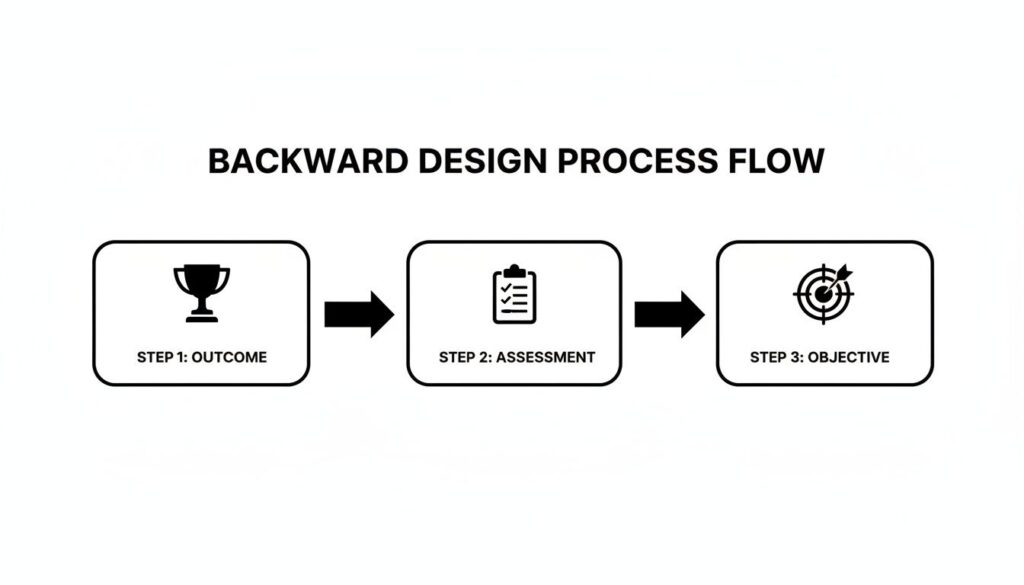
Following this process ensures your assessments are never just an afterthought. They’re central to your course’s DNA from the very beginning.
Choosing the Right Tool for the Job
The biggest mistake I see creators make is a mismatch between the outcome and the assessment. It just doesn’t work to test a high-level skill with a low-level tool.
Think about it. If your outcome is, “Students will be able to create a functional one-page website,” you can’t measure that with a multiple-choice quiz about HTML tags. The assessment has to mirror the action verb in the outcome. In this case, the only valid assessment is for the student to actually build a website.
Let’s break down some common alignments that work.
- For “Remembering” or “Understanding” outcomes: Quizzes, short-answer questions, and definition-matching exercises are perfect. They effectively check for foundational knowledge.
- For “Applying” or “Analyzing” outcomes: Case studies, problem-solving scenarios, and data interpretation tasks are great. These push students to use what they know in a new context.
- For “Evaluating” or “Creating” outcomes: You need hands-on projects, portfolios, presentations, or peer reviews. These are performance-based tasks that require students to produce something new.
The rule is simple. The assessment must ask the student to perform the same action described in the learning outcome. If the outcome says “analyze,” the assessment must require analysis. If it says “build,” they have to build.
Getting this alignment right is crucial for your course’s integrity. Misalignment leads to real problems. A 2021 analysis from DataWorks-ED showed that 55% of K-12 programs that confused their goals with how they measured them saw achievement gaps widen by 15-20%. While that study focused on K-12, the principle is exactly the same for course creators like us.
Practical Examples of Strong Alignment
Let’s look at how this plays out with a few concrete examples. Seeing the direct connection usually makes the whole concept click into place.
Example 1: Digital Marketing Course
- Learning Outcome: “By the end of this module, you will be able to write three engaging headlines for a social media ad.”
- Aligned Assessment: A simple assignment where students submit three headline variations for a sample product. You can then provide direct feedback on their work.
Example 2: Graphic Design Course
- Learning Outcome: “By the end of this course, you will be able to design a brand identity package, including a logo, color palette, and font selection.”
- Aligned Assessment: A final project where students develop and submit a complete brand identity package for a fictional client.
This direct alignment gives students a clear, tangible way to see their own progress and proves the value of your course. For a deeper dive, it’s worth exploring different approaches for how to measure training effectiveness. Also, understanding science-backed methods for efficient exam study can help you advise students on how to prepare for the very assessments you’ve designed to prove their new skills.
We’ve all been there. I know I’ve certainly made my share of mistakes when setting up course goals. Getting the balance right between learning objectives and outcomes can feel a bit tricky at first, but sidestepping a few common pitfalls makes a world of difference.
Let’s walk through some of the most frequent missteps I see out in the wild. This isn’t about pointing fingers. It’s about learning from experience so you can build a rock-solid foundation for your course from day one.
Making Outcomes Too Broad
One of the most common issues is creating outcomes that are just way too general. An outcome has to be a specific, measurable skill you can actually look at and say, “Yep, they did it.”
- The Mistake: “By the end of this course, students will understand social media marketing.”
- The Fix: Break that down into something concrete and tangible. A much better outcome is, “By the end of this course, students will be able to create a one-month content calendar for an Instagram business account.”
See the difference? “Understand” is a feeling, a state of mind. “Create” is an action. You can see it, you can evaluate it, and your student has a real-world skill to show for their effort.
Vague outcomes lead to vague courses. When your destination is fuzzy, both your teaching and your students’ learning will wander off track. Be specific, be clear, and promise a tangible result.
Confusing Activities with Outcomes
Here’s another classic mistake: listing the “doing” part of the course as the end goal. Remember, the outcome is the result of the activity, not the activity itself. This distinction is absolutely critical when we talk about learning objectives vs. outcomes.
- The Mistake: “Students will watch 10 video lessons on copywriting.”
- The Fix: Focus on what they can do after watching those videos. For example, “Students will be able to write a 250-word sales page that includes a clear call-to-action.”
Watching videos is the process. Writing an effective sales page is the prize.
Creating Too Many Goals
Finally, it’s so easy to get overexcited and list a dozen or more outcomes for a single course. I get it, you’re passionate and want to deliver a ton of value. But this can seriously overwhelm students and dilute the core promise of your course.
Focus on the 3-5 most important transformations you want your students to achieve. Keep your main course outcomes high-level and impactful. You can then use your lesson-level objectives to map out all the smaller, detailed steps needed to get them there. This keeps your course focused, your marketing clear, and your students motivated.
Quick Answers to Common Questions
Let’s wrap up by tackling some of the questions I hear all the time from course creators trying to get this right. Think of this as a quick-reference guide to clear up any lingering confusion so you can get back to building an amazing experience for your students.
Can a Course Have Both Learning Objectives and Outcomes?
Yes, it absolutely should. They’re two different tools that work together perfectly. They aren’t in competition with each other. They just serve different purposes.
Think of your learning outcomes as the main destination for the entire course. That’s the big promise you’re making. The learning objectives are the turn-by-turn directions for each lesson that get your students to that final destination. You need both to complete the journey.
How Many Learning Outcomes Should a Course Have?
This is a great question because it’s so easy to get carried away. A good rule of thumb is to aim for 3 to 5 main outcomes for your entire course.
This keeps the overall goal clear and focused, which prevents you from overwhelming your students with too many promises. Each of your modules can then have 2 to 4 smaller, more specific objectives that build toward those big, course-level outcomes.
Sticking to a handful of powerful outcomes makes your course marketing clearer and helps students immediately grasp the core value you’re offering. It’s all about focus.
Should I Share Objectives or Outcomes with My Students?
Definitely share the learning outcomes. These are the promises you’re making to your students about what they’ll be able to achieve by the end.
Putting your outcomes front and center on your sales page and at the start of your course sets clear expectations and is a huge motivator for learners. You can share lesson-level objectives too, maybe at the start of a video or a worksheet, but the course-level outcomes are the most important thing for your students to see and connect with.
How Does This Apply to a Membership Site?
This framework is perfect for memberships. Your main learning outcomes can define the core transformation your entire community provides over the long term.
Then, your monthly content, workshops, or guest expert sessions can each have their own specific learning objectives. These smaller objectives help members make consistent, measurable progress toward those larger, aspirational community goals, keeping them engaged month after month.