Gamified Learning Platform: How to Drive Engagement and Results
Ever heard the term gamified learning platform? When I first came across it, I pictured students just playing video games in a classroom. But that’s not quite it. It’s way more interesting.
Think of it like this: a gamified learning platform borrows the most engaging, motivating parts of games and applies them to educational content. I’m talking about the stuff that keeps you hooked. It’s about turning a passive lesson into an active, rewarding journey.
What a Gamified Learning Platform Really Is
So, what are we actually talking about? At its heart, a gamified learning platform uses the psychology of games to improve the learning process.
It cleverly taps into our basic human drives, like the need for achievement, a bit of friendly competition, getting feedback, and earning rewards. By using proven game mechanics, it makes learning feel less like a chore and more like a challenge you genuinely want to beat.
Instead of just passively reading text or watching a video, learners are suddenly in the driver’s seat. They’re actively participating. This simple shift from passive consumption to active engagement is the secret sauce that makes this approach so powerful.
The Core Idea Behind the Fun
The concept is pretty straightforward. We layer game mechanics on top of the educational content to encourage specific actions and behaviors. For example:
- Points give learners instant feedback for completing a task and reward their effort.
- Badges are like little trophies, visual markers that celebrate milestones and achievements.
- Leaderboards introduce that spark of competition, nudging learners to push themselves a little further.
These elements don’t work in isolation. They combine to create a structured experience where learners see their progress, compare their performance, and feel a real sense of accomplishment as they master the material.
A well-designed gamified course creates a safe space where learners feel motivated to tackle challenges and can try again without penalty, just like in a real game. This builds confidence and makes the whole process more enjoyable.
The image below gives a good visual of how these different pieces come together.
It shows how various game mechanics are mapped to specific learning goals, all with the aim of boosting motivation and making the information stick.
Why Gamified Learning Is Gaining So Much Ground
This isn’t just a passing fad. It’s a major shift in both education and corporate training. The numbers back it up. The global game-based learning market, a huge piece of this puzzle, was valued at USD 6.23 billion in 2025 and is projected to explode to USD 17.82 billion by 2030.
Why the incredible growth? Because organizations are seeing tangible results. Making learning interactive simply works. You can read more about these market projections and their impact to see just how big this trend has become.
The Core Features That Drive Engagement
So, what are the actual nuts and bolts that make a gamified learning platform click? I’ve found it’s about carefully selected features designed to tap into our natural human motivations.
Think of these elements as the ingredients in a recipe for genuine engagement. When you combine them correctly, you create an experience that keeps people coming back because they want to, not because they have to.
Points, Badges, and Leaderboards: The Big Three
When most people hear “gamification,” their minds jump straight to points, badges, and leaderboards, and for good reason. This classic trio provides the kind of immediate, tangible feedback our brains are wired to appreciate.
Point Systems: This is feedback in its simplest form. Learners earn points for watching a video, acing a quiz, or contributing to a discussion. It provides that little hit of instant gratification and a clear metric for tracking effort.
Badges and Achievements: Badges are like digital trophies that mark significant milestones. Finishing a tough module or mastering a new skill just feels more substantial when you get a visual reward for it. They’re signposts of progress and accomplishment.
Leaderboards: A little friendly competition can be a massive motivator. Leaderboards rank learners by points or achievements, tapping into our social nature and encouraging a healthy desire to keep up with peers. Done right, some platforms have seen a 34% higher course completion rate with these elements in play.
This map breaks down how these core ideas of motivation, feedback, and achievement all interconnect to create a powerful learning loop.
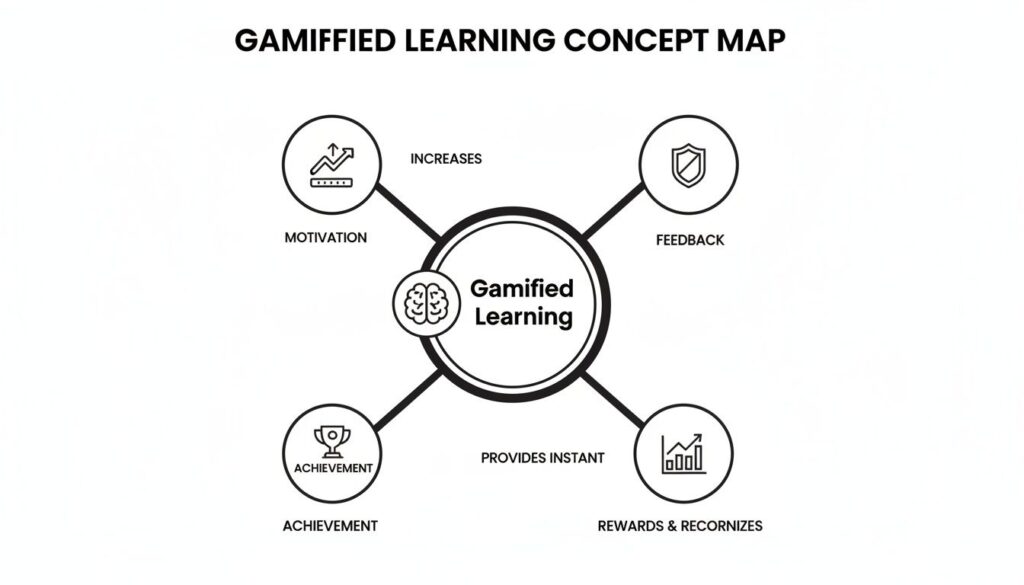
As you can see, each element builds on the others, reinforcing the cycle and keeping learners moving forward.
Going Deeper Than Just the Basics
While the “Big Three” are foundational, the most effective gamified platforms use more subtle mechanics to structure the entire learning journey. These features add depth and transform a simple checklist of lessons into a genuine adventure.
Progress bars are a perfect example. Watching that bar fill up as you move through a course is a powerful visual cue. It shows you how far you’ve come and, just as importantly, how close you are to the finish line. It’s a simple trick, but it works wonders for motivating completion.
Quests or missions take this idea a step further by weaving learning activities into a cohesive narrative. Suddenly, “Lesson 3” becomes “The Quest to Master Advanced Formulas.” This simple reframing gives the process a sense of purpose and excitement. To discover more ways to blend these elements into your course, check out our in-depth guide to gamification for elearning.
The best gamified systems make learners feel a sense of agency. They are active participants making choices, overcoming challenges, and charting their own path to mastery.
Finally, some platforms build in virtual currencies. Learners earn coins or tokens for their efforts, which they can then “spend” to unlock bonus content, customize an avatar, or access special resources. This creates a mini-economy within the course, adding another layer of engagement that rewards dedication and sustained effort. Applying SaaS onboarding best practices can make a huge difference in helping users understand and appreciate these features from day one.
So, what’s the real payoff for going through the effort of gamifying your learning platform? It’s simple: you get real, measurable results that make a difference for everyone involved. For your learners, education stops being a passive chore and becomes an exciting challenge. For you, it translates directly into a healthier business.
Let’s get into the specifics of how this all cashes out. We’ll look at the tangible benefits that can completely change the game for your courses, your community, and your bottom line.
Supercharge Learner Motivation and Completion
One of the biggest heartbreaks for any course creator is the dreaded drop-off rate. You pour everything into creating amazing content, only to watch learners lose steam and never cross the finish line. This is precisely where a gamified learning platform changes everything.
When you introduce elements like points, badges, and progress bars, you’re building a constant stream of positive reinforcement right into the learning experience. Every small action a learner takes gets acknowledged, creating a powerful feedback loop that fuels their desire to see what’s next.
This isn’t just a nice theory. The numbers tell a compelling story. Platforms using these mechanics report a 34% higher course completion rate compared to their traditional eLearning counterparts. It’s a massive shift, and it’s why in 2023, over 71% of eLearning providers integrated gamification to get better results. You can see more data on eLearning gamification trends to get a sense of how widespread this strategy has become.
Boost Knowledge Retention and Deeper Understanding
Motivation is one piece of the puzzle, but does the learning actually stick? Absolutely. Gamification makes the entire process more active and memorable, which has a direct impact on how well your students retain information.
Think about it from your own experience. Are you more likely to remember a dry paragraph you skimmed, or a concept you figured out while solving a fun, interactive puzzle? By turning lessons into challenges and quizzes into mini-games, you’re pushing learners to participate instead of just consume.
When learners are actively engaged, they are applying knowledge, making decisions, and seeing the immediate consequences of their choices. This process forges much stronger neural pathways, making information easier to recall later on.
This active practice is the key. Instead of just passively watching a video, learners are doing something with the content. That hands-on approach is incredibly effective for cementing new skills and ideas into their long-term memory.
Build a Stronger Brand and a Thriving Community
The benefits of a gamified platform ripple out far beyond individual students. When your learners are engaged and feel successful, it creates a powerful effect that strengthens your entire brand.
Here’s how it usually plays out:
Higher Student Satisfaction: Happy learners who feel a sense of accomplishment are your single best marketing asset. They walk away with a positive feeling about your course, your teaching style, and your brand.
Glowing Testimonials and Reviews: It’s a simple formula: satisfied students leave great reviews. This kind of social proof is pure gold when it comes to attracting new people to your platform.
A More Active Community: Features like leaderboards and team-based challenges get people talking. They foster a natural sense of camaraderie where students discuss strategies, celebrate each other’s wins, and offer support, turning your course from a solo activity into a vibrant hub.
Ultimately, these benefits feed into each other, creating a positive growth cycle. A more engaging platform leads to better student outcomes, which builds a stronger reputation and attracts more learners. It’s a powerful engine for sustainable growth, all powered by making learning more rewarding and, frankly, more fun.
How to Design Your Gamified Learning Strategy
So, you’re ready to build your own gamified learning platform? Let’s get practical. This is about being intentional, thoughtful, and building your strategy around your specific learners from the ground up.
Think of yourself less as a course creator and more as a game designer. Your mission is to craft an experience that guides a learner from novice to master in a way that feels genuinely fun and rewarding. I find it helpful to think about designing a cohesive system where the game mechanics and the learning objectives are perfectly in sync.
Let’s walk through the blueprint, step by step, from setting crystal-clear goals to mapping out the entire learner’s journey.
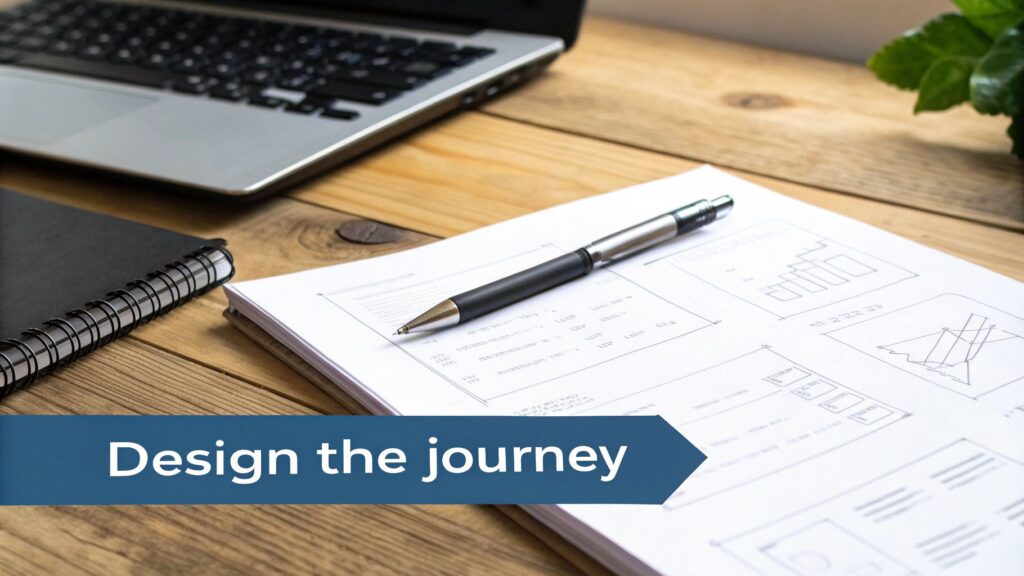
This image captures the essence of the process perfectly. It’s all about intentional design, sketching out every twist and turn of the path before you ever write a line of code.
Start with Clear Learning Objectives
Before you even dream about leaderboards or quests, you have to answer one fundamental question: what, exactly, do you want your learners to be able to do? This is the bedrock of your entire strategy. Without clear goals, your gamification efforts will feel random and tacked-on.
Your learning objectives need to be specific and measurable. “I want them to learn marketing” is way too vague. Try something like, “By the end of this module, learners will be able to launch their first successful ad campaign.” See the difference?
Once you nail down these objectives, you can start connecting them to game mechanics that actually help learners get there. If collaboration is a key objective, for example, then a team-based challenge will be far more effective than a solo leaderboard. It’s all about picking the right tool for the job.
Map the Player Journey
Now it’s time to put on your level designer hat. The player journey is the complete path your learner takes, from the moment they sign up to the day they graduate. A great journey has a palpable sense of progression, with challenges that scale up just as the learner’s skills improve.
I find it helpful to think about this in three main stages:
Onboarding: This is your “tutorial” level. Here, you introduce the basic rules of the game, like how to earn points, what a badge means, and how to navigate the course. The goal is to make learners feel comfortable and score an easy win right away.
Scaffolding: This is the heart of your course. You introduce new concepts and challenges in a structured way, building on what the learner already knows. Think of each module as a “level,” with quizzes and activities acting as “boss battles” they must conquer to advance.
Endgame: So, what happens when a learner finishes the main content? The endgame provides ongoing challenges to keep them hooked. This could be a “mastery” level, special community roles, or access to exclusive bonus content.
This structure ensures learners always know what’s next and feel a constant sense of forward momentum.
Choose the Right Game Mechanics
With your objectives defined and the journey mapped, you can finally pick your game mechanics. Remember, the goal is to choose elements that directly support your learning outcomes.
The most powerful gamification strategies use a mix of mechanics that cater to different types of motivation. Some people are driven by competition, while others are motivated by achievement or social connection.
Take the language-learning app Duolingo. It uses a brilliant combination of streaks, experience points (XP), and leaderboards to keep users engaged. They layer competitive elements with personal achievement goals.
This multi-layered approach is key to creating a system that appeals to a wide audience. For more ideas on this front, you can explore our detailed guide on how to increase learner engagement for some fresh perspectives.
Balance Challenge and Achievability
This might be the trickiest part of the whole process: getting the difficulty curve just right. If your course is too easy, people get bored. If it’s too hard, they get frustrated and give up.
You’re aiming for that sweet spot, a state of “flow,” where the challenge is perfectly matched to the learner’s skill level. This means your system needs to serve up a steady stream of achievable goals. Start with simple tasks to build confidence, then gradually introduce more complex challenges as they progress.
Get this balance right, and your platform will feel rewarding, not punishing, keeping your learners motivated for the long haul.
Choosing the Right Gamification Tools and Technology

With a solid strategy in your back pocket, it’s time to talk about the fun part: the tech that brings your vision to life. The tools you choose will form the backbone of your gamified learning platform, and there’s a huge range of options out there, each with its own quirks and benefits.
You could go for an all-in-one Learning Management System (LMS) that has gamification features baked right in. Or, you might prefer a more flexible approach, using standalone plugins that integrate with your current setup. There’s no single “best” choice here, only what’s best for your course and your learners.
All-in-One LMS vs. Standalone Plugins
The first big decision you’ll likely face is whether to get a complete system or simply add on to what you already have. An all-in-one LMS is a fantastic option if you’re starting from scratch. It handles everything from course hosting to gamification, but you’re often limited to the specific features that particular platform offers.
On the other hand, using standalone plugins or specialized gamification software gives you more freedom to customize. You can pick and choose the exact features you want and integrate them into a platform you already know and love. This can be more complex to set up, but the flexibility is often worth it for creators who want a specific experience.
When considering the technology for your gamified learning platform, it’s a good idea to consult an online course platform comparison guide to understand the full spectrum of options.
To Build or To Buy
Another classic debate is whether to build a custom solution or buy an off-the-shelf product. Building your own platform gives you complete control over every single detail. You can design the perfect system tailored to your learners, but this path requires significant time, technical expertise, and a hefty budget. Don’t underestimate the resources involved.
Buying a ready-made solution is much faster and more cost-effective for most people. These platforms are built on proven frameworks and come with support, so you can focus on what you do best: creating great content. While you might sacrifice some customization, the speed and reliability are often a worthwhile trade-off.
Your choice of technology should always serve your learning objectives, not the other way around. Don’t get distracted by flashy features that don’t align with what you’re trying to help your students achieve.
The market for these platforms is absolutely booming, which is great news for course creators. The global market is projected to jump from USD 12.7 billion in 2024 to a staggering USD 216.7 billion by 2034. A huge 55.8% of these solutions are cloud-based, making them easy to access and manage. This explosive growth shows just how much demand there is for engaging, game-like learning.
Gamification Platform Options Comparison
When you’re trying to figure out the right technology, it helps to see the main approaches laid out side-by-side. Each one serves a different purpose, so thinking about your own goals and resources will point you in the right direction.
| Platform Type | Best For | Pros | Cons |
|---|---|---|---|
| All-in-One LMS | Creators who want a simple, unified system and are starting fresh. | Everything is in one place, easier setup and management. | Less customization, locked into the platform’s features. |
| Standalone Plugins | Creators who already have a platform and want to add specific gamification elements. | High flexibility, only pay for what you need. | Can be complex to integrate, potential compatibility issues. |
| Custom Build | Businesses with unique needs, large budgets, and technical teams. | Complete control over every feature and design element. | Very expensive, time-consuming, requires ongoing maintenance. |
| No-Code Platform | Non-technical creators who want more customization than an LMS offers. | Visual development, faster than custom builds. | Can be more expensive than plugins, potential limitations. |
Ultimately, the best path depends on your budget, technical comfort level, and how much control you want over the final product. Don’t just pick the one with the most features. Pick the one that fits your workflow.
A Framework for Making Your Decision
Feeling a little overwhelmed by the options? I get it. To make a smart choice, you need a clear framework for evaluating what’s out there. The right gamified learning platform for someone else might not be the right one for you.
Here are the key factors I always recommend considering:
- Scalability: Can the platform grow with you? You need a solution that can handle your user base, whether you have 100 learners today or 10,000 next year.
- Customization: How much control do you have over the look and feel? The best tools let you tweak the gamification elements to match your brand and the specific needs of your audience.
- Integration: Does it play nicely with other tools you rely on? Think about your email marketing service, community platform, or payment processor. Smooth integrations save you a world of headaches down the road.
If you’re leaning toward an LMS, our team has put together a fantastic resource. Check out our guide on how to choose an LMS for a deeper dive into the evaluation process. It will help you ask the right questions and pick a foundation that will support your vision for years to come.
Common Mistakes to Avoid When Gamifying Your Course
Building a gamified learning platform is a blast, but it’s surprisingly easy to get tripped up by a few common traps. I’ve seen some incredibly smart creators make small missteps that, unfortunately, ended up souring the whole learner experience. Let’s walk through the big ones so you can sidestep them completely.
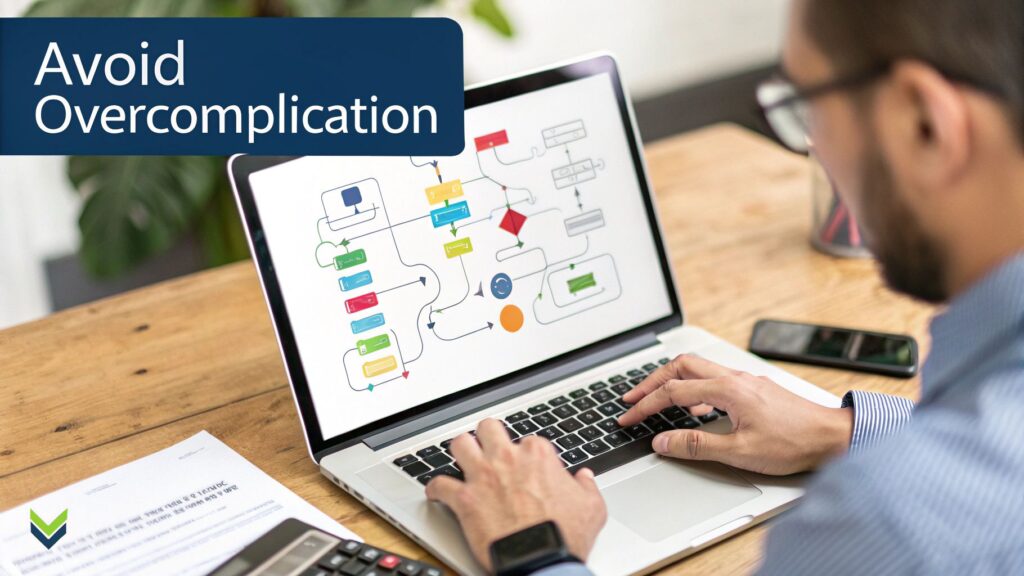
The single biggest mistake I see is overcomplication. It’s so tempting to pile on every bell and whistle you can think of, from ten different kinds of points to intricate avatar upgrade paths. But a system drowning in rules just confuses learners and makes them feel overwhelmed.
Instead of motivating them, it creates a wall they have to climb before they can even start learning. Simplicity is your best friend here. A clean, intuitive system will always outperform one that feels like it needs its own instruction manual.
Making Rewards Feel Meaningless
Another classic blunder is creating rewards that feel totally disconnected from the actual learning. This is what happens when the focus drifts to just racking up points or badges for the sake of it, a behavior often called “pointsification.” The game becomes about chasing the reward instead of mastering the material.
To sidestep this, you have to make sure every reward is directly tied to a meaningful achievement.
- Reward real effort and progress: Give points for nailing a tough quiz, not just for logging in.
- Celebrate genuine milestones: A badge for mastering a difficult concept feels earned and important.
- Connect rewards to real value: Make sure every single reward reinforces a key learning objective.
This keeps the learner’s eyes on the prize that actually matters: their own education and skill development.
Creating an Unbalanced System
It’s also absolutely critical to design a system that feels fair and motivating for everyone. If your leaderboard only ever celebrates the top 1% of hyper-competitive users, it can be a huge turn-off for everyone else. A lot of people just aren’t driven by that kind of intense competition and will simply check out.
A well-designed gamified course should support different learning styles and paces. The goal is to motivate everyone, not just the people who are already at the top of the class.
Try adding things like team-based challenges or personal progress trackers. These elements let learners feel a sense of accomplishment based on their own improvement or collaboration. That’s how you create a more welcoming and effective gamified learning platform for your entire audience.
Got questions? Good. That means you’re thinking critically about how a gamified learning platform could actually work for you. Let’s dig into a few of the most common ones I hear from creators.
Is Gamification Really Suitable for Serious or Professional Topics?
This is a big one, and the answer is a resounding yes. It’s a common misconception that gamification is just for kids or lightweight topics. In reality, it has to do with tapping into the core human drivers of motivation, progress, and achievement.
These principles are universal, no matter how serious the subject matter.
For professional training, you simply mature the tone and mechanics. Instead of earning cartoonish badges, your learners might unlock industry-recognized certifications for mastering complex skills. You could build sophisticated simulations or branching scenarios that challenge them to solve tough, real-world problems.
The key is to match the game mechanics to the gravity and goals of your content.
How Can I Measure if My Gamified Course is Actually Working?
Measuring success goes way beyond checking who’s at the top of the leaderboard. You need to connect your gamification efforts to the metrics that actually move the needle for your educational and business goals.
Here are the big ones to keep a close eye on:
- Course Completion Rates: This is the clearest sign of sustained engagement. Are more people actually finishing your course than before you added game mechanics?
- Learner Engagement Time: How long are students actively spending in your course? Longer, more frequent sessions are a great indicator that you’ve created a compelling experience.
- Knowledge Retention: This is the ultimate test. Are learners scoring higher on assessments or demonstrating better skills after going through the gamified modules? This tells you if the learning is actually sticking.
But don’t just rely on the numbers. The qualitative feedback is gold. Simple surveys asking learners what they enjoyed or what motivated them most can give you priceless insights that a dashboard will never show you.
Can I Add Gamification to a Course I’ve Already Built?
Absolutely, and this is great news for anyone who doesn’t have the time or resources to start from scratch. You can definitely retrofit an existing course with gamification elements without having to tear the whole thing down and rebuild it.
The best way to do this is to start small and introduce new mechanics one at a time. This lets you see how your audience responds without overwhelming them.
You could begin by adding a simple point system for completing lessons. Or maybe introduce a few achievement badges for mastering your cornerstone modules. This iterative approach lets you thoughtfully enhance your course over time, turning a good program into a great one.