Using an LMS for Employee Engagement Programs That Work

An LMS for employee engagement is so much more than a digital filing cabinet for compliance training. I see it as a living, breathing ecosystem for growth, connection, and motivation. It’s what turns a static content library into an active hub where your people want to learn and grow.
Why an LMS Is Your Secret Weapon for Employee Engagement
Most organizations see their Learning Management System (LMS) as a necessary chore, a place to park mandatory training and check a box. I want you to see it differently. I’ve spent my career helping companies build online learning that people actually enjoy, and I’ve seen firsthand how a modern LMS can become a dynamic hub that supercharges engagement.
We’re going to explore how to transform a simple content library into a place where your team can truly thrive.
Shifting from a Chore to a Choice
The core idea is simple. When learning feels like a personal benefit rather than a corporate mandate, genuine engagement follows. Think about features like self-paced learning, personalized content paths, and social forums. These tools help create an environment where employees feel valued and invested in their own development.
My goal here is to show you that an LMS is one of the most powerful tools you have for building a genuinely engaged workforce. You can explore some of the fundamental benefits of an LMS in one of our previous articles.
This isn’t some niche strategy, either. The adoption of these platforms is exploding. Over 412,402 companies worldwide are already using LMS tools for this very reason. A massive 83% of organizations now use an LMS, and 58% of employees say they prefer self-paced learning, something an LMS delivers exceptionally well.
The real magic happens when you stop thinking about training as a series of events and start treating it as an ongoing conversation. An LMS gives you the platform to host that conversation, making learning a continuous, natural part of the job.
Connecting Learning to Broader Engagement Goals
To really get why an LMS is a secret weapon, you have to look at the bigger picture. When you read up on how to improve employee engagement, you’ll see that learning and development play a critical role. An effective program pushes courses and solves real problems for your people.
Here’s how an LMS helps you do just that:
- It offers clarity and direction. Employees can see clear pathways for career growth, complete with the specific skills and training required to get there. No more guessing games about what it takes to get promoted.
- It builds community. Social learning features like discussion forums and group projects allow team members to connect and learn from each other. This is huge for breaking down departmental silos and fostering collaboration.
- It shows you value them. Investing in an employee’s development is one of the clearest signals you can send that they are a valued part of the organization’s future. It’s an investment in them, not just their current role.
Ultimately, a well-used LMS becomes the backbone of a culture that prioritizes its people. It provides the structure and tools needed to turn abstract goals like “improving company culture” into tangible, measurable actions that resonate with every single employee.
Matching Your Engagement Goals to the Right LMS Features
Before we even start talking about specific platforms, we need to get one thing straight. What does “engagement” actually mean for your company? It’s a fuzzy word, and if you can’t define it, you can’t measure it.
Is your main goal to improve employee retention by 15% this year? Maybe it’s about fostering more collaboration between the sales and marketing teams. Or perhaps you’re focused on getting new hires fully productive in 60 days instead of 90.
Each of these goals requires a different set of tools. Setting clear, measurable objectives is the only way to choose a platform that will actually help you achieve them. It’s the difference between buying a tool and solving a real business problem.
Once you have that clarity, you can start connecting your goals to specific LMS features. This is where the magic happens. You begin to see how technology can directly support your people and, ultimately, your bottom line.
This flow shows how the right LMS can evolve your training from a simple compliance checkbox into a genuine engine for growth and active participation.

Moving beyond mandatory training is what fosters a culture where employees feel truly invested in their development and the company’s success.
Pinpointing Your Must-Have Features
Let’s get practical. An LMS built for engagement looks and feels completely different from one made for simple compliance tracking. It’s packed with features designed to create a more interactive, rewarding, and connected learning experience.
For example, a company focused on building leadership skills needs an LMS with strong social learning forums and personalized learning paths. On the other hand, a business trying to improve technical skills might prioritize features like hands-on practice environments and skills assessments.
The following table maps some common engagement objectives to the LMS features that directly support them. Think of it as your cheat sheet for translating business needs into technical requirements.
A Real-World Scenario
Imagine a mid-sized tech company struggling with high turnover among its junior developers. Their engagement surveys reveal that developers feel stagnant and don’t see a clear path for career growth.
Their engagement goal is crystal clear: Reduce developer turnover by 20% in the next 18 months by creating clear career progression paths.
With that specific goal in mind, their LMS feature checklist gets very focused:
- Personalized Learning Paths: They need to build custom learning tracks for “Senior Developer,” “Tech Lead,” and “Solutions Architect” roles, assigning the exact courses and skills needed for each level.
- Skills Gap Analysis: The platform must have a tool to assess a developer’s current skills against the requirements for their next role, creating a truly personal development plan.
- Mentorship Program Support: They need features to facilitate a mentorship program, allowing senior developers to easily connect with and guide junior team members.
- HRIS Integration: This is crucial. Completed certifications must automatically update an employee’s profile, making their progress visible during performance reviews.
By mapping their business problem to these specific LMS features, the company can confidently choose a platform that will deliver a measurable return. If you’re in this selection phase, our complete guide on how to choose an LMS offers a much deeper dive into the evaluation process.
Designing Learning Content That People Actually Enjoy
Let’s be honest. You can have the best LMS on the planet, but it won’t make a lick of difference if the content is a snooze-fest. Generic, off-the-shelf courses are the fastest way to kill an engagement program before it even gets off the ground.
Your real foundation is amazing content. The goal is to shift learning from a chore to a choice. That only happens when the material feels personal, immediately useful, and respects your team’s time.

It’s time to move away from those hour-long videos and dense PDFs that nobody has time for. We need to think smaller, smarter, and way more relevant. A huge part of making an LMS work for employee engagement is knowing how to create training materials that engage and educate from the very beginning.
Embrace the Power of Microlearning
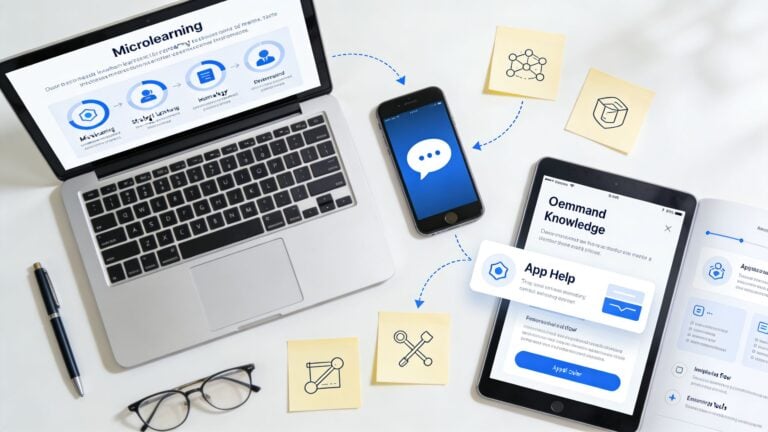
I’m a massive advocate for microlearning. It’s simply the practice of breaking down big, complex topics into small, digestible pieces. Think five-minute videos, two-minute interactive quizzes, or quick one-page checklists.
The beauty of this approach is that it fits perfectly into a busy workday. Your team doesn’t have to block off an entire afternoon. They can learn something new while waiting for a meeting to start or during their morning coffee.
Here’s a practical example. Instead of a single, 45-minute course on “Effective Communication,” you could create a microlearning series:
- Week 1: A 3-minute video on active listening techniques.
- Week 2: An interactive quiz where employees identify the best way to phrase difficult feedback.
- Week 3: A downloadable PDF with templates for running more efficient meetings.
This makes learning feel manageable, not intimidating. It also dramatically improves knowledge retention, since people are far more likely to remember small, focused chunks of information.
Structure Drip Courses for Long-Term Stickiness
Microlearning gets even more powerful when you use it in a drip course. This is where your LMS automatically “drips” content to learners over a set period, like a few days or a few weeks. It keeps employees coming back for more and reinforces learning over time, which is so much more effective than a one-and-done training event.
Imagine a new manager gets enrolled in a 30-day leadership drip course. On day one, they get a welcome video. On day three, a short module on setting clear expectations. On day seven, a checklist for conducting their first one-on-one.
The key is to build momentum. Drip courses turn learning into a habit rather than an event. Each piece of content builds on the last, creating a cohesive learning journey that feels guided and supportive.
Your LMS for employee engagement programs should handle all this automatically, ensuring consistent training without adding to your admin workload.
Use a Mix of Media to Keep Things Interesting
Everyone learns differently. Some people are visual and love videos, while others would rather listen to a podcast during their commute. A great engagement program respects these different styles by offering a variety of media formats.
Don’t be afraid to mix it up. Your LMS should make it easy to incorporate all sorts of content.
Consider using formats like:
- Short, engaging videos: Perfect for showing a process or explaining a key concept.
- Audio clips or podcasts: Great for interviews with subject matter experts or for on-the-go learning.
- Interactive scenarios: Allow employees to practice new skills in a safe, simulated environment.
- Downloadable resources: Checklists, templates, and job aids provide immediate, practical value they can use on the job.
When you offer multiple ways to engage with the material, you increase the odds that your training will resonate with everyone. It shows you get that there isn’t a one-size-fits-all solution to learning.
Automating and Gamifying the Learning Experience
This is where your engagement program starts to run on its own and, frankly, gets a lot more fun. A good LMS should be taking administrative work off your plate, not adding to it. The real magic happens when you let the system handle the heavy lifting.

We’re talking about building automated learning paths that guide employees on their development journey. This removes the need for constant manual check-ins from you or your team.
Setting Up Smart Automation
Think of automation as your personal training coordinator. It handles all the routine tasks so you can focus on the bigger picture. When you set it up right, your LMS becomes a proactive partner in employee development.
For instance, you can create rules, or “triggers,” that automatically assign training based on specific events. A new hire gets added to your HRIS in the “Sales” department? Bam. They’re instantly enrolled in the “Sales Onboarding” and “Product Knowledge 101” courses.
Here are a few more real-world examples I’ve seen work wonders:
- Promotions: When an employee’s job title changes to “Manager,” the LMS automatically assigns them the entire “Leadership Essentials” learning path. No delays, no one slipping through the cracks.
- Performance Reviews: A skill gap like “Project Management” is flagged in a review. The system can immediately assign a few key microlearning modules to help them build that skill.
- Gentle Nudges: If someone hasn’t cracked open a module after two weeks, the system can send a friendly, automated reminder. You don’t have to be the one chasing people down.
These automated workflows make learning timely, relevant, and consistent for everyone. It takes the guesswork out of the equation and weaves development seamlessly into the employee lifecycle.
Making Learning Fun with Gamification
Now for the best part: gamification. The goal here is to use simple, proven game mechanics to motivate people and make the learning process more enjoyable, not turn serious training into a video game.
When you do it right, it creates a powerful sense of accomplishment and sparks a little healthy competition.
The most common (and effective) gamification elements are pretty simple:
- Points: Awarding points for completing modules, acing quizzes, or joining discussions provides immediate positive feedback. It’s a small thing that makes a big difference.
- Badges: These are visual symbols of achievement. Earning a “Public Speaking Pro” badge after finishing a communications course is a great way to recognize and validate a new skill.
- Leaderboards: This is my favorite for competitive teams. Displaying top performers can ignite a team’s spirit, especially for things like sales or product knowledge training.
This taps into our natural desire for recognition and progress. And the results speak for themselves. Digitized training via an LMS can boost productivity by 15-25%. More importantly, organizations with strong learning cultures see 30-50% higher employee engagement and retention rates.
I once worked with a sales team launching a complex new product. We set up a leaderboard in their LMS just for the new product training. The top three performers each week got a simple shout-out in the team’s weekly email. That small bit of recognition sparked a huge wave of friendly competition, and they absolutely smashed their initial sales targets.
This approach works because it makes learning visible. Employees see their own progress, and managers can easily spot and celebrate their top performers. For more ideas you can steal, check out our guide on using gamification for training.
By combining smart automation with engaging gamification, you transform your LMS from a passive library of content into an active, motivating learning environment that people actually want to use.
How to Weave Your LMS into the Daily Workflow
An LMS that lives on an island is destined to fail. For your employee engagement program to really take off, it has to feel like a natural part of your team’s day. It should not be another password to remember or a separate website to check. This is where smart integrations make all the difference.
When your LMS talks to the other systems your team already relies on, you eliminate friction. Learning stops being a scheduled “event” and becomes a continuous, easy-to-access resource. The goal is simple: make learning as easy as checking email or sending a chat message.
Start with Single Sign-On
First things first: set up Single Sign-On (SSO). I can’t overstate how important this is. Forcing employees to create and remember yet another login is the fastest way to kill adoption before you even get started.
With SSO, your team can access the LMS using the same credentials they already use for everything else, like their company email or main portal. This one simple step removes the biggest initial barrier to entry and sends a clear message that learning is a core part of your company’s official toolkit.
It’s a small technical detail, but it has a massive impact on the user experience.
Connect Your LMS to Your HRIS
Next up is connecting your LMS to your Human Resources Information System (HRIS), like Workday or BambooHR. This is where you unlock some serious power, both for employees and your HR team.
When these two systems are in sync, user management becomes almost completely hands-off.
- Automatic User Provisioning: A new hire gets added to the HRIS, and boom, an LMS account is instantly created for them. No more manual data entry.
- Automated Role Updates: Someone gets a promotion? Their role and learning paths in the LMS can update automatically, ensuring they get the right training at the right time.
- Course Completion Syncing: Completed courses and certifications can be written directly back to an employee’s official record in the HRIS, which is incredibly helpful for performance reviews and career pathing.
This connection turns your LMS from a static library into a living system that mirrors your organization’s structure. It directly links learning activities to career progression, making professional development feel tangible. In a world where 63% of employers are scrambling to close skills gaps, an HRIS integration is critical for aligning training with real business needs. You can find more stats on how LMS integrations drive engagement on thirst.io.
When learning is visibly tied to career growth through an HRIS integration, it stops feeling like an extracurricular activity. It becomes a clear, supported pathway to an employee’s next role, which is a massive driver of engagement.
Meet Your Team Where They Already Are
Finally, let’s talk about bringing your LMS into the communication tools your team uses all day, every day. Think Slack or Microsoft Teams. If your people are already collaborating in these channels, that’s where learning notifications and discussions should be happening.
This is all about embedding learning into the natural flow of work.
Imagine how this could work:
- A new microlearning course on negotiation skills is launched, and a notification is automatically posted in the Sales team’s Slack channel.
- An employee finishes a tough compliance module, and a congratulatory message is sent to their manager through Teams.
- A discussion prompt from a leadership course is posted in a channel, sparking a real-time conversation among managers.
This makes learning social, timely, and visible. It means employees don’t have to constantly remember to check the LMS platform for updates, the learning comes to them. By making participation this frictionless, you dramatically increase the odds that your team will actually engage with the amazing content you’ve worked so hard to create.
You’ve poured your energy into building a fantastic program. Now comes the exciting part: launching it and, just as crucially, proving it actually works. A great launch is so much more than a single company-wide email. It’s about creating genuine excitement and building momentum right from the start.

Before anyone else sees it, get your managers and team leaders on board. These are your champions. Give them a sneak peek of the LMS, walk them through the most important courses, and show them exactly how this program will make their teams stronger and their own jobs easier. When they’re excited, that enthusiasm is contagious.
Next, you need to decide how to go live. A phased rollout, where you start with a pilot group or a single department, is often the smartest play. It gives you the space to iron out any wrinkles, gather honest feedback, and collect success stories you can use to sell the program to the rest of the company. On the flip side, a big-bang launch can create a huge wave of initial energy, which is perfect if your program is tied to a major company initiative.
Looking Beyond Completion Rates
Once the program is out there, the real work begins. We have to get past the outdated habit of just tracking who finished what course. Frankly, “completion rates” tell you almost nothing about real engagement. We need to focus on KPIs that paint a much richer picture of how your LMS for employee engagement programs is truly performing.
Think about the metrics that show people are choosing to learn:
- Voluntary Course Sign-Ups: How many people are enrolling in non-mandatory courses? This is a massive indicator of genuine interest and curiosity.
- Repeat Logins: Are employees coming back to the platform week after week? This shows it’s becoming a go-to resource, not a one-and-done task.
- Social Forum Activity: Check out the number of posts, comments, and questions in your discussion forums. This is where you can see real collaboration and peer-to-peer learning unfold.
- Qualitative Feedback: Don’t forget to just ask people what they think. Short, simple pulse surveys can give you incredible insights into what’s hitting the mark and what’s falling flat.
Connecting Learning to Business Impact
This is the final, most critical piece of the puzzle. You absolutely must connect these learning metrics back to the business goals you defined at the very beginning. This is how you demonstrate the powerful ROI of your engagement program and secure the budget for next year.
The ultimate goal isn’t just to increase training activity. It’s to prove that this increase in activity is positively impacting the business. You need to be able to draw a straight line from your LMS data to your company’s bottom line.
For example, six months down the line, can you show a measurable decrease in employee turnover in the departments with the highest course engagement? Are new hires who complete your onboarding path hitting their productivity targets faster than before? Making that connection is everything.
Modern, flexible learning programs are making a real difference. In fact, a recent report shows that 84% of employees now report satisfaction with their training, a steady climb from previous years. This proves that when we focus on delivering a great experience, employees feel more valued and engaged. You can read more about these training satisfaction findings to see the full picture.
By tying your program’s success to these bigger business outcomes, you’re not just running a training initiative, you’re driving meaningful change across the organization.
Even after you’ve dotted every ‘i’ and crossed every ‘t’ on your LMS engagement plan, a few nagging questions always seem to surface right before launch. I’ve heard them all over the years, so let’s tackle the big three head-on. These are the practical, real-world hurdles you’re likely to face.
What if My Initial Adoption Rates Are Low?
First off, don’t panic. A slow start is more common than you think. Your first instinct might be to send another company-wide email blast, but resist the urge. That’s just adding more noise.
Instead, go talk to people. Find a handful of employees from different departments and ask for their honest, unfiltered feedback. More often than not, the problem isn’t the quality of your content but a simple friction point you overlooked. Maybe the single sign-on is buggy, or the connection between a course and their actual job feels too abstract.
Sometimes, all you need is a spark. Getting a few respected managers to champion the LMS within their own teams can be the catalyst that gets the ball rolling. Peer influence is incredibly powerful.
How Should We Budget for an Engagement-Focused LMS?
When you’re building the budget, it is critical to think beyond the annual license fee. The real magic of an engagement-focused LMS comes from the custom content you create, so be sure to factor in the time and resources needed to produce it. If you’re planning to use gamification, set aside a small budget for rewards and prizes, too.
Most importantly, you have to frame this cost as an investment, not an expense. High-quality learning and development is a massive driver of employee retention. When you remember that 94% of employees report they would stay at a company longer if it invested in their career development, the LMS starts to look like a bargain. You can discover more insights about LMS statistics on programs.com.
Don’t just think about the cost of the platform. Think about the cost of high turnover, low morale, and skills gaps. An engagement-focused LMS is an investment in solving those much bigger, more expensive problems.
How Can I Keep the Content Fresh Over Time?
This is such a crucial question. Stale, outdated content is the fastest way to kill your program’s momentum. The trick is to treat content creation as an ongoing process, not a one-time project.
Build a simple content calendar and make it a regular part of your workflow. But you don’t have to do it all yourself.
Look around your organization for subject matter experts and empower them to contribute. Your top salesperson could record a 3-minute video on handling objections. A senior project manager could share their go-to template for running an effective kickoff meeting. This kind of user-generated content is not only authentic and hyper-relevant, but it also takes a huge amount of the creation burden off your plate.