Launch Calendar for Recurring Product Creators

If you’ve ever felt like your business is a chaotic mess of last-minute marketing pushes followed by total burnout, you’re not alone. When I first started creating recurring products, my “strategy” was pure chaos. I’d launch whenever I felt a burst of inspiration or, more often, when my bank account started looking a little thin.
It was a stressful rollercoaster. I knew there had to be a better way to escape that feast-or-famine cycle.
That’s when I discovered the power of a launch calendar. It felt like just another task on my already massive to-do list, but it turned out to be the single most important thing for building a sustainable, predictable business. I learned to trade those frantic sprints for a calm, repeatable system that keeps revenue steady and my audience engaged.
Why Your Business Needs a Predictable Launch Rhythm

Mapping out your launches transforms how you run your entire business. To really get a handle on how this rhythm optimizes everything, it helps to first understand the whole process of how to launch a new product from start to finish. A launch calendar is the strategic overlay that makes that process repeatable and far less stressful.
Building Anticipation and Trust
A great launch calendar is about creating a predictable rhythm for both you and your audience.
Think about your favorite TV show. You know when a new season is coming, and that anticipation builds over time. A launch calendar does the exact same thing for your products.
When your audience knows what to expect and when, they start to see you as a reliable creator who consistently delivers value. That consistency is what builds powerful trust and turns one-time buyers into loyal, long-term customers.
The real magic of a recurring launch calendar is moving from a mindset of one-off promotions to building a sustainable marketing engine. It smooths out your revenue, reduces your stress, and deepens your connection with your community.
Key Benefits of a Launch Calendar
Having a clear plan does more than just organize your dates. It provides a framework that supports your entire business. Here’s what you can expect:
- Reduced Stress: You’ll eliminate the last-minute scramble by planning your marketing activities weeks or even months ahead. No more pulling all-nighters to write launch emails.
- Improved Marketing: With a calendar, your marketing becomes more thoughtful and strategic. You can create content that genuinely helps your audience and builds momentum long before you ever ask for a sale.
- Predictable Revenue: This is the big one. A steady launch rhythm smooths out the revenue spikes and dips, giving you a much clearer, more reliable picture of your monthly and quarterly income.
The data backs this up, too. Creators who meticulously plan their launches see dramatically higher success rates.
For example, recurring launches like monthly membership feature drops have been shown to lift retention by 40% because audiences learn to anticipate the rhythm. This strategic timing has also helped 70% of recurring creators double their monthly recurring revenue within just a few quarters. This whole process is about working smarter.
Choosing Your Launch Cadence: Evergreen, Cohort, or Hybrid
Alright, let’s talk about one of the biggest decisions you’ll make for your course or membership: your launch rhythm. This is the core operating system for your revenue and your energy.
The right “cadence” depends entirely on your business, your product, and frankly, how you want to spend your time. What works for a high-touch coaching program will absolutely burn you out if you try to apply it to a self-paced video course.
There’s no magic formula here, but there are three proven models. Let’s break them down so you can find the one that feels right for you.
The Always-On Evergreen Model
Think of the evergreen model as your 24/7 digital storefront. Your product is always available for purchase, and your marketing hums along in the background, bringing in new customers on autopilot.
This approach is a dream for creators aiming for a more passive, predictable income stream. Once you dial in your automated sales funnel, it can generate revenue while you’re focused on creating your next thing or just taking a well-deserved vacation.
The catch? Creating urgency. When people can buy anytime, they often do just that: buy anytime, which can easily turn into never. This means you need a seriously sophisticated and well-optimized automated system, usually powered by email, to gently nudge people toward a decision. It’s a slow-and-steady game that requires patience and a real love for automation.
The High-Energy Cohort Model
On the complete opposite end of the spectrum is the cohort model, also known as a “live” or “open/close cart” launch. This is all about concentrated energy and massive buzz.
You open enrollment for a short, specific window, maybe just one week, and then you slam the doors shut. Everyone who joins goes through the experience together, at the same time.
This model is pure rocket fuel for sales. The limited timeframe forces people to make a decision, which is why you see those huge revenue spikes. The shared journey also creates an incredible sense of community, which is a powerful selling point. We’ve written before about how to build successful cohort-based courses that really lean into this community vibe.
But let’s be real: it can be absolutely draining. Cohort launches are intense, all-hands-on-deck sprints. The revenue is also super spiky, which can make financial planning feel like a rollercoaster if you haven’t mapped out your launches for the year.
My Personal Favorite: The Hybrid Model
This brings us to the model I’ve come to rely on and recommend most often: the hybrid model. It strategically blends the best parts of evergreen and cohort launches into something far more sustainable and powerful.
With a hybrid model, you get the predictable cash flow of an automated evergreen funnel combined with the high-energy revenue spikes of periodic live launches. It’s the perfect balance.
Here’s what this looks like in the real world:
- Your core offer is always available (the evergreen part). Anyone can land on your website on any given Tuesday and buy your main course.
- You run quarterly “live” promotions (the cohort part). A few times a year, you create a major event around that same evergreen product. Maybe you offer a limited-time bonus package, host a live workshop series for new sign-ups, or run a rare discount.
This approach gives you the stability of a monthly revenue baseline from your evergreen sales. Then, your quarterly promotions create those big cash injections and bring a fresh wave of energy and excitement to your community.
It’s an incredible way to structure your year. You get the stability you need to run your business without the constant, exhausting pressure of back-to-back live launches.
To make the choice clearer, here’s a quick breakdown of how these three models stack up against each other.
Launch Cadence Comparison: Evergreen vs. Cohort vs. Hybrid
This table cuts through the noise to help you see which launch model truly aligns with your business goals, your product type, and your personal work style.
| Model | Best For | Pros | Cons |
|---|---|---|---|
| Evergreen | Self-paced courses, digital products, businesses with strong automated marketing skills. | Predictable, steady revenue; scalable; less hands-on once set up. | Lacks urgency; requires sophisticated funnels; can feel impersonal. |
| Cohort | High-touch programs, coaching, community-focused courses where peer learning is key. | Creates massive urgency and buzz; high conversion rates; strong community. | Intense and exhausting; spiky, unpredictable revenue; not scalable. |
| Hybrid | Established course creators, memberships, businesses looking for both stability and growth. | The best of both: stable baseline revenue plus high-energy launch spikes; sustainable. | More complex to manage two systems; requires clear planning. |
Ultimately, the best cadence is the one you can stick with consistently. The hybrid model often provides the most sustainable path to growth, but don’t be afraid to start with one model and evolve as your business grows. The key is to choose a rhythm that works for you, not against you.
Mapping Out Your Annual And Quarterly Launch Plan
Alright, this is where we get tactical. We’re moving from the idea of a launch rhythm to actually building the calendar that brings it to life. I’ll walk you through a simple, flexible process you can use in a spreadsheet, Asana, Trello, or even just a big wall calendar if that’s your style.
The trick is to start big and then zoom in. We’ll lay out the whole year first, then get laser-focused on the next 90 days. This two-layer approach gives you a clear sense of direction for the year without the overwhelm of trying to plan every single detail twelve months out.
Start with a High-Level Annual View
Before you can plan a killer quarter, you have to know what the entire year looks like. The goal here is to plant the “big rocks” that will anchor your promotional calendar, not schedule every email.
These are the non-negotiable dates and events you absolutely have to plan around. Skipping this step is like trying to host a backyard barbecue during a hurricane, it just won’t work.
Here’s what I always plug into my annual calendar first:
- Major Holidays: Think Black Friday/Cyber Monday, New Year’s, or any other holiday that dramatically shifts your audience’s buying habits.
- Industry Events: Are there big conferences or seasons in your niche? A fitness creator, for example, would pencil in a “New Year’s Resolution” push in January and a “get ready for summer” promo in May.
- Personal Time Off: This is a big one, and it’s non-negotiable. Block out your vacations and personal commitments first. This forces you to build a realistic launch calendar that serves you, not the other way around.
- Your Big Launches: Get a rough idea of when your major promotions will happen. Maybe it’s one big push per quarter. Pencil those in.
Using a solid B2B product launch plan template can be a huge help here. It provides a proven framework that you can easily adapt for your recurring product.
Zoom In On Your Next 90-Day Plan
Once your annual “big rocks” are in place, it’s time to zoom in and create a detailed plan for the upcoming quarter. This is where your launch calendar transforms from a nice overview into a powerful, actionable tool.
Think of this 90-day plan as your road map. It’s what turns your revenue goals into specific marketing actions. While the annual plan is about direction, the quarterly plan is all about execution.
A well-structured quarterly plan is the bridge between your long-term vision and your daily to-do list. It’s what ensures the work you do today is directly contributing to where you want to be in three months.
This is where you’ll get specific. You’ll plan out content themes that build hype leading into a launch, schedule smaller promotions for workshops or member bonuses, and decide which marketing channels you’ll lean on most.
This graphic really helps visualize how different launch cadences can fit into a yearly timeline.
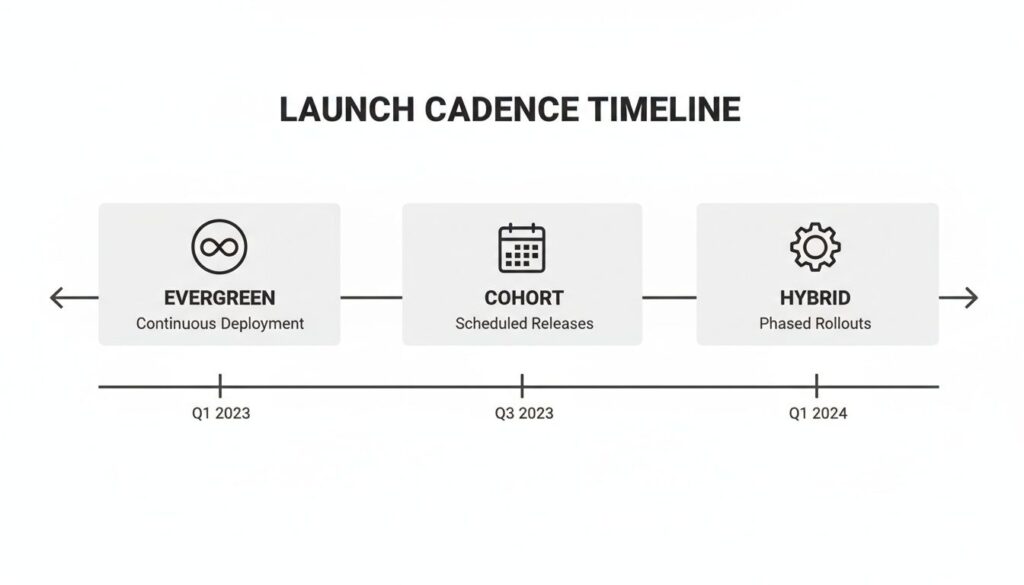
As you can see, an evergreen funnel can run continuously in the background while you strategically place your bigger, cohort-style launches throughout the year.
Connecting Your Calendar to Revenue Goals
Your launch calendar can’t just be a list of dates. It needs to be directly wired to your financial targets. A structured approach is what separates hopeful creators from successful ones.
The data backs this up. Companies that use structured, recurring launch calendars see 21% median growth rates, a huge step up from pure subscription models alone. And in the massive $400 billion e-learning market, creators who lock in non-negotiable events, like a course refresh every Q1, see 30% higher learner engagement.
Here’s how to connect your calendar to your goals for the quarter:
- Set a Revenue Target: First, get specific. How much revenue do you want to generate in the next 90 days?
- Break It Down: Next, translate that dollar amount into sales. How many units of your main product does that require? How many workshop spots?
- Map Promotions to Numbers: Finally, assign a revenue goal to each promotional activity on your calendar. For instance, your big quarterly launch might be responsible for 70% of the goal, while a smaller bonus offer handles the other 30%.
This simple exercise transforms your calendar from a passive schedule into an active, revenue-generating plan. You’ll know exactly what each launch needs to achieve, giving you incredible clarity and focus for the quarter ahead.
Your Promotional Playbook: Before, During, and After a Launch
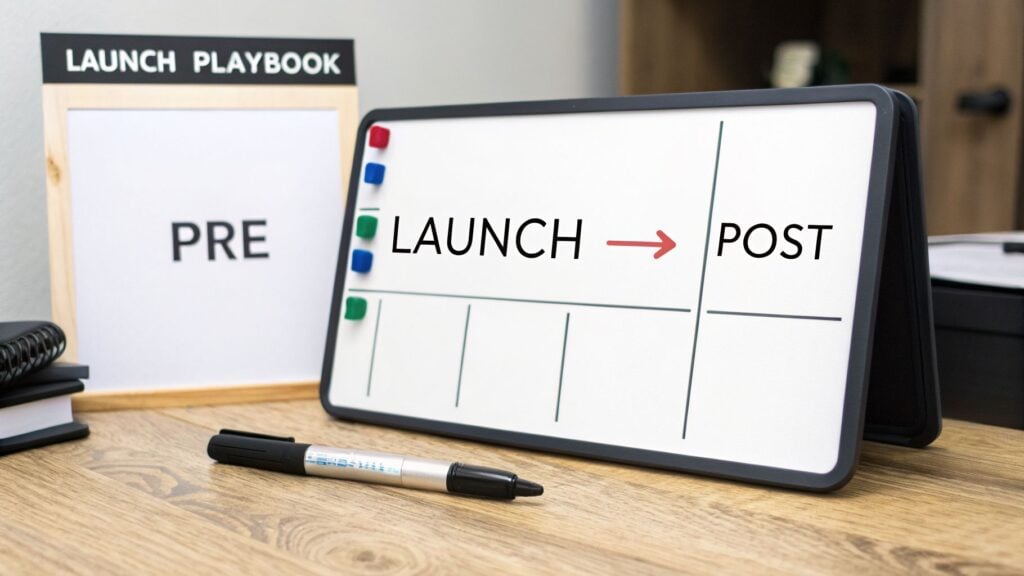
Putting a date on the calendar is a good start, but let’s be real, it’s the promotional energy you build around that date that actually drives sales. You need a repeatable playbook you can run for every single launch, whether it’s a massive event or a smaller, more intimate opening.
Thinking about your promotion in three distinct phases makes the whole process feel much less chaotic. You’ve got the Pre-Launch, the Launch itself, and the Post-Launch. Each one has a specific job to do, and nailing all three is how you create momentum that feels exciting and natural, not desperate or pushy.
Let’s break down exactly what you should be doing in each phase to make your next launch your best one yet.
The Pre-Launch Phase: Building Buzz
The pre-launch phase is all about warming up your audience. This is where you strategically shift from your regular content to creating things designed to build anticipation and prime people for your offer. The goal here is to get your product on their radar long before you ever ask for a credit card.
I usually kick off my pre-launch activities about two to three weeks before the cart officially opens. This gives me enough runway to build genuine excitement without my audience getting tired of hearing from me.
During this period, your content should be laser-focused on solving problems directly related to what your product offers. You’re demonstrating your expertise and showing people you genuinely understand their struggles.
This phase is about earning the right to make an offer by delivering immense value upfront. When you do this well, the sale feels like the next logical step for your audience.
Here’s a simple checklist of activities that work really well in the pre-launch phase:
- Behind-the-Scenes Content: Share sneak peeks of what you’re working on. This makes your audience feel like insiders and builds a much stronger personal connection.
- Valuable Webinars or Workshops: Host a free training session that solves a key pain point for your ideal customer. At the end, you can naturally introduce your paid product as the next step.
- Email Teaser Sequence: Send out a series of emails hinting at what’s coming. Share stories, case studies, or early-bird waitlist announcements to build your “hot” lead list.
- Social Media Countdown: Use stories and posts to count down to launch day. It’s a simple but surprisingly effective way to create a sense of urgency.
The Launch Phase: Opening The Doors
The launch phase is go-time. The cart is officially open. This window can last anywhere from a few days to a full week. Now, your focus shifts from warming people up to clearly communicating the value of your offer and handling any last-minute objections.
This is where all that pre-launch work pays off. Instead of trying to sell to a cold audience, you’re talking to people who are already interested, engaged, and maybe even a little excited.
Your messaging needs to be direct, benefit-driven, and packed with proof. Show potential customers exactly how your product will change their situation for the better. If you need some ideas, we have a helpful guide on how to market online courses that dives into a few different strategies.
Here’s what to zero in on during your open cart window:
- Clear Calls-to-Action (CTAs): Every single email, social media post, and piece of content should have an obvious, direct link to your sales page. Don’t make people hunt for the “buy now” button.
- Social Proof: This is huge. Share testimonials, case studies, and screenshots of positive feedback from past customers. Showing that other real people have gotten results is one of the most powerful sales tools you have.
- Objection Handling: Proactively address common questions and concerns in an FAQ email or a live Q&A session. This builds trust and removes the final barriers that might be stopping someone from buying.
The Post-Launch Phase: Nurturing And Analyzing
Finally, the post-launch phase kicks in the moment your cart closes. So many creators skip this step, but it’s absolutely critical for long-term success, especially if you’re launching recurring products.
Your work isn’t done once the sales are in. Now it’s time to deliver an amazing onboarding experience for your new customers and, just as importantly, analyze your launch results to make the next one even better.
This is also the perfect time to reconnect with the people on your list who didn’t buy. A simple survey asking why they chose not to join can provide insights that are pure gold for refining your offer and messaging for the next round.
Your simple post-launch checklist should include:
- Welcoming New Members: Send a dedicated onboarding email sequence that helps new customers get started and feel confident in their purchase.
- Gathering Feedback: Survey both new buyers and non-buyers to understand what worked and what didn’t.
- Analyzing Key Metrics: Dive into your numbers. Look at your sales page conversion rate, email open and click-through rates, and overall revenue. Use this data to set clear benchmarks for your next launch.
Automating Your Launch Calendar With The Right Tech
Trying to manage every single piece of your launch calendar by hand is a surefire way to burn out. I know, because I’ve been there. The real goal is to build a system that works for you, freeing you up to focus on creating amazing products.
Let’s walk through the essential (and affordable) tools I use to put my launch calendar on autopilot. This is about putting together a lean, effective tech stack that saves you a ton of time while still delivering a polished, professional experience.

Your Launch Calendar’s Command Center
First things first, you need a central place to map out your entire calendar. This is your command center, the one spot where you can see everything from your big quarterly promotions all the way down to the individual social media posts scheduled for next Tuesday.
For this, project management tools are your absolute best friend. I’ve used both Asana and Trello for this exact purpose, and honestly, they’re both fantastic options.
- Asana: If you’re someone who loves structure and detailed timelines, Asana is a dream. You can build out templates for each launch type, assign tasks to your team (even if that’s just you), and set dependencies so everything happens in the right order.
- Trello: If you’re more of a visual planner, you’ll love Trello’s card-based system. It’s perfect for creating boards for each launch and literally dragging-and-dropping tasks through different stages like “To-Do,” “In Progress,” and “Done.”
Whichever you choose, the key is to get everything out of your head and into a system you can rely on. This step alone brings an incredible amount of clarity to your launch calendar for recurring product creators.
The Engine for Your Promotions
Next up, we need to talk about your email marketing platform. This is the engine that will drive most of your promotional sequences, from warming up your audience before the launch to welcoming new customers after they buy.
I’ve had a lot of success with platforms like ConvertKit and Mailchimp. They’re built for creators and make it ridiculously easy to schedule entire email sequences well in advance. You can sit down, write your whole pre-launch campaign, set the send dates, and then trust that it will go out exactly as planned.
This is where the real automation magic kicks in. When your email sequences are scheduled and ready to go, you free up a massive amount of mental energy during launch week to actually engage with your audience and handle real-time questions.
The ability to tag subscribers based on their actions is a total game-changer, too. For example, you can automatically tag anyone who clicks a link about your upcoming product and then send them more targeted follow-up emails.
Connecting All The Pieces
The final piece of the puzzle is making sure all your tools talk to each other. You want a seamless flow of information between your systems, and that’s where “connector” tools like Zapier are indispensable.
Zapier basically acts as a bridge between different apps. You can create simple “if this, then that” automations without writing a single line of code.
For instance, you could set up a “Zap” that does this:
- When someone registers for your pre-launch webinar on your website…
- Zapier automatically adds them to your email list in ConvertKit…
- …And tags them as “interested in X launch,” which then kicks off your warm-up email sequence.
This kind of automation creates a smooth, professional experience for your audience and saves you from hours of mind-numbing manual data entry. For more ideas on what tools to include, check out our guide on building a tech stack for a membership site.
Modern launch strategies are increasingly data-driven for a reason. Studies show that data-driven launch calendars using smaller, relevant “micro-occasions” outperform strategies focused only on major holidays by 28%. Looking ahead, it’s predicted that 70% of successful launches will be anchored to clear dates, using automations to boost productivity by 35%. This leads to an impressive 80% on-time delivery rate and helps creators see revenue bumps of around 25%. You can learn more about these data-driven marketing trends and their impact.
Your Top Launch Calendar Questions, Answered
Even with the best templates, I know from experience that building a launch calendar for the first time brings up a lot of questions. Over the years, I’ve heard just about all of them from fellow creators trying to find their rhythm.
So, I’ve put together answers to the most common ones I get. My hope is that this gives you the clarity to build a launch rhythm that actually works for you and your business.
How Far In Advance Should I Plan My Launch Calendar?
This is probably the number one question I get, and my answer is always the same: you need a two-part approach. Trying to map out every single detail for the next 365 days is just a recipe for a plan you’ll never stick to. It’s overwhelming.
First, sketch out a high-level annual calendar. Think of this as your 30,000-foot view for the year. The only things that go on this calendar are your “big rocks.”
- Your Major Promotions: Pencil in one big launch or promo per quarter. That’s it.
- Key Holidays: Block out dates like Black Friday or other holidays when your audience is either slammed or completely checked out.
- Personal Time Off: Add your vacations first. Seriously. You build the business around your life, not the other way around.
This gives your year a clear, manageable direction.
Next, you get granular, but only for the upcoming quarter. This is your 90-day action plan. Here’s where you map out the specific dates for everything, from your pre-launch content and webinars to the exact days your cart will be open. This hybrid approach gives you long-term vision without the short-term overwhelm.
What Are The Most Important Launch Metrics To Track?
It’s so easy to get lost in a sea of data. Vanity metrics can make you feel good, but they don’t pay the bills. When it comes to your launch calendar, you only need to focus on a few key numbers that tell you what’s actually working.
Measure what matters. Focusing on a handful of core metrics will give you 90% of the insights you need to improve your next launch, without the data-analysis headache.
Here are the essentials to track for each phase:
- Pre-Launch: Your main goal here is building buzz and your audience. The two numbers to watch are your email list growth rate and the open/click-through rates on your warm-up content. Are people signing up, and are they actually interested in what you have to say?
- During Launch: Once the cart is open, one metric rules them all: your sales page conversion rate. This tells you exactly what percentage of people who hit your sales page actually buy. You should also keep an eye on your cart abandonment rate to see if something in your checkout process is tripping people up.
- Post-Launch: After the doors close, you want to know if you delivered on your promise. Your refund rate is the clearest signal you’ve got. Over the long haul, track your customer lifetime value (LTV) to see if your product is creating happy, loyal customers who stick around.
These core numbers will tell you the real story of your launch’s success, no fluff required.
What Should I Do If A Launch Doesn’t Meet My Goals?
First, take a deep breath. A launch that misses its target happens to literally everyone, including me. A launch that doesn’t hit a revenue goal is not a personal failure. It’s just data.
And that data is incredibly valuable if you use it the right way.
The very first thing to do is dig into the metrics we just talked about. Don’t just stare at the final sales number. Was the problem a lack of traffic to your sales page? Or did you have plenty of visitors but a really low conversion rate? Each of those problems has a completely different solution.
Next, send out a simple, one-question survey to your email list, especially to the people who clicked around but didn’t buy. Ask them: “What was the main reason you decided not to join this time around?” The replies you get will be pure gold.
This is exactly why having a recurring launch calendar is so powerful. You don’t have to wait a year to try again. You can take the lessons you just learned, tweak your messaging or your offer, and go again next quarter with a much smarter strategy.