How to Deliver Internal Compliance Training That Engages and Protects

Let’s be honest. When you hear the words “compliance training,” does a jolt of excitement run through you? Probably not.
You’re more likely picturing a mind-numbing slideshow, a dense PDF, or a monotone video everyone clicks through just to snag that completion certificate. Sound familiar?
For years, this “check-the-box” mentality has been the default. The goal wasn’t real learning, it was just getting it done. But this old-school approach is more than just dull. It’s a genuine risk in today’s business world.
Why Your Compliance Training Is Probably Failing
The stakes are simply higher now. Companies are waking up to the fact that ineffective training is a massive financial and reputational liability.
There’s a reason the Global Corporate Compliance Training Market is projected to hit USD 9,617.33 million by 2033. The cost of getting it wrong is staggering. Studies show that non-compliance can cost a business an average of $14.82 million every single year. Suddenly, investing in training that actually works seems like a pretty smart move. You can dig into more of these compliance training trends and their market impact.
This is about reframing the conversation. We have to stop seeing training as a defensive chore and start treating it as a strategic investment.
The most successful companies I’ve worked with treat compliance as a cultural pillar. It’s about empowering employees to make the right decisions instinctively, every single day.
Shifting from Chore to Culture
The key is to flip the script. We need to transform a mandatory task into a powerful tool for building a stronger, healthier organization.
When you get it right, compliance training does more than just tick a box. It can:
- Boost employee confidence: When people truly understand the rules of the road, they feel more secure and empowered to do their jobs well.
- Improve morale: Let’s face it, people want to work for an ethical company. A culture of integrity, reinforced by good training, makes for a better workplace.
- Drive business success: A solid compliance foundation protects your brand, builds trust with customers, and prevents eye-watering fines and costly mistakes.
This guide is designed to help you make that shift. We’re going to ditch the boring slideshows and build a program that actually sticks, covering everything from getting stakeholder buy-in to designing content that people genuinely find useful.
Building Your Foundation for Effective Training
Before we even start dreaming up cool videos or interactive quizzes, we have to lay the groundwork. A solid foundation is what separates compliance training that gets ignored from a program that actually changes behavior and protects your company.
Honestly, this prep work is the most important part of the entire process. It’s where you align everyone on the why, figure out what people actually need to learn, and create a clear roadmap for everything that follows.
Getting the Right People in the Room
Your first move? Figure out who needs to be in the room. You can’t build a successful program in a silo. You need buy-in from the people who have a vested interest in a strong compliance culture, and you need it early.
Getting their input from day one ensures your training is relevant, supported from the top down, and addresses real-world needs instead of just theoretical problems. It’s been shown that 48% of executives see employee training as the second most critical factor for a strong compliance culture, just behind leadership sponsorship. That connection, detailed in PwC’s comprehensive Global Compliance Survey, tells you everything you need to know about aligning your plan with business priorities from the start.
Key Stakeholders in Compliance Training
To make this easier, here’s a quick reference guide to identify who you need on your side and what their role is in the process.
| Stakeholder Role | Key Responsibilities | Why Their Buy-In Matters |
|---|---|---|
| Legal & Compliance | Provide subject matter expertise on regulations and internal policies. | They ensure the content is accurate, legally sound, and covers all necessary bases. |
| Human Resources | Manage employee data, track completions, and handle logistics. | HR is your operational partner for rolling out, tracking, and integrating training. |
| Department Heads | Offer insights into daily operational risks and reinforce learning. | They know what really happens on the ground and are crucial for making it stick. |
| Senior Leadership | Provide executive sponsorship and champion the program’s importance. | Their support signals to the whole company that this is a priority, not just a task. |
Having this core team assembled prevents blind spots and ensures the final program has the support it needs to succeed.
This process flow shows exactly why this is so critical. Outdated or misaligned training isn’t just ineffective. It directly contributes to compliance failures and creates tangible risks for your organization.
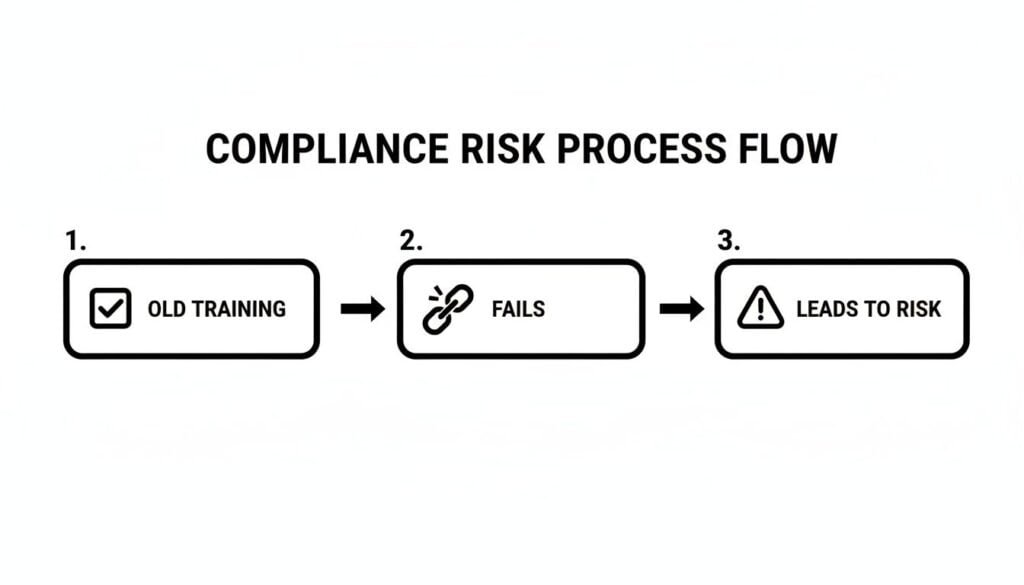
The visualization makes it painfully clear. A “check-the-box” approach is a direct pathway to vulnerability.
Pinpointing Your Real Risks and Gaps
Once you have your team assembled, it’s time for a needs analysis. This is where you dig in to find your organization’s specific compliance risks and current knowledge gaps. A one-size-fits-all approach is a recipe for disengagement and, frankly, a waste of everyone’s time.
You need to ask the right questions:
- Which roles face the highest compliance risks? (Think of the finance team with anti-money laundering or sales with anti-bribery).
- Where have we had compliance issues or near-misses in the past?
- What new regulations are on the horizon that we need to prepare for?
A thorough needs analysis ensures your training is laser-focused on what matters most. To get started, check out our guide on how to conduct a training needs assessment with a helpful template.
The goal is to create training that solves a real problem. When employees see the direct connection between the content and the challenges they face in their jobs, they are far more likely to pay attention.
Setting Clear and Measurable Objectives
With your risks identified, you can now set clear learning objectives. This is a simple but powerful step that many people skip. Instead of just listing topics, define what you want employees to be able to do after the training.
For example, an objective like “Understand the data privacy policy” is vague. A better, action-oriented version would be: “After this module, the employee will be able to correctly identify and report a potential data breach according to company procedure.”
This small shift focuses on behavior, which is the ultimate goal of any compliance program. By building this solid foundation, you create a clear roadmap for everything that follows, from content design to technology selection.
Designing Content People Actually Want to Take
Okay, this is where the fun really begins. We’ve laid the strategic foundation, and now it’s time to design compliance training that doesn’t make your employees’ eyes glaze over.
Forget the dense PDFs and monotone videos that feel more like a punishment than a learning opportunity. We’re going to build something that actually sticks.
The goal is to shift from passive information consumption to active learning. We want employees engaged, thinking critically, and figuring out how to apply these rules to their actual jobs. This is how we make training more effective.

This shift is a big deal, and it’s directly tied to how mature a company’s compliance program is. In fact, a recent study showed that 57% of risk and compliance professionals now rate their programs as mature. That’s a 7% jump from the previous year. This progress often comes from moving beyond simple policy sign-offs to more dynamic, engaging training methods.
Matching the Method to the Message
One of the biggest mistakes I see is a one-size-fits-all approach to delivery. You wouldn’t use a hammer to turn a screw, so why force a 60-minute e-learning course on your team for a simple policy update? Choosing the right format is everything.
A blended learning strategy is almost always the most successful path. This just means you mix and match different formats to keep things fresh and align the delivery method with the learning objective.
With so many options, picking the right one can feel overwhelming. This table breaks down the most common formats to help you decide what works best for different compliance topics.
Choosing the Right Training Delivery Method
| Method | Best For | Pros | Cons |
|---|---|---|---|
| Microlearning | Quick updates, single-topic refreshers, performance support | High completion rates, mobile-friendly, easy to update | Not suitable for complex, nuanced topics |
| Interactive E-Learning | Foundational topics like data privacy, anti-bribery policies | Self-paced, scalable, tracks completion automatically | Can be expensive to create, lacks real-time Q&A |
| Instructor-Led Training (ILT) | High-stakes topics like anti-harassment, manager training | Deep engagement, allows for Q&A and discussion, builds culture | Hard to scale, scheduling can be difficult, inconsistent delivery |
| Blended Learning | Comprehensive programs (e.g., new hire onboarding) | Combines the best of all methods, reinforces learning | Requires careful planning and coordination |
Ultimately, the goal is to use each format for its strengths. An annual anti-harassment policy might require a live ILT session, but you can reinforce key concepts throughout the year with short microlearning modules for your staff. This layered approach creates a much more effective learning journey.
Turning Dry Policies into Relatable Scenarios
Let’s be real. Nobody gets excited to read a 20-page policy document. But people do get engaged by stories and real-world problems. The best way to make dry compliance content relatable is to wrap it in a scenario-based story.
Instead of just stating the rule, create a short narrative where a character faces a situation that requires them to apply that rule.
The most powerful training puts people in a situation where they have to make a choice, rather than just telling them the rules. This active decision-making is what makes the learning stick.
For example, don’t just list what constitutes a conflict of interest. Create a short, interactive scenario:
“Sarah, a project manager, just found out her cousin’s company is bidding on a contract for her department. What should she do?”
- Say nothing to avoid family drama.
- Immediately disclose the relationship to her manager and legal.
- Give her cousin a few “helpful hints” about the bidding process.
This simple format forces the employee to think through the policy and its practical application. It’s a small change that makes a huge difference in both engagement and retention. For highly specialized fields, you can even explore advanced options like medical training simulations in XR to create deeply immersive learning experiences.
Making It Stick with Gamification
Another powerful tool in your kit is gamification. This doesn’t mean you need to build a complex video game. It’s about applying game-like elements to the training experience to motivate learners.
Simple gamification tactics can include:
- Points and Badges: Award points for completing modules or badges for mastering a topic.
- Progress Bars: Visually showing employees how far they’ve come can be a surprisingly powerful motivator.
- Leaderboards: For the right company culture, a bit of friendly competition can drive completion rates sky-high. Just be sure this fits your environment before you roll it out.
By combining the right delivery methods, using relatable scenarios, and adding a dash of gamification, you can design internal compliance training that people actually find valuable, not just mandatory.
Choosing Your Tech and Launching the Program
You’ve got some brilliant, engaging content mapped out. Fantastic. But now comes the real test. How do you actually get it into the hands of your employees without creating a logistical nightmare? This is where your tech stack and a smart launch plan become your two best friends.
Even the best content will fall flat if the delivery is clunky. Let’s get into the nitty-gritty of the technology and rollout strategy that will make or break your compliance training.

Selecting the Right Learning Management System
Your Learning Management System (LMS) is the absolute backbone of your compliance program. Think of it as more than just a library for courses. For compliance, it needs to be an airtight system of record that will hold up under the intense scrutiny of an audit.
When I’m vetting an LMS for a compliance-heavy organization, there are a few non-negotiables. It must have rock-solid tracking and reporting that can prove who took what training and when. This goes way beyond simple completion rates. You’re creating a bulletproof, verifiable audit trail.
You’ll also want features that make your life infinitely easier, like:
- Automated Assignments: The system should be smart enough to automatically enroll new hires in foundational training or assign annual refreshers based on their job role or department.
- Recertification Management: Look for tools that track certification expiry dates and fire off automated reminder notifications. This feature alone can save you dozens of hours of manual chasing.
- Version Control: Regulations and policies are always changing. Your LMS has to be able to track which version of a policy an employee was trained on, complete with a timestamped acknowledgment.
An LMS built for compliance is your central command for automating, tracking, and proving that your organization is meeting its regulatory obligations. It turns a manual, error-prone process into a streamlined system.
Finding Easy-to-Use Authoring Tools
Good news. You no longer need a degree in graphic design to create beautiful, interactive content. Modern authoring tools are designed for learning professionals, not specialized developers, allowing you to build those engaging scenarios, quizzes, and interactive modules we talked about earlier.
Look for tools with a user-friendly interface and a good selection of templates to get you started. Many of these tools publish content in a format called SCORM, which is simply a standard that allows your content to “talk” to your LMS. It sends back crucial data like scores and completion status.
Your Launch Communication Plan
You can’t just flip a switch on the LMS and expect everyone to flood in. A successful launch needs a communication plan that builds awareness and actually drives people to participate. Think of it as your internal marketing campaign.
Your plan should be a sequence of well-timed communications.
- The Leadership Endorsement (1-2 weeks out): Kick things off with an announcement from a senior leader. This email should clearly articulate the “why” behind the new training, framing it as a way to protect both the company and every individual employee.
- Launch Day Announcement (Day 0): This is your official go-live email. Keep it short, sharp, and actionable. Include a direct link to the LMS, dead-simple login instructions, and a clear completion deadline.
- The Gentle Nudge (Mid-way and a few days before the deadline): Set up automated reminders that only go to those who haven’t completed the training. Acknowledge that everyone is busy, but gently nudge them toward the finish line.
The key is to be clear, concise, and consistent. Always frame the training as a valuable resource that helps people do their jobs better and safer, not just another task on their to-do list.
Don’t Skip the Pilot Program
Before you unleash the training on the entire organization, please, run a pilot program. Get a small, representative group of employees to go through the whole experience first. This is your golden opportunity to catch any technical glitches, confusing instructions, or awkward phrasing before they blow up.
I always pilot my programs with a mix of people. Some from marketing, some from engineering, some who are tech-savvy, and some who aren’t. Their feedback is invaluable. They’ll be the ones to tell you that a quiz question is poorly worded, a video won’t load on Chrome, or the login instructions are confusing.
Fixing these small issues after a pilot test with 15 people is easy. Fixing them after you’ve launched to 5,000 employees is a full-blown crisis. Taking this one extra step ensures a smooth, professional rollout and shows your employees you respect their time.
How to Measure Success and Maintain Momentum
Getting your compliance training launched is a huge milestone, but let’s be real. The job isn’t over. In fact, this is where the real work begins. An effective program is a living thing, a continuous cycle of measuring what works, refining what doesn’t, and reinforcing what your employees have learned.
Now it’s time to look past simple completion rates and figure out if the training actually made a difference.

Beyond Completion Rates: What to Really Measure
I’m just going to say it. Completion rates are a vanity metric. Knowing that 95% of employees clicked through a course tells you nothing about whether they understood it, retained it, or can apply it when a tricky situation pops up.
To get a true sense of success, we need to track smarter metrics. These are the data points that will not only show you the training’s impact but also help you prove its value to leadership. Once your training is live, your focus has to shift to how you measure and boost compliance program effectiveness for the long haul.
Here are the metrics I obsess over after a launch:
- Assessment Scores: I look for trends in quiz or scenario scores. Are people consistently getting tripped up on a specific question about data handling? That’s a crystal-clear signal that you need to clarify that part of the training.
- Behavioral Changes: This is the ultimate goal. Start tracking things like the number of helpline calls about potential conflicts of interest or the accuracy of incident reporting. A positive change here is powerful, undeniable evidence that the training is working.
- Time-to-Competency: How quickly are new hires completing their mandatory compliance onboarding and getting the concepts right? An efficient program should help them get up to speed much faster than the old way of doing things.
These metrics paint a much richer, more honest picture of how your training is landing. For a deeper dive into this topic, we’ve put together a detailed guide on how to measure training effectiveness.
The goal is to gather intelligence that helps you make the program smarter, more targeted, and more effective year after year, not just to check a box for an audit.
Building Your Reporting Dashboard
All this data is completely useless if it’s buried in some spreadsheet nobody ever looks at. I always recommend setting up a simple reporting dashboard in your LMS that gives you an at-a-glance view of your program’s health.
Your dashboard should deliver quick insights without forcing you to run a complex report. I like to build out separate views for different stakeholders. For instance, a department head might only need to see the completion status for their own team, while the Chief Compliance Officer will want a high-level, company-wide view of risk areas.
The Cycle of Recertification and Reinforcement
Compliance isn’t a “one-and-done” activity. Regulations change, internal policies get updated, and honestly, people just forget things over time. A sustainable program absolutely needs a solid strategy for ongoing reinforcement.
This is where planning your recertification schedule comes in. For high-risk topics like anti-harassment or data privacy, an annual refresher is usually the standard. Your LMS should be able to automate this whole process, from sending reminders to tracking completions, so you’re not manually chasing hundreds of people down.
But don’t just lean on the big annual training event. That’s not enough.
Keeping Compliance Top-of-Mind
The best programs I’ve ever seen use small, consistent touchpoints throughout the year to keep key policies fresh in people’s minds. I call these “micro-campaigns.”
These aren’t full-blown courses. They’re quick, lightweight reminders that reinforce what people have already learned, keeping the concepts active.
Here are a few ideas I’ve seen work incredibly well:
- Scenario of the Month: Send out a quick, one-question scenario via email or your company’s chat tool. Something like, “You receive a suspicious email asking for login details. What do you do?” with a few multiple-choice options.
- Policy Spotlights: Create a short, 90-second video or a sharp infographic that highlights a single aspect of a key policy, like the gift acceptance rules right before the holidays.
- Manager Huddle Guides: Equip your managers with a simple one-page guide to discuss a specific compliance topic in their weekly team meetings. This gets them involved and makes the message stick.
This approach keeps the conversation going. It transforms compliance from an annual, often-dreaded event into an ongoing, integrated part of your company culture. This is exactly where you want it to be. This continuous effort is what truly reduces risk and builds a more resilient organization.
Common Questions About Compliance Training
After you’ve planned, designed, and finally launched a program, the questions start rolling in. And they’re usually great questions. Running an internal compliance training program means you’re going to have to navigate some tricky situations, so it’s smart to think through them ahead of time.
I’ve pulled together some of the most common ones I hear from training managers and compliance officers, along with some straightforward, no-nonsense answers.
How Can I Make Mandatory Training Feel Less Like a Punishment?
This is the classic challenge, isn’t it? The secret is to reframe it. You have to shift the perspective from a chore that needs to be checked off to a tool that empowers employees.
Always, always lead with the “why” behind the rules. Use relatable stories and real-world scenarios instead of just reciting company policy. Show them what can go wrong, but also frame compliance as something that protects the company, their colleagues, and even their own careers. The goal is to build a safe, ethical workplace, not just dodge fines.
A few other tactics I’ve seen work wonders:
- Add a touch of gamification. Simple things, like earning points or digital badges for finishing a module, can inject a little fun and a sense of accomplishment. It turns a passive task into an active achievement.
- Keep it relevant. Nothing kills motivation faster than sitting through training that has zero to do with your daily job. Tailor content to specific roles so every minute feels like time well spent.
- Respect their time. Keep it short, sharp, and focused. If a module can be five minutes, don’t you dare stretch it to fifteen.
When employees see that you’ve actually put thought into making the training relevant and efficient, they’re far more likely to engage. It’s a sign of respect. You value their time as much as their compliance.
What Is the Best Way to Train a Remote or Global Workforce?
Training a distributed team brings its own set of hurdles, but it’s completely manageable if you have the right setup. In this scenario, your Learning Management System (LMS) is your absolute best friend.
A solid e-learning program is built for this. It allows for self-paced learning, which is a lifesaver when you’re dealing with different time zones and flexible work schedules. People can take the training when it works for them, which immediately removes a major point of friction.
When you’re building out training for a global team, keep these points top of mind:
- Localize your content. This means more than just translating the text. You need to make sure your scenarios and examples are culturally neutral or, even better, adapted for different regions.
- Offer multilingual support. If you have a large group of employees who speak another language, providing training in their native tongue is a non-negotiable for true comprehension.
- Use virtual instructor-led sessions strategically. For complex topics that really need a live discussion, virtual sessions are perfect. They let people from all over the world connect, ask questions in real-time, and build a shared understanding.
How Often Should We Repeat Compliance Training?
This is a great question, and the honest answer is: it depends. There’s no magic number that fits every single topic. Your schedule really needs to be based on the specific regulation, the level of risk involved, and your own internal policies.
As a general rule of thumb, many critical topics require annual recertification. Think about the high-stakes stuff. Data privacy, anti-harassment, and workplace violence prevention are all areas where you absolutely need to refresh knowledge every single year.
For other policies, you might do a full-blown course every two years, but sprinkle in short microlearning refreshers in between. The most important thing is to have a documented schedule and a system, preferably your LMS, that automatically handles the assignments and reminders for you.
What Are the Biggest Mistakes to Avoid?
I’ve seen a few common pitfalls that can completely undermine even the most well-intentioned programs.
The single biggest mistake is creating a one-size-fits-all program. The risks faced by the sales team are wildly different from those in engineering or finance. Your training has to reflect that reality.
Another huge error is drowning people in legal jargon. Your job is to translate complex policies into plain, simple language that everyone can understand and actually apply to their work.
Finally, don’t forget about your middle managers. These are the people on the front lines. They are absolutely critical for reinforcing the training every single day. Make sure they’re not only trained themselves but are also equipped with the resources they need to answer their team’s questions and champion a culture of compliance.