A Clear Asynchronous Learning Definition for Course Creators
Let’s jump right in and clear up any confusion. The simplest asynchronous learning definition is a method where students access materials and complete coursework on their own schedule. There are no live classes or mandatory login times. This makes it the “Netflix” of education, where learners can press play whenever and wherever they want.
What Exactly Is Asynchronous Learning?
When I first heard the term, it sounded a bit technical, but the core idea is simple and really powerful.
Think of it like the difference between watching a live TV show versus streaming your favorite series. One happens at a fixed time, and if you miss it, you’ve missed it. The other is ready and waiting for you whenever you have a free moment. That’s the real essence of asynchronous learning.
The On-Demand Education Model
Asynchronous learning gives students the course materials, like pre-recorded video lectures, readings, and assignments, and lets them decide when to engage.
Deadlines still exist, of course. But how and when they get the work done within that window is entirely up to them.
This approach puts the student in the driver’s seat. It respects that people have jobs, families, and live in different time zones.
This self-paced education model has become a cornerstone of modern online education. It offers unmatched flexibility for busy professionals and learners worldwide by allowing them to access pre-recorded lectures and modules without real-time instructor involvement. Discover more insights about online education trends.
The polar opposite is synchronous learning, where everyone has to be online at the same time for a live lecture or discussion. This real-time model is more like a traditional classroom, just moved online. To better understand the differences, you can explore our detailed comparison of instructor-led training vs self-paced learning.
Asynchronous vs Synchronous Learning at a Glance
To make this crystal clear, here’s a quick breakdown of the key differences. Understanding these distinctions is the first step in deciding which model is the right fit for your online course.
| Feature | Asynchronous Learning (On-Demand) | Synchronous Learning (Real-Time) |
|---|---|---|
| Schedule | Flexible, learners set their own pace within deadlines | Fixed, scheduled class times and live sessions |
| Interaction | Delayed, through forums, email, or comments | Immediate, with live Q&A and group discussions |
| Best For | Independent learners with busy or varied schedules | Students who thrive on structure and direct interaction |
| Content Delivery | Pre-recorded videos, downloadable resources, quizzes | Live webinars, virtual classrooms, breakout rooms |
Ultimately, the choice comes down to what kind of experience you want to create and who you’re trying to serve.
So, what’s all the buzz about asynchronous learning? Why are so many creators and students gravitating toward this model?
It boils down to a handful of powerful, real-world benefits that create a win-win for everyone involved.
The single biggest advantage for your students is flexibility. This is a huge deal. It’s the very thing that makes learning possible for a massive group of people who would otherwise be left out. It hands them back control over their own education.
Freedom for the Modern Learner
Think about a working parent trying to level up their career. They can’t just hit pause on life for a live workshop at 2 PM on a Tuesday.
With an asynchronous course, though, they can jump into a lesson after the kids are in bed or squeeze in a video during their lunch break. This is the kind of freedom that turns ambitious goals into actual achievements.
I’ve seen countless stories of people finally earning a certification or mastering a new skill simply because the on-demand format fit into the beautiful mess of their real lives. This isn’t a niche need, either. A recent report from the National Center for Education Statistics found that in the fall of 2021, a staggering 61% of all undergraduate students were taking at least one online course. The demand for this flexibility is now mainstream.
For your students, the benefits are tangible:
- Learn at Your Own Pace: They can rewind a confusing part of a video lecture as many times as they need. They can spend an entire evening on one tough concept without feeling like they’re holding up the class.
- Fit Learning into Life: Juggling work, family, and other commitments becomes manageable. This dramatically cuts down on stress and boosts the odds they’ll actually finish the course.
- Deeper Reflection: Having time to mull over an idea before jumping into a discussion forum often leads to more thoughtful and insightful contributions than a spontaneous, on-the-spot answer.
A Sustainable Model for Creators
Now, let’s flip the coin and talk about you. The perks of an asynchronous model are just as transformative for creators, especially if you’re trying to build a business that lasts.
The magic word here is scalability.
You pour your heart and soul into creating the course once. You craft high-quality videos, design practical workbooks, and set up engaging activities. Once that asset is built, it can serve ten students, a hundred students, or ten thousand students without you needing to show up and teach the same live class over and over again.
This fundamentally breaks the link between your time and your income. You stop trading hours for dollars, which is the crucial shift you need to make to truly grow your business and your impact.
The real power of an asynchronous model is creating a system that works for you, even when you’re not working. It allows you to reach a global audience and generate revenue around the clock, creating true freedom in your business.
This model lets you step off the hamster wheel of constantly scheduling, launching, and delivering live sessions. Instead, you can channel that energy into marketing your evergreen course, developing new products, or just engaging with your community in a more relaxed, meaningful way.
You get to design a workflow that works for you, not against you. The benefits are crystal clear:
- Serve More People: You can help a much larger audience without hitting a wall of burnout.
- Create Passive Income: Your course becomes a digital asset that earns money long after the creative work is done.
- Focus on Impact: With the day-to-day logistics automated, you can spend your time making your content even better and building real connections with your students.
Ultimately, asynchronous learning creates more freedom and opportunity on both sides of the screen. It gives learners the power to own their educational journey and gives you the framework to build a more scalable and impactful business.
The Core Components of a Great Asynchronous Course

Building a powerful asynchronous course is all about intentional design. You can’t just dump a few videos into a folder and call it a day. For your course to actually make an impact, it needs a thoughtful structure built from a few key ingredients.
I’m going to walk you through the essential pieces that make a self-paced course engaging, effective, and absolutely worth a student’s time and money.
It all starts with making your content incredibly easy to consume.
Embrace the Power of Microlearning
Let’s be real, nobody wants to sit through a 90-minute video lecture anymore. Our attention spans just aren’t built for that.
This is where the magic of microlearning comes in. It’s the simple practice of breaking down big, complex topics into short, focused, and easy-to-digest lessons.
Think of each lesson as a single, distinct building block. The goal is to teach one specific skill or concept in a video that’s maybe five to ten minutes long. This approach respects your students’ time and makes it so much easier for them to fit learning into a busy schedule. Plus, it gives them a satisfying sense of progress as they knock out each small lesson.
Make High-Quality Videos the Heart of Your Course
Pre-recorded videos are the absolute foundation of your asynchronous course. They’re your main channel for teaching, connecting with, and guiding your students. Because of this, their quality really, really matters.
This doesn’t mean you need a Hollywood-level production studio. Not at all. It just means your audio needs to be crystal clear, your lighting should be decent, and your on-camera presence should feel engaging.
Talk to the camera like you’re talking to a friend. Let your personality shine through and make your students feel like you’re right there with them. This personal connection is what turns a generic video into a truly compelling experience.
A great asynchronous course feels like a one-on-one conversation, even though it’s delivered on-demand. The key is to create content that feels personal, supportive, and directly relevant to the student’s goals.
This diagram breaks down how this model is a win-win for both the learner and the creator.
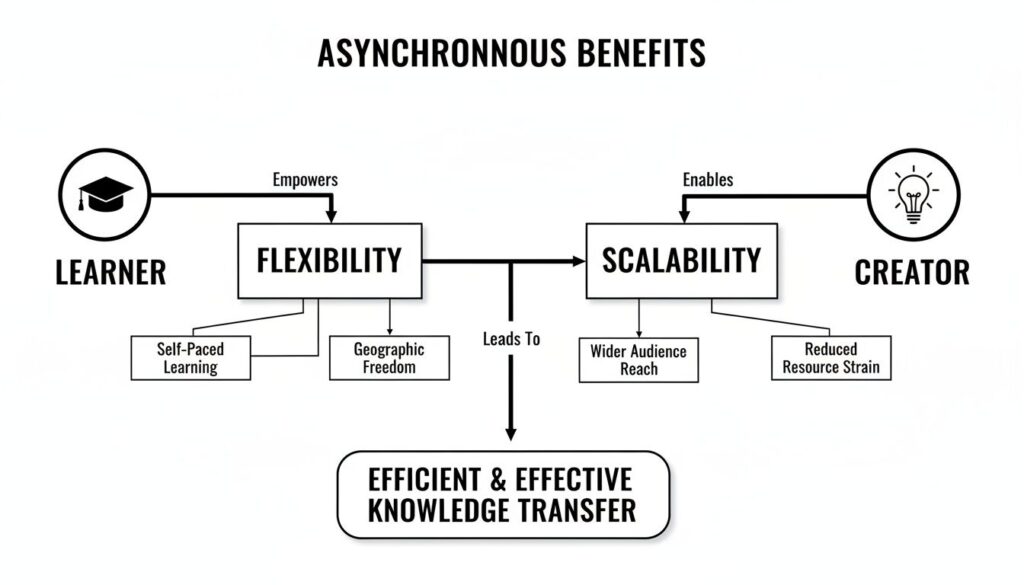
As you can see, this approach delivers incredible flexibility for students while giving creators a scalable way to share their expertise.
Provide Actionable Downloadable Resources
Videos are fantastic for teaching the “what” and the “why,” but downloadable resources are what help your students with the “how.” These are the practical tools they can take away and put to use immediately.
Giving students these resources is crucial for helping them apply what they’ve learned in the real world. Think about including things like:
- Checklists: Step-by-step guides for a specific process they can follow.
- Templates: Pre-built documents or spreadsheets that save them a ton of time.
- Workbooks: Guided exercises that help them reflect and put ideas into practice.
- Resource Guides: Curated lists of tools, articles, or books for digging deeper.
These materials add a ton of value to your course and reinforce the learning in a very tangible way.
Build a Community with Discussion Forums
One of the biggest risks with self-paced learning is that it can feel isolating. That’s why building a community is an essential component. It’s not just a nice bonus.
A dedicated discussion forum or community space gives students a place to connect, ask questions, and share their wins. It lets them learn from each other’s experiences, which often leads to insights they would have never gained on their own.
As the instructor, your job is to get the ball rolling. Post thought-provoking prompts, jump in to answer questions, and encourage students to support one another. This is how you transform your course from a solo journey into a shared, collaborative experience.
This shift toward flexible, community-driven education has exploded. The online learning industry was already growing, but recent world events turned it from a niche option into a mainstream necessity. Before 2020, the market was projected to grow at 9.1% annually, but the pandemic sparked an incredible 200% industry expansion in just five years. This shows how the core ideas of asynchronous learning have become absolutely essential, letting people learn without the constraints of time or place. You can explore more data on the online learning boom and see how it reshaped education.
Designing Activities That Keep Students Engaged
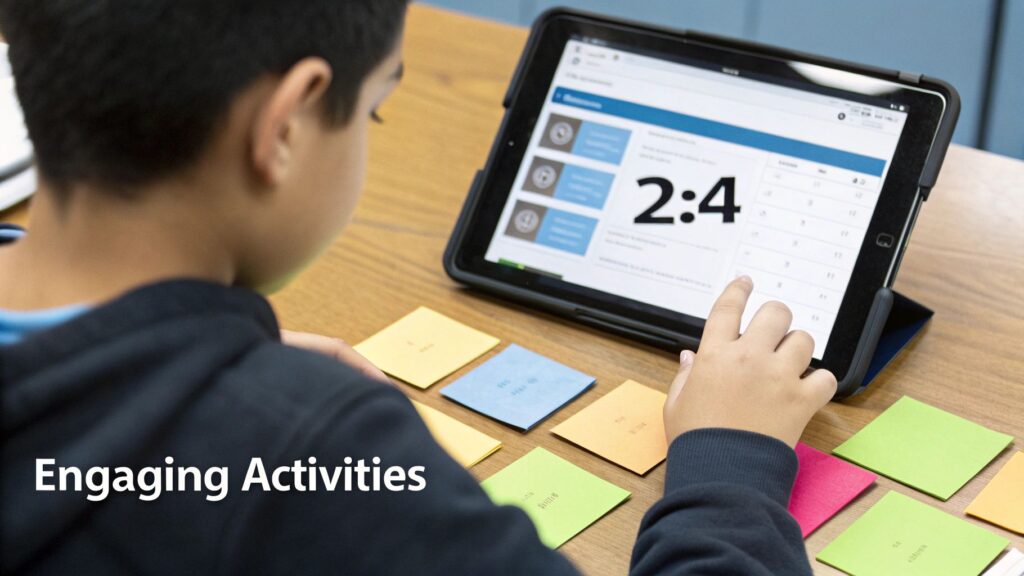
So, how do you make sure people are actually learning anything if you’re not there with them in real-time? This is the million-dollar question every asynchronous course creator asks.
The answer is about designing thoughtful, engaging activities that keep your students connected and moving forward. Great content is only part of it.
Passive learning, like just watching a series of videos, only gets a student so far. To make a real impact, you have to transform your course from a simple viewing experience into an active learning journey. This is where you deliberately build in chances for students to apply what they’ve learned, get feedback, and connect with each other.
Using Quizzes and Knowledge Checks for Instant Feedback
One of the simplest yet most powerful tools in your arsenal is the self-paced quiz or knowledge check. I like to sprinkle these in at the end of key modules or even after a single, important lesson.
These aren’t meant to be high-pressure exams. Think of them as instant feedback loops. A quick, low-stakes quiz helps a student realize, “Hey, I should probably re-watch that video,” reinforcing the concept on the spot. This immediate validation builds confidence and stops them from moving on with a shaky foundation.
This approach is the very definition of asynchronous learning in action. It empowers students to check their own progress at a pace that works for them. For more ideas on keeping learners hooked, check out our guide on proven student engagement strategies.
Creating Meaningful Project-Based Assignments
While quizzes are great for checking comprehension, project-based assignments are where the real magic happens. These are tasks that ask students to take the skills you’ve taught and apply them to a situation they might actually encounter in the real world.
Depending on your topic, this could look like a few different things:
- Marketing course: Ask students to create a social media content calendar for a fictional brand.
- Coding course: A project might involve building a small but functional web application.
- Design course: Learners could be tasked with creating a logo and brand guide for a new business.
The whole point of a project-based assignment is to bridge the gap between knowing something and doing something. It gives students a tangible result for their efforts and proves to them (and you) that they’ve truly mastered the material.
These assignments are a fantastic way to measure progress because they demonstrate applied skill, not just memorization. Providing personalized, thoughtful feedback on these projects is also one of the most valuable things you can do as an instructor.
Sparking Life in Your Discussion Forums
Your discussion forum is the community hub of your course, but it won’t run itself. You have to be intentional about sparking lively, meaningful conversations.
The key is to ask open-ended, thought-provoking questions that can’t be answered with a simple “yes” or “no.” Instead of asking, “Did you enjoy this week’s lesson?” try something that requires a bit more reflection.
Here are a few prompts that always get good results:
- “Share one surprising thing you learned this week and explain how you plan to apply it.”
- “What was the biggest challenge you faced on this module’s project? How did you overcome it?”
- “Post a link to an article or resource you found that relates to our topic, and tell us why you think it’s valuable.”
These kinds of questions encourage students to dig deeper, share their unique perspectives, and learn from one another’s experiences. Your active presence in the forums is what will truly bring the community to life. Make sure to reply to posts and ask follow-up questions.
This interactive approach is becoming non-negotiable as online learning solidifies its place in education. In fact, by 2025, an estimated 75% of US schools are expected to use online or hybrid models. This global trend is powering a market projected to be worth over $325 billion, underscoring just how critical these engagement strategies have become.
Choosing the Right Technology for Your Course

The tech you choose can either make your asynchronous course a dream to run or an absolute nightmare. The best tools feel invisible. They let your content and teaching shine without causing friction for your students. The wrong ones just create a frustrating mess for everyone.
My goal here is to help you build a simple, effective tech stack that supports your teaching, not one that gives you a constant technical headache.
We’ll look at the must-have features for your course platform and a few simple tools for creating professional-quality content. This is all about finding the right home for your course, a place where your students can truly thrive.
What to Look for in a Course Platform
Your course platform, often called a Learning Management System (LMS), is your digital classroom. It’s where your students will spend their time, so it needs to be more than just a place to host videos. It’s the engine that powers the whole learning experience.
Not all platforms are created equal, especially when you need to support the self-paced nature of asynchronous learning. As you start shopping around, here are the non-negotiable features you should be looking for:
- Content Dripping: This lets you release course modules on a set schedule, like one new module per week. It’s a lifesaver for preventing students from feeling overwhelmed by all the content at once and helps keep everyone moving at a similar pace.
- Progress Tracking: Students need to see how far they’ve come. Features like a completion percentage or a simple checklist give them a visual sense of accomplishment. This is incredibly motivating when they’re learning on their own.
- Integrated Quizzes and Assignments: The ability to build quizzes and assignment drop boxes directly into the platform is a huge time-saver. It keeps the learning experience seamless so students aren’t forced to jump between a bunch of different websites to get things done.
Picking the right platform is a big decision, and it’s worth taking your time. For a much deeper dive, you can check out this guide on how to choose an LMS that fits your specific needs.
Popular Platforms for Asynchronous Courses
While I can’t point to a single “best” platform for everyone, there are a few popular options that course creators love for their user-friendly design and powerful features.
One critical technical detail that often gets missed is file size. Large video files or bulky PDFs can absolutely ruin the student experience, especially for anyone with a slow internet connection. It’s well worth your time to focus on optimizing digital course materials to ensure smooth delivery and easy access for all your learners.
The best technology for your course is the one that allows you to focus on teaching, not on troubleshooting. Look for tools that are intuitive, reliable, and designed with the end-user, your student, in mind.
Simple Tools for Creating Your Course Content
Beyond the platform where your course will live, you’ll also need a few tools to actually create the content. The good news is you don’t need a Hollywood budget or a ton of fancy equipment to make professional-looking materials.
Here’s a simple tech stack that can get you started right away:
- For Video Recording: Software like Loom or Descript is fantastic for recording your screen and webcam at the same time. They’re both incredibly easy to use and make editing feel as simple as tweaking a text document.
- For Audio: A quality USB microphone is one of the best investments you can make. Honestly, clear audio is even more important than perfect video, and a good mic makes a world of difference.
- For Workbooks and Slides: You don’t need to be a graphic designer. Tools like Canva offer thousands of professional-looking templates that you can quickly customize to create beautiful workbooks, checklists, and presentation slides for your lessons.
Ultimately, your tech stack should serve your teaching style and your students’ needs. Start simple, focus on quality, and choose tools that feel intuitive to you.
Keeping Students Motivated from Start to Finish
One of the biggest hurdles in any self-paced environment is keeping students from losing steam. Without the fixed schedule of a live class, it’s all too easy for motivation to dip and for students to quietly disappear.
But I’ve found that a few simple, intentional strategies can make a massive difference in boosting both student engagement and those all-important completion rates.
Let’s dive into some proven tactics to keep your learners excited and moving forward. Applying even one or two of these can completely change how many of your students actually make it across the finish line.
Use Automation to Show You Care
Just because your course is asynchronous doesn’t mean you should be absent. Your presence, even when automated, is a powerful motivator. This is where a simple email sequence can work wonders.
You can set up emails to trigger based on student progress, or lack thereof. For example, a student who just conquered a tough module could get an encouraging “Way to go!” email. On the other hand, someone who hasn’t logged in for a week might get a gentle nudge, like “Hey, just checking in! Let me know if you need any help with Module 3.”
These small touchpoints show that you’re paying attention and that they aren’t on this journey alone. It creates a supportive wrapper around the on-demand content that makes the experience feel much more personal.
Introduce a Little Friendly Competition
Let’s be honest, everyone loves a little recognition for their hard work. This is why gamification, even in its simplest form, can be incredibly effective at keeping people engaged.
I’m not talking about building a complex video game. We are just adding small elements that create a sense of forward momentum and achievement.
You can easily implement this by:
- Awarding Badges: When a student completes a major section of your course, they unlock a digital badge. It’s a simple visual reward that celebrates their progress.
- Issuing Certificates: At the end of the course, provide a professional-looking certificate of completion. This gives students a tangible takeaway to show for their effort.
- Creating Milestones: Break the course into clear milestones and celebrate when students reach them. A quick shout-out in the community or an automated email can make a big impact.
Adding these small rewards taps into our natural desire for progress and recognition. It turns the learning process into a more engaging and satisfying experience, encouraging students to see the course through to the end.
This simple shift in framing provides the external validation that can sometimes go missing in a purely self-paced learning model.
Build a Community They Can Lean On
Isolation is the number one enemy of motivation in an asynchronous setting. If a student gets stuck and feels like they have nowhere to turn, they’re far more likely to just give up. That’s why fostering a supportive community is not just a “nice to have,” it’s an absolute must.
Your community forum or group is the lifeline for your students. It’s the place they go to ask for help when they’re confused, share their wins when they have a breakthrough, and cheer each other on when things get tough.
Encourage this interaction by posting regular discussion prompts and celebrating student successes publicly. When learners feel connected to their peers, they build relationships and a sense of shared purpose. This accountability network can be the single most powerful tool for keeping them on track from start to finish.
Your Top Questions About Asynchronous Learning, Answered
As you start planning your own course, questions are bound to pop up. It’s a natural part of the process. To get you started, I’ve put together a few of the most common questions I hear from creators just like you, along with some straight-to-the-point answers.
Is Asynchronous Learning Less Effective Than Synchronous Learning?
Not at all. It’s just a different tool for a different job. A thoughtfully designed asynchronous course, packed with engaging activities and a real sense of community, can be incredibly effective.
Its success really boils down to two things. First, the student’s self-discipline, and second, the quality of your course design. For many adult learners, the flexibility actually makes it more effective because they can dive in when they’re truly focused and ready to learn, not just when their calendar tells them to.
Can I Mix Asynchronous and Synchronous Learning?
Absolutely. This is often called a “hybrid” or “blended” model, and honestly, it can be a fantastic way to structure a course.
You can deliver your core content asynchronously through videos, readings, and projects. Then, you can host optional live Q&A sessions or hands-on workshops for that real-time support. This approach truly offers the best of both worlds, combining the convenience of self-paced learning with the irreplaceable human connection of live interaction.
What Is the Biggest Mistake to Avoid?
The single biggest mistake you can make is falling into the “set it and forget it” trap. Just uploading your content, hitting publish, and walking away is a guaranteed recipe for dismal student completion rates.
A great asynchronous course still requires your presence. Think of it like a library versus a classroom. One has information, but the other has a guide.
You need to be an active guide. Show up in the discussion forums, provide thoughtful feedback on assignments, and send out regular communications to keep your students motivated and on track.
Your engagement is the glue that holds the community together. It’s that key ingredient that inspires learners to push through the tough spots and triumphantly cross the finish line.