
The Top Benefits of E Learning in Modern Education
The benefits of e-learning have become undeniable. I’ve spent the better part of my career in corporate training and education, and I can tell you the move to online learning isn’t just some passing trend. It offers a powerful blend of flexibility, affordability, and effectiveness that simply wasn’t possible before.
The Real Value of Learning Online Today
This is a fundamental shift in how we get our hands on new knowledge. Think of it like having a personalized library and a private tutor that fits right in your pocket, ready to go the moment you are. This guide is all about the practical, real-world benefits of e-learning and how it’s knocking down old barriers.
I’ve seen it firsthand. Suddenly, a single parent can work on a certification during their lunch break. A full-time employee can study for a new degree after the kids are asleep. E-learning makes education fit your life, instead of forcing your life to fit around education. For so many people, that’s an absolute game-changer.
This simple concept map breaks down the core pillars that support this new way of learning.
A Seismic Shift in How We Learn
The move toward digital education is a massive one. The global eLearning market has absolutely exploded over the last two decades, growing by an astonishing 900% since 2000.
To put that in perspective, a market valued at around $107 billion back in 2015 is on a rocket ship trajectory to hit $325 billion by 2025. That’s basically tripling in just a decade.
What’s fueling this incredible growth? It comes down to a few things that make online learning uniquely suited for today’s world.
- On-Demand Access: The old constraints of a classroom schedule are gone. Learners can dive into materials whenever and wherever they want.
- Personalized Pace: You get to be the driver. Speed through the topics you already get and spend more time on the concepts that are a bit trickier.
- Cost Efficiency: E-learning slashes expenses. We’re talking less money on commuting, physical textbooks, and sometimes even hefty campus fees.
The real power of online learning is that it puts the student in the driver’s seat. It adapts to their life, their pace, and their learning style, which a one-size-fits-all classroom can rarely achieve.
This shift mirrors the broader benefits of technology in education, which helps create more dynamic and responsive learning environments. We’ll start with the obvious wins like cost savings and scheduling freedom. Then we’ll go deeper, exploring how online platforms are crafting more engaging and personalized educational experiences for everyone, from college students to seasoned professionals.
Powering Growth Through Smarter Corporate Training
I’ve worked with companies of all sizes, and one thing has become crystal clear. E-learning isn’t just a nice-to-have anymore. It’s the engine that lets businesses build stronger, more adaptable teams. It’s how you scale training across global offices, making sure everyone gets the same high-quality information without the logistical nightmare of in-person seminars.
For employees, this is a game-changer. They can tackle training modules at a pace that actually fits their workflow, without derailing important projects. I’ve seen it firsthand. This flexibility closes critical skill gaps, boosts job satisfaction, and builds a culture where people genuinely want to keep learning. You’re giving your team the tools they need to win, which is how the entire organization moves forward.
Scaling Knowledge Consistently
One of the biggest wins with e-learning is simple: consistency. Picture trying to roll out a critical new safety protocol or software update across a dozen offices, each with a different instructor. The message inevitably gets watered down or twisted along the way.
E-learning solves this by creating a single source of truth. Every single employee, whether they’re in New York, London, or Tokyo, gets the exact same core material. That kind of consistency is non-negotiable for compliance, onboarding, and rolling out new company-wide processes.
What was once a logistical headache is now just a few clicks away.
Boosting Employee Engagement and Retention
Let’s be honest, happy, skilled employees don’t just leave. I’ve seen that companies who invest in their people’s growth see a real, tangible impact on retention. E-learning signals that you’re invested in their careers, not just their current output. That goes a long way for morale.
The data backs this up. A staggering 90% of organizations are worried about keeping their talent, and their number one strategy is offering better learning opportunities. When people feel like they’re growing, they feel more connected to their work and the company’s mission.
This goes beyond just training for a current role. It’s about upskilling and reskilling.
- Upskilling: This is about making an expert even better. Think of a marketing specialist taking an advanced course on digital analytics to sharpen their skills.
- Reskilling: This is about teaching employees entirely new skills to move into different roles, which is perfect for adapting to market shifts. An admin assistant could learn to code and transition into a junior developer position.
E-learning makes both of these strategies affordable and scalable. Instead of hiring externally for every new skill set, you can develop the incredible talent you already have. This builds loyalty and creates a much more versatile workforce.
The Financial Advantage of Online Training
Now, let’s talk about the bottom line. Traditional training is expensive. You’ve got travel costs, venue rentals, printed materials, and instructor fees, not to mention the cost of pulling people away from their jobs.
E-learning slashes these expenses. Once you create a course, you can deliver it to hundreds or even thousands of employees for a fraction of the cost. The corporate e-learning sector is exploding for this very reason, projected to hit $117 billion by 2025 as more companies catch on to the financial upside. In fact, by 2023, about 98% of organizations worldwide had either adopted or were planning to adopt online learning. It’s a clear strategic move.
This cost-effectiveness means your training budget suddenly goes a lot further. You can offer a wider variety of courses, from highly technical skills to soft skills like leadership and communication. A smarter training budget generates a much stronger return. For those interested, we’ve put together a guide on how you can calculate the ROI of your employee training programs.
Investing in your team is one of the smartest financial moves a company can make, and e-learning makes it easier and more impactful than ever before.
Creating a More Engaging Student Experience
When we talk about e-learning, it’s easy to get caught up in the logistics like cost savings, scheduling, and scalability. But the real magic happens in the learning journey itself. I’ve seen it time and time again. When students feel a sense of control over their education, their engagement and success rates go through the roof. E-learning is fantastic at providing that sense of ownership.
The data backs this up. Recent figures show that 73% of students now prefer some form of online learning to purely in-person classes. In the U.S. alone, about 63% of students are involved in online learning every single day. This reflects a desire for a better, more effective way to learn.
This massive shift makes perfect sense when you realize just how good digital platforms are at catering to different learning styles.
Meeting Learners Where They Are
Think about a traditional classroom for a moment. You have one instructor delivering one lesson in one way. This works great for some, but it inevitably leaves others behind.
E-learning completely shatters that old model. It allows you to create a rich, mixed-media experience where students can engage with material in the format that clicks best for them.
- Visual Learners: They can dive into detailed video lectures, explore animated infographics, or follow along with on-screen demonstrations that bring concepts to life.
- Auditory Learners: These students can listen to podcast-style lessons or recorded lectures during their commute, absorbing information purely through sound.
- Kinesthetic Learners: For those who learn by doing, interactive elements are a game-changer. Think drag-and-drop exercises, virtual labs, and hands-on projects that require active participation.
This ability to mix and match formats means you can build a far more effective learning environment that connects with a much wider audience.
Before we move on, let’s quickly break down how these two approaches stack up side-by-side.
E Learning vs Traditional Classroom A Quick Comparison
This table breaks down the key differences between e-learning and traditional in-person classes, helping you see the unique advantages of each approach.
| Feature | E Learning | Traditional Classroom |
|---|---|---|
| Pacing | Self-paced, flexible | Fixed schedule, uniform pace for all |
| Accessibility | Available anytime, anywhere with an internet connection | Restricted to a specific location and time |
| Learning Style | Accommodates various styles (visual, auditory, kinesthetic) | Primarily caters to auditory and visual learners |
| Feedback | Often instant and automated | Delayed, usually provided after assignments are graded |
| Content Updates | Can be updated quickly and easily across all learners | Requires reprinting materials or creating new lectures |
| Interaction | Facilitated through forums, chats, and peer reviews | Direct, face-to-face interaction with peers and instructor |
As you can see, each has its place, but e-learning opens up a world of possibilities for personalization and engagement that a physical classroom just can’t match.
The Power of Gamification and Interactivity
One of the most exciting aspects of e-learning is its power to make learning genuinely fun. I’m a huge believer in using game-like elements to boost motivation and keep students hooked. Simple things like earning badges for completing modules or seeing your name climb a leaderboard can make a world of difference.
When learning feels less like a chore and more like a challenge or a game, students are far more likely to stick with it. They become active participants instead of passive observers.
These interactive elements transform the entire experience. Instead of just reading a chapter, a student might have to solve a puzzle, navigate choices in a branching scenario, or master a new skill in a realistic simulation. This active participation leads to much deeper understanding and far better retention. If you want to dive deeper, we have a whole article covering the ins and outs of using gamification in eLearning.
Debunking the Completion Rate Myth
I often hear people express concern about low completion rates in online courses, and it’s a valid point to raise. But here’s the truth. Well-designed programs with strong support systems see fantastic results. The key is to intentionally build a sense of community and connection.
When a course includes features like active discussion forums, peer-review assignments, and live Q&A sessions with instructors, it fights the feeling of isolation that can sometimes creep into online learning. Students feel like they’re part of something bigger, which is a powerful motivator to see it through to the end. To learn more, check out these proven strategies for student engagement in online learning. At the end of the day, thoughtful design makes all the difference.
The Practical Wins of Flexibility and Cost
Let’s get down to the nuts and bolts. The benefits of e-learning that make a real, tangible difference in people’s lives. For me, two of the most powerful are flexibility and cost. These are total game-changers for so many people I’ve worked with.
Think about the old way of doing things. Traditional education demands you show up at a specific place, at a specific time, on a specific schedule. That rigid system works for some, but it slams the door on countless others juggling jobs, family, and life.
This is exactly where online learning flips the script.
Learning On Your Own Terms
I’ve seen so many working parents finally finish a degree and career-changers earn a critical certification. This was possible because online learning fit their schedule, not the other way around. They could study during a lunch break, late at night after the kids were in bed, or on a quiet Sunday morning.
That’s the magic. This flexibility unlocks doors that were previously bolted shut by a rigid timetable. You’re no longer forced to choose between your job and your education, or between family time and professional growth.
- Adaptable Schedules: Learners can grab materials whenever they have a spare moment, turning downtime into productive time.
- Global Access: It doesn’t matter if you’re in a bustling city or a small rural town. An internet connection gives you access to world-class education.
- Self-Pacing: You’re in the driver’s seat. You can fly through topics you get right away and spend extra time wrestling with the concepts that are more of a challenge.
This level of control is genuinely empowering. It respects the simple fact that everyone’s life and everyone’s learning journey is different.
The real beauty of e-learning’s flexibility is that it meets people where they are. It adapts to the reality of their lives, making personal and professional growth possible for almost anyone.
The Clear Financial Advantages
Beyond the freedom in scheduling, the financial upside of e-learning is impossible to ignore. A good education can be brutally expensive, but online formats often slash many of the biggest costs tied to traditional learning.
For an individual, the savings pile up fast. You immediately cut out daily commutes, including gas, public transit, and parking fees. Many courses use digital materials, which means you’re not shelling out hundreds of dollars for physical textbooks that will just collect dust later.
For anyone chasing a degree, the savings can be massive, especially when you ditch the sky-high costs of on-campus housing and meal plans. These practical savings make education far more attainable.
How Businesses Save Big
The financial picture is just as compelling for businesses. In my experience, a company’s training budget stretches so much further with online programs. Just think about the line items for a typical in-person training seminar.
| Expense Category | Traditional In-Person Training | E-Learning |
|---|---|---|
| Venue and Travel | High costs for flights, hotels, and event space | Eliminated |
| Instructor Fees | Paid per session or per day | One-time development cost |
| Materials | Ongoing costs for printing and shipping | Minimal cost for digital updates |
| Employee Downtime | Significant time away from core job duties | Minimal, as learning fits into the workflow |
When you wipe those expenses off the board, you can train more people, more often, without blowing your budget. In fact, a recent survey found that 84% of companies that moved to online training reported a significant drop in their overall training costs.
This financial efficiency is a huge reason e-learning is so attractive. It turns continuous professional development into a sustainable, scalable strategy instead of a one-off luxury.
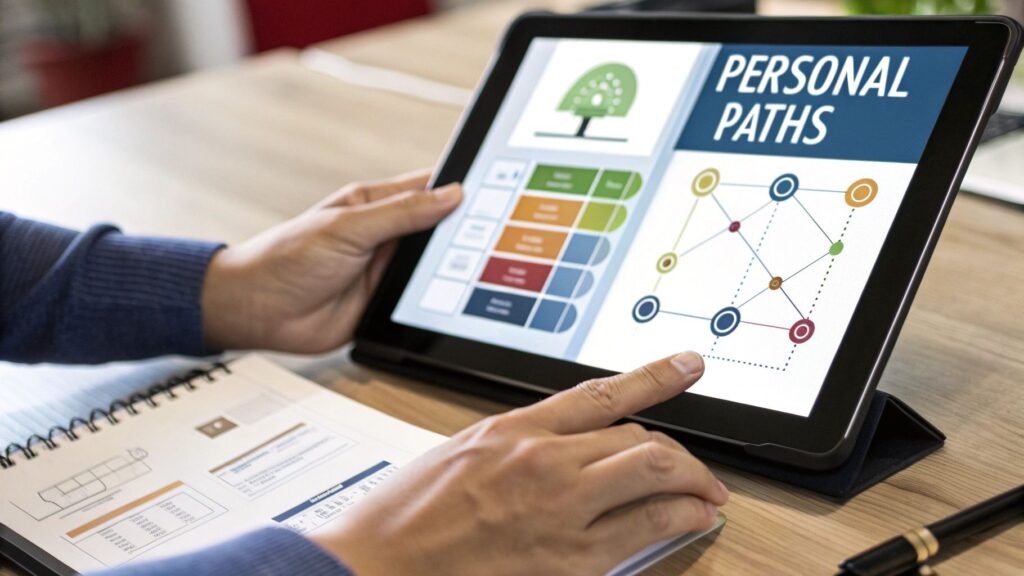
How Data Personalizes the Learning Path
Here’s where online learning starts to feel less like a lecture and more like a personal coach. One of its most powerful advantages is the ability to use data to build a truly personal experience for every single learner.
Think about a traditional classroom. It’s nearly impossible for one instructor to know exactly where each student is on their journey at any given moment. But digital platforms can. And they do it in real-time.
This is the part that gets me really excited. We shift from just delivering instruction to providing intelligent, timely support. A well-designed learning management system (LMS) can see which concepts a student is mastering and, more importantly, pinpoint precisely where they’re starting to struggle.
This data-driven approach is about tailoring the experience to meet a learner’s needs right now. The data becomes the fuel for a more responsive and, ultimately, more effective educational path.
Creating Adaptive Learning Experiences
So, what does this actually look like?
Imagine you’re taking an online course on digital marketing. As you work through a module on SEO, the platform notices you’re flying through the quizzes on keyword research but hitting a wall on the section about technical audits.
Instead of just pushing you forward, an adaptive system can step in with extra resources automatically. You might see:
- A short video tutorial breaking down the trickiest parts of a technical SEO audit.
- An interactive checklist to guide you through the process step-by-step.
- A link to a case study showing how another company successfully fixed its technical SEO.
This kind of immediate, targeted feedback is gold. It means you get help the moment you need it most, preventing frustration from setting in and keeping you from falling behind. The entire process changes from a one-size-fits-all broadcast into a dynamic, responsive conversation.
The goal of data in e-learning is to create a path that bends and adapts to the individual learner. It ensures no one gets left behind and everyone is challenged at just the right level.
This data is just as valuable for the instructor. If they see that 70% of the class is getting stuck on the same module, they know exactly where to focus their energy. They can create a supplementary video, host a live Q&A session, or add more practice exercises to clarify that one tough topic for everyone.
Moving Beyond Simple Completion Rates
For a long time, the main metric for online learning was brutally simple. Did someone finish the course? But data lets us dig so much deeper. I always encourage course creators to look past who just clicked the “complete” button.
We can now measure real comprehension and genuine engagement.
- Time on Task: How long are learners spending on specific lessons? A lot of extra time could signal a difficult concept.
- Assessment Scores: Are there specific questions or topics where most learners are getting tripped up?
- Interaction Data: Which interactive elements are they using? Are they re-watching certain videos over and over?
This level of detailed insight is one of the biggest wins for e-learning. It allows for constant, meaningful improvement for both the learner and the course itself. By understanding how people are actually interacting with the material, creators can refine their content over time to make it clearer, more engaging, and far more effective.
This data-driven feedback loop is what makes modern online learning so potent. It’s a continuous cycle of learning, feedback, and improvement that helps everyone involved get better results.
Real-World Examples of E Learning Success
It’s one thing to talk about the benefits of e-learning in theory, but seeing these ideas in action is what really drives the point home. Concepts like flexibility and scalability can feel a bit abstract until you see how real organizations are using them to get things done.
These stories aren’t just hypotheticals. They show how online education is making a tangible, measurable difference right now.
Upskilling a Global Tech Workforce
Let’s start with a global tech company facing a classic problem. They needed to get their entire remote workforce up to speed on a new project management framework to stay competitive. The old way of flying everyone to a central location for in-person training would have been a logistical and financial nightmare.
Instead, they rolled out a custom e-learning program. The platform included a mix of self-paced modules, interactive simulations, and collaborative group projects. This meant employees could fit the training around their existing deadlines, keeping productivity high.
The results were impressive. They hit a 100% completion rate within three months. But here’s the number that really mattered to the business. Post-training analysis showed project efficiency shot up by 22%, and costly project errors dropped by 15%. This is a perfect example of how e-learning delivers consistent, scalable training that directly boosts the bottom line.
Expanding Access to Higher Education
Another great story comes from a university that wanted to grow beyond its physical campus. They knew thousands of potential students, especially working adults and parents, simply couldn’t commit to a traditional on-campus schedule. Their solution was a series of fully online degree programs.
This was far more than just putting lectures on the internet. They built an entire digital campus designed for their audience.
- Flexible Scheduling: Courses were asynchronous, so students could study whenever they actually had time.
- Virtual Support: They offered online tutoring, career counseling, and dedicated academic advisors, mimicking the on-campus support system.
- Community Building: Digital forums and group projects helped students connect with each other, fighting the isolation that can sometimes come with online learning.
This initiative completely changed the university’s trajectory. They saw a 40% increase in total enrollment in just two years, with most new students being working professionals over the age of 30.
This story highlights how e-learning demolishes the old barriers of place and time. It opens the doors of education to people who were previously locked out, allowing them to advance their careers without having to put the rest of their lives on pause. These are the kinds of real-world wins that show the true power of learning online.
Common Questions About E Learning

Over the years, I’ve heard a lot of the same questions pop up as people start digging into e-learning. It’s completely normal to have questions when you’re thinking about making a big shift in how you learn or train your team.
So, I wanted to take a moment to answer some of the most common ones I hear. These are the practical, real-world concerns that come up again and again.
My goal here is to give you clear, straightforward answers to help you feel more confident about stepping into the world of online education.
Is E-Learning as Effective as In-Person Classes?
That’s a fantastic question, and one I get all the time. The short answer is yes, it absolutely can be. The real difference-maker is the quality of the course design and the motivation of the person taking it.
Plenty of studies have shown that when an online course is interactive and provides strong support, the learning outcomes are just as good, if not better, than a traditional classroom. The key ingredient is engagement.
A dynamic course with quizzes, hands-on projects, and active discussion boards can be incredibly effective. It gives you the freedom to learn at your own pace and revisit tricky subjects as many times as you need.
What Are the Biggest Challenges with Online Learning?
While the benefits are clear, it’s always smart to go in with your eyes open to the potential hurdles. I find that self-discipline is often the biggest one for learners. Without a set class schedule, you really have to be motivated to log in and get the work done.
Another challenge can be a feeling of isolation, which is precisely why the best online programs work so hard to build in community features.
- Active discussion forums where students can ask questions and help each other out.
- Group assignments that encourage collaboration and teamwork.
- Live Q&A sessions with instructors to create a direct, personal connection.
Finally, technical problems can sometimes get in the way. Having a reliable internet connection and a basic level of comfort with technology are both really important for a smooth experience.
The most successful e-learning programs are the ones that anticipate these challenges. They don’t just put content online. They build a supportive and interactive environment around it.
How Can Our Company Choose the Right E-Learning Platform?
Picking the right platform, often called a Learning Management System (LMS), is a critical step. I always tell companies to start by clearly defining their goals. What specific skills do you need your team to develop? Knowing your “why” makes the “how” much easier.
Next, you have to look at usability. A platform that’s confusing or clunky is a non-starter. It should be simple and intuitive for both the learners and the administrators who will be managing it.
Finally, think about scalability. Will this platform be able to grow with your company? You don’t want to have to switch systems in a year or two. It’s always a good idea to test out a few different options with a small pilot group before you make a final decision.