8 Powerful Blended Learning Model Examples for Corporate Training
Alright, let’s talk about corporate training. I’m sure we’ve all been there. Sitting through hours of presentations and trying to remember everything, only to forget most of it by next week. It can feel like a huge waste of time and money. But what if there was a better way? A way to make training more engaging, flexible, and actually effective?
That’s where blended learning comes in. It’s a smart approach that mixes different learning methods, combining the convenience of online, self-paced modules with the collaborative energy of live sessions, whether they are in-person or virtual. This method gives employees the freedom they need while providing the structure and support that ensures they actually absorb the material. To make these programs even more accessible, especially the video parts, it is a great idea to use tools like subtitle generators so everyone can follow along easily.
The real challenge is figuring out how to blend these elements effectively. A one-size-fits-all approach just doesn’t work.
In this guide, we are going to dive deep into 8 practical blended learning model examples for corporate training. I won’t just give you a high-level overview. We’ll break down each model with detailed scenarios, the tech you’ll need, and step-by-step implementation tips you can use right away. We’ll explore everything from the Flipped Classroom to Project-Based Blended Learning. My goal is to show you exactly how to build training programs that your team will find genuinely useful and that deliver real results for your business. Let’s get into it.
1. Rotation Model (Station Rotation, Lab Rotation, Flipped Classroom)
The Rotation Model is one of the most structured and versatile blended learning model examples for corporate training. It works by systematically cycling employees through different “stations” or learning activities. At least one of these stations is an online, self-paced activity, while others involve face-to-face instruction, group collaboration, or hands-on practice. This approach ensures every learner gets a well-rounded experience.
Think of it like a circuit training workout for the brain. Instead of doing one long, monotonous exercise, you move between different activities that build on each other. A learner might start with a self-paced e-learning module, then move to a virtual instructor-led session to discuss it, and finish with a hands-on project applying the new skill.
How It Works in Practice
A classic corporate example is Starbucks’ barista training. New hires cycle through online modules covering coffee theory, in-store mentoring with a seasoned barista, and practice sessions on the espresso machine. Each station reinforces the same core objectives but in a different way. This model is popular because it caters to various learning preferences and provides a clear, predictable structure for both trainers and learners.
Key Insight: The power of the Rotation Model lies in its intentional sequencing. Each station is not an isolated event but a building block. The online learning provides the foundation, the instructor-led session clarifies it, and the hands-on practice solidifies it.
Actionable Tips for Implementation
- Communicate Clearly: Provide a clear schedule in advance. Learners should always know which station they are heading to next and what is expected of them there.
- Design for Reinforcement: Ensure each station tackles the same learning objective from a new angle. For example, a “Lab Rotation” for a tech team might involve a coding tutorial (online), a group debugging session (collaboration), and a live Q&A with a senior engineer (instructor-led).
- Use a Learning Hub: A Learning Management System (LMS) or a central platform is essential for tracking progress and guiding learners from one station to the next. For an even deeper look into the principles behind this, you can explore more about blended teaching and learning.
- Include Peer Stations: Create a station dedicated to peer-to-peer review or discussion. This builds a knowledge-sharing culture and helps learners articulate what they have learned.
2. Flex Model (Customized Learner Pathways)
The Flex Model is a highly adaptable blended learning approach where online learning forms the backbone of the training experience. Learners navigate through digital content at their own speed, with instructors or facilitators available for support on an as-needed basis. This model gives employees significant control over their learning journey.
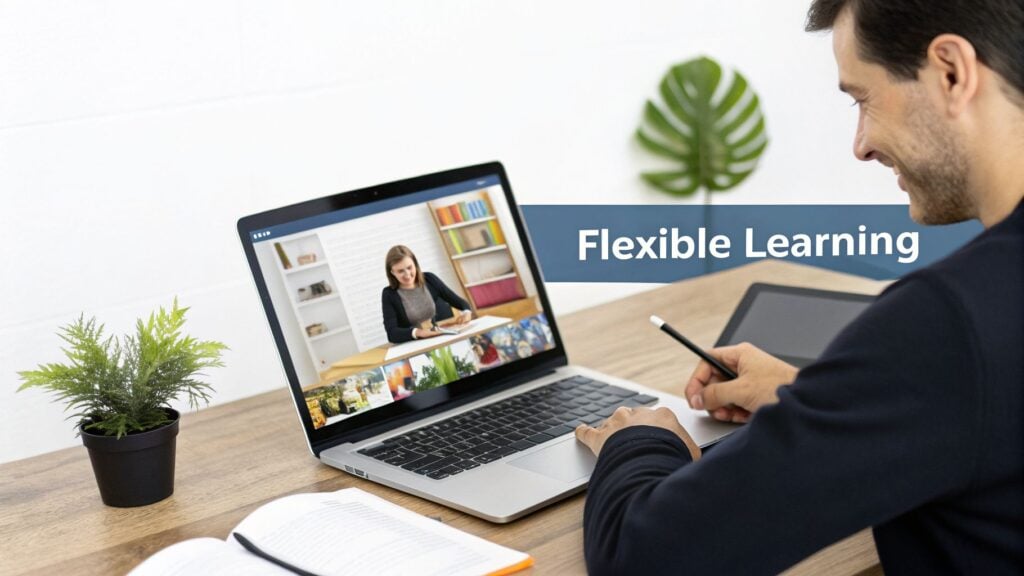
Unlike more structured blended learning model examples, the Flex Model empowers learners to seek help when they need it, whether through one-on-one tutoring, small group discussions, or peer collaboration channels. It’s perfect for companies with distributed teams or employees with demanding schedules, allowing them to fit professional development into their workflow.
How It Works in Practice
Think of how Salesforce uses its Trailhead platform. Learners can access a massive library of self-paced modules to build skills. If they get stuck, they can access community forums or schedule time with certified experts. This setup puts the learner in the driver’s seat, with the organization providing the map and the roadside assistance. Microsoft also applies this by offering employees flexible learning paths through its internal platforms, combining self-study with on-demand expert consultations via Teams.
Key Insight: The Flex Model thrives on providing high-quality, on-demand support. Its success is heavily dependent on the reliability and accessibility of the human support system that backs up the self-paced content.
Actionable Tips for Implementation
- Create Clear Pathways: Develop recommended learning paths based on roles, career goals, or competency assessments. This gives learners a starting point without restricting their freedom to explore.
- Set Support Expectations: Clearly define the hours and response times for instructor support. If an expert will reply within 24 hours, make that known. This builds trust and manages learner expectations.
- Design for Busy Schedules: Break content into short, focused modules (often called microlearning) that are 5-15 minutes long. This makes it easy for employees to learn during a coffee break or between meetings.
- Foster Peer Connection: Mitigate the risk of isolation by creating dedicated peer support channels. Discussion forums, private chat groups, or scheduled virtual study sessions can build community and a shared sense of purpose.
- Track Progress Mindfully: Use learning analytics dashboards to give managers insight into team progress without needing to micromanage. This data can help identify where employees are struggling and where they are excelling.
3. Enriched Virtual Model (Synchronous Blended)
The Enriched Virtual Model puts live, online instruction at the core of the learning experience but supplements it with a rich library of asynchronous content. It keeps the human element of instructor-led sessions and group interaction while giving learners the freedom to explore topics deeper on their own time. This approach is a great fit for corporate training because it maintains team connection and expert guidance without pulling everyone away from their work for extended periods.
Unlike a fully online course, this model prioritizes the synchronous sessions as the main event. The self-paced work is designed to prepare learners for the live discussion or reinforce what was covered. For example, a learner might complete a pre-work module on a new software feature, then join a live virtual workshop to practice using it and ask an expert questions.
How It Works in Practice
Deloitte’s leadership development programs often use this model effectively. Leaders participate in scheduled, virtual instructor-led workshops that focus on case studies and group problem-solving. Before these sessions, they complete self-paced modules on foundational leadership theories. After the live workshop, they access a portal with reinforcement materials, articles, and on-demand videos to solidify their learning. This makes the live sessions highly interactive and valuable, as the groundwork has already been laid.
Key Insight: The Enriched Virtual Model is about maximizing the value of live interaction. By handling foundational knowledge transfer through asynchronous work, synchronous time is freed up for high-impact activities like Q&A, collaborative problem-solving, and role-playing that require real-time human connection.
Actionable Tips for Implementation
- Protect Live Session Time: Keep synchronous sessions focused on activities that can only be done live. Use pre-work for lectures and readings, and reserve live time for discussion, feedback, and networking.
- Structure for Accountability: Motivate learners to complete asynchronous work by tying it directly to the live session. You could start the virtual class with a quick poll or discussion based on the pre-work content.
- Repurpose Session Recordings: Don’t just archive your live session recordings. Turn them into powerful learning assets. When implementing an enriched virtual model, ensuring accessibility and reusability of synchronous blended content is crucial. This can be significantly enhanced through the use of speech-to-text solutions for educational content to create searchable transcripts, captions, and content summaries.
- Use Breakout Rooms Strategically: Small group activities in breakout rooms are essential for preventing virtual fatigue. Give each group a clear task and a time limit to keep them engaged and foster peer connections.
4. Self-Blend or Learner-Directed Model (Pick Your Own Path)
The Self-Blend Model puts learners in the driver’s seat of their own development. Instead of following a prescribed path, employees choose from a curated library of resources to build a learning journey that fits their unique needs, goals, and schedules. This is the ultimate “choose your own adventure” approach to corporate training.
Think of it as a buffet of learning. The L&D team sets out a rich spread of options: e-learning modules, virtual workshops, articles, podcasts, mentoring sessions, and project-based challenges. Learners then fill their plates with what they need most. One person might focus heavily on self-paced courses, while another might create a blend of social learning and hands-on practice.
How It Works in Practice
This model is at the heart of Amazon’s “Career Choice” program, which gives employees funds to pursue education in high-demand fields, letting them choose from a network of learning providers. Similarly, many companies that adopt a 70-20-10 learning framework are using a self-blend approach. They provide a structure where employees are encouraged to find their own resources for experiential (70%), social (20%), and formal (10%) learning. This model grants autonomy and fosters a culture of continuous, self-driven improvement.
Key Insight: The Self-Blend Model succeeds when there is a strong partnership between the organization and the employee. The company provides the resources and framework, but the learner takes ownership of their growth. This fosters accountability and intrinsic motivation.
Actionable Tips for Implementation
- Create a Competency Framework: Before you offer choices, define what “good” looks like. A clear framework shows employees the skills the company values and helps them identify their own development gaps.
- Curate, Don’t Overwhelm: Choice is good, but too much leads to paralysis. Offer a well-organized and vetted menu of high-quality resources. Group them by skill, role, or proficiency level to make navigation easy.
- Provide a Learning Plan Template: Give employees a simple template to structure their choices. This encourages them to set goals, select relevant activities, and define how they will apply their new knowledge.
- Schedule Manager Check-ins: Regular, informal check-ins with a manager are critical. These conversations help keep learners on track, provide encouragement, and offer a space to discuss challenges and successes.
- Offer Guided Self-Assessments: Help learners understand where to start. A simple quiz or self-reflection tool can guide them toward the most relevant content for their needs, making their choices more purposeful.
5. Cohort-Based Blended Learning (Cohort Model)
The Cohort-Based Model is a powerful blended learning example for corporate training that centers on community and shared experience. It groups employees into a “cohort” that moves through a learning program together over a set period. This model mixes synchronous events like live workshops with asynchronous work like self-paced modules, peer reviews, and collaborative projects. It creates a powerful sense of accountability and psychological safety.
Think of it as embarking on a team expedition. Everyone starts at the same point, follows the same map, and helps each other reach the destination. A cohort might attend a live kickoff session on Monday, complete an e-learning module by Wednesday, and submit a group project for peer feedback by Friday. The shared schedule keeps everyone on track and fosters deep professional connections.
How It Works in Practice
Many forward-thinking companies use this model for leadership development or technical upskilling. For instance, a company like Carta might run an internal program where a cohort of new managers learns about performance management. They would attend weekly live sessions with an expert, work through asynchronous scenarios, and meet in small peer groups to discuss real-world challenges. This approach is popular because it combines the structure of a formal course with the organic support of a peer network.
Key Insight: The Cohort-Based Model thrives on social learning. It turns passive content consumption into an active, collaborative experience. The real learning happens not just in the official modules but in the Slack discussions, peer feedback sessions, and group problem-solving that occur along the way.
Actionable Tips for Implementation
- Set Optimal Cohort Size: Keep cohorts small enough for meaningful interaction, typically between 15 and 30 members. This ensures no one gets lost in the crowd and everyone has a chance to contribute.
- Establish Community Norms: Kick off the program by co-creating guidelines for communication, feedback, and participation. This sets a positive and respectful tone from day one.
- Schedule Regular Syncs: Plan mandatory synchronous touchpoints, like weekly or bi-weekly video calls, to maintain group momentum and cohesion. These sessions are vital for answering questions and building rapport.
- Design for Interdependence: Create projects that require genuine peer collaboration rather than just dividing up work. This encourages learners to rely on and learn from each other’s strengths. To go deeper on this, you can find out more about cohort-based courses and their design principles.
6. Microlearning with Blended Support (Bite-Sized Blended)
The Microlearning with Blended Support model is perfect for the modern, time-crunched professional. It breaks down complex topics into short, focused online modules, usually just 3-10 minutes long, that employees can access whenever they have a spare moment. The key is that this flexible self-study is paired with scheduled support, like instructor mentoring, peer discussions, or live Q&A sessions, to ensure accountability and deep learning.
This approach respects busy schedules while preventing the isolation that can come with purely self-paced learning. Think of it as a “just-in-time” learning snack, followed by a scheduled “meal” with an expert to discuss how to apply that knowledge. It’s one of the most practical blended learning model examples for corporate training because it fits learning into the flow of work.
How It Works in Practice
A great example is how Grammarly trains its customer support team. Agents can quickly review bite-sized modules on new product features or common customer issues on their own time. Then, they attend weekly “office hours” with a senior expert to ask complex questions, role-play difficult scenarios, and get direct feedback. Similarly, Spotify uses daily five-minute modules to keep teams updated on internal tools, followed by monthly team huddles to ensure everyone is aligned.
Key Insight: This model separates knowledge acquisition from knowledge application. The microlearning modules deliver the “what,” and the blended support sessions focus on the “how” and “why.” This makes synchronous time more valuable because learners arrive with a baseline understanding.
Actionable Tips for Implementation
- Create Clear Learning Paths: Even though modules are short, they shouldn’t be random. Sequence them logically with clear prerequisites so learners know what to tackle next. A visual path in your LMS is a great way to show progress.
- Design for Mobile First: Assume your learners will be accessing content on their phones between meetings. Ensure your design is responsive and easy to navigate on a small screen.
- Focus Support Sessions: Use your live sessions for application, not lectures. Focus on problem-solving, group discussions, and answering specific questions that came up during the self-paced learning.
- Use Spaced Repetition: Don’t let the knowledge fade. Send automated reminders or short quizzes a few days or weeks after a module is completed to reinforce key concepts. For a deeper dive, you can find more strategies for creating effective microlearning modules for your staff.
7. Project-Based Blended Learning (Experiential Blended)
The Project-Based Blended Learning model throws learners into the deep end, but with a life raft. This approach centers training around a real-world project that employees tackle individually or in groups. Instead of front-loading theory, learners encounter problems first and pull in learning resources like online modules, articles, or expert mentorship exactly when they need them to move forward.
This model flips traditional training on its head. It is about learning by doing, not learning then doing. Employees are given a meaningful challenge, like developing a new feature or solving a customer issue, and they acquire knowledge and skills as a direct result of working toward that goal. This is a powerful example of experiential learning blended with digital support.
How It Works in Practice
Think of Google’s famous “20% Time,” where employees could use a portion of their workweek to pursue passion projects. This led to innovations like Gmail and AdSense. While not a formal training program, it embodies the spirit of project-based learning: give smart people a meaningful problem, provide resources and mentorship, and let them figure it out. Similarly, many consulting firms onboard junior staff by immediately placing them on client projects alongside senior mentors, supplemented by a library of on-demand training resources.

Key Insight: This model’s strength comes from its context. Learning isn’t abstract, it’s immediately applicable. The need to solve a real problem creates intrinsic motivation, making the learning process more engaging and the skills more memorable.
Actionable Tips for Implementation
- Define the Right Projects: Select projects that are challenging enough to be engaging but not so difficult that they become discouraging. The project brief should be detailed, with clear deliverables and embedded learning objectives.
- Curate a Resource Library: Don’t just give learners a project and walk away. Build a well-organized, just-in-time library of resources like videos, templates, articles, and case studies that they can access on demand.
- Establish a Feedback Cadence: Set up regular check-ins with mentors or managers. These weekly or bi-weekly sessions are crucial for guidance, course correction, and building confidence.
- Use Clear Rubrics: Create and share rubrics that define what success looks like for both the final project and the learning process itself. This helps set clear expectations.
- Foster Peer Collaboration: Designate time for peer reviews or knowledge-sharing sessions. This allows learners to see how others are approaching the problem and reinforces their own understanding by explaining it to others.
8. Mentoring and Coaching-Enhanced Blended Model
The Mentoring and Coaching-Enhanced Blended Model adds a powerful human element to digital learning. This approach combines structured online courses and self-paced resources with personalized, one-on-one guidance from an experienced mentor or coach. It’s designed to bridge the gap between knowing information and applying it effectively in a real-world context.
Think of it as having a personal guide for your learning journey. You work through the digital curriculum on your own schedule, but then you meet regularly with a mentor who helps you connect those lessons to your specific career goals, challenges, and development areas. This model is a great fit for leadership development and accelerating talent growth because it focuses on both knowledge acquisition and personal application.
How It Works in Practice
Many top companies use this model for leadership succession and skill acceleration. For example, Google often pairs junior engineers with senior technical leaders for mentorship alongside formal training. Similarly, GE’s famous Crotonville leadership programs combine executive education modules with dedicated executive coaching to help leaders translate theory into practice. The online learning provides the “what,” and the coaching provides the “how” for each individual.
Key Insight: The success of this model is rooted in its focus on personalized application and accountability. A self-paced course can teach management theory, but a mentor can help a new manager navigate their first difficult conversation with a direct report, making the learning stick.
Actionable Tips for Implementation
- Define Clear Roles: Create a document that outlines the exact expectations for both mentors and mentees. Clarify the purpose, time commitment, and desired outcomes to prevent misunderstandings.
- Train Your Mentors: Being a subject matter expert does not automatically make someone a good mentor. Provide training on active listening, giving constructive feedback, and guiding a mentee’s growth.
- Establish a Cadence: Set a clear schedule for meetings, such as one or two hours per month. A consistent rhythm ensures the relationship stays active and provides ongoing support without becoming a burden.
- Provide Mentor Resources: Equip your mentors with a toolkit of discussion prompts, goal-setting templates, and conversation guides. This helps them facilitate meaningful discussions, especially in the early stages of the relationship.
- Formalize the Matching Process: Don’t leave pairing to chance. Use a structured process based on skills, career goals, and personality to create strong, productive mentor-mentee matches.
Corporate Training: 8 Blended Learning Models Compared
| Model | Implementation complexity | Expected outcomes | Ideal use cases | Key advantages |
|---|---|---|---|---|
| Rotation Model (Station Rotation, Lab Rotation, Flipped Classroom) | Intermediate to Advanced (complex scheduling and design) | Balanced skill development, measurable station-level outcomes, higher engagement | Technical skills, compliance, leadership, product training | Accommodates varied learning styles; hands-on practice; scalable delivery |
| Flex Model (Customized Learner Pathways) | Intermediate (needs pathway design and support workflows) | Increased learner autonomy and steady upskilling; variable completion rates | Continuous upskilling, distributed teams, onboarding, sales enablement | High flexibility and autonomy; cost-efficient for distributed learners |
| Enriched Virtual Model (Synchronous Blended) | Intermediate (coordinate live and asynchronous elements) | Preserved social learning with reduced live time; sustained access via recordings | Team training, cohort programs, leadership development, onboarding | Combines live interaction with on-demand content; supports global delivery |
| Self-Blend / Learner-Directed Model | Advanced (requires cultural change and strong guidance) | Highly personalized learning with variable outcomes and autonomy growth | Senior professionals, knowledge workers, continuous learning cultures | Maximizes personalization and engagement; scalable without cohort scheduling |
| Cohort-Based Blended Learning | Intermediate to Advanced (cohort management and facilitation skills needed) | Strong peer accountability, network building, measurable cohort outcomes | Leadership development, company-wide capability building, certifications | Builds community and accountability; effective peer learning |
| Microlearning with Blended Support | Intermediate (careful sequencing and spacing design) | Improved retention for discrete skills, just-in-time performance support | Compliance, product updates, language learning, busy professionals | Fits busy schedules; high engagement; easy to update and maintain |
| Project-Based Blended Learning | Advanced (intensive design and mentoring infrastructure) | Deep practical skill transfer, business value from deliverables, higher motivation | Innovation projects, technical skill development, transformational change | Authentic application; dual benefit (learning + business outcomes) |
| Mentoring & Coaching-Enhanced Blended Model | Intermediate to Advanced (mentor program setup and matching) | Personalized growth, high completion and transfer, leadership pipeline | Leadership development, succession planning, high-potential employees | Personalized guidance and accountability; accelerates development |
Your Next Move: Start Blending, Not Mandating
I just walked you through a ton of information. From the structured cadence of the Rotation Model to the personal connection in a Mentoring and Coaching-Enhanced approach, you’ve seen the sheer variety available. The eight blended learning model examples for corporate training we covered are not just theories. They are practical, adaptable frameworks used by companies to build more skilled, engaged, and effective teams.
If there is one thing to take away from all these examples, it’s this: flexibility is the new standard. The days of herding everyone into a conference room for a mandatory eight-hour PowerPoint marathon are over. Modern learning is about meeting employees where they are, respecting their time, and giving them the tools they need to succeed on their own terms.
This shift moves us from a top-down mandate to a bottom-up culture of curiosity.
Key Insights to Take With You
Looking back at the models, a few core themes keep popping up. These are the principles that separate a truly successful blended program from one that just checks a box.
Choice Drives Engagement: The Self-Blend and Flex Models are built on this idea. When learners have a say in how and what they learn, their investment in the outcome skyrockets. They are no longer passive recipients of information but active drivers of their own development.
Connection Is Not Optional: Notice how many models, like the Cohort-Based and Mentoring-Enhanced approaches, explicitly build in human interaction. Learning isn’t a solo activity. Peer discussions, expert guidance, and collaborative projects turn abstract concepts into tangible skills.
Context Is Everything: Project-Based Learning nails this. Skills learned in isolation are quickly forgotten. When training is directly tied to real-world tasks and business challenges, the learning sticks. It becomes a tool, not just a fact.
A Quick Word on Technology: You might have noticed that the tech stacks we discussed were there to support the learning design, not dictate it. The goal is not to buy the fanciest platform. The goal is to choose tools that make the learning experience seamless, accessible, and effective. Always start with your learning objectives, then find the tech that helps you meet them.
Your First Step: Start Small, Think Big
Seeing all these options can feel overwhelming. You don’t need to boil the ocean. The best way to begin is to pick one area of need and run a small pilot program.
Here’s a simple, actionable plan to get started:
Identify a Clear Pain Point: What is one specific skill gap or performance issue your team is facing? Maybe it’s new managers struggling with feedback, or a sales team needing better product knowledge.
Choose ONE Model to Test: Based on the problem, pick a model that seems like a good fit. For new manager training, a Cohort-Based model with mentoring elements could be perfect. For quick product updates, a Microlearning with Blended Support approach might be the winner.
Select a Small, Willing Group: Find a group of 5-10 employees who are open to trying something new. Their honest feedback will be your most valuable asset.
Gather Feedback and Iterate: After the pilot, ask them what worked and what didn’t. Was the online content engaging? Was the live session valuable? Use their input to refine the program before you consider a wider rollout.
By starting small, you lower the risk and increase your chances of success. You’re not just launching a training program, you’re building a business case for a better way to learn. The detailed breakdowns of the blended learning model examples for corporate training in this article give you a blueprint to follow.
Ultimately, this is about building a learning culture, not just a training calendar. When you empower your employees with flexible, relevant, and engaging learning opportunities, you are investing directly in the future of your organization. You’re showing your team that you trust them to own their growth, and that’s one of the most powerful retention tools you have. So, which model will you try first?