
A Guide to Building a Membership Site That Lasts
Before you even think about plugins, platforms, or payment gateways, let’s talk strategy. This is the stuff that actually matters, and frankly, it’s the part too many creators skip over in their excitement to just build something.
A successful membership isn’t built on slick technology. It’s built on a rock-solid understanding of who you’re serving and the unique value you’re bringing to their world.
Laying the Groundwork for Your Membership Site
The opportunity is massive. People are more comfortable than ever with recurring payments for things they value. The subscription economy is absolutely exploding, with forecasts projecting it will grow from around $200 billion in 2023 to an eye-watering $2.23 trillion by 2028.
But tapping into that market doesn’t happen by accident. It starts right here, with a smart, deliberate plan.
Know Your Ideal Member Inside and Out
First things first: who is this for? And please, don’t say “everyone.” The more specific you get, the easier every other decision becomes. We need to go way beyond basic demographics and get into what makes these people tick.
- What are their biggest, most frustrating pain points related to your niche?
- What does success actually look like for them? What are their real goals?
- Where are they already hanging out online trying to solve these problems? Think forums, subreddits, Facebook groups, or specific blogs.
- What have they already tried that failed them? This is gold.
You’re essentially creating a detailed “member persona.” This is a focusing tool that will guide your content, your copy, and your community-building efforts. For a deeper look at the entire process, check out this excellent guide on how to create a membership website.
Validate Your Big Idea Before You Build
A brilliant idea in your head is one thing. An idea that people will happily open their wallets for is something else entirely. Idea validation is the step that separates successful launches from expensive hobbies.
So, how do you prove there’s real demand?
Start by lurking in the online communities where your ideal members live. What questions pop up over and over again? You can also run a simple survey, hop on a few one-on-one calls, or even just put up a basic landing page describing your idea to collect emails for a “founding members” list.
The goal here is to get a definitive “yes” to the question: Is this a problem people are actively trying to solve with their money?
Choose Your Membership Model
Finally, let’s figure out the structure. How are you actually going to deliver the value you’ve promised? There’s no single right answer, but most successful memberships fall into one of these buckets.
- The Content Library: Think “Netflix for [Your Niche].” Members pay a recurring fee for on-demand access to your library of courses, workshops, templates, and resources.
- The Community: The main draw here is the connection. The value comes from the forums, the live calls, the mastermind groups, and the network of like-minded peers. Content often supports the community, but it isn’t the star of the show.
- The Hybrid: This is the sweet spot and the most common model. It blends a strong library of core content with a vibrant, active community, giving members the best of both worlds.
Picking your primary model early on brings incredible clarity. It tells you whether you should be spending most of your time creating amazing content or facilitating powerful connections. Getting this right shapes everything that follows.
Choosing the Right Tech Stack for Your Members
Okay, let’s get into the engine room. Picking the right technology for your membership site can feel like a massive, overwhelming decision, but I promise it’s more straightforward than it looks. When you strip everything else away, you’re really just choosing between two main paths.

You can go with an all-in-one platform that does everything for you, or you can take a more hands-on approach with WordPress and a dedicated membership plugin.
There’s no single “right” answer here. The best choice comes down to your budget, how comfortable you are with the tech side of things, and what your long-term vision is for your community.
All-In-One Platforms: The Simplicity Route
All-in-one platforms like Kajabi or Teachable are designed to make your life as a creator incredibly easy. They bundle everything you need into one tidy package with a single monthly fee, from website hosting and content delivery to payment processing and email marketing.
The biggest advantage here is pure simplicity. You don’t have to stress about plugin conflicts, security updates, or weird technical glitches. The platform manages all that backend stuff, freeing you up to focus on what you do best: creating amazing content and engaging with your members.
But that convenience comes with a trade-off. These platforms are often more expensive, and you’re pretty much locked into their ecosystem of features and design options. If you want to build something custom that falls outside their pre-built system, you’re usually out of luck.
WordPress + Plugins: The Flexibility Route
The other path involves using WordPress, the most popular website builder on the planet, and pairing it with a powerful membership plugin like MemberPress. This is the “build it yourself” approach, and it offers almost limitless freedom.
With this kind of setup, you own everything. You have total control over the design, the user experience, and every single piece of functionality. You can integrate thousands of other tools to create a truly unique experience for your members, and it’s often more affordable to get started.
The flip side? You’re the one in charge of managing the technical stuff. This means choosing a hosting provider, keeping your site and plugins updated, and troubleshooting any issues that pop up. While modern tools make this far less daunting than it used to be, it definitely requires a more hands-on approach. For a deep dive, our guide on the tech stack for a $10 membership site has some great ideas for keeping costs down.
Picking the right foundation is a big deal, especially since the membership platform market is growing like crazy. It was valued at around $7.9 billion in 2025 and is projected to hit $14.3 billion by 2033. This boom means more innovation and better tools are constantly hitting the market for creators like us. (Source: HTF Market Intelligence)
So, how do you actually make a decision? Let’s break down the key factors.
Comparing Membership Platform Approaches
Here’s a quick look at the two main tech routes for your membership site to help you decide which is the best fit for your goals.
| Factor | All-in-One Platforms (e.g., Kajabi) | WordPress + Plugins (e.g., MemberPress) |
|---|---|---|
| Ease of Use | Very beginner-friendly. Everything works together out of the box. | Steeper learning curve. Requires managing updates and plugins. |
| Flexibility | Limited. You’re confined to the platform’s features and design tools. | Nearly limitless. You can build almost any feature you can imagine. |
| Cost | Higher, fixed monthly fees. Predictable but can be expensive. | Lower starting costs, but can grow with premium plugins and themes. |
| Ownership | You rent the platform. If you leave, you have to start over. | You own 100% of your site, content, and data. Fully portable. |
| Maintenance | None. The platform handles all security, updates, and hosting. | Your responsibility. You need to manage updates, security, and hosting. |
Ultimately, both paths can lead to a successful membership site. The choice is about aligning your tools with your skills, budget, and vision for the future.
Key Factors to Consider
Think hard about these three areas before you pull the trigger. Being honest with yourself now will save you a world of headaches down the road.
Your Budget: All-in-one platforms come with a higher, fixed monthly cost. WordPress can be cheaper to start, but those costs can creep up as you add premium plugins and themes. It’s a good idea to map out your estimated expenses for both options over a full year.
Your Tech Comfort Level: If the idea of dealing with hosting or plugin updates makes you break out in a cold sweat, an all-in-one platform is probably your best friend. But if you enjoy tinkering and want complete control, WordPress will feel empowering, not intimidating.
Your Long-Term Vision: Where do you see your membership in three years? If you’re dreaming up custom features, unique community integrations, or specific marketing funnels, the flexibility of WordPress is a massive advantage. If your goal is to keep things simple and streamlined, an all-in-one might be all you ever need.
At the end of the day, your goal is to pick a tech stack that supports your business without becoming a second job. Your members won’t care what platform you use, but they will absolutely care about having a smooth, reliable, and easy-to-use experience.
Crafting Your Content and Community Strategy
Alright, you’ve wrestled with the tech and have a solid foundation. Now for the fun part: the content and community. This is the absolute heart of your membership. It’s why people will sign up and, more importantly, why they’ll stick around month after month.
This is where you deliver on the promise you made back in the planning stage. It’s all about creating value that feels both essential and engaging. Let’s break down how to structure your content and build a community that people are genuinely excited to be a part of.
Planning Your Content Delivery
One of the first big decisions you’ll face is how to give your members access to everything. There are two main playbooks here, and each creates a totally different member experience.
- The “All-Access Pass” Model: This is the Netflix approach. New members sign up and instantly unlock your entire library of courses, resources, and tutorials. It’s a fantastic way to show off a massive amount of value right out of the gate.
- The “Drip” Model: This strategy releases content on a set schedule. A new member might get Module 1 in their first week, Module 2 in their second, and so on. This is perfect for guiding members through a specific journey and preventing that dreaded feeling of overwhelm.
From my experience, the drip model can seriously boost member engagement. It creates a structured path, builds anticipation for what’s next, and turns passive consumption into an active learning experience.
The old saying goes, “They come for the content, but they stay for the community.” It’s 100% true. While your content opens the door, the human connections forged inside are what make your membership feel like a second home.
Making Your Content Stick
It’s one thing to have great content. It’s another to present it in a way that keeps people coming back for more. The goal is to avoid the “digital dust” problem, where members download a few things, feel satisfied, and then disappear forever.
To get the most mileage out of your work, look into smart content repurposing strategies. This is a game-changer. You can turn a single workshop into a blog post, a downloadable checklist, and a dozen social media clips, saving you a ton of production time.
Also, think about breaking down your big topics into smaller, digestible chunks. This concept, known as microlearning, is all about respecting your members’ busy schedules. A 10-minute video is far less intimidating than a two-hour webinar recording, making it much more likely they’ll actually watch it.
Building Your Community Hub
Let’s be clear: a membership without a community is just a content library. The real magic happens when your members start connecting with each other. This is how you transform a list of customers into a loyal, tight-knit tribe.
But where should this community actually live?
- Facebook Groups: This is the easiest place to start. Nearly everyone is on Facebook, so the platform is familiar and accessible. The downside? You’re on rented land, constantly battling distractions and the whims of the algorithm.
- Dedicated Community Platforms: Tools like Circle or Mighty Networks give you a focused, brandable space. You get way more control, but they do come with a separate monthly fee.
- On-Site Forums: Using a WordPress plugin like bbPress or BuddyBoss keeps everything under one roof. This gives you total ownership but usually requires more technical setup and ongoing management.
My advice? Start simple. A Facebook Group is a great way to test the waters and see how your members interact. If the community becomes the core of your membership, you can always migrate to a dedicated platform down the road.
The key is to start fostering connections from day one. Spark conversations, ask questions, and make every single new member feel seen and welcomed. That’s the real foundation of a community that lasts.
Pricing and Launching Your Membership Site

This is it. The part where so many creators get stuck in a loop of analysis paralysis. I’ll be honest, deciding what to charge for my own membership was one of the most stressful parts of building it. You’re trying to balance the immense value you know you provide with a price that won’t scare off the very people you want to help.
Let’s get this sorted out. My goal is to help you land on a price that feels like a total steal for your ideal member while also building a sustainable, predictable income stream for your business. It’s about finding that sweet spot where everyone wins.
Finding Your Value-Based Price
Before you even think about numbers, take a step back and think about the transformation you’re offering. What specific, tangible outcome will someone get from being a member?
Are you helping them save 10 hours a month with your templates? Are you teaching them a skill that could land them a raise or new clients? Put a real, concrete value on that outcome.
If your membership helps a freelance designer land just one extra project a year, what’s that worth? Probably a lot more than a $29 monthly fee. This is value-based pricing, and it’s the key to charging what you’re worth with confidence.
Common Pricing Models That Work
Once you have a handle on the value you provide, you can decide how to package it. There are a few tried-and-true models that work great for building a membership site.
Here’s a quick breakdown to help you find the best fit.
Comparing Pricing Strategy Options
Evaluating the pros and cons of common pricing models for membership sites to find your perfect fit.
| Pricing Model | Best For | Potential Downside |
|---|---|---|
| Single Tier (Monthly/Annual) | Simplicity and clarity. Perfect when your offer is straightforward and you want to avoid confusing buyers. | Can leave money on the table. Superfans might be willing to pay more for extra access or perks. |
| Tiered Pricing | Memberships with different levels of content, access, or support. Great for upselling dedicated members. | Can create complexity. You need to clearly differentiate the value between each tier to justify the price gaps. |
| Lifetime Deal (LTD) | Launching a new membership to generate a quick cash injection and build a base of founding members. | Can devalue your recurring model long-term and create a support burden without ongoing revenue. |
For most people starting out, a simple monthly and annual plan is the way to go. Offering an annual option at a slight discount (like getting two months free) is a fantastic way to improve your cash flow and lock in committed members.
The Great Trial Debate: Free or Paid?
Okay, let’s talk about trials. Should you let people peek behind the curtain for free, or should you charge a small fee to get them in the door? This is a huge topic with a lot of opinions. The debate over free trials versus a low-cost entry fee is one worth exploring, as the right choice really depends on your audience and offer.
A free trial is amazing for lowering the barrier to entry. It removes all the risk for a potential member and can attract a high volume of sign-ups. The downside? You’ll get more tire-kickers who have no real intention of ever paying.
A low-cost paid trial, even just for $1, fundamentally changes the dynamic. It ensures that every single person who signs up has “skin in the game,” making them far more likely to engage with your content and become a long-term member.
A paid trial (like $1 for 7 days) filters for serious buyers. The volume of trial sign-ups will be lower, but the quality will be much, much higher. These are people who have already pulled out their credit card, signaling a much stronger intent to purchase. Personally, I’m a huge fan of this model. It respects your work and attracts the right kind of member from day one.
Preparing for Launch Day and Beyond
This is it. The moment you’ve been working toward. Launch day is packed with excitement, but I’ve learned the hard way that a smooth launch starts long before you hit the “go live” button. Preparation is everything.
Let’s walk through a simple checklist to make sure you’ve got all your bases covered, from the final tech checks to your marketing rollout. This is about making a killer first impression that sets the tone for your entire membership.
Remember, your launch is the final piece of the puzzle, built on a solid foundation of value and a clear business model.
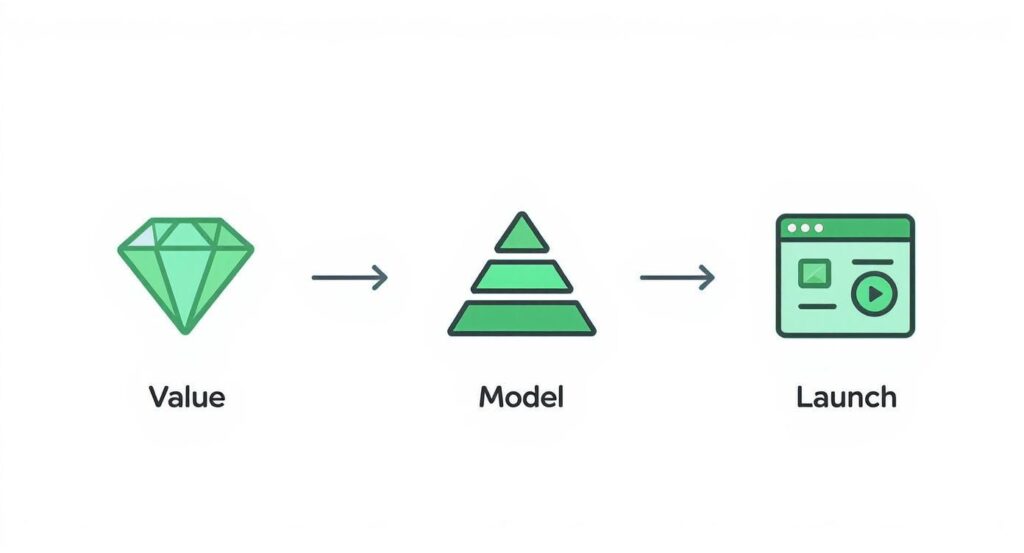
As the diagram shows, you figure out your value and your model before you ever think about the launch itself.
Choosing Your Launch Strategy
Not all launches have to be a massive, public spectacle. There are a couple of smart ways to approach this, and the right one depends on your goals and where your audience is at.
- The Quiet “Beta” Launch: This is my favorite approach, especially for a brand-new membership. You invite a small, hand-picked group to become your founding members, often at a lifetime discount. They get early access, and you get priceless feedback to iron out the kinks before opening the doors to everyone.
- The Big Public Launch: This is the more traditional route. You build hype with your email list and social channels, then open enrollment to the public, usually for a limited time to create a bit of urgency. This works best if you already have an established audience just waiting for you to release something.
Both are totally valid. The key is picking the one that feels right for you and won’t have you pulling your hair out on launch day.
Your launch is the starting line. The most critical part of building a membership isn’t getting people to sign up. It’s what happens in the first few hours and days after they join.
Creating a Warm Welcome and Onboarding
First impressions are everything. The second someone trusts you with their credit card details, your job is to immediately prove they made an amazing decision. A clunky, confusing, or silent welcome is a fast track to buyer’s remorse and quick cancellations.
Your onboarding goal is simple: guide new members to their first quick win. You want them to achieve something small and feel successful as fast as humanly possible. This creates instant momentum and reinforces the value of what they just bought.
Here’s a simple but incredibly effective onboarding sequence you can set up:
- The Welcome Email: This needs to land in their inbox instantly. It should have their login details, a link to the member dashboard, and one crystal-clear call to action, like “Click here to watch our 2-minute welcome video.”
- The Welcome Video: A short video from you is ridiculously powerful. Personally welcome them, give them a quick tour of the one or two most important spots inside the site, and tell them exactly what to expect next. Keep it brief.
- The “First Steps” Checklist: Inside the member area, have a simple checklist waiting for them. Think small, achievable tasks: “Introduce yourself in the community,” “Download your workbook,” or “Watch the first lesson.”
This sequence doesn’t have to be complicated. It’s just a guided tour that vaporizes confusion and makes new members feel right at home. By focusing on that first win, you drastically increase the chances they’ll stick around, stay engaged, and become a true fan of what you’ve built.
Retaining and Engaging Your Members
Getting a new member is an amazing feeling, but keeping them is what turns a side project into a sustainable business. Now we shift our focus from the launch-day high to the long-term health of your community. The real work is just beginning when someone signs up.
This is all about creating an experience so valuable that hitting the “cancel” button feels like a terrible decision. It goes way beyond just dumping more content into the library every month. Real, lasting retention comes from connection, genuine engagement, and a sense of forward momentum.
Beyond Content: The Keys to Retention
Your members didn’t just sign up for a folder of videos. They signed up for a transformation. Your job is to keep delivering on that promise in new and exciting ways. In fact, piling on more and more courses can sometimes backfire, leading to overwhelm and analysis paralysis.
Instead, think about other ways to deliver incredible value. Here are a few things that have worked wonders for me:
- Host Member-Only Events: Think monthly live Q&A sessions, interviews with outside experts, or even casual “co-working” calls. These create a living, breathing reason for people to show up and connect in real time.
- Celebrate Their Wins: Actively look for member successes and shout them out within your community. When people feel seen and celebrated, their loyalty to the group skyrockets.
- Personalized Check-Ins: You don’t have to do this for every single person, but sending a quick, personal email to a new member or someone who’s gone quiet can make a massive impact. It shows a human is behind the curtain.
These small, personal touches are what elevate a simple transaction into a genuine relationship. That’s the bedrock of loyalty. For a much deeper dive on this, check out our guide on powerful membership retention strategies.
Know Your Numbers: Churn and Engagement
You can’t fix what you don’t measure. While you could track a dozen different metrics, one number reigns supreme when it comes to the health of your membership.
That metric is churn rate, which is the percentage of members who cancel their subscription in a given period. It’s the silent killer of subscription businesses.
A high churn rate means you’re constantly trying to fill a leaky bucket. Your top priority should always be plugging those leaks and keeping churn as low as humanly possible. Even a tiny improvement in retention has a massive impact on your bottom line over time.
Don’t just track the number. Dig into the why. When someone cancels, have a simple, one-question exit survey asking why they decided to leave. This feedback is absolute gold. It tells you exactly where your offer might be falling short or what your members truly want next.
Keeping members engaged is a constant effort, but the industry benchmarks are actually pretty encouraging. The median membership renewal rate holds steady at a strong 84%, which shows that once people are in, they tend to stick around. We’re also seeing a rise in the use of AI, with 31% of organizations planning to use it for things like content creation and data analysis to improve the member experience. You can find more of these insights in the 2025 Membership Marketing Benchmarking Report.
By actively listening to your members and focusing on community-building activities, you create a sticky experience that people won’t want to leave. This is how you move from just building a website to cultivating a thriving, long-lasting community.
A Few Common Questions I Get Asked All The Time
Let’s quickly tackle some of the questions that pop up again and again. Getting these sorted out early will save you a lot of headaches as you get ready to launch and start growing.
“How Much Content Do I Need Before I Can Launch?”
This is the big one, the question that keeps so many amazing membership ideas stuck on the drawing board. The fear is you need a massive, Netflix-style library of content from day one. You don’t.
In fact, launching with too much content is a classic mistake. It completely overwhelms your founding members, making them feel like they’re already behind before they’ve even started.
Here’s my simple rule of thumb: launch the moment your core promise is fulfilled.
- If you promised a foundational course on sourdough baking, have that course ready to go.
- If you promised a toolkit of sales templates, make sure you have a solid starting collection of your most valuable ones.
That’s it. You can, and should, build out the rest of your content over time. This approach keeps your members engaged because there’s always something new to look forward to. Better yet, it lets you create future content based on what your members actually ask for, not what you think they want.
Don’t let the quest for a “perfect” amount of content paralyze you. It’s far better to launch with immediate, tangible value and iterate than to wait forever for an ideal that doesn’t exist. Get started.
“What’s the Smartest Way to Handle Customer Support?”
When you’re just starting, customer support is probably just going to be you. And that’s perfectly fine.
Keep it simple. Set up a dedicated email address (like support@yourbrand.com) and just be responsive. As you start to grow, you can layer in a simple ticketing system like Help Scout or build out a small knowledge base with answers to the most common questions.
The most important thing in the early days is to be quick and personal. A fast, helpful reply from the founder builds an incredible amount of goodwill and shows your first members that you genuinely care. That’s a feeling they’ll remember.
“Can I Run a Membership Site Without a Community Component?”
You absolutely can. Not every membership model needs a bustling forum or an active Slack channel to be successful.
Some of the best memberships are purely content-driven. Think about a subscription to a premium financial newsletter or access to a constantly updated library of design assets. The value is in the content, not the interaction.
That said, community is often the “glue” that makes a membership sticky. It’s the reason people stay long after they’ve binged the initial course content. Connection is a powerful retention tool. Even something as simple as a monthly live Q&A call or a private group for members can create that powerful layer of connection.
It really comes down to your audience and, frankly, what you want to build. If the idea of managing a community doesn’t light you up, don’t force it. Focus on delivering absolutely incredible content and world-class support instead.