
Cognitive Load Theory in E-Learning Design Explained
Have you ever poured your heart and soul into an online course, meticulously packing it with valuable content, only to watch the engagement stats flatline? Learners start strong, but then they just… fade away. If that sounds painfully familiar, the problem probably is not your content. It’s cognitive load.
This is the secret frustration of so many course creators. The culprit is a concept that explains why our brains have a finite amount of mental bandwidth for taking in new information. When you overload that bandwidth, learning stops cold.
Why Your E-Learning Isn’t Sticking
If you run a course or a membership site, watching learners disengage is a gut punch. You know the material is solid, so what’s the disconnect? The issue is usually how the information is delivered.
When we hit learners with confusing navigation, walls of dense text, or too many ideas at once, their brains work overtime just trying to figure out the interface. This leaves almost no mental energy for the actual learning.
This is where understanding cognitive load theory becomes a complete game-changer. It is the framework I lean on to build courses that feel intuitive, not infuriating. The goal is to work with the brain’s natural wiring.
The Core Idea of Cognitive Load
At its heart, the theory is pretty simple. Pioneered by educational psychologist John Sweller back in 1988, it recognizes that our working memory, the brain’s processing unit, is surprisingly small. It can only juggle a few new pieces of information at a time.
In fact, a 2017 research review found that something as simple as having redundant information on-screen can burn through 20-30% of a learner’s mental capacity. That is a huge waste of brainpower. You can read more about how this discovery changed e-learning on maplelearningsolutions.com.
Your main goal as a course creator is to reduce the mental effort spent on anything that is not the core learning material.
This means getting ruthless. You have to slash distractions and stamp out sloppy design. Once you do, you free up your learners’ precious mental resources to focus on what actually matters, mastering your content and hitting their goals.
What This Guide Will Show You
This guide is my practical roadmap for applying these powerful ideas. I’ll show you exactly how to stop overwhelming your students and start creating experiences that feel effortless and engaging.
Here’s what we are going to cover:
- The Three Loads: We will break down the different types of cognitive load, intrinsic, extraneous, and germane, and what each one means for your course design.
- Practical Strategies: I will give you actionable tactics for minimizing the bad kinds of load and maximizing the good kind that leads to deep understanding.
- Real-World Examples: You will see clear before-and-after examples that bring these concepts to life.
To make sure your content truly sticks, it helps to ground these principles in proven best practices for online learning. By the end of this guide, you’ll have a complete toolkit to audit your existing courses and build new ones that are cognitively efficient, engaging, and genuinely effective. Let’s dive in.
Understanding The Three Types of Cognitive Load
To design courses that people actually finish, you need to get a handle on the three distinct ‘loads’ competing for your learner’s limited mental energy. It helps to think of it like packing a suitcase for a trip. You only have so much space. Some items are essential, some are just clutter taking up room, and others are clever packing cubes that help you fit more in.
Effective course design is really just the art of managing what goes into that suitcase.
Intrinsic Load: The Necessary Effort
First, there’s intrinsic load. This is simply the built-in difficulty of the topic you are teaching. Learning to tie your shoes has a very low intrinsic load. Learning the principles of quantum mechanics? That’s an incredibly high intrinsic load.
You cannot eliminate this part, it is baked into the subject matter. But you can absolutely manage it. When you break a massive, complex topic into smaller, sequential lessons, you are managing intrinsic load. The subject is still challenging, but you are serving it up in a way that’s much easier for the brain to handle.
Fail to manage this, and you get cognitive overload, which leads directly to learners giving up.
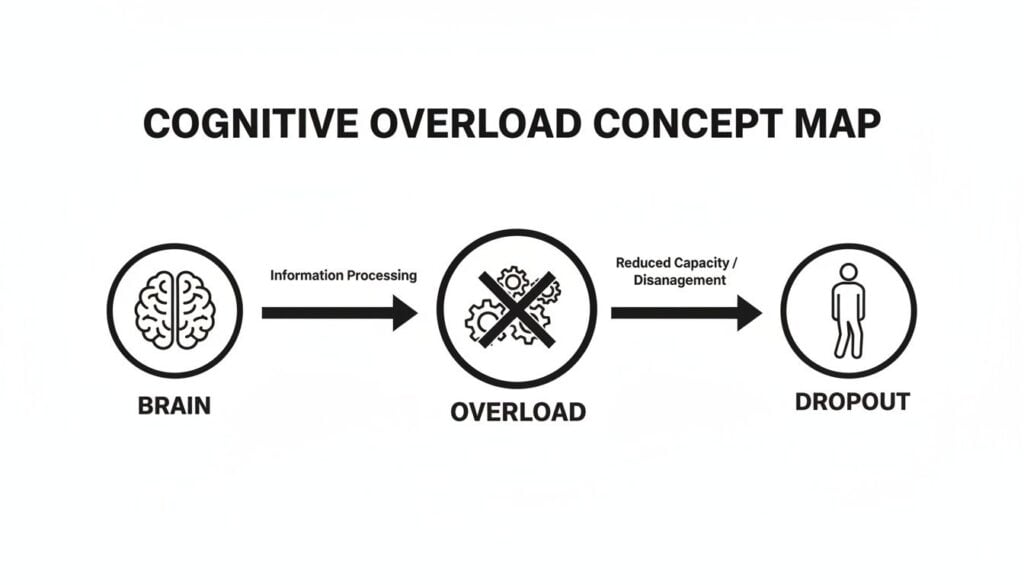
When the brain’s capacity is maxed out, the most common outcome is that the learner walks away.
Extraneous Load: The Bad Kind of Load
Next up is extraneous load, and this is the one you should truly obsess over. I call this the “bad” load. It is all the mental energy your students waste on things that have absolutely nothing to do with the actual learning. It is the junk mail, the styrofoam peanuts, the useless clutter you packed in your suitcase.
Think about a course with a clunky interface, confusing navigation, tiny unreadable fonts, or a video plagued by distracting background music. Every ounce of mental energy a learner spends figuring out how to use your course is energy they cannot spend learning your material.
This is the load you have the most direct control over as a course creator. Your goal should be to hunt it down and eliminate it relentlessly. Every bit of extraneous load you cut frees up precious mental bandwidth for what really matters.
Germane Load: The Good Kind of Load
Finally, we have germane load, the “good” kind of load. This is the productive, effortful thinking that leads to true understanding and locks information into long-term memory. It’s the mental work of connecting new ideas to existing knowledge, building what experts call a ‘schema’.
When you ask learners to apply a concept to a real-world problem, reflect on how a lesson connects to their own work, or compare two different case studies, you are promoting germane load. This is where the magic happens. It’s where learning actually sticks.
Your main job as a learning designer is to minimize extraneous load to free up as much mental space as possible for germane load, all while carefully managing the intrinsic load of your topic.
The Three Types of Cognitive Load at a Glance
To keep these straight, I always come back to a simple furniture-building analogy. It’s a surprisingly effective way to visualize the difference between the three loads.
| Type of Load | What It Is | Analogy (Building Furniture) | Your Goal in E-Learning Design |
|---|---|---|---|
| Intrinsic | The inherent difficulty of the task. | How complex the furniture design is. A simple stool is much easier to build than an ornate wardrobe. | Manage It by breaking down complex topics into smaller, logical, and sequential steps. |
| Extraneous | Mental clutter from poor instructions or presentation. | The instruction manual is blurry, in a foreign language, uses confusing diagrams, or has parts mislabeled. | Reduce It by creating a clean, simple, and intuitive learning environment. Eliminate all distractions. |
| Germane | The productive effort that builds lasting skill. | The mental work of connecting the instructions to the parts and seeing how it all fits together to form a whole. | Optimize It by using relevant examples, case studies, and activities that help learners build connections. |
Once you start seeing your course through this lens, constantly asking whether an element is managing intrinsic load, reducing extraneous load, or promoting germane load, you will start making dramatically better design decisions.
Strategies for Reducing Extraneous Load
Alright, let’s get practical. We’ve covered the theory, and now it’s time to take on the biggest saboteur of effective learning: extraneous load. This is all the mental friction caused by how you design and present your course, and the best part is, you have complete control over it.
Eliminating this kind of cognitive static is one of the most powerful things you can do to make your e-learning stick. I am going to walk you through the exact strategies I use to hunt down and remove this clutter from my courses. These are small, intentional design choices that make a huge difference in your learners’ success.

Fight the Split-Attention Effect
One of the sneakiest culprits of extraneous load is something called the split-attention effect. This happens anytime a learner has to mentally stitch together related bits of information that you’ve placed far apart. Think of a diagram on one slide and the text explaining it on the next. Or an image at the top of a page with its label at the very bottom.
Every time they have to scan back and forth, they burn precious mental energy, energy that should be spent on understanding the actual concept.
The fix is surprisingly simple: integrate related information.
- Place text labels directly on the parts of the diagram they describe.
- Keep your descriptive text right next to the image or chart it relates to.
- If you are explaining data, make sure the visualization and the explanation are visible at the same time.
This tiny change stops the brain from wasting effort on searching and allows it to focus entirely on learning.
Stop the Redundancy
Another common mistake is creating the redundancy effect. This happens when you present the exact same information in multiple ways at once. The classic example is a video where the instructor narrates the exact text written on the screen, word for word.
It feels like you’re being helpful, but you’re actually forcing the brain to process the same information twice, once through the eyes and once through the ears. It is a huge waste of cognitive bandwidth. Instead, your visuals and audio should complement each other, not just be clones.
A slide should support the speaker, not be a teleprompter. Use keywords, a key image, or a simple graphic on-screen while you provide the detailed explanation with your voice.
This approach lets each channel do what it does best. Visuals provide a focal point, and narration provides the rich detail and context.
Declutter Your Interface
Think of your course interface like a physical workspace. A messy, cluttered desk makes it hard to focus on the task at hand. The same is true for your e-learning design. Every unnecessary button, purely decorative image, or distracting animation adds to the extraneous load.
Here’s how you can clean up the digital workspace for your learners:
- Be a minimalist: Ask yourself if every single element on the screen serves a real purpose. If it does not directly support the learning goal, get rid of it.
- Use clear headings and subheadings: A logical structure helps learners know where they are and what’s next, reducing the mental effort of just trying to navigate.
- Maintain design consistency: Use the same fonts, colors, and layout across all your lessons. A predictable design eventually becomes invisible, letting learners focus 100% on your content.
These are just a few of the many simple but effective instructional design best practices that can make a massive difference. By actively reducing extraneous load, you prevent learner frustration and create a clear path for them to stay engaged and on track.
Techniques for Boosting Germane Load and Deeper Learning
Alright, you’ve decluttered your course and trimmed the fat by cutting extraneous load. So, what now? This is where the magic happens. You’ve created the mental breathing room for what we really want: germane load.
Think of germane load as the “good” kind of mental effort. It’s the deep thinking learners do when they connect new ideas to what they already know, building the strong mental frameworks, or schemas, that lead to real mastery. This is how you move knowledge from fragile short-term memory to a permanent place in their long-term toolkit.
Guide Learners with Worked Examples
One of the most effective ways to build this good kind of load, especially for anyone new to a topic, is through worked examples. Instead of just tossing a problem at your students and wishing them luck, you walk them through it, step-by-step. You are showing them your entire thought process, explaining not just what to do, but the why behind every move.
Let’s say you are teaching how to craft a persuasive email. A worked example would not just be the final email. It would be a complete breakdown: the psychology behind the subject line, the reason for the specific opening sentence, the structure of the body, and the logic behind the call-to-action. Only after that deep dive do you ask them to write their own.
This approach is powerful because it demystifies the process. It strips away the initial fear of the blank page and allows learners to channel all their mental energy into understanding the core strategy.
The Expertise Reversal Effect
But here is a crucial catch. What works wonders for a beginner can actually hold an expert back. This is a well-documented phenomenon called the expertise reversal effect. As your learners get better, they do not need the hand-holding anymore.
Forcing someone who already gets it to sit through a detailed, step-by-step guide is not helpful, it is frustrating. It becomes just another form of extraneous load they have to process, creating boredom and slowing them down.
The solution is to gradually pull back your support. This is a classic teaching technique known as scaffolding.
- Full Worked Example: Start by showing them absolutely everything.
- Partial Worked Example: Next, show them the first few steps and have them finish the rest.
- Problem-Solving Task: Finally, give them a similar problem to tackle entirely on their own.
By strategically fading your guidance, you keep learners in that sweet spot of productive challenge, forcing them to retrieve what they’ve learned from memory and truly solidifying their skills.
Encourage Schema Building with Case Studies and Reflection
To build those robust mental models, learners have to do more than just passively consume your content. You need to design activities that make them think, connect, and apply.
- Case Studies: Drop them into a real-world scenario. Present a problem that requires them to pull from the concepts you’ve taught, analyze the situation, and come up with a plan.
- Reflective Questions: Prompt them to connect the dots. Ask things like, “How could you use this in your own work next week?” or “What was the trickiest part of this concept for you, and why?”
- Comparison Activities: Put two different approaches or examples side-by-side and ask them to break down the similarities and differences. This forces a much deeper level of analysis.
This is not just theory. A 2023 pilot study in medical education found that redesigning online modules to optimize cognitive load led to major performance boosts on a practical skills exam. By clearing out the extraneous junk first, they freed up the mental bandwidth needed for deeper learning. You can read more about these compelling findings on PubMed.
Of course, this is just one piece of the puzzle. To really crank up the effectiveness and make learning stick, you can weave in other powerful strategies like Gamification in Education or spaced repetition. In fact, you can learn more about spaced repetition in our dedicated article. Each of these methods helps you intentionally increase germane load, making learning active, engaging, and built to last.
Why Microlearning Is a Perfect Fit for Cognitive Load
If you are already breaking your content into bite-sized lessons or using a drip-feed schedule, you’ve stumbled onto something powerful. This is not just a passing trend. It is a strategy that aligns perfectly with how our brains are wired to learn. This approach, often called microlearning, is the ideal partner for cognitive load theory.
It works because it respects the surprisingly small capacity of our working memory. Trying to teach a massive, complex topic all at once is like asking someone to drink from a firehose. Most of the information sprays everywhere, and very little actually gets absorbed.
Microlearning turns that firehose into a series of manageable sips.
Breaking Down Intrinsic Load
The real magic of microlearning lies in how it tames the intrinsic load of a topic, the natural difficulty of the material itself. When you break a big subject into short, focused lessons, you give your learners a fighting chance to master one idea at a time before moving on.
A single 5-minute video or a 10-minute interactive lesson feels achievable, not like a huge, intimidating commitment. This is a game-changer for busy adults, especially those in a membership program who are trying to squeeze learning in between work, family, and everything else. They can knock out a quick lesson without feeling like they need to clear their entire afternoon.
This approach builds momentum. Every tiny win, each completed micro-lesson, delivers a hit of dopamine, giving learners a sense of progress that motivates them to keep going.
This structure also makes it way easier to figure out where someone is getting stuck. Instead of a vague “I don’t get this whole topic,” they can tell you, “I am hung up on that 7-minute lesson about X.” That’s feedback you can actually work with.
Maximizing Germane Load with Bite-Sized Content
But microlearning is not just about making things easier. It is about making the learning stick. Short formats are brilliant for promoting germane load, which is the productive mental effort that builds long-term knowledge. When a lesson is laser-focused on a single objective, learners can pour all their cognitive resources into truly understanding it.
A 2026 study on this exact topic found that microlearning produced high levels of germane load, the kind of effort that builds those crucial mental models, or schemas. The research confirmed that breaking complex topics into these small nuggets is a proven way to sidestep working memory overload, with an impressive 70% of learners reporting higher satisfaction. You can see how this applies to drip-fed modules in our guide on how to structure microlearning content.
The study also showed this approach boosted both knowledge retention and overall engagement. If you want to see the numbers yourself, you can read the full research about these microlearning findings.
Here’s a simple framework for structuring a micro-lesson to get the most out of every minute:
- The Hook: Kick things off with a sharp question, a surprising stat, or a quick story. You have about 15 seconds to grab their attention and signal what is coming.
- The Core Concept: Deliver the single most important piece of information. Use simple language and one strong visual. No fluff.
- The Example: Immediately ground the concept in reality. Show it in action with a concrete, relatable example they can connect with.
- The Quick Check: Wrap it up with a single-question quiz, a reflective prompt (“How could you use this tomorrow?”), or a tiny task to lock in the learning.
Your Actionable Cognitive Load Design Checklist
Theory is great, but it’s useless until you put it into practice. This is where the rubber meets the road. Let’s translate all the concepts we have covered into a simple, practical checklist you can use on your very next course build.
Think of this as your pre-flight check before you launch any new learning material. Run your course through these questions to spot opportunities to make it more brain-friendly, effective, and less frustrating for your students.

Minimizing Extraneous Load
This is your first job. Before you do anything else, you need to become a ruthless editor of your own work. Your mission is to hunt down and eliminate anything that does not directly contribute to the learning goal. Every ounce of mental energy a student wastes on a confusing layout is energy they cannot spend learning your material.
Ask yourself:
- Is every single word, image, and graphic on this screen absolutely essential?
- Have I removed all purely decorative elements and distracting animations that do not add meaning?
- Are my slide layouts, fonts, and navigation buttons consistent from one lesson to the next?
- Is the on-screen text as concise as it can possibly be? Get straight to the point.
- Are visuals and the text that explains them physically close to each other on the screen?
- Am I narrating word-for-word the exact same text that’s written on the screen? (Hint: do not do this).
If you answer “no” to any of these, you’ve found a quick win. Fix it.
Managing Intrinsic Load
Once you’ve cleared out the clutter, you can focus on the core content itself. This is not about “dumbing down” your topic. The goal is to be a master architect of information, presenting its natural complexity in a way that feels manageable, not overwhelming.
Here’s how to approach the inherent difficulty of your subject:
- Break it down. Have I deconstructed this complex topic into its smallest, most logical, sequential parts? Can I break it down even further?
- Start simple. Am I scaffolding the learning by introducing foundational ideas before building up to more complex applications?
- Pre-train if needed. Could a quick glossary of key terms or a short “warm-up” module make the main content much easier for a beginner to grasp?
- Offer different paths. Is there a way for learners with prior experience to test out or skip introductory content and jump to what is relevant for them?
This is about respecting where your learner is starting from and building a ramp for them, not a wall.
Maximizing Germane Load
Alright, this is where the magic happens. After you have removed distractions and structured the content for clarity, you can finally focus on what matters most: helping learners build new mental models. Germane load is the “good” kind of effort, the deep thinking that makes learning stick.
- Does this activity prompt personal reflection? (e.g., “How could you apply this in your work next week?”)
- Am I using a variety of relevant examples, case studies, and stories to illustrate the core concept from different angles?
- Have I built in opportunities for learners to actively apply their new knowledge through scenarios, practice problems, or small projects?
- As learners get more competent, am I gradually fading my support and challenging them to solve problems on their own?
By intentionally designing for these moments, you shift from being an information-presenter to an architect of true understanding.
Cognitive Load Design Audit
To make this even more practical, I’ve put the key questions into a quick audit table. Use this to review a module you’ve already created or to guide a new one you’re building. It’s a simple way to hold yourself accountable to these brain-friendly design principles.
| Checklist Item | Load Type Targeted | Yes/No |
|---|---|---|
| Is navigation and layout consistent across all lessons? | Extraneous | |
| Are all non-essential images, words, and animations removed? | Extraneous | |
| Is text and its related visual element presented together? | Extraneous | |
| Has the core topic been broken into smaller, sequential chunks? | Intrinsic | |
| Are foundational concepts taught before complex ones? | Intrinsic | |
| Are there opportunities for learners to practice and apply knowledge? | Germane | |
| Does the course use varied, relevant examples to illustrate ideas? | Germane | |
| Are learners asked to reflect on how they will use the information? | Germane |
This simple check can reveal so much. If you find yourself with a lot of “No” answers, do not panic! Just see it as a clear roadmap for what to improve next. Each “No” you flip to a “Yes” is a significant upgrade to your students’ learning experience.
Of course, once you start digging into cognitive load theory, the practical questions start bubbling up. It is one thing to understand the concepts, but another to know what to do with them in your actual course.
Here are a few of the most common questions I get from course creators who are trying to put these principles into practice.
How Can I Actually Measure Cognitive Load in My Course?
You don’t need a university lab or a team of neuroscientists to get a read on this. Honestly, the simplest method is often the most powerful: just ask your learners.
After a particularly dense lesson or a complex module, pop in a quick, one-question survey. Ask something straightforward like, “On a scale of 1 to 9, how much mental effort did that last section require?” If you start seeing a pattern of 7s, 8s, and 9s, that’s a huge red flag telling you there is an overload problem.
You can also play detective with your course analytics. The data is full of clues if you know where to look:
- Completion Times: Are people taking way longer than you anticipated on a specific lesson? That’s a classic sign of a struggle.
- Drop-Off Points: Is there a certain video or quiz where a big chunk of your students just disappear? That is not a coincidence, it is a friction point.
- Error Rates: Are you seeing a spike in failed attempts or wrong answers on one particular assessment?
Think of these data points as smoke signals for a cognitive fire. They pinpoint the exact spots in your course that need a closer look and a simpler design.
Is This Just for Super-Technical or Academic Subjects?
Not at all. This is probably the biggest misconception out there. The rules of cognitive load are completely universal. They apply whether you’re teaching advanced coding, a creative skill like watercolor painting, or how to use a new software tool.
Think about it this way: every time you teach something new, you’re asking someone’s brain to use its very limited working memory to build new connections.
A cluttered slide, a rambling explanation, or a distracting background image will derail learning just as easily in a course on social media marketing as it would in a course on quantum physics. The brain’s hardware limitations do not care about your subject matter.
Is It Possible for a Course to Have Too Little Cognitive Load?
Yes, and this is such a great question. It’s something every thoughtful course creator needs to consider. If your course is too simple and never really challenges the learner, it backfires. It leads to boredom, disengagement, and a feeling that they are not getting their money’s worth.
We need a certain amount of what researchers call ‘desirable difficulty’ to actually trigger deep thinking and make learning stick.
The goal is never to eliminate all mental effort. The real goal is to get rid of the unproductive effort, the extraneous load that comes from confusing design and irrelevant fluff.
When you do that, you free up your learner’s precious mental bandwidth. They can then invest that energy where it really counts: in the productive struggle of germane load, which is where real, lasting skills are built.