8 Smart Course Bundling Techniques for Sales

So you’ve poured countless hours into creating amazing online courses. The thing is, selling them one by one can feel like an uphill battle. It often means you’re leaving money on the table, and your students might be missing out on everything you have to teach. There’s a much better way to structure your offers.
This is where course bundling comes in.
It’s a powerful strategy that can seriously boost your revenue, make your programs look more valuable, and help your students get better results. Think of it like a value meal at a restaurant. Your customer gets more for their money, and you increase average order value. It’s a classic win-win situation.
But here’s the catch: not all bundles are created equal. Just throwing a few courses together and slapping a discount on them usually leads to underwhelming sales. A successful bundle is a strategic package that’s designed to solve a bigger problem for your ideal student. You need a clear plan.
In this guide, I’m going to walk you through eight of my favorite course bundling techniques for sales. We’ll explore specific, actionable methods you can start using today, from leveraging pricing psychology to building bundles that promise a real, tangible transformation. Let’s dive in and package your expertise for maximum impact and profit.
1. The Tiered Bundle Strategy
One of the most powerful course bundling techniques for sales is borrowed straight from the software world: the tiered bundle. This strategy involves creating multiple package options at different price points. Each one offers a progressively larger set of courses, resources, or support. Think of it as creating “good,” “better,” and “best” options for your students.

This approach works so well because it appeals to different segments of your audience. Some students might be on a tight budget and only need the basics. Others are ready to invest more for a complete, all-inclusive experience. By offering tiers, you capture sales from both groups and everyone in between, which can really increase your average revenue per user.
How to Implement Tiered Bundles
The key is to make each tier a clear step up from the last one. You’ll want to anchor the value in your middle or highest tier to make it the most appealing choice. This is often called the “Goldilocks” principle, where the middle option feels “just right.”
- Tier 1 (e.g., Bronze, Starter): This should be your entry-level offering. It might include one or two core courses and minimal bonus materials. It’s designed to get price-sensitive customers in the door.
- Tier 2 (e.g., Silver, Professional): This is your target tier. It should offer the best value. I recommend bundling your most popular courses here. You should also add valuable resources like workbooks or a community membership and price it attractively.
- Tier 3 (e.g., Gold, Elite): This is your premium package. It should include everything from the lower tiers plus exclusive content like 1-on-1 coaching, live Q&A sessions, or specialized masterclasses.
Actionable Tips for Success
When building your tiers, think about the psychological impact of your pricing. For a deeper dive into this, you can learn more about how to price your online course for maximum profit.
A common and effective pricing ratio to follow is 3:5:8. For example, if your starter tier is $300, your middle tier would be $500, and your top tier would be $800. This structure makes the middle tier feel like a significant upgrade without a huge price jump, positioning it as the best deal.
Finally, use clear naming conventions. For B2C audiences, names like “Essential,” “Premium,” and “All-Access” work well. For B2B clients, “Starter,” “Professional,” and “Enterprise” are more familiar and effective. This clarity helps potential buyers quickly pick the package that’s right for them.
2. The Learning Path Bundle
Another highly effective bundling technique is to create a structured learning journey. The Learning Path Bundle organizes individual courses into a sequential, progressive curriculum. It guides students from foundational concepts to advanced mastery. You’re selling a complete, cohesive transformation.
This model is incredibly powerful because it establishes you as an authority who can deliver a clear A-to-Z result. Think of how HubSpot Academy or LinkedIn Learning use ‘Learning Paths’ to guide professionals through a specific career track. They build knowledge and confidence at each step.
How to Implement Learning Path Bundles
Success with this strategy depends on creating a logical and motivating progression. The journey itself becomes the product. You need to clearly map out the skills a student will acquire and the order in which they need to learn them. This is a guided tour to expertise.
- Beginner Stage: Start with 1-2 foundational courses. These should cover the core principles and essential terminology. This ensures everyone starts with the same base knowledge.
- Intermediate Stage: Introduce more complex topics and practical applications. This part of the path should build directly on the beginner courses, connecting theory to real-world action.
- Advanced Stage: Conclude with specialized masterclasses or advanced strategy courses. This is where students apply everything they’ve learned to solve complex problems and achieve mastery.
Actionable Tips for Success
To make your learning path irresistible, you need to treat it like a well-designed curriculum. Visual aids like flowcharts or roadmaps can be extremely effective. They show students the journey ahead and the value at each milestone. To get this right, you can learn more about how to create a curriculum that keeps students engaged.
A great way to boost engagement is to “gate” content. This means you require proof of completion for one course before unlocking the next. You can also use drip-feeding to release modules progressively. Celebrate student progress with milestone badges or certificates at key completion points (e.g., 25%, 50%) to keep motivation high. This structured approach dramatically increases the perceived value of your bundle, justifying a premium price.
3. The Niche-Specific Bundle
Another great bundling technique is to move away from general topics and create packages for very specific audiences. The niche-specific bundle groups courses that solve the unique problems of a particular industry, job role, or customer segment. Instead of a generic “Sales Mastery” bundle, you might offer a “B2B SaaS Sales Accelerator” or a “Real Estate Agent Marketing Kit.”
This approach resonates powerfully because it speaks directly to a defined audience’s pain points. It uses their language and addresses their specific challenges. When a potential student sees a bundle tailor-made for their reality, it feels more like a personalized solution. This perceived relevance dramatically increases the desire to buy.
How to Implement Niche-Specific Bundles
The goal here is to curate a collection of courses and resources that provides a complete A-to-Z solution for one target group. You are essentially creating a specialized learning path that promises mastery within a specific context.
- Define Your Niche: Start by identifying a profitable and underserved segment within your broader audience. This could be freelance graphic designers, new e-commerce store owners, or enterprise-level sales managers.
- Curate with Precision: Select courses that directly address the most pressing challenges of that niche. For example, a bundle for freelance writers might include courses on client acquisition, contract negotiation, and content marketing. It would likely exclude a course on corporate blogging.
- Add Niche-Specific Resources: The real power comes from including bonuses that are hyper-relevant. Think role-specific templates, industry case studies, or checklists tailored to their workflow. For instance, a “Real Estate Agent” bundle could include social media templates for property listings.
Actionable Tips for Success
To make your niche-specific bundle a no-brainer purchase, you need to go deep on specialization. Start by doing some research, like surveys or interviews, to uncover the exact pain points and desired outcomes of your target segment. Use this intelligence to infuse your marketing and course content with niche-specific language, examples, and case studies.
Consider partnering with a recognized thought leader in that niche. Adding a guest lesson or a co-hosted webinar from an industry expert adds immense credibility and value. Finally, create a dedicated landing page for each niche bundle. Customize the messaging, testimonials, and visuals to speak directly to that audience. Show them you truly understand their world and have the perfect solution for them.
4. The Skill Stacking Bundle
A truly effective approach is the skill stacking bundle. This strategy is all about combining courses that teach complementary skills. When these skills are learned together, they create a multiplied professional value. The core idea, popularized by thinkers like Naval Ravikant, is that becoming exceptional in a unique combination of skills is more valuable than being average at one.
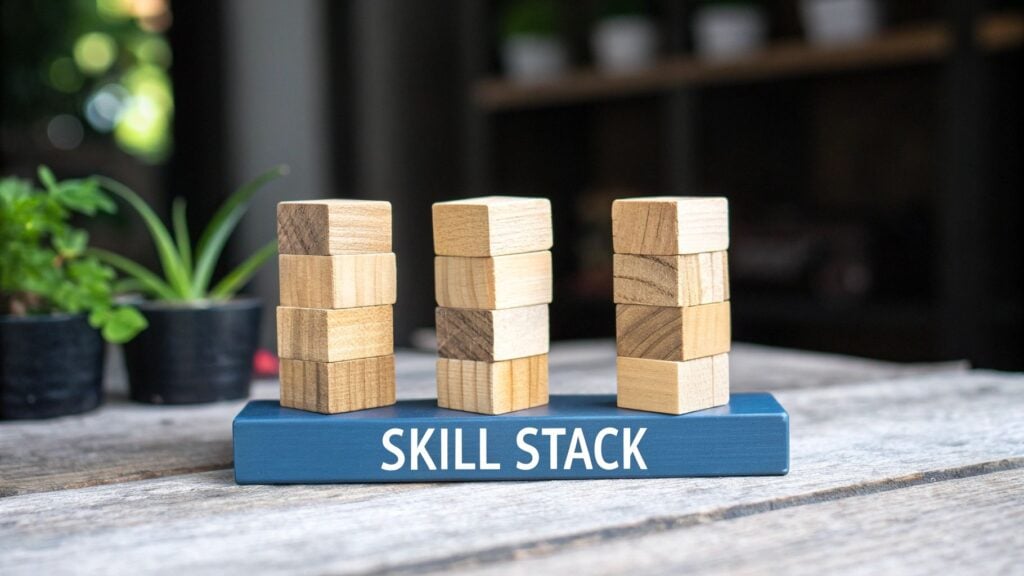
For instance, a course on “Sales Psychology” is powerful on its own. But when you bundle it with “Negotiation Mastery” and “Effective Communication,” you are selling a complete, synergistic skill set that transforms a salesperson into a top performer. The whole becomes far greater than the sum of its parts, which is a compelling value proposition for any student looking for a real career boost.
How to Implement Skill Stacking Bundles
The goal here is to create a logical learning path where each skill builds upon the last. You need to show students how these skills interconnect to form a powerful professional toolkit. The bundle should feel like a cohesive, intentional program, not just a random collection of courses.
- Identify Complementary Skills: Look at your course catalog and identify skills that naturally reinforce each other. Think about what combination creates a “T-shaped” professional with both broad and deep expertise. For example, a “Product Strategy” course pairs perfectly with “User Research” and “Data Analytics” for aspiring product managers.
- Create a Narrative: Frame the bundle around a specific career outcome. You’re not just listing courses, you’re selling the transformation. For example, a “Copywriting Fundamentals,” “Conversion Psychology,” and “Email Marketing” bundle becomes the “Become a High-Converting Email Marketer” program.
- Showcase the Synergy: Explicitly explain why this specific combination is so powerful. Use your sales page to detail how each skill amplifies the others. Show how they lead to better results than if they were learned in isolation.
Actionable Tips for Success
To make your skill stacking bundle irresistible, you need to connect the dots for your students. Create a visual “skill tree” or a roadmap that illustrates how the individual skills link together. Show how they build toward a larger, more valuable capability. This helps learners see the journey you’ve designed for them.
Another powerful tactic is to include a capstone project. This project should require students to use all the skills from the bundle at the same time. This provides tangible proof of their new, combined expertise. Also, add bonus materials like integrated templates or a “Skill Integration Workshop” module that specifically teaches students how to weave their new abilities together in real-world scenarios. This elevates the bundle from a simple package to a truly transformative learning experience.
5. The Time-Based (Cohort) Bundle
A powerful way to rethink course bundling is to package your content by time. The time-based, or cohort, bundle shifts the focus from a self-paced library of videos to a shared, live-learning experience. This technique involves selling a package of courses and resources as a limited-enrollment program. It starts and ends on specific dates, with students moving through the material together.
This approach taps into powerful psychological triggers like scarcity, urgency, and social proof. When enrollment is only open for a short period, it encourages people to act. More importantly, it fosters a strong sense of community and accountability as students learn alongside peers. This can dramatically improve completion rates and satisfaction. It’s a fantastic course bundling technique for sales because you’re selling a transformation, not just information.
How to Implement Cohort Bundles
The key to a successful cohort bundle is structuring it as a complete program or “sprint.” You are creating an immersive event that combines pre-recorded content with live interaction. It guides a group toward a specific outcome over a defined period, like 4 to 12 weeks.
- Define the Curriculum: Bundle together courses that logically follow a learning path. For example, a “Web Developer Accelerator” cohort could bundle courses on HTML, CSS, JavaScript, and React.
- Set a Schedule: Establish a clear start date, end date, and a weekly schedule. This might include releasing one course module per week, followed by a live group Q&A or a workshop.
- Integrate Live Elements: This is the core of the cohort model. Include weekly group coaching calls, expert guest sessions, or interactive workshops to support the pre-recorded material. This live access is a major selling point.
- Build a Community Hub: Use a platform like Discord, Slack, or Circle for students to interact, ask questions, share their work, and support each other. This peer-to-peer connection is invaluable.
Actionable Tips for Success
To make your cohort bundle a success, focus on building anticipation and creating a supportive environment. I’d recommend starting to market your cohort 2 to 3 weeks before enrollment opens to build a waitlist. You can learn more about crafting a successful program by exploring the fundamentals of building cohort-based courses. A great tactic is to limit enrollment to maintain a strong community feel. Somewhere between 50 and 200 participants is often a sweet spot.
Beyond just the cohort model, you can layer on other time-sensitive incentives. For instance, leveraging early bird ticket strategies can create a surge of initial sign-ups and build momentum for your launch. Finally, create an “alumni” community for graduates to network and access future perks. This adds long-term value and encourages word-of-mouth marketing for your next cohort.
6. The Problem-Solution Bundle
A powerful way to frame your offerings is to start selling solutions. The Problem-Solution Bundle organizes your content by the specific, urgent problem it solves for your audience. This technique reframes your educational content as a direct answer to a pain point. This makes the value proposition instantly clear and compelling.
This approach is highly effective because it speaks directly to your customer’s “why.” They aren’t buying a course on “Lead Generation 101.” They’re buying a solution to the problem, “I can’t generate enough leads.” This shift in positioning makes your bundle feel more like a necessary investment in their success.
How to Implement Problem-Solution Bundles
The key is to identify a single, significant problem your target audience faces. Then, package 3-5 courses that systematically solve it. Instead of leading with course titles, lead with the problem. For example, a bundle for sales professionals is “The Cold Outreach Conversion Kit.”
- The Prospecting Problem Bundle: Solves the challenge of an empty pipeline. This could include courses on lead sourcing, cold emailing, and LinkedIn outreach.
- The Objection Handling Bundle: Addresses the pain of losing deals at the final stage. It might bundle courses on negotiation, common sales objections, and closing techniques.
- The Sales Pipeline Problem Bundle: Targets the issue of disorganized and leaky sales funnels. It could combine courses on CRM management, sales process optimization, and forecasting.
Actionable Tips for Success
Start your bundle’s sales page by agitating the problem. Use a headline like, “Tired of Staring at an Empty Sales Pipeline?” before you even mention the courses inside. This immediately qualifies your audience and makes them receptive to your solution.
Use outcome-focused language for everything. Rename course modules from “Introduction to Prospecting” to “From Zero Leads to an Overflowing Pipeline.” Include specific metrics and results guarantees, such as “Our students increase their close rate by an average of 23%” or “Resolve your lead-gen issues in 30 days or your money back.” This builds trust and positions your bundle as a tangible tool for transformation.
7. The Tool-Specific Bundle
A highly effective and practical course bundling technique is to center your packages around a specific software, platform, or tool. This strategy involves creating a comprehensive curriculum that guides a student from beginner to expert on a single, in-demand system. Think of bundles like the “Complete Salesforce Administrator Path” or the “Adobe Creative Cloud Mastery Suite.”
This approach works because professionals constantly need to learn specific tools to get hired, earn a promotion, or improve their workflow. A bundle that promises complete mastery of a critical platform is an incredibly compelling offer. It removes the guesswork for students, giving them a clear, structured path to gaining a valuable, job-ready skill.
How to Implement Tool-Specific Bundles
The goal is to create an all-in-one resource that becomes the go-to training for that specific tool. You want your bundle to be so thorough that students won’t need to look anywhere else.

- Foundation Course: Start with the basics. This course should cover setup, core features, and the fundamental concepts of the tool.
- Advanced Modules: Build on the foundation with courses on advanced features, strategic use cases, and complex workflows. This is where you demonstrate deep expertise.
- Integration and Ecosystem: Include content showing how the tool works with other popular platforms. For example, a HubSpot bundle could include a mini-course on integrating it with Salesforce or Zapier.
- Certification Prep: If applicable, offer a final course or module dedicated to helping students pass an official certification exam. This adds immense value and a tangible outcome.
Actionable Tips for Success
To make your tool-specific bundle a standout success, focus on credibility and keeping the content current. Software changes fast, so your curriculum needs to keep up.
A powerful way to build trust is to partner with the software vendor for co-marketing opportunities or an official endorsement. Even without a formal partnership, you can add credibility by including “Version X.Y Compatible” badges on your course materials and committing to regular updates. Create “What’s New” modules that you release quarterly or whenever the tool has a major update. This keeps the content relevant and gives you a great reason to re-engage past students and market the bundle to new ones.
8. The Transformation/Achievement Bundle
One of the most profound course bundling techniques is to start selling a specific, measurable transformation. The Transformation/Achievement Bundle frames your offer as a guaranteed pathway from a defined “before” state to a desired “after” state. It’s about packaging your courses with the accountability, support, and milestones needed to achieve a tangible outcome.

This approach taps into a deep customer motivation: the desire for real change. People don’t just want to learn a skill. They want to become a successful freelancer, launch their first profitable product, or break their sales quota. A transformational bundle promises that result, making it an incredibly compelling and premium offer. It’s the difference between selling a map and selling a guided expedition to a treasure.
How to Implement Transformation/Achievement Bundles
The foundation of this strategy is defining a clear, quantifiable outcome. Your entire bundle should be reverse-engineered from this specific achievement. Ramit Sethi’s Earn1K program is a classic example. It’s about making your first $1,000.
- Define the “Before” and “After”: Be explicit. What is your student’s current pain point, and what will their life or career look like after completing your program? For example, from “struggling to close deals” to “top 10% sales performer.”
- Package for the Journey: This should include everything needed for the transformation: courses, workbooks, accountability groups, milestone tracking tools, and direct support.
- Build in Accountability: Transformation is hard. Include peer groups, coaching calls, or public commitments to keep students on track. Amy Hoy’s 30×500 course does this exceptionally well by fostering a community focused on shipping products.
Actionable Tips for Success
To make this bundle work, you must build trust and prove the transformation is possible. Showcase your results relentlessly.
Use case studies and testimonials that focus on metrics. Instead of a vague “I learned so much,” feature a student who says, “I increased my close rate from 15% to 35% in 90 days.” These specific, documented wins are your most powerful marketing assets.
Consider offering a “transformation guarantee.” This is a bold move, but it shows immense confidence in your system. This could be a promise of achieving a specific outcome (like earning a certain amount) or a full refund. It removes the risk for the buyer and justifies a premium price point. Finally, celebrate milestones throughout the journey to keep motivation high and build a sense of forward momentum.
8-Point Comparison of Course Bundling Techniques
| Bundle | Complexity | Expected outcomes | Ideal use cases | Key advantages |
|---|---|---|---|---|
| The Tiered Bundle Strategy | Medium – pricing strategy & tier management | Higher average order value; increased upsells; broader market capture | Broad audiences; monetization optimization; B2C and B2B packaging | Increases transaction value; caters segments; easy to A/B test |
| The Learning Path Bundle | High – rigorous sequencing & prerequisite management | Higher completion rates; cumulative skill mastery; certification readiness | Career programs; certification tracks; progressive reskilling | Clear progression; improved retention; natural upsell stages |
| The Niche-Specific Bundle | Medium – content tailoring and expert sourcing | Higher conversion within niche; premium pricing; engaged community | Industry- or role-specific training (e.g., B2B SaaS, real estate) | Extremely relevant messaging; defensible positioning; focused audience |
| The Skill Stacking Bundle | High – integrated design and capstone alignment | Multiplied professional value; stronger testimonials; premium pricing | Differentiated career paths; professionals seeking unique skill combos | Synergistic skill gains; hard-to-copy offerings; high perceived ROI |
| The Time-Based (Cohort) Bundle | High – scheduling, live facilitation, cohort orchestration | Significantly higher completion; premium pricing; strong community effects | High-touch training, leadership cohorts, product/growth intensives | Accountability-driven results; recurring launch revenue; real-time customization |
| The Problem-Solution Bundle | Medium – research-led curriculum focused on outcomes | Clear ROI perception; motivated buyers; higher conversion rates | Fixing specific pain points (e.g., prospecting, objections) | Strong outcome-focused marketing; easy-to-understand value; conversion lift |
| The Tool-Specific Bundle | Medium–High – deep tool expertise and ongoing maintenance | Immediate workplace application; certification value; steady demand | Platform mastery, onboarding, tool migrations (Salesforce, HubSpot) | Practical, job-ready skills; low hesitation to buy; good SEO demand |
| The Transformation/Achievement Bundle | Very High – support infrastructure and measurable guarantees | Highest perceived value; premium pricing; powerful testimonials & referrals | Premium coaching programs; career transformations; high-ticket cohorts | Delivers measurable transformation; strong loyalty; justifies top pricing |
Your Turn: Pick a Bundle and Get Started
Whew, that was a deep dive into the world of course bundling. We’ve journeyed through eight distinct and powerful strategies, from the straightforward Tiered Bundle to the deeply impactful Transformation/Achievement Bundle.
If there’s one thing to take away from all this, it’s that effective bundling is about creating a strategic package. It’s an art form that, when you master it, can dramatically increase your revenue and, more importantly, deliver superior results for your students.
You now have a complete toolkit of course bundling techniques for sales at your disposal. You’ve seen how to guide students along a clear educational journey with a Learning Path Bundle and how to solve their most pressing issues with a targeted Problem-Solution Bundle. You understand the psychology behind creating irresistible offers and the mechanics of packaging them for maximum impact.
From Information to Action: Your Next Steps
Feeling a little overwhelmed by the possibilities? That’s perfectly normal. The key is not to try everything at once but to choose the one strategy that feels most aligned with your business right now. Let’s break down how to get started.
1. Take Inventory of Your Assets:
First, look at what you already have.
- List all your existing courses, workshops, and digital products.
- What are your most popular or highest-rated courses? These are your star players.
- What topics do your students consistently ask for more help with?
2. Analyze Your Audience:
Next, think about your ideal student.
- Are they beginners who would benefit from a foundational learning path?
- Are they advanced learners looking to master a specific tool or stack a new skill?
- What is the ultimate transformation they are trying to achieve by taking your courses?
3. Choose Your “First-Draft” Bundle:
Now, match your assets to your audience’s needs. Pick one of the eight strategies we talked about that feels like the easiest and most logical first step.
- For a quick win, consider the Problem-Solution Bundle. You likely already know a major pain point your audience has. Package the solution.
- If you have a clear progression of content, the Learning Path Bundle is a natural fit.
- If you want to create urgency and community, experiment with a Time-Based (Cohort) Bundle.
A Key Insight to Remember: Your first bundle doesn’t have to be perfect. Think of it as version 1.0. The goal is to get it out there, gather data, and see how your audience responds. You can always refine it later.
Why This Is More Than Just a Sales Tactic
It’s easy to view bundling as just another way to get more revenue out of your business, but that’s a limited perspective. When you use these course bundling techniques thoughtfully, you are fundamentally changing the value you offer your students.
You stop being a seller of individual courses and become a curator of solutions. You provide a more complete, holistic learning experience that saves your students time, money, and the mental energy of figuring out what they need to learn next. This builds immense trust and positions you as the go-to expert in your niche.
Your students get better outcomes because they have a clearer path to success, and you build a more sustainable and profitable business. It’s a true win-win scenario.
So, the only question left is: which bundle will you build first? Take a moment, review the strategies, and pick the one that sparks an idea. Sketch it out, give it a compelling name, and start building an offer your audience can’t wait to buy. The path to higher sales and happier students is right in front of you. Go for it.