10 E Learning Advantages You Can’t Ignore

Hey there, Jason Webber from LearnStream here. If you’ve been around the education or corporate training space lately, you’ve probably noticed that e-learning isn’t just a trend anymore, it’s a total game-changer. It feels like every day I’m seeing new ways people are using online courses to upskill, switch careers, or just learn something fun.
But what’s really behind this big shift? It’s more than just convenience. The fundamental e learning advantages are reshaping how we acquire knowledge, both personally and professionally. I wanted to dig into the real, practical benefits that are making so many people choose digital learning.
As more individuals and organizations embrace the digital classroom, it becomes really important to understand the strategies that make online education truly effective. Discover the 10 best practices for online teaching that boost engagement and learning outcomes.
In this guide, we’re going to break down the 10 biggest advantages that are making this happen. We’ll explore everything from cost savings and flexibility to data-driven insights and better knowledge retention. Whether you’re a course creator yourself, a training manager, or a lifelong learner, I think you’ll find some powerful insights here. Let’s get into it.
1. Flexibility and Self-Paced Learning
One of the most significant e learning advantages is the incredible flexibility it offers. Traditional education operates on a fixed schedule, but e-learning breaks free from those constraints. It empowers learners to access content anytime, anywhere, and on any device.
This means a professional can complete a certification module during their commute on a train, or a parent can study after their children have gone to bed.
The power of this model is that learning fits into life, not the other way around. Learners can progress at their own speed, pausing to absorb complex topics or rewinding videos to clarify a point. This self-paced approach accommodates different learning styles and prior knowledge levels, ensuring no one is left behind or held back.
Making Flexibility Work for You
This freedom is a huge benefit, but it also requires self-discipline to be effective. Without a structured plan, it’s easy to fall behind. Here’s how you can make the most of a flexible learning environment:
- Create a Schedule: Treat your e-learning course like any other important commitment. Block out specific times in your calendar for studying and stick to them.
- Break It Down: A 10-hour course can feel daunting. Break it into manageable, 30-minute chunks you can tackle daily. This makes the goal feel much more achievable.
- Set Up a Dedicated Space: Designate a specific area for your studies. A dedicated space helps minimize distractions and signals to your brain that it’s time to focus.
- Use Reminders: Set deadlines and reminders for assignments and modules. This helps you stay on track and maintain momentum throughout the course.
Deciding between instructor-led and self-paced models depends on your goals and learning style. To dig deeper into this, you can explore the pros and cons of self-paced versus instructor-led learning on learnstream.io.
2. Cost-Effectiveness and Reduced Training Expenses
One of the most compelling e learning advantages is the significant reduction in costs. Traditional learning models are expensive, involving expenses for travel, venue rentals, physical materials, and instructor time. E-learning eliminates many of these overheads, making education and training far more affordable for both organizations and individuals.
For businesses, this means training more employees for less. Companies like IBM have reportedly saved hundreds of millions by shifting to e-learning.
On an individual level, learners can access high-quality courses on platforms like Udemy or Coursera for a fraction of the cost of a university degree or an in-person bootcamp. This model democratizes access to valuable skills and knowledge.
Maximizing Your E-Learning Budget
Lower costs are a major draw, but you can be even more strategic with your spending. Smart planning ensures you get the best value without sacrificing quality. Here’s how to make your budget go further:
- Compare Pricing Models: Don’t just pick the first course you see. Compare subscription-based platforms like LinkedIn Learning with per-course pricing on sites like Udemy to see which offers better value for your needs.
- Utilize Free Trials: Many platforms offer free trial periods. Use them to evaluate the course quality, instructor style, and platform usability before committing financially.
- Look for Bundles and Group Rates: Course creators and platforms often offer discounts for purchasing course bundles or for group enrollments. This is a great way for teams to save money.
- Calculate the Full ROI: The savings are not just about the initial price. Consider the productivity gains from employees learning new skills without taking time off for travel.
Understanding the financial impact is key to justifying any training investment. You can learn more about how to measure the return on investment for training programs on learnstream.io.
3. Personalized Learning Experiences
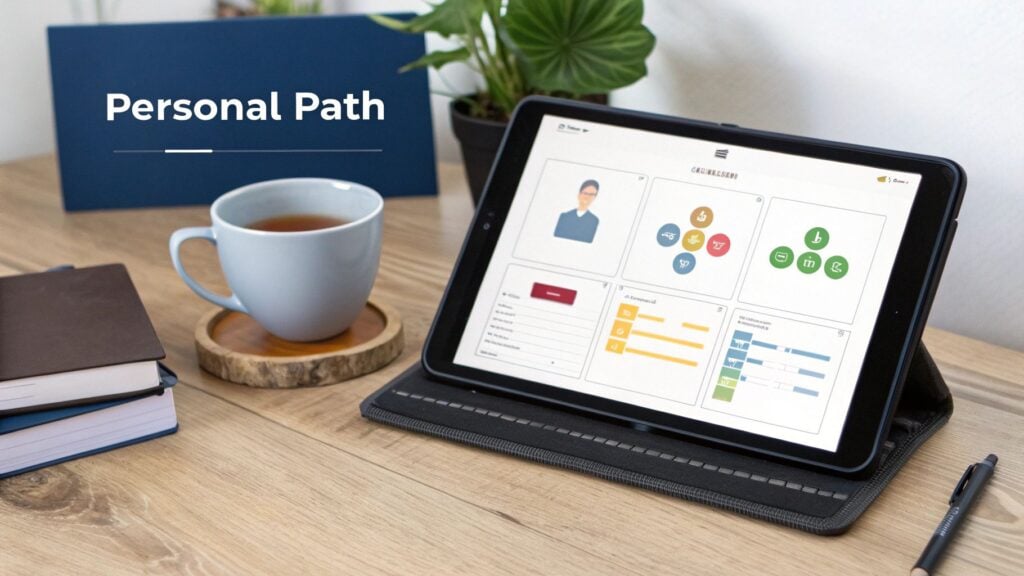
Another powerful e learning advantage is the ability to create truly personalized learning experiences. Unlike a one-size-fits-all classroom, e-learning platforms can use data and AI to tailor content to each individual. This means the learning path adapts based on a person’s skill level, learning pace, and even their specific career goals.
For instance, platforms like Khan Academy and Duolingo use adaptive algorithms to recommend next steps, ensuring learners are always challenged but never overwhelmed.
This personalized approach makes learning more efficient and engaging. Instead of sitting through topics they already know, learners can focus on areas where they need improvement. By offering personalized and self-paced learning, e-learning environments are uniquely suited for training new employees effectively, preventing information overload and boosting retention from day one.
Making Personalization Work for You
A personalized path can accelerate your learning, but you need to engage with the system to get the most out of it. Here’s how you can leverage adaptive learning:
- Complete Initial Assessments: Take any pre-course assessments seriously. Your honest answers provide the baseline data the system needs to build an accurate and effective learning path for you.
- Provide Feedback: Many platforms ask for feedback on content difficulty or relevance. Use these features to help the algorithm fine-tune its recommendations.
- Regularly Review Your Path: Check in on your recommended learning journey. See how it’s adapting to your progress and make sure it still aligns with your goals.
- Combine AI with a Human Touch: Don’t rely solely on the algorithm. Pair the personalized content with guidance from a mentor or instructor to get answers to complex questions and add a human element to your studies.
Personalized learning is a key benefit of modern educational technology. To understand more about its impact, you can explore the benefits of technology in education on learnstream.io.
4. Access to Global Educational Resources and Expertise
One of the most transformative e learning advantages is the way it dissolves geographical boundaries. Before, access to world-class education was often limited by your location. Now, e-learning platforms connect you with top-tier courses and instructors from anywhere in the world, democratizing access to specialized knowledge that was once out of reach.
This global classroom means a student in a small town can learn machine learning from a Stanford professor, or an entrepreneur in Southeast Asia can take a business course from a Wharton expert.
Platforms like Coursera and edX partner with elite universities, bringing Ivy League-level instruction to your laptop. It creates a rich, diverse learning environment where international perspectives and best practices are just a click away.
Making Global Learning Work for You
Tapping into this global pool of knowledge is empowering, but it helps to be strategic. You need to navigate different cultures, languages, and time zones effectively. Here’s how you can make the most of a global learning environment:
- Verify Credentials: Before enrolling, always check the reputation of the institution and the credentials of the instructor. Look for reviews and see what other learners have experienced.
- Join International Groups: Engage in course forums or find study groups on social media. Collaborating with peers from different countries provides diverse viewpoints and invaluable support.
- Manage Time Zones: If a course includes live sessions or webinars, be mindful of time zone differences. Use a world clock tool to add these events to your calendar correctly so you don’t miss out.
- Leverage Translation Tools: Don’t let language be a barrier. Use browser extensions or built-in platform features to translate content, captions, and forum discussions if needed.
For those looking to explore courses from some of the world’s most prestigious institutions, a great place to start is MIT OpenCourseWare, which offers a vast library of materials completely free.
5. Improved Knowledge Retention and Learning Outcomes
One of the most powerful e learning advantages is its ability to make learning stick. Traditional lectures often lead to passive information intake, but e-learning flips the script by using interactive and multi-sensory tools. By engaging learners through videos, quizzes, simulations, and gamified elements, it activates multiple parts of the brain, significantly boosting knowledge retention.
The results are impressive. Research shows that interactive e-learning can improve retention rates by 25-60% compared to classroom settings.
Platforms like Duolingo use gamification to keep users engaged for over 30 minutes daily, while medical schools use VR simulations to help students master complex surgical skills in a risk-free environment. This active, hands-on approach ensures that information is truly understood and retained.
Making Retention an Active Process
Better retention doesn’t happen automatically. It requires active engagement from the learner. To get the most out of an interactive course, you need to participate fully. Here are a few ways to make sure the knowledge sticks:
- Engage with Everything: Don’t just watch the videos. Actively participate in all interactive elements, including quizzes, drag-and-drop exercises, and simulations.
- Take Quizzes Repeatedly: Use practice quizzes as learning tools, not just assessments. Retake them until you consistently score well to reinforce key concepts.
- Teach Someone Else: The best way to solidify your understanding of a topic is to try and teach it to another person. This forces you to organize your thoughts and identify any gaps in your knowledge.
- Mix Passive and Active Learning: Combine watching a lesson with taking notes or immediately applying the skill. For example, after a coding tutorial, write the code yourself without looking.
This active approach to learning is ideal when you need to master practical skills or complex information that requires deep understanding. To see how interactive exercises can make a huge difference in skill acquisition, check out the hands-on learning model at Codecademy.
6. Scalability for Organizations and Mass Education
Another key e learning advantage is its incredible scalability. Unlike traditional classrooms with physical capacity limits, e-learning platforms can train thousands or even millions of learners simultaneously without a proportional increase in costs. This allows organizations to roll out company-wide training seamlessly and enables educational institutions to offer courses to a global audience.
This model transforms how education and training are delivered. A company like Google can launch its Career Certificates and reach hundreds of thousands of learners globally, a feat impossible with in-person classes.
Similarly, during the COVID-19 pandemic, e-learning platforms allowed millions of students to continue their education without disruption, demonstrating the power of scalable digital infrastructure.
Making Scalability Work for You
Scaling your e-learning offerings requires more than just opening enrollment. You need a robust system to handle the increased demand while maintaining quality. Here’s how to manage large-scale learning effectively:
- Invest in Reliable Infrastructure: Your learning platform is your foundation. Choose a system known for its stability and ability to handle high traffic, especially during peak usage times.
- Automate Assessments: Manually grading thousands of assignments is impractical. Use automated quizzes, multiple-choice exams, and peer-review systems to provide instant feedback and reduce instructor workload.
- Foster Peer Support: Build a community forum or discussion board where learners can ask questions and help one another. This creates a supportive environment and reduces the number of support tickets.
- Leverage Chatbots: Implement AI-powered chatbots to answer common questions about course logistics, deadlines, and technical issues. This frees up human support staff to handle more complex inquiries.
Scalability is crucial for any organization aiming for widespread impact. For a closer look at how modern learning platforms are built to handle massive user bases, check out the architecture behind systems like Open edX, which powers platforms like edX.
7. Enhanced Engagement Through Interactive Multimedia
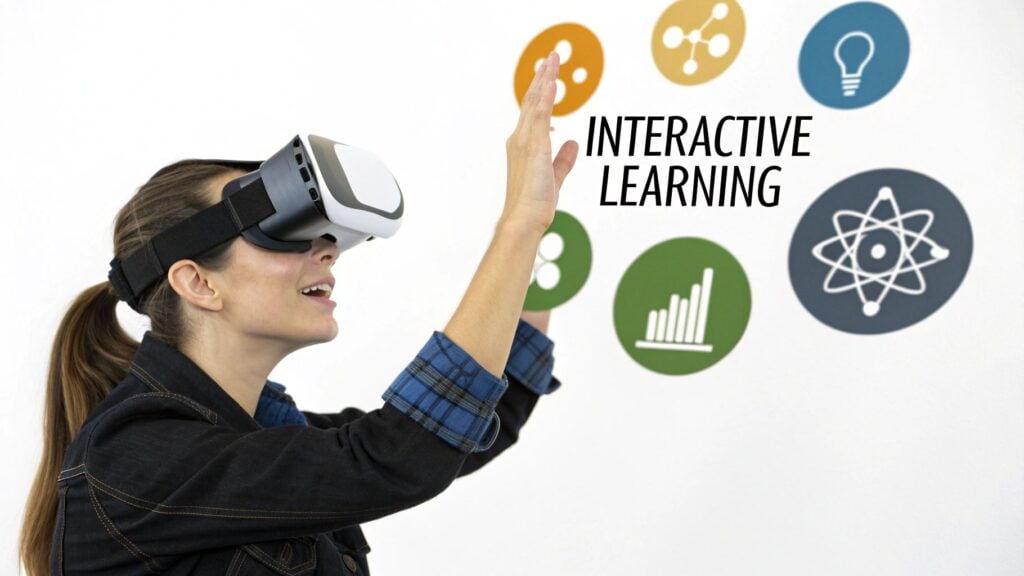
One of the most compelling e learning advantages is the ability to create deeply engaging experiences through interactive multimedia. Unlike traditional text-heavy materials, e-learning platforms leverage videos, animations, interactive simulations, and even virtual reality (VR) to bring concepts to life.
This dynamic approach caters to various learning styles and is far more effective at capturing and holding a learner’s attention.
Imagine a medical student practicing a complex surgical procedure in a risk-free VR simulation or a chemistry student visualizing 3D molecular structures. These immersive experiences make learning active, not passive, leading to better comprehension and knowledge retention. Platforms like Labster and PhET have popularized this by offering virtual labs and interactive simulations that make abstract scientific principles tangible.
Making Multimedia Work for You
Interactive content is powerful, but it must be used thoughtfully to support learning goals rather than just being a distraction. Here’s how to effectively integrate multimedia into your courses:
- Align with Objectives: Ensure every video, quiz, or simulation directly supports a specific learning objective. Ask yourself: does this activity help the learner master a skill or concept?
- Balance Media Types: Mix different types of content to keep things fresh. Combine short video lectures with interactive quizzes, downloadable guides, and hands-on simulations.
- Prioritize Accessibility: Use captions for all videos, provide transcripts, and ensure interactive elements can be navigated using a keyboard. This makes your content inclusive for everyone.
- Check Technical Requirements: Make sure your learners have the necessary internet bandwidth and software to access the multimedia content without issues. Provide clear instructions and support.
This video provides a great overview of how interactive elements can transform the learning journey.

8. Data-Driven Performance Analytics and Progress Tracking
Another one of the key e learning advantages is the ability to gather and analyze vast amounts of data. Unlike traditional classrooms where tracking individual progress can be manual and subjective, e-learning platforms automatically collect detailed information on every learner interaction. This creates a powerful feedback loop for both learners and instructors.
These platforms can track everything from quiz scores and time spent on modules to video engagement and forum participation.
The resulting analytics provide a clear, objective view of performance, revealing who is excelling and who might be struggling. For corporate training, an LMS dashboard can instantly show compliance rates, while in academia, predictive models can flag at-risk students before they fall behind, allowing for timely intervention.
Making Analytics Work for You
Harnessing this data effectively is crucial for improving learning outcomes, but it requires a thoughtful approach. Here’s how you can make the most of performance analytics:
- Establish Clear Metrics: Before launching a course, define what success looks like. Align your key performance indicators (KPIs) with specific learning objectives, such as course completion rates or competency mastery.
- Identify Improvement Opportunities: Use the data to refine your content. If a large number of learners are failing a specific quiz or re-watching a certain video, it’s a sign that the material may need clarification.
- Share Results Transparently: Provide learners with access to their own progress dashboards. This empowers them to take ownership of their learning journey and see where they need to focus their efforts.
- Balance Data with Feedback: Quantitative data tells you what is happening, but qualitative feedback from learners tells you why. Combine analytics with surveys and direct conversations to get the full picture.
To see how modern platforms are implementing these tools, you can look at the features offered by systems like Canvas by Instructure, which provide robust analytics for educational institutions.
9. Consistent Quality and Standardized Content Delivery
One of the most powerful e learning advantages is the ability to deliver a completely consistent message. In traditional settings, the quality of a lesson can vary dramatically from one instructor to another. E-learning solves this by standardizing the curriculum, ensuring every single learner receives the exact same high-quality information, no matter where they are or who is guiding them.
This creates an equitable learning environment. Think of large-scale corporate compliance training or global educational platforms like Khan Academy. Every user accesses identical modules, videos, and assessments.
This standardization guarantees a baseline level of knowledge and skill acquisition across the board, eliminating discrepancies and ensuring everyone meets the same learning objectives.
Making Consistency Work for You
Standardization is key, but it shouldn’t mean your content becomes stale or rigid. You need a strategy to maintain quality and relevance over time. Here’s how to do it right:
- Audit Your Content: Regularly review your course materials to ensure they are still accurate, relevant, and effective. Schedule quarterly or yearly audits to catch outdated information.
- Use Version Control: Implement a system to track changes and updates to your curriculum. This ensures everyone is working from the most current version and prevents confusion.
- Gather Learner Feedback: Actively seek feedback from your audience. Use surveys and Q&A sessions to identify areas for improvement and refine the content for better understanding.
- Document All Changes: Keep a clear log of all updates made to the course content. This transparency helps instructors and learners understand what has changed and why.
This approach is perfect for certifications, compliance training, or any program where a uniform standard of knowledge is non-negotiable. To see how standardized curricula are used effectively in higher education, you can look at the models used by accredited institutions like Western Governors University (WGU), which relies on consistent, competency-based online programs.
10. Increased Accessibility for Diverse Learners
One of the most powerful e learning advantages is its ability to break down barriers to education. Traditional learning often excludes individuals due to physical location, disabilities, or demanding schedules. E-learning opens the door for everyone by creating a more inclusive and accessible environment where learning can happen on the learner’s own terms.
This model fundamentally democratizes education. A person with mobility challenges can attend a top-tier university program from home, and someone in a remote village can gain critical job skills through a platform like Coursera, which offers courses with captions in over 50 languages.
This ensures that knowledge is not restricted by geography or physical ability, creating equitable opportunities for growth and development.
Making Accessibility a Priority
Building an accessible course isn’t just a good idea. It’s essential for creating a truly effective learning experience. It ensures every single learner feels welcomed and supported. Here’s how you can prioritize accessibility in your own e-learning content:
- Follow WCAG Guidelines: Ensure your platform and content meet the Web Content Accessibility Guidelines (WCAG) 2.1 AA standards. This is the global benchmark for web accessibility.
- Provide Transcripts and Captions: Always include closed captions for videos and provide full transcripts for all audio content. This supports learners who are deaf or hard of hearing and also benefits those learning in a non-native language.
- Offer Multiple Formats: Present key information in various formats. For example, supplement a video lecture with a downloadable PDF summary and an audio-only version.
- Use Accessible Design: Pay attention to color contrast to assist colorblind users, and make sure all course navigation can be completed using only a keyboard.
This focus on accessibility is a core reason why e-learning is so transformative. When you design for the widest possible audience, you create a richer and more impactful learning environment for all participants.
Top 10 e-Learning Advantages Comparison
| Item | Implementation complexity | Expected outcomes | Ideal use cases | Key advantages |
|---|---|---|---|---|
| Flexibility and Self-Paced Learning | Low — standard LMS setup | Greater access and convenience; variable completion | Working professionals, asynchronous training, microlearning | 24/7 access, flexible pacing, repeatable review |
| Cost-Effectiveness and Reduced Training Expenses | Medium — platform selection & integration | Lower per-learner cost, improved ROI | Enterprise training, large cohorts, budget-constrained programs | Significant cost savings, scalable distribution |
| Personalized Learning Experiences | High — AI, analytics, content tagging | Tailored learning paths, higher engagement & retention | Remediation, competency-based programs, adaptive tutoring | Customized pathways, focused practice, efficiency |
| Access to Global Educational Resources and Expertise | Low–Medium — partnerships & localization | Broader course selection, expert instruction | Specialized subjects, international learners, enrichment | Access to top instructors, diverse perspectives |
| Improved Knowledge Retention and Learning Outcomes | Medium — instructional design, interactivity | Higher retention and measurable learning gains | Language learning, technical skills, certification prep | Interactive practice, immediate feedback, spaced review |
| Scalability for Organizations and Mass Education | High — cloud scaling, automation | Massive reach, consistent delivery, lower marginal cost | MOOCs, enterprise-wide rollouts, emergency mass training | Unlimited reach, rapid deployment, cost-efficiency at scale |
| Enhanced Engagement Through Interactive Multimedia | High — VR/AR/simulation production | Increased engagement, improved concept understanding | Labs, simulations, experiential and complex subjects | Immersive experiences, practical practice, motivation |
| Data-Driven Performance Analytics and Progress Tracking | High — analytics pipelines & dashboards | Actionable insights, early intervention, ROI measurement | Compliance tracking, large programs, adaptive learning | Predictive support, data-informed decisions, transparency |
| Consistent Quality and Standardized Content Delivery | Medium — content governance & QA | Uniform learner experience, reliable assessments | Compliance courses, accredited programs, franchised training | Equitable access, predictable quality, easier benchmarking |
| Increased Accessibility for Diverse Learners | Medium — accessible design & testing | Broader inclusion, improved participation | Programs for disabilities, remote learners, multilingual audiences | Inclusive access, assistive support, legal compliance |
So, What’s the Next Step for You?
We’ve journeyed through the core of what makes online education so revolutionary. We’ve seen how the e learning advantages we discussed are not just minor perks. They represent a fundamental shift in how we approach skill development, corporate training, and personal growth.
From the incredible flexibility of self-paced learning to the cost savings that make education more attainable, the benefits are clear. We touched on creating personalized learning paths that speak directly to individual needs, and we saw how data analytics can give us unprecedented insight into learner progress. It’s a powerful combination.
But knowing these advantages is just the first step. The real magic happens when you put them into action.
Turning Knowledge into Action
So, where do you go from here? Instead of feeling overwhelmed by all the possibilities, I encourage you to pick one or two key benefits that resonate most with your immediate goals.
- For Course Creators & Entrepreneurs: Are your students struggling with engagement? Focus on incorporating more interactive multimedia (Item #7). Think about adding a short quiz, an interactive video, or a branching scenario to your next module. The goal is to move learners from passive consumption to active participation.
- For Corporate Training Managers: Is consistent messaging a challenge across your organization? Double down on standardized content delivery (Item #9). Start by creating a single, high-quality onboarding module that every new hire experiences. This ensures everyone starts with the same foundational knowledge, which is a huge win for consistency.
- For Educators & Instructional Designers: Do you want to better support a diverse student body? Revisit the principles of increased accessibility (Item #10). A simple first step could be ensuring all your videos have accurate captions or providing transcripts for audio content. This small effort can make a world of difference for many learners.
The Bigger Picture: Why This Matters
Mastering these concepts means more than just building a better course or a more efficient training program. It’s about creating learning experiences that genuinely empower people. When you leverage these e learning advantages effectively, you’re building confidence, fostering curiosity, and equipping individuals with the skills they need to thrive.
The future of learning is learner-centric. It’s adaptive, inclusive, and incredibly effective. By taking these ideas and weaving them into your own work, you become a key part of that future.
Now it’s your turn. Pick your starting point, take that first small step, and see how the power of e-learning can transform your educational goals. I’m excited to see what you build.