A Friendly Guide to Gamification in eLearning to Boost Engagement

At its core, gamification in eLearning is pretty simple. We’re just borrowing the elements that make games so addictive and applying them to educational content. It’s all about using things like points, badges, and leaderboards to make the learning process more engaging and motivating.
So, What Is Gamification in eLearning, Really?
Have you ever found yourself playing a mobile game for just “one more level” to beat your high score? Or maybe you’ve used a language app like Duolingo and felt a genuine sense of pride from keeping your daily streak alive. That little thrill, that feeling of accomplishment and forward momentum? That’s exactly what we’re aiming to capture with gamification.
This is about strategically lifting the most effective ingredients from games and sprinkling them into our training materials.
Think of it like adding spices to a meal. The educational content is still the main dish, but the game mechanics, our spices, make it far more interesting and easier to digest.
Tapping into Human Nature
The reason this strategy works so well is that it plugs directly into fundamental human psychology. We are hardwired with certain desires that games have perfected satisfying.
- We crave rewards: Earning points for a correct answer gives us instant, positive feedback.
- We need to see progress: A progress bar inching forward shows us how far we’ve come and nudges us to get to the finish line.
- We enjoy a little competition: Seeing our name climb a leaderboard sparks a healthy, natural drive to do better.
- We love to achieve: Unlocking a badge after finishing a tough module feels like a real accomplishment.
By weaving these elements into a standard online course, we can shift the experience from something passive into an active, rewarding journey. The learner stops being a spectator and becomes the hero of their own story.
This approach is a game changer in environments like corporate training, where keeping people focused and engaged is a constant battle. The research backs this up, too. One study found that 83% of employees who went through gamified training felt motivated. That’s a massive leap from the 28% who felt motivated by traditional, non-gamified training.
Ultimately, gamification in eLearning is about thoughtfully designing a more enjoyable and effective path to knowledge. It’s the art of making education feel less like a chore and more like a challenge you’re genuinely excited to take on.
The Real-World Payoff of Gamifying Your Training
So, why bother bringing game mechanics into your training programs? The benefits go way beyond just making learning feel “fun.” The biggest and most immediate impact I see time and again is a massive spike in how engaged learners are and, more importantly, how much they actually remember.
When someone is actively clicking, earning points, and chasing goals, they aren’t just passively watching a video. They’re involved. This active participation turns them from a passive viewer into a motivated player who is genuinely invested in the outcome.
Driving Motivation and Completion Rates
Gamification directly tackles one of the biggest headaches in corporate training, which is keeping people motivated enough to actually finish a course. Simple game mechanics provide the kind of constant, positive feedback that keeps learners pushing forward.
Think about it. A progress bar that’s almost full is a powerful psychological nudge to complete that last module. Earning a badge for mastering a tough concept delivers a tangible sense of accomplishment that a generic “Module Complete” message just can’t match. This consistent feedback loop is exactly what drives higher course completion rates and better performance, and you can see this impact when you calculate the return on investment from training.
This infographic highlights the core elements that consistently motivate learners.
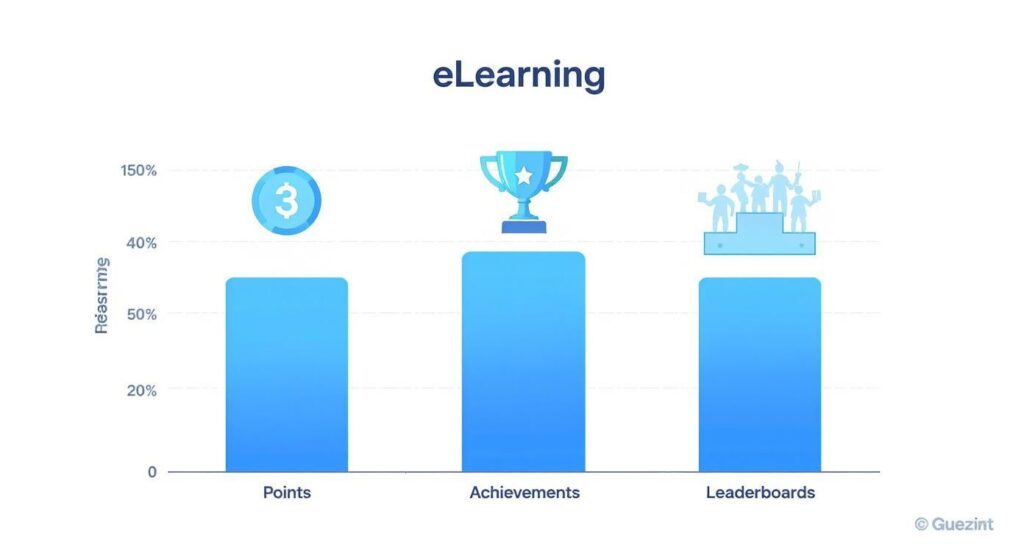
As you can see, these simple mechanics tap directly into our natural human desire for progress, recognition, and a little friendly competition.
Boosting Knowledge Retention and Performance
Ultimately, the whole point of training is for people to learn new skills and actually remember them on the job. This is where gamification in eLearning really pulls its weight.
By transforming learning from a passive chore into an active experience, gamification helps embed information deep into a learner’s long-term memory. It’s the difference between just reading the manual and actually getting your hands dirty.
The data backs this up in a big way. Let’s take a quick look at how gamified learning stacks up against more traditional methods.
Impact of Gamification on Learning Metrics
Here’s a quick look at how gamified learning compares to traditional methods across key performance indicators.
| Metric | Traditional eLearning | Gamified eLearning |
|---|---|---|
| Learner Engagement | Often passive, with lower interaction rates | Active, with high interaction and participation |
| Completion Rates | Varies widely, often below 50% | Consistently higher, with learners motivated to finish |
| Knowledge Retention | Typically 8–10% in classroom-style settings | Can increase to between 25% and 60% |
| On-the-Job Application | Slower transfer of skills | Faster application due to practice and reinforcement |
As the table shows, the improvements are not minor. They represent a fundamental shift in learning effectiveness.
Some research shows that gamification can improve learner performance by nearly 90% compared to old-school, lecture-based methods. It’s a game changer because the material is presented in a context that is both engaging and memorable, making the information stick long after the course is over.
Core Game Mechanics You Can Use Today

Alright, let’s get into the fun stuff. How do you actually start weaving gamification in eLearning? It all starts with understanding the basic building blocks, the core game mechanics that make this whole approach so powerful.
These aren’t super-complex ideas. In fact, you’ve probably run into them hundreds of times in games, apps, and even your favorite coffee shop’s loyalty program. We’ll start with what I like to call the “big three,” simply because they are so effective and surprisingly easy to put into action.
Points, Badges, and Leaderboards
This trio is the bedrock of most gamified systems, and for a simple reason: they tap directly into our fundamental need for feedback, recognition, and a little friendly competition.
Points: Think of points as instant gratification. When a learner gets a question right and immediately sees “+10 points” pop up, it’s a small but potent hit of positive reinforcement. It’s a dead-simple way to track progress and make every correct action feel like a win.
Badges: These are your virtual trophies. Awarding a badge for finishing a tough module or mastering a new skill gives learners a tangible symbol of their achievement. It’s a visual fist-bump that says, “Hey, you accomplished something cool!”
Leaderboards: This is where you bring in the social element. Tossing up a leaderboard with the top performers can spark a healthy competitive spirit, pushing learners to try a little harder to climb the ranks. This works especially well in places like sales training, where competition is already part of the daily culture.
Together, these three elements deliver immediate feedback, tangible rewards, and a social backdrop for learning. It’s a powerful combination that plays right into our core psychological drivers for achievement and status.
Points and badges are great on their own. But when you add a leaderboard, you create a dynamic environment where people are not just tracking their own growth, they’re seeing how they measure up against their peers.
Going Beyond the Basics
While the big three are a fantastic starting point, they’re just the beginning. You can layer in other mechanics to build a richer, more compelling learning journey. These elements often work best when you mix and match them.
For instance, you could tie progress bars directly to the points someone is earning. A learner physically watches their bar fill up as they complete tasks, giving them a clear, visual cue of how close they are to the finish line. It’s a simple trick, but it’s incredibly effective at getting people to complete a course.
Another powerful mechanic is using levels. As learners rack up enough points, they can “level up,” unlocking new, more advanced content or even special privileges. This creates a clear path forward and gives the entire experience a sense of momentum and progression.
Creating a Compelling Narrative
Finally, you can wrap all these mechanics inside a larger story or narrative. Instead of just presenting a series of modules, you can frame the course as a “mission” or a “quest.” The learner becomes the hero who has to overcome challenges (quizzes) and gain new powers (skills) to reach their ultimate goal.
A strong narrative gives context to all the other game mechanics. Earning points is now about gathering the resources needed for the next leg of the journey. For a deeper dive into weaving these kinds of elements together, check out our guide on interactive learning design ideas. And to see how these mechanics are applied in real-world interactive experiences, it’s worth exploring resources on how to make a game app.
How Gamification Works in the Real World
It’s one thing to talk about points and badges, but seeing these ideas in action is where it really starts to click. Let’s look at a few examples of gamification in eLearning that are getting it right, starting with one you’ve probably used yourself.

Think about the language-learning app Duolingo. Its incredible success is because the entire experience is built around powerful game mechanics. The most famous is the daily streak, which taps into our desire for consistency, motivating you to log in every single day just to keep that number growing.
Each correct answer earns you experience points (XP), which in turn pushes you up a weekly leaderboard against other users. This simple system creates a powerful feedback loop of achievement and social competition that keeps millions of people coming back. It’s a perfect case study in how small, consistent rewards can drive long-term habits.
Gamification in Corporate Training
It’s not just consumer apps that have cracked the code. A lot of big companies are now using gamification to make their internal training, especially onboarding, far more effective and a lot less boring.
Instead of handing new hires a massive binder of policies to read (which, let’s be honest, no one does), they’re turning it into an interactive challenge. A new employee might go on a “mission” where they have to answer scenario-based questions about company ethics or data security.
- Correct answers might earn them points or unlock the next “level” of their training.
- A leaderboard could show how all the new hires are progressing, adding a dose of friendly competition.
- Badges could be awarded for mastering key topics like workplace safety or product knowledge.
This approach transforms what is often a dry, forgettable process into an engaging and memorable first impression. More importantly, it ensures critical information is actually absorbed, not just skimmed over.
The goal of these real-world examples is to use proven game mechanics to drive specific, desired behaviors, whether that’s daily language practice or understanding crucial company policies.
Beyond Training and Onboarding
The principles of gamification stretch into many other areas of business, particularly when it comes to keeping customers engaged. To see how these ideas play out in a commercial setting, you can explore how businesses use loyalty gamification platforms. These systems use the same mechanics, points, rewards, and challenges, to encourage repeat business and build much stronger relationships with customers.
Whether you’re teaching someone a new software, training a sales team on a new product, or trying to keep customers coming back for more, these examples show that the right game mechanics can make a world of difference.
Getting Started with Gamification in Your eLearning

Feeling inspired? Awesome. Let’s talk about how to actually bring gamification in eLearning into your own projects. I’ll give you a strategic roadmap to get you thinking like a learning experience designer and pointed in the right direction.
The whole journey starts with a simple but crucial question: what are you trying to achieve? Before you even dream up points systems or leaderboards, you have to get crystal clear on your learning objectives. What specific skills or knowledge do your learners absolutely need to walk away with?
Once you’ve nailed that down, the next step is figuring out who you’re building this for. Knowing your audience is everything.
Know Your Players
Are your learners naturally competitive people who would thrive on a public leaderboard? Or are they more collaborative and would prefer to team up to solve a big challenge? Understanding these motivations is the key to choosing game mechanics that will actually resonate instead of falling flat.
You don’t have to guess, either. A simple survey or a few informal chats can give you a ton of insight into what makes your specific audience tick. This small step can make a massive difference in the success of your gamified course.
The growing interest in this area is hard to ignore. The global gamification market is projected to skyrocket from $9.1 billion in 2020 to $30.7 billion by 2025, and it’s estimated that around 70% of Global 2000 companies are already using it. You can discover more about the gamification market growth and see just how widespread its adoption has become.
Start Small and Build Momentum
One of the biggest mistakes I see people make is trying to do too much, too soon. You don’t need to overhaul your entire curriculum overnight. The best approach is to start small and prove the concept works.
Here’s a simple plan to get you started:
- Pick one module: Choose a single, high-impact module from an existing course. This will be your testing ground.
- Add one mechanic: Introduce something straightforward, like a points system. Award points for completing lessons, watching videos, or acing quiz questions.
- Gather feedback: After learners go through the module, ask them what they thought. Did the points make it more engaging? What could be improved?
This iterative approach lets you learn and adapt without getting overwhelmed. It’s all about building momentum, one small win at a time.
The secret to successful gamification is finding the perfect balance where the game mechanics support and amplify the core learning content, never overshadow it.
To make this happen, you’ll need the right tools. Many modern Learning Management Systems (LMS) come with built-in gamification features, but standalone authoring tools often give you far more creative control. If you’re exploring your options, our guide on the best authoring tools for eLearning can help you find a platform that fits your needs and budget.
Ultimately, remember that the goal is always to enhance the learning. The game elements are the vehicle, but the educational content is the destination. Keep that balance in mind, and you’ll be well on your way to creating truly effective and memorable experiences.
Common Questions About Gamifying Your eLearning
As you start digging into gamification, a few questions always seem to pop up. I get them all the time from clients and colleagues, so let’s walk through the most common ones. Getting these answers straight will give you the confidence to move forward.
Is Gamification a Good Fit for All Training Topics?
This is probably the number one question I hear. The short answer? Pretty much, yes. Gamification is incredibly flexible and can be adapted for just about anything, from highly technical skills development to the driest of compliance training.
The real key is matching the game mechanics to your learning goals and, just as importantly, your audience. For a serious topic like safety protocols, a flashy, competitive leaderboard might feel completely tone-deaf. Instead, you could use progress-based challenges and achievement badges to mark the mastery of critical procedures. It’s all about thoughtful application.
The most effective gamification happens when the game elements directly support the learning objectives. The goal is to make learning more engaging, not to bolt on a distracting game for the sake of it.
Do I Need to Be a Game Designer to Do This?
Absolutely not. You don’t need to go out and build the next Fortnite. Most modern Learning Management Systems (LMS) already have built-in gamification features like points, badges, and progress bars that you can set up with just a few clicks.
Your focus should always be on solid instructional design first. Get a handle on the core principles of what actually motivates your learners, and then use the available tools to support those principles. Think of yourself as a learning experience designer, not a game developer. Your job is to create an engaging path to knowledge. The game elements are just tools in your toolbox.
Will Gamification Distract from the Actual Learning?
This is a totally valid concern. It’s easy to imagine learners getting so caught up in racking up points that they completely miss the point of the training.
But when it’s done right, the exact opposite happens. Effective gamification in eLearning actually enhances the learning experience instead of overshadowing it. The trick is to tie every single game element directly to a learning objective.
- Points should be awarded for answering questions correctly or completing a learning activity.
- Badges should be earned for mastering a specific skill or finishing a tough module.
- Leaderboards should reflect genuine progress through the material, not just how many times someone clicked a button.
When the mechanics are aligned this way, they act as motivators that reinforce the content. The whole point is just to make the process of learning itself more rewarding and memorable, which helps the information stick.