How to Launch an Online Course That Actually Sells

So, you’re ready to launch an online course. The whole process can feel massive, but it really boils down to a clear roadmap. You start by validating your idea, then you move on to designing the curriculum, picking your tech, setting a price, and finally, executing a solid marketing plan.
But here’s the absolute key: you have to confirm that people will actually pay for what you want to teach before you sink hundreds of hours into creating it.
Validate Your Course Idea Before You Build Anything
I know the feeling. You’ve got a brilliant course idea, and you’re just itching to start outlining modules and hitting “record” on your camera. But hold on. Before you dive headfirst into creation mode, let’s hit pause for a second.
The most common mistake I see new creators make is building a course in a vacuum, only to launch to the sound of crickets. It’s heartbreaking, and it’s avoidable.
This first step, validation, is the single most important part of the entire process. Think of it as your insurance policy against a silent launch. It’s where you find out if your great idea is also a profitable one. This phase is about getting real-world proof that people are willing to pay for the transformation you’re promising.
Define Your Ideal Student
Before you can validate anything, you need to know exactly who you’re trying to help. Getting laser-focused here makes everything that follows so much easier, from your marketing messages to the actual content inside your course. Vague ideas like “I want to help small business owners” are just too broad to be effective.
Instead, get granular. A much better target might be, “I want to help freelance graphic designers who are amazing at their craft but totally lost when it comes to finding high-paying clients.” See the difference? That’s a specific person with a very specific, painful problem.
Ask yourself these questions to paint a clearer picture:
- What specific problem are they facing right now? Don’t just say “struggling to find clients.” Dig deeper. Maybe it’s “Relying on low-paying, soul-crushing freelance marketplaces.”
- What outcome do they desperately want? It’s rarely just about the skill you teach. They want to land a promotion, finally start that side hustle, or just feel more confident in their career.
- Where do they hang out online? This is crucial for your marketing later. Are they in certain Facebook groups? Following specific influencers on Instagram? Reading particular blogs?
Find Your Unique Angle by Researching the Market
Once you know who you’re serving, it’s time to see what solutions they’re already turning to. A quick search for courses on your topic might reveal a crowded market, but don’t let that discourage you. A competitive market is a good sign. It means people are already spending money here.
Your goal is to be a better or different course, not the only one on the topic.
Look at 2-3 of the top courses in your niche. Analyze their sales pages, read student reviews (both the glowing and the critical ones), and check out their free content. Before you even think about course creation, it’s vital to validate your idea, much like the initial steps you’d take when you start an online business from scratch.
Your unique angle comes from finding the gaps. Maybe existing courses are too technical for beginners. Maybe they’re too expensive, or they lack any personal support. That gap is where your course can shine.
The e-learning industry is absolutely booming, so you’re entering a massive market. This isn’t just a small side project. The global market is projected to hit about $1 trillion by 2032, showing a massive appetite for quality online education. Even the US market alone was valued at $100 billion in 2022. This kind of growth means there’s plenty of room for new, unique voices like yours.
The Power of the Pre-Sale
Now for the ultimate validation test. The absolute best way to know if someone will buy your course is to, well, ask them to buy it. Before it’s fully built. This might sound terrifying, but it’s the single most effective strategy I know.
Here are two simple ways to pre-sell your idea:
- Launch a Paid Workshop: Offer a live, 90-minute workshop on a small, juicy piece of your course topic. If people pay for the workshop, you’ve not only validated the topic but you’ve also gathered a group of ideal customers you can ask for direct feedback.
- Run a “Beta” Round: Outline your course curriculum and create a simple sales page. Offer a limited number of spots at a significant discount for “founding members” who will get the content as you create it, week by week. In exchange for the low price, they agree to provide valuable feedback. You’ll find more detailed strategies in our complete guide on how to create an online course from scratch.
This approach completely flips the script. Instead of spending months building in silence, you co-create the course with your first batch of students, ensuring it’s exactly what they need. You get early revenue, priceless feedback, and powerful testimonials all before your “official” launch. It’s a total game-changer.
Design a Learning Experience People Actually Finish

Alright, you’ve confirmed people actually want what you’re teaching. That’s a huge hurdle cleared. Now for the fun part: designing the actual learning experience.
This is where a lot of creators stumble. It’s so easy to just film a bunch of videos, throw them behind a paywall, and call it a day. But if you want to create something truly impactful, a course people rave about, you need to think more like a guide and less like a lecturer.
My goal here is to help you create a clear, step-by-step path that leads your students from where they are now to the result you promised. This means focusing on instructional design that keeps people engaged and moving forward. Forget about information dumps. We’re building a journey.
Map Out a Clear Learning Path
Before you ever hit record, you need a blueprint. Think of your course as a roadmap. Your student is at Point A (their current problem), and your course needs to guide them to Point B (their desired outcome). Every single module, lesson, and activity should be a deliberate step on that path.
I like to start with sticky notes or a big whiteboard. First, I write down the final, tangible result a student should have at the end of the course. Then, I work backward, asking myself, “What do they need to know or do right before that?” I keep repeating this process until I’ve mapped out all the major milestones.
Those milestones become your modules. From there, you can break each module down into smaller, bite-sized lessons. Keep each lesson focused on one specific concept or action. This is critical for preventing overwhelm and giving your students a steady stream of small wins as they complete each one.
Go Beyond Just Video Lessons
Video is a fantastic teaching tool, but it shouldn’t be your only tool. Relying solely on “talking head” videos can lead to passive learning, where students watch but don’t actually absorb or apply the information.
To create a more active and engaging environment, you need to mix up your content formats. This simple shift caters to different learning styles and keeps motivation high.
- Worksheets and Action Guides: These are perfect for helping students apply what they’ve learned immediately. A simple PDF checklist or a fillable worksheet can make an abstract concept much more concrete.
- Quizzes: Short, simple quizzes at the end of a module are great for reinforcing key ideas. The goal isn’t a perfect score. It’s to help students check their own understanding before moving on.
- Real-World Projects: Give students a small project to complete. If you teach graphic design, have them create a simple logo. If you teach copywriting, have them write a short email. This moves them from learning to doing.
Combining these elements is a core principle of good course design. For a deeper dive, our guide on online course design best practices has a ton of great ideas.
The secret to a great course is how you structure the experience to build momentum and confidence for your students.
Don’t Underestimate Community and Support
Here’s a simple truth about launching a course that succeeds long-term. Students who feel connected and supported are far more likely to finish and get results.
Traditional self-paced courses often struggle with shockingly low completion rates, sometimes as low as 10–15%.
However, when you add elements like community, coaching, or accountability, those numbers can skyrocket. Programs with structured support can see completion rates climb to 70% or higher. With over a third of American students now having online learning experience, the expectation for this kind of support is only growing.
This doesn’t mean you need to be on call 24/7. It can be as simple as:
- A Private Community Forum: A dedicated space for students to ask questions, share their wins, and help each other out.
- Weekly or Monthly Q&A Calls: Live sessions where you can answer questions in real-time and provide direct feedback.
Adding this layer of support turns your course from a simple digital product into a transformative group experience. It builds a loyal following and creates students who become your most powerful advocates.
Course Engagement Booster Checklist
To help you think through how to bake engagement into your course from the start, I’ve put together this quick checklist. Don’t feel like you need to add everything, but consider which of these tactics would best serve your students and your topic.
| Engagement Tactic | Impact on Completion | Implementation Effort |
|---|---|---|
| Community Forum (Slack, Circle) | High | Medium |
| Live Q&A Calls (Weekly/Monthly) | High | Medium |
| Actionable Worksheets/Templates | Medium | Low |
| Peer Accountability Partners | High | Low |
| Gamification (Badges, Points) | Medium | High |
| Real-World Capstone Project | High | High |
| Regular Email Check-ins | Medium | Low |
Adding just one or two of these elements can dramatically improve how many of your students make it to the finish line and achieve the transformation you promised.
Choosing Your Tech Stack Without the Overwhelm
Okay, let’s talk about the part that makes a lot of new course creators break out in a cold sweat: the technology. Picking the right tools can feel like a huge, complicated decision, but I promise it’s much simpler than it looks. You absolutely do not need a dozen fancy subscriptions to launch a killer online course.
You really only need to dial in on a few key pieces of software that play nicely together. This is your “tech stack.” We’re going to break down the essentials so you can make a smart choice that fits your budget, your tech comfort level, and where you want your business to go.
The whole point here is to build a reliable system that lets you get back to what you do best, which is teaching.
The Core of Your Course: Your Learning Management System
The most critical piece of your tech puzzle is the Learning Management System, or LMS. This is the platform where your students will actually live and breathe your course. It’s where they’ll log in, watch videos, download worksheets, and see their progress. Think of it as your digital classroom.
You’ve got two main paths you can go down here. There’s no single “right” answer. It all comes down to what you value more, simplicity or control.
All-in-One Platforms: These are services like Teachable, Kajabi, or Thinkific. They are built specifically for creators and handle almost everything for you. They’ll host your videos, process payments, and manage all your student accounts under one roof. It’s hands-down the fastest and easiest way to get up and running.
Self-Hosted Options: This route typically means using a WordPress website with a specialized plugin like LearnDash or LifterLMS. You get total control over the look, feel, and functionality of your course site. It can be more affordable in the long run and offers endless customization, but it definitely requires more technical setup on your part.
For most people just starting out, I strongly recommend beginning with an all-in-one platform. The convenience is absolutely worth the monthly fee when you’re focused on launching. You can always migrate to a self-hosted solution later on as your business grows and your needs change.
Picking your LMS is a foundational step, so take your time to explore the options. A crucial step in launching your online course is selecting the right technology, so consider reviewing the best course creation platforms to see a detailed breakdown of the top contenders.
Connecting with Your Audience: Email Marketing Tools
I’m going to say this plainly. Your email list is your single most valuable asset when you launch. It’s the direct line you have to your potential students, letting you build trust and excitement long before you ever ask for a sale.
While some all-in-one platforms have built-in email features, I strongly suggest using a dedicated email marketing provider from day one. These tools give you far more powerful features for segmenting your audience and automating the email sequences that will drive your launch.
Here are a few I’ve seen work well for creators at different stages:
- For Beginners: ConvertKit or MailerLite are fantastic starting points. They are built with creators in mind, making it dead simple to create sign-up forms, tag subscribers based on their interests, and build simple email automations.
- For Growing Businesses: As you scale, you might look at something like ActiveCampaign. It offers more advanced automation and CRM capabilities that can help you manage a more complex sales process down the road.
Don’t overthink this one. Just pick one and start building your list now.
Getting Paid: Payment Processors
Finally, you need a secure and reliable way to actually take money from your students. This piece of the puzzle is often handled directly by your chosen LMS, which makes your life a whole lot easier.
Most course platforms integrate seamlessly with one or both of the two biggest players in the game: Stripe and PayPal.
Both are excellent, secure, and trusted by millions of businesses around the world. When you’re setting up your course, your LMS will usually just ask you to connect your Stripe or PayPal account. From there, it automatically handles the checkout process, enrolls the student, and sends the money to your bank, minus a small transaction fee.
This smooth integration is one of the biggest reasons I tell new creators to use a dedicated course platform instead of trying to rig something up on their own website. It just works.
How to Price Your Course for Maximum Value
Let’s talk about the one question that keeps course creators up at night: “How much should I charge?” This is where so many people get stuck, bouncing between undervaluing their expertise and just pulling a number out of thin air.
But your price is more than just a number. It’s a powerful signal. It tells potential students exactly what kind of transformation you’re promising. We’re going to ditch the guesswork and land on a price that feels like a no-brainer for your ideal student while truly reflecting the value you deliver.
Price the Transformation, Not the Clock
The single biggest mistake I see creators make is tying their price to the length of their course. They fall into the “hours-for-dollars” trap, thinking, “Well, it’s only five hours of video, so I can’t possibly charge more than $100.” That’s a race to the bottom.
Instead of counting videos and PDFs, ask yourself this question: What is the outcome of my course actually worth to my student?
If your program helps a freelance web designer land just one new client worth $3,000, then a $497 price tag suddenly sounds like an incredible deal. If you teach exhausted parents how to finally get their baby to sleep through the night, the value of that outcome is practically priceless. That’s how you price based on value.
Price your course based on the value of the solution you provide, not the amount of content you’ve created. A shorter course that delivers a powerful result fast is often far more valuable than a massive one that just creates overwhelm.
Create Tiers to Give People Options
A fantastic way to boost your revenue and appeal to different types of buyers is by offering a few pricing tiers. This isn’t about being complicated. It’s about letting people choose the level of support they want. It’s a classic strategy that just plain works.
Imagine you’re selling a course on how to launch a successful podcast. A simple three-tier structure could look like this:
- The DIY Kit ($297): This gets them lifetime access to all the core video lessons, worksheets, and checklists. It’s the essential “do-it-yourself” package.
- The Community Access ($497): This includes everything in the DIY Kit, plus access to a private student community and monthly live Q&A calls with you. This adds a critical layer of support and accountability.
- The VIP Accelerator ($997): This is the ultimate, high-touch experience. It includes everything from the Community tier, plus two one-on-one coaching calls to personally review their podcast launch strategy.
This approach lets customers self-select the level of investment and support they need. You’ll find that a surprising number of people will choose the middle “best value” option, significantly increasing your average sale.
Pricing your online course can feel daunting, but it doesn’t have to be a guessing game. By focusing on the value you deliver and providing clear options, you can find a sweet spot that works for both you and your students. To help you navigate this, I’ve put together a quick comparison of the most common pricing models you’ll encounter.
Popular Course Pricing Models Compared
| Pricing Model | Best For | Potential Downside |
|---|---|---|
| One-Time Payment | Signature courses with a clear start and finish. This is the simplest and most common model. | Can be a barrier for those on a tight budget. Revenue is tied directly to new launches. |
| Payment Plans | Higher-priced courses (typically $500+) to increase accessibility and boost conversion rates. | Slightly more administrative work to manage failed payments. Total revenue is slightly lower per student if you don’t add a small fee. |
| Subscription / Membership | Ongoing content, community access, or topics that require continuous learning (like marketing or stocks). | Requires a constant stream of new content and community management to prevent churn. |
| Tiered Pricing | Courses where you can offer different levels of support (e.g., DIY vs. with coaching). | Can sometimes cause decision fatigue if the tiers are not clearly differentiated. |
Each model has its place. The key is to choose the one that aligns with the experience you want to create for your students and the business model you want to run. Don’t be afraid to start with one and experiment as you grow.
Making Payment Easy and Secure
Once you’ve nailed down your price, you need a simple and reliable way to get paid. Thankfully, you don’t need to be a tech wizard to make this happen.
Most modern course platforms like Teachable or Kajabi have payment processing built right in. They integrate directly with the two biggest players in the game: Stripe and PayPal. Both are incredibly secure and trusted by millions. Your platform will walk you through connecting your account, and from there, they handle the entire secure checkout process for you.
One of the easiest ways to increase your sales is by offering payment plans. Breaking a $500 course into three monthly payments of $175 makes your offer feel much more attainable for people on a budget. This simple tweak can dramatically boost your conversion rates, and most platforms let you enable it with the flip of a switch. It might just be the most impactful financial decision you make for your launch.
Your Pre-Launch Marketing Playbook
A killer course launch doesn’t just happen the day you open the doors. The real work, the stuff that builds the unstoppable momentum you see in successful launches, starts weeks, or even months, beforehand. This is where we shift gears from building the product to building an audience that’s genuinely excited to buy it.
I’m going to walk you through a simple but incredibly powerful pre-launch marketing plan. This isn’t about shouting from every rooftop. It’s about being strategic, building real trust, and creating a wave of anticipation that peaks right when your cart opens.
Always Start with Your Email List
If you only take one piece of advice from this entire guide, make it this one: your email list is your single most important asset. It’s a direct line to your most engaged followers, completely unfiltered by fickle social media algorithms. If you don’t have an email list yet, your absolute top priority is to start one now.
Your pre-launch is all about warming up this list. You’re not just going to send a single “Hey, my course is for sale!” email and hope for the best. Instead, you’ll send a carefully crafted series of emails designed to build trust, highlight your audience’s pain points, and tease the solution you’re about to offer.
During a typical 7-day launch window, it’s not uncommon to send 9-11 emails. Don’t be afraid of this frequency. The people who are truly interested will appreciate the reminders and the extra value you’re providing. To keep everyone happy, just add a small link at the bottom of your emails allowing subscribers to opt-out of launch-specific messages while staying on your main list.
Attract the Right People with a Lead Magnet
So, how do you get the right people onto your email list in the first place? With a lead magnet. This is a free, high-value piece of content you offer in exchange for an email address. The key is to make it a perfect “appetizer” for your main course.
Your lead magnet should solve a small, specific problem for your ideal student. Think of it as a quick win.
- If your course is “Mastering Adobe Photoshop,” a great lead magnet would be a “Top 10 Photoshop Keyboard Shortcuts” PDF.
- If you teach a “Beginner’s Guide to Sourdough,” a simple “Sourdough Starter Troubleshooting Checklist” is perfect.
This approach ensures that the people signing up are already interested in your core topic. They are pre-qualifying themselves as potential customers, which makes your launch efforts infinitely more effective.
The process of figuring out your course pricing is a crucial piece of your overall marketing message. This visual breaks down the core steps to consider.
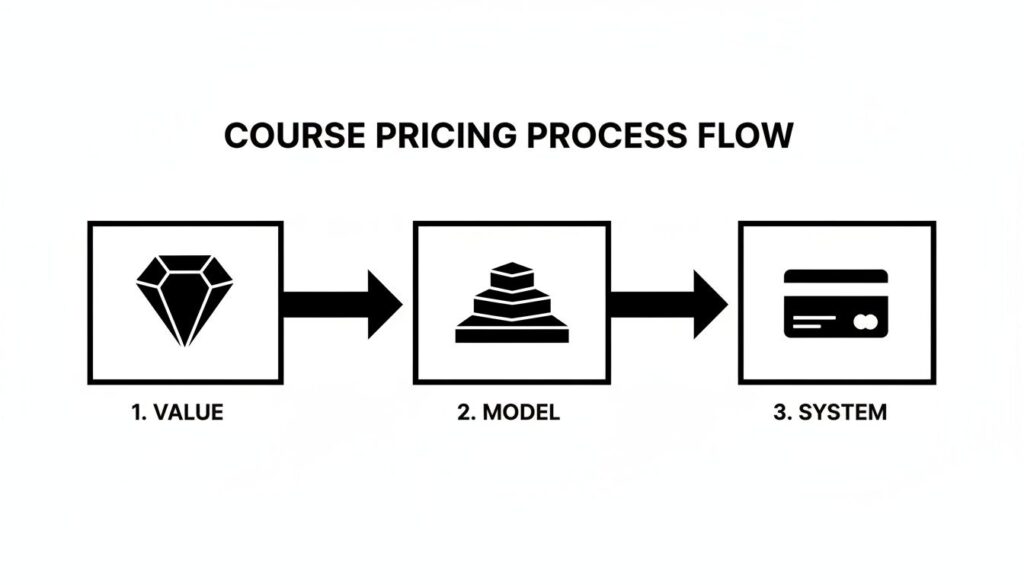
This flow highlights that pricing begins with understanding the value you provide, then choosing a model that fits, and finally implementing a reliable payment system.
Host a High-Value Launch Webinar
Webinars are one of the most powerful tools for launching an online course, period. A live online training allows you to connect with your audience in real-time, teach them something genuinely valuable, and then seamlessly transition into your course offer. It’s an event, and events create excitement and urgency.
Don’t overcomplicate it. A great launch webinar follows a simple, proven structure:
- The Hook (5 mins): Kick things off with a bold promise of what they’ll learn and a quick intro to who you are and why you’re qualified to teach it.
- The Core Content (40 mins): This is where you deliver the goods. Teach three powerful tips or secrets related to your course topic. Give them real, actionable advice they can use immediately. This builds immense trust and positions you as the expert.
- The Transition (5 mins): Connect what you’ve just taught to the bigger journey. Explain that while these tips are great, they’re just the first few steps on a much larger path to transformation.
- The Pitch (10-15 mins): Introduce your course as the complete roadmap to that transformation. Walk them through the modules, the bonuses, the community, and the price. Make your offer crystal clear and compelling.
The goal of your pre-launch is to get people to a decision point. You want them to know, like, and trust you enough to confidently say “yes” or “no” when you finally open the doors to your course.
Many of the most successful launches see a huge spike in sales right after a webinar, especially if you offer a limited-time “fast-action” bonus for attendees who sign up within a few hours. This creates urgency and rewards people for showing up live.
For more ideas on generating buzz, check out our complete guide on how to market online courses. By combining an engaged email list, a targeted lead magnet, and a high-energy webinar, you set the stage for a launch that feels less like a sales pitch and more like an exciting event your audience can’t wait to be a part of.
The Launch Questions That Keep You Up at Night
Alright, you’ve mapped out the perfect plan, your checklists are pristine, but a few nagging questions always seem to surface right before you’re about to hit that big “go live” button. I get these questions all the time from course creators, so let’s tackle them head-on.
Think of this as our final chat before the big week, a quick confidence boost to help you navigate the launch with a clear head. We’ll cover timelines, feedback, and what to do if your first go isn’t the blockbuster you dreamed of.
How Long Should My Launch Actually Be?
When we talk about a “launch,” we’re really talking about two distinct phases. First, you have the pre-launch, which is all about building hype and warming up your audience. This can be anywhere from two to six weeks, depending on how much runway you give yourself.
Then comes the main event: the open cart period. This is the short, focused window when people can actually buy your course. It’s almost always a tight timeframe, usually between five and ten days. This isn’t arbitrary. It creates a healthy sense of urgency that encourages people to make a decision.
For your very first launch, I’m a big fan of a 7-day open cart. It’s the sweet spot. You have enough time to send a few reminder emails and maybe host a live Q&A, but not so long that the energy starts to fizzle out.
What’s the One Metric I Absolutely Have to Track?
It’s so easy to get obsessed with the big, shiny number: total sales revenue. But honestly, the most actionable metric you can track is your sales page conversion rate. This one simple number tells you exactly what percentage of people who landed on your sales page actually clicked “buy.”
If you see a low conversion rate, say, under 1%, that’s a crystal-clear signal that something in your offer isn’t connecting. It could be the price, the sales copy, or maybe a disconnect between what you promised in your marketing and what the offer delivers. Tracking this helps you pinpoint exactly what needs fixing for the next round.
Your sales page conversion rate is the truest measure of your offer’s effectiveness. It removes audience size from the equation and tells you, “Of the people who were interested enough to look, how many were convinced?”
Beyond that, definitely keep an eye on your email open and click-through rates during the launch. These are your real-time indicators of how engaged your audience is and whether your messaging is hitting the mark.
The Launch Is Over… Now What?
First off, take a breath and celebrate. Seriously. You did it! Launching a course is a monumental effort, no matter what the final numbers say.
Once the cart officially closes, your focus needs to pivot immediately to your new students. This post-launch phase is absolutely critical for building a great reputation and keeping refund requests at bay.
Here’s a simple game plan to follow:
- Roll Out the Welcome Mat: Don’t rely on the automated system email. Send a personal welcome that gets them genuinely excited and shows them exactly how to log in and dive in.
- Build a Clear Onboarding: Make sure the very first module is a simple orientation. Show them where everything is, how the course flows, and how they can get help if they get stuck.
- Be Hyper-Present: For the first couple of weeks, be extra visible in your community space (like a Slack channel or Facebook group). Answer every question promptly and encourage students to introduce themselves.
- Ask for Feedback (and Mean It): After about a week or two, send out a simple survey. Ask what they love, what’s confusing, and what could be better. This feedback is absolute gold for your next iteration.
This first group of students is your secret weapon for refining your course and making it even more incredible for the next cohort.
What if My First Launch Doesn’t Hit My Sales Goals?
This is the big one, and I need you to hear this loud and clear. It is completely normal for a first launch not to be a six-figure home run. Please, please do not get discouraged if your numbers are smaller than you hoped.
A launch with even a handful of dedicated students is a massive win. Why? Because you’ve officially proven that people are willing to pay for what you know. You’ve cleared the biggest hurdle in this entire journey.
Now, you get to put on your detective hat and look at the data.
- Did your sales page get enough traffic in the first place?
- Where did people drop off in your email sequence?
- Did you get any comments or emails suggesting the price felt too high or the offer was unclear?
Treat every piece of information as a clue. Every launch, big or small, gives you the data you need to make the next one stronger. Survey the people who didn’t buy, tweak your messaging based on real feedback, and get ready to go again. You’ve got this.