How to Market Online Courses and Actually Get Sales

It’s a classic, painful story. I’ve seen it happen so many times. A course creator pours months of their life into building a truly amazing product, hits “launch,” and… crickets. Why does this happen so often? They almost always skip the most important part: the groundwork.
Marketing an online course effectively doesn’t start with fancy ads or clever social media posts. It begins with a rock-solid foundation. The real key is to deeply understand your ideal student and position your course as the only logical solution to their most painful problems. This foundational work is what makes every piece of marketing you create later actually resonate and, more importantly, convert.
Build Your Foundation Before You Market Anything

Before you even think about writing a single email or designing an ad, you have to get painfully clear on your audience and your message.
This is all about digging deep into the real-world frustrations and aspirations your potential students are dealing with every single day. We’re not just creating some generic “buyer persona” with a cute name like “Marketing Molly.”
Pinpoint Your Ideal Student
Who are you really helping here? Get hyper-specific. Forget “small business owners.” Instead, think “Etsy sellers who are brilliant at their craft but break out in a cold sweat every time they have to look at their finances.”
The more granular you get, the easier it is to speak directly to their soul.
Ask yourself these questions:
- What’s the biggest, most frustrating roadblock that keeps them stuck?
- What have they already tried that just didn’t work (and left them even more frustrated)?
- What does success truly look like for them after they’ve finished your course? What will they be able to do?
Answering these questions is how you shift from selling a boring list of video modules to selling a life-changing transformation. This is a critical step that many people miss when they first learn how to create an online course to sell.
Craft a Compelling Value Proposition
Once you know your audience inside and out, you need to nail down your value proposition. This is just a simple, clear statement explaining why your course is the absolute best solution for them. It becomes the North Star for every marketing decision you make.
A powerful value proposition should instantly answer the question, “Okay, but why should I choose this course over all the others?”
For example, instead of a flat “Learn to bake sourdough,” a much stronger value prop would be: “Master the art of perfect, no-knead sourdough in just 15 minutes a day, even if you have a ridiculously busy schedule.”
The difference is huge. One is a topic. The other is a promise. Your value proposition is the irresistible promise you make to your students.
The e-learning space is exploding. The market value shot up from $165 billion in 2014 to over $316 billion in 2023, and it’s on track to smash $1 trillion by 2032. That means more opportunity, but it also means a lot more noise. A sharp, specific value proposition is your secret weapon for cutting through it all.
To help you get this right, here’s a quick checklist to make sure you’ve covered the essentials before you go any further.
Your Core Marketing Foundation Checklist
| Foundation Element | Key Question to Answer | Why It Matters |
|---|---|---|
| Ideal Student Profile | Who is the one person you can help the most? Be specific. | If you try to talk to everyone, you end up talking to no one. Specificity builds connection. |
| Pain Points & Problems | What specific, urgent problem does your course solve for them? | People buy solutions to their pain, not just information. Your marketing must address this pain directly. |
| Desired Transformation | What is the tangible, desirable outcome they will achieve? | You’re selling a future state, a better version of themselves. Clearly define what that looks like. |
| Unique Value Proposition | Why is your course the best possible solution for this student? | This is your competitive advantage. It’s the core message that differentiates you from everyone else. |
Completing this table is the strategic core of your entire marketing plan. It’s not just a box-ticking exercise.
Getting this foundation right is non-negotiable. From here, every decision you make, from your content strategy to your ad copy, will be smarter, more focused, and aimed squarely at attracting the right people. For a deeper dive into applying this to your promotional efforts, the ultimate social media content strategy guide is a great next step.
Choose Your Marketing Channels Without The Burnout
So you know who you’re talking to. Now, where do you actually find them? The internet is a massive, noisy place, and trying to be everywhere at once is a surefire way to burn out. Trust me, I’ve been there. This is all about working smarter, not harder.
The goal here is to confidently pick just two or three marketing channels you can genuinely master. Spreading yourself thin across ten different platforms is a classic recipe for frustration and mediocre results. You want to go deep, not wide.
Start with Your Strengths and Your Audience
The best marketing channels are the ones that feel natural to you and are where your ideal students already hang out. If you love to write and can explain complex topics clearly, blogging and SEO might be your sweet spot. If you’re a natural on camera, YouTube is a no-brainer.
Think about your course topic, too. A highly visual course on landscape photography is going to crush it on Instagram. On the other hand, a technical course on financial modeling for startups would find a much more receptive audience on LinkedIn or through targeted blog posts that show up on Google.
Don’t just pick a channel because it’s popular. Pick it because it’s the right place to have a genuine conversation with the people you want to help.
Focusing your energy means you can create much better content and build real connections. Remember, a small, engaged audience on one platform is infinitely more valuable than a scattered, uninterested following across five.
The Power Trio: Organic, Owned, and Paid
Let’s break down the main types of channels. I like to think of them in three buckets: organic, owned, and paid. A smart strategy usually involves a solid mix of the first two, with the third one added when you’re ready to pour some fuel on the fire.
Organic Channels: Building for the Long Haul
These are your long-term assets. They take time and consistent effort to build, but the payoff is a steady, reliable stream of leads that you don’t have to pay for directly with ad spend.
- SEO & Blogging: This is my personal favorite for sustainable growth. By creating helpful blog posts that answer the exact questions your ideal students are Googling, you attract highly motivated traffic. Answering a question like “how to learn Python for data analysis” positions you as the expert before they even know you have a course to sell.
- Social Media: This is where you build your community and let your personality shine. Choose one or two platforms where your audience is most active. For a B2B course, that’s almost certainly LinkedIn. For a creative or lifestyle course, it might be Instagram or TikTok. The key is to provide value and engage in conversations, not just broadcast your course link into the void.
- YouTube: Video is incredibly powerful for teaching and building trust. Creating tutorials, behind-the-scenes content, or Q&A sessions can attract a loyal following that already sees you as a credible teacher.
Owned Channels: Your Most Valuable Asset
This is the territory you control completely. No algorithms to fight, no platform risk.
- Email Marketing: Your email list is the single most important marketing asset you will ever build. Full stop. These are people who have explicitly raised their hand and said, “Yes, I want to hear from you.” This direct line of communication is where you build deep relationships and, ultimately, where most of your sales will come from.
Paid Channels: Pouring Fuel on the Fire
Paid advertising is fantastic for getting quick results and valuable data, especially when you’re launching. It’s how you can reach a brand-new audience, fast.
- Paid Social Ads (Facebook, Instagram, LinkedIn): These platforms allow you to get incredibly specific with your targeting. You can target people based on their interests, job titles, companies they work for, or even people who have visited your website but didn’t buy.
- Search Ads (Google Ads): This lets you show up at the very top of Google for specific keywords. It’s powerful because you’re reaching people at the exact moment they are actively looking for a solution to a problem your course solves.
When you’re ready to explore paid options, it’s helpful to get inspired by proven digital advertising campaign ideas to see what’s working for others. Just remember the golden rule: start with a small budget to test what works before you even think about scaling up.
Design a Sales Funnel That Actually Converts
Okay, so you’ve got a fantastic course idea and a good sense of where your people hang out online. That’s a huge head start. But it’s not the whole picture.
You need a reliable system that guides curious visitors toward becoming happy, paying students. Think of it as creating a smooth, gentle path from “Who are you?” to “Take my money!”
That system is your sales funnel. Forget all the confusing jargon, we’re going to keep this simple and practical.
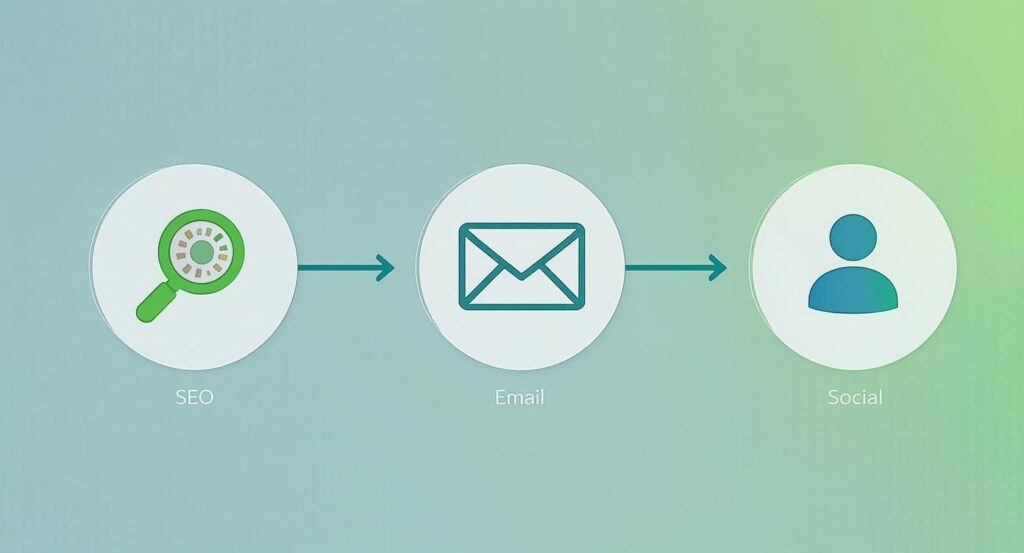
This just shows how everything should work together. Your content, your emails, and your social media presence all feed into one cohesive journey for your future students.
The Three Core Stages of a Simple Funnel
Your funnel doesn’t need to be some complicated, 27-step monstrosity. At its core, it’s just about building trust. Here’s what that looks like in practice.
- Attract with a Lead Magnet: This is the top of your funnel. You offer something valuable for free in exchange for an email address. This could be a detailed PDF guide, a short video workshop, or a powerful checklist that solves a small but nagging problem for your ideal student.
- Nurture with an Email Sequence: This is where the magic happens. Once they’ve given you their email, you send a series of automated messages designed to build a real relationship. You’ll share your story, provide even more value, and prove you understand their struggles.
- Convert with a Sales Page: Finally, you present your course. After building trust through your emails, you direct them to a sales page that clearly explains the transformation your course delivers. A well-designed page is critical here. For inspiration, check out some of the best landing page design ideas for online courses.
This simple process turns cold traffic into warm leads who are genuinely excited about what you have to teach.
Live Launch vs. Evergreen: Which Is Right for You?
One of the biggest questions you’ll face is how to sell your course. There are two main ways to go about it, and the best one really depends on your style and your audience.
An evergreen funnel means your course is always open for enrollment. Someone can find your lead magnet, go through your email sequence, and buy your course any day of the year. Once it’s set up, this is fantastic for creating a steady, more passive income stream.
A live launch, on the other hand, means you only open enrollment for a short period, maybe a week or two. This approach creates a ton of excitement and urgency, often leading to a huge spike in sales.
My advice? Start with a live launch. It forces you to focus your energy, helps you build a ton of buzz, and gets you immediate feedback from your first cohort of students. After one or two successful live launches, you can use what you’ve learned to build a killer evergreen offer.
The demand for online learning is absolutely massive. Enrollment in massive open online courses jumped to around 220 million students in 2021, and that number has only continued to climb. There is a huge audience out there ready to learn from you.
My Pre-Launch Checklist to Build a Waitlist
One of the most powerful things you can do before a live launch is build a waitlist. It’s about creating a pre-qualified group of people who are practically raising their hands to buy the moment you open the doors. This is more than just collecting emails.
Here’s a simple checklist I use to get started:
- Create a “Coming Soon” Page: Set up a simple landing page that teases the course, highlights the main transformation, and has a clear call-to-action to join the waitlist.
- Offer a Waitlist Bonus: Give people a real incentive to sign up. This could be an exclusive discount, a special bonus module, or early access to the course content. Make it juicy.
- Start Talking About It Early: Begin mentioning your upcoming course in your blog posts, social media, and newsletters at least 4-6 weeks before your planned launch date.
- Share Behind-the-Scenes Content: Show people the process of you creating the course. Film a short video of your recording setup or share a screenshot of a module outline. This builds anticipation and makes them feel invested in the journey with you.
This pre-launch phase is just as important as the launch itself. It warms up your audience so you’re not selling to a cold, uninterested crowd. If you want to dive deeper into converting these prospects, learning how to build a scalable sales funnel for LinkedIn can provide a fantastic model that aligns perfectly with selling high-value courses.
Craft an Irresistible Offer and Price With Confidence
Let’s talk about the part that makes most course creators sweat: the money. Setting a price for your course can feel like you’re pulling a number out of thin air, but I promise it doesn’t have to be a guessing game.
The magic is in building an offer so valuable that the price tag feels like an absolute steal to your ideal student. It’s not about the number itself.
Go Beyond Just the Course Content
Your offer is so much more than a collection of video lessons. It’s the entire package, the whole experience you deliver, and this is where you can really set yourself apart. Think about what you could add to dramatically ramp up the perceived value.
A few carefully chosen bonuses can completely change how people see your course, letting you charge a premium price and attract more dedicated students in the process.
Here are a few ideas to get your wheels turning:
- Ready-to-Use Templates: If you teach a skill, give them templates they can use immediately. For a content marketing course, this could be blog post outlines or a slick content calendar.
- Exclusive Community Access: Set up a private space (like a Slack channel or Facebook group) where students can ask questions, share wins, and connect with each other. This feature alone can often be worth the price of the course.
- Live Q&A Calls: Host monthly or bi-weekly group coaching calls where students get direct feedback from you. This adds a powerful element of personal access that pre-recorded videos just can’t match.
- A “Fast Action” Bonus: Offer something special just for the first 24 hours of your launch, like a one-on-one strategy call. It rewards the most eager buyers.
These aren’t just random add-ons. They are designed to help your students get results faster and feel more supported, which is what they’re really paying for.
Choosing Your Pricing Model
Once you’ve stacked the value in your offer, it’s time to put a price on it. There are a few standard models out there, and the right one really depends on your course and your audience.
- One-Time Payment: This is the simplest model by far. Students pay one price upfront for lifetime access. It’s clean, easy to understand, and gives you an immediate cash injection.
- Payment Plan: This breaks the full price into smaller, more manageable monthly payments (e.g., three payments of $197 instead of one payment of $497). This makes your course accessible to more people without devaluing it.
- Subscription or Membership: If you’re providing ongoing content, regular updates, and community support, a recurring monthly or annual fee can be a fantastic option. This creates predictable, stable revenue for your business.
And don’t just think about individual learners. The corporate e-learning market is projected to hit $117 billion by 2025, with a staggering 90% of companies now offering online training. Research shows that businesses using online learning achieve 42% higher revenue per employee, making your course a potentially powerful tool for entire teams. You can find more insights in these corporate online learning statistics on entrepreneurshq.com.
Using Urgency and Scarcity Ethically
Urgency is what helps people make a decision. Without a clear reason to buy now, most people will mentally file it under “later,” which usually means never. The goal here is to encourage action without being manipulative or dishonest.
Your launch offer should feel like an exciting event, not a high-pressure sales tactic. It’s a genuine opportunity for your most eager students to get the best deal.
You can create this ethical urgency by offering limited-time bonuses that disappear when the launch period ends. Or, you could close enrollment entirely after a set period, which is the cornerstone of the live launch model. This isn’t about tricking people. It’s about respecting their time and rewarding those who are ready to take action.
A time-sensitive or enrollment-capped offer provides a clear “why now?” for potential students. This section’s table compares the two most common launch offer structures to help you decide which one best suits your strategy.
Launch Offer Comparison
| Offer Type | Key Feature | Best For… | Example |
|---|---|---|---|
| Time-Based Scarcity | The offer expires on a specific date and time. | Courses with a “live” feel, cohort-based learning, or creating a big launch event. | “Enrollment closes this Friday at midnight, and the special launch bonus disappears with it!” |
| Enrollment-Based Scarcity | The offer is limited to a set number of students. | High-touch programs, courses with a coaching component, or beta launches where you want a smaller group. | “I’m only accepting 50 students into this founding cohort to ensure everyone gets personal attention.” |
Choosing the right structure helps frame your launch in a way that feels both compelling and authentic to your audience. The key is to make the limitation feel like a genuine benefit to the student, not just a sales gimmick.
Turn Happy Students Into Your Best Marketers

Making the sale feels like the finish line, but honestly, it’s just the start. Your most powerful marketing asset is a successful student who is absolutely thrilled with their results. It’s not a clever ad or a viral post. This part of the playbook is all about engineering that success after they click “buy.”
It all kicks off with a killer first impression. The second someone pays, a little voice in their head often whispers, “Was this a mistake?” This is buyer’s remorse, and your first job is to crush that feeling immediately with a fantastic onboarding experience that gets them fired up to start.
Create a Welcome Experience That Wows
Those first few hours in your course are critical. A simple, thoughtful onboarding process can reassure a new student they made the right call and set them up for a win right from the get-go.
Here are a few things that make a world of difference:
- A Personal Welcome Video: Don’t skip this. Record a short, genuine video of yourself. Thank them for joining, give them a quick tour, and point them to the very first step. It instantly humanizes the whole experience.
- Crystal Clear Next Steps: Confusion is the enemy of momentum. Send a welcome email that leaves no doubt about what to do first. Is it “Watch Module 1”? Or maybe, “Pop into the community and say hi”? Be specific.
- Engineer an Early Win: Design your first lesson to give them a quick, satisfying victory. This builds confidence and proves that the transformation you promised is actually achievable.
This initial welcome sets the tone for their entire journey and builds a foundation of trust.
Build a Thriving Student Community
I’m a huge believer in this. A vibrant community is one of the most valuable, and often overlooked, parts of any online course. It turns what can be a lonely, self-paced slog into a collaborative adventure. This doesn’t just boost completion rates. It becomes a goldmine for powerful, authentic testimonials.
When students connect, they hold each other accountable. They troubleshoot problems, celebrate breakthroughs, and often answer each other’s questions before you even see them.
A strong community doesn’t just support students. It becomes a self-sustaining engine for engagement and motivation. This is how you create true fans who will rave about your course to everyone they know.
This shared journey also naturally generates incredible social proof. Seeing other people just like them succeed is wildly motivating and provides the real, human stories you’ll use in your marketing for years to come.
Nurture the Relationship for Future Growth
Once a student finishes your course and gets a great result, the relationship isn’t over. In fact, it’s just getting started. This is your prime opportunity to guide them to their next logical step, transforming a one-time sale into a long-term, profitable relationship.
Think about the customer journey you’re actually creating. What’s the next problem you can solve for them? This opens the door to follow-up offers that provide even more value.
Here are a few pathways you could build:
- An Advanced Course: Create a “Part 2” or a deep-dive program that builds directly on the skills they just learned.
- A Private Membership: Offer a recurring membership for ongoing support, fresh content, and continued access to the community (and to you).
- One-on-One Coaching: For those who want personalized guidance, a premium coaching package is the perfect high-ticket upsell.
By thinking beyond the initial transaction, you build a sustainable business that continuously serves your best students. This is good for revenue, and it’s also the core of how you market an online course for the long haul.
Got Questions About Course Marketing?
I get asked about marketing online courses all the time. To wrap things up, I’ve pulled together some straight-shooting answers to the questions I see pop up again and again. Think of this as your go-to guide for those nagging questions that keep you up at night.
How Much Should I Actually Spend on Marketing?
This is the classic “it depends” question, but let’s put some real numbers on it.
If you’re just starting and leaning into organic stuff like SEO and social media, your biggest investment is sweat equity. Your time. That’s a perfectly good place to start, and many successful creators bootstrap this way.
But when you step into paid ads, a solid benchmark is to set aside 10-20% of your target revenue for marketing. Let’s say your course is $200 and you want to sell 50 spots. That’s $10,000 in revenue. Your ad budget should probably land somewhere between $1,000 and $2,000.
But here’s the most important part: don’t just light that money on fire. The goal isn’t to spend big. The goal is to spend smart.
Start small. Seriously. Test your ads with a tiny daily budget, think $10-$20. See what works. Once you find an ad that’s actually bringing in students profitably, then you can start turning up the dial. This test-and-learn phase is what separates the pros from the people who just burn through their cash.
If I Could Only Pick One Marketing Channel, What Should It Be?
Easy. Email marketing. It’s not even a fair fight.
If I had to build my entire business on a single channel for the rest of my life, it would be my email list. Hands down.
Why? Because it’s the only asset you truly own. Social media algorithms can change on a whim, sending your reach plummeting overnight. Ad costs will always, always go up. But your email list? That’s a direct line to your people. It’s your home turf.
The magic isn’t just in the sending. It’s in the relationship you build. You show up, provide value, share your stories, and build rock-solid trust long before you ever ask for the sale.
The vast majority of my course sales, especially during a big launch, come straight from my email list. A warm, well-nurtured list will outperform cold ad traffic or a random social post every single time. If you’re feeling overwhelmed by all the options, just put your head down and focus on building that list.
How Long Until I Start Seeing Results?
This one is all over the map, and it really depends on whether you’re planting seeds or setting off fireworks.
Here’s a realistic breakdown of what to expect:
- Paid Ads: You’ll get feedback almost immediately. Within a few days, you’ll know if your ads are getting clicks and, more importantly, if those clicks are turning into sales. It’s the fastest way to get data, good or bad.
- Organic Social Media: This is the middle ground. You can start getting some traction and building a community pretty quickly, but turning followers into buyers takes time. Trust isn’t built in a day.
- SEO & Content Marketing: Think of blogging or a YouTube channel as a long-term investment. You need to be patient here. It can easily take 6-12 months of consistent, high-quality work before you start seeing meaningful traffic and leads from search engines.
My advice? Play both the short and the long game. Start building your content library from day one. But for your first launch, don’t be afraid to use paid ads or partnerships to get those crucial initial sales and feedback.
Do I Need a Huge Social Media Following to Sell My Course?
Absolutely not. This is one of the biggest, most destructive myths I hear. I have seen creators with 500 die-hard fans completely crush launches from creators with 50,000 followers who couldn’t care less.
Your follower count is a vanity metric. What actually moves the needle is engagement and trust.
A small, hyper-engaged audience that hangs on your every word is infinitely more valuable than a massive, disconnected crowd. Stop chasing follower counts and start building a real community.
Answer every question. Jump into the DMs. Share value like you’re giving away secrets. You can launch a wildly successful course to a tiny email list or a small Facebook group if the people in it trust you. It’s about the quality of the connection, not the size of the crowd.