Rethinking Learning Styles of Adults for Better Courses
Welcome to the LearnStream blog! My name is Jason Webber, and if you create online courses, you’ve almost certainly run into the idea of different learning styles of adults. We’re often told to label our students as ‘visual’ or ‘kinesthetic’ learners, but I’ve found this popular approach is a bit of a myth. It might even be holding your courses back.
Why We Need a New Approach to Adult Learning
Let’s be honest, the idea of catering to a student’s specific learning style sounds great in theory. The concept is refreshingly simple. If someone is a “visual learner,” just give them videos and charts, and they’ll get it. If they’re an “auditory learner,” podcasts and lectures are the answer. It feels like a quick win for personalization.
But this common way of thinking has some major flaws. The truth is, boxing learners into fixed categories like Visual, Auditory, or Kinesthetic (the VAK model) isn’t backed by any solid evidence. In fact, obsessing over these labels can seriously limit how you design your courses and, more importantly, how much your students actually learn.
Moving Beyond the VAK Model
Instead of trying to match your teaching method to a single, rigid “style,” there’s a much more powerful way to think about this. The real goal is to build flexible, multi-sensory learning experiences that resonate with everyone.
Think of it like a well-balanced meal. You wouldn’t just eat protein for every single meal. You need a mix of different nutrients to be healthy. The same goes for learning.
The most effective courses don’t just cater to one preference. They provide multiple ways for a learner to engage with the material, which strengthens understanding and boosts retention for everybody.
By moving past the VAK model, you can start focusing on what truly matters: creating rich, engaging content that works for the human brain. To get a better handle on these foundational concepts, you can explore our guide on the core principles of adult learning theory.
What to Expect in This Guide
Together, we’ll dive into strategies that make a real difference in your course design. I’ll help you understand:
- Why the “fixed styles” idea is a myth: We’ll look at what the research actually says and why it’s time to let go of this popular misconception.
- Effective, evidence-based learning models: Discover powerful frameworks like Kolb’s Experiential Learning Cycle that are perfect for adult education.
- Practical design strategies: Learn how to create multimodal content that includes video, audio, text, and hands-on activities.
- Smarter personalization: Find out how to customize the learning journey based on a student’s goals and prior knowledge, not some arbitrary style label.
My goal here is to help you build something better. Let’s create online courses that are not just informative but genuinely effective, helping every single one of your students succeed.
Let’s get one thing straight right from the start. You’ve probably been told you’re a “visual learner” or an “auditory learner.” Maybe you even took a quiz that gave you a label. The idea is that we each have one primary, fixed learning style, and we only learn effectively when information is presented in that specific way.
This concept even has a fancy name: the “meshing hypothesis.” It suggests that if we just match the teaching method to a person’s preferred style, learning will magically click into place. It sounds so intuitive, so perfectly logical. But the truth is, there’s a mountain of research that says it just isn’t true.
It’s one of the most persistent myths in education. Despite dozens of studies trying to prove it, scientists have found virtually no credible evidence that tailoring instruction to one specific style actually improves learning outcomes. We all have preferences for how we like to take in information, of course. But a preference is not the same thing as a need.
Why Preferences Aren’t the Whole Story
Thinking about our preferences is a good starting point, but it’s dangerous to stop there. For instance, I might prefer to watch a video to learn how to assemble a new chair, but that doesn’t mean I’m incapable of following a written manual. The nature of the content should be what dictates the best way to teach it, not a learner’s supposed style.
Some topics are just inherently visual. You can’t effectively teach someone the layout of a city without a map. Others are naturally auditory, like learning to distinguish different bird calls. And some things absolutely demand a hands-on approach, like perfecting your golf swing.
Relying on a single “style” is like trying to build a house with only a hammer. A hammer is a fantastic tool, but you’re not going to get very far without a saw, a screwdriver, and a measuring tape. The best learning happens when we use a full toolkit, picking the right tool for the job at hand.
Think of It Like a Balanced Diet
I love comparing this to nutrition. You wouldn’t eat only your favorite food, say, carbohydrates, and expect to be perfectly healthy, would you? Of course not. Your body needs a balanced mix of proteins, fats, and vitamins to function at its best.
Learning works the exact same way. When we engage with material through multiple senses and formats, seeing, hearing, doing, reading, we build stronger, more flexible connections in our brains. This is what actually leads to deep understanding and long-term memory. In fact, a classic study from the National Training Laboratories found that learners retain up to 75% of what they learn by doing, compared to just 10% from passive methods like reading.
This gets to the heart of a much smarter way to think about how adults learn.
- Relying on one mode is limiting. Sticking to just visuals or just text actually creates a weaker learning experience for everyone involved.
- A varied approach is always stronger. Combining video, text, audio, and hands-on activities creates a much richer, more effective, and more memorable environment.
- Let the content guide the format. The best way to teach a concept should be determined by the nature of the concept itself, not a personality quiz.
Once you understand this, it’s incredibly freeing. You can stop worrying about the impossible task of creating three or four different versions of every single lesson. Instead of catering to flimsy labels, you can focus on what actually works: creating engaging, high-quality experiences that use multiple formats to reinforce the same core ideas. This multimodal approach benefits all your learners, no matter what their personal preferences are.
So, if we’re finally ready to kick the VAK model to the curb, what comes next? It’s the million-dollar question, and thankfully, the answer is a good one. There are far more powerful, evidence-backed frameworks that are practically built for designing courses for adult learners.
This is where we fundamentally shift our thinking. Instead of asking, “Is my student a visual learner?” we need to start asking, “How can I help my students experiment, reflect, make sense of this, and then actually apply it?” Making that one small change is a complete game-changer for how you build your courses.
Let’s dive into two of my go-to frameworks. These models don’t just work. They respect the complex, experience-rich ways adults actually learn and give us a much better blueprint for creating courses that get real results.

The big takeaway here is that solid research just doesn’t back up the idea of fixed learning styles. It pushes us toward creating richer, mixed-media experiences instead.
Kolb’s Experiential Learning Cycle
One of the most useful models I’ve ever come across is Kolb’s Experiential Learning Cycle. It’s built on a simple but profound idea: adults learn best by doing. It’s about going through a natural four-stage cycle, not just consuming information.
- Concrete Experience (Doing): This is the hands-on part. Your learner is actively doing something, whether it’s participating in a workshop, tackling a real-world project, or just trying out a new technique for the first time.
- Reflective Observation (Reflecting): After the “doing,” they need to step back and think about what just happened. They might ask, “What went well? What totally surprised me?” This is where journaling or small group discussions become incredibly powerful.
- Abstract Conceptualization (Thinking): Next, they try to make sense of it all. They connect that single experience to bigger ideas, looking for patterns and drawing conclusions. This is where the “aha!” moments happen.
- Active Experimentation (Applying): Finally, they take their new insight and put it to the test in a new situation. They’re trying out their theories to see what works, which, of course, kicks off the entire cycle all over again with a new experience.
This cycle beautifully shows that the learning styles of adults are a dynamic, continuous process, not static labels. As a course creator, your real job is to guide people through all four stages of this loop.
The Power of Andragogy for Adult Learners
Another absolute must-know framework comes from Malcolm Knowles, who pioneered the principles of andragogy, which is basically the art and science of how adults learn. He made the crucial point that adults are not just big kids. Our brains and motivations are fundamentally different, and our teaching methods have to reflect that.
Knowles pinpointed a few core truths about adult learners that are gold for anyone designing a course or membership.
- Self-Directed: Adults need to be in the driver’s seat. They want a say in their goals and how they get there.
- Full of Experience: An adult learner never shows up as a blank slate. They bring a lifetime of experience that you should treat as a valuable resource, not something to be ignored.
- Goal-Oriented: Most adults are learning to achieve a specific goal, like landing a promotion, solving a business problem, or mastering a hobby. They need to see the “why” right away.
- Problem-Centered: Adults are far more interested in learning things that solve immediate problems in their work or life. Theory is great, but application is everything.
When you build a course around these principles, you create an environment where adults feel seen, respected, and motivated. You’re not just a lecturer. You’re a partner in their learning journey. This shift in dynamic is absolutely key for engagement.
Interestingly, while we’re moving past fixed styles, research does show that adults have strong preferences. One detailed study found that kinesthetic, or hands-on, learning was rated highest, with visual methods a close second. But here’s the kicker. The single biggest factor influencing success wasn’t a “style” at all. It was the learner’s motivation, which explained a massive 44.2% of the difference in outcomes. You can discover more insights from the study about adult learner motivation.
Practical Strategies for Multimodal Course Design
Alright, we’ve waded through a lot of theory. Now for the fun part: turning these ideas into a real-world course that actually works better for the adults you’re trying to teach. This is where the rubber meets the road.
The goal is to create what’s known as a multimodal learning experience. It’s a straightforward way of saying you need to offer your content in more than one format. When you give people multiple ways to grasp a concept, you’re not just catering to a preference. You’re actively making the learning stick.
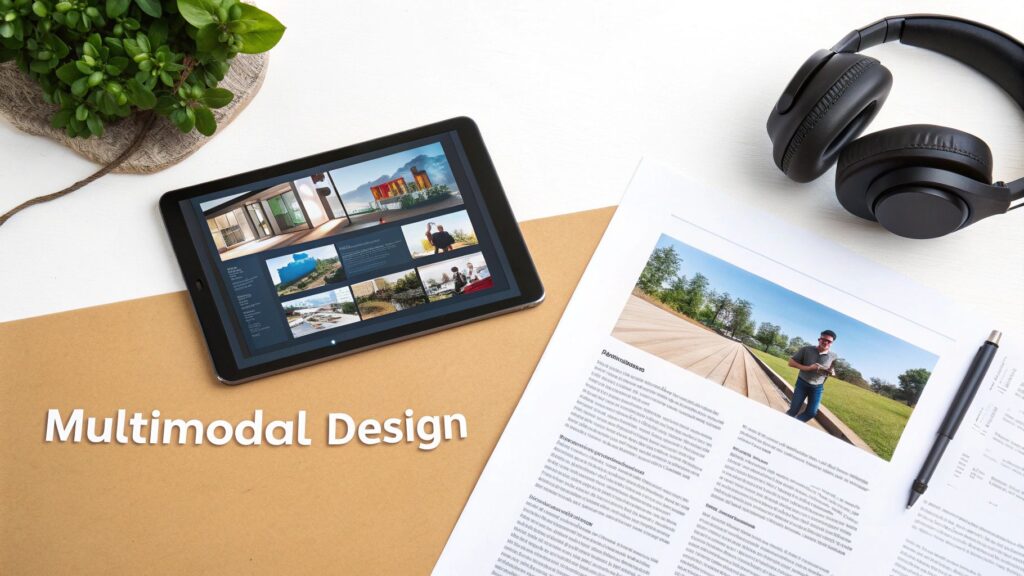
Think of it like this. If someone watches a video, reads a quick summary, and then fills out a hands-on worksheet, they’ve engaged with the same core idea from three different angles. That kind of repetition across different formats is incredibly powerful for memory and long-term retention.
Building Your Multimodal Content Toolkit
So, what does this actually look like in your course? It’s all about creating a rich blend of content for each of your key lessons. You don’t have to create every single one of these for every single topic, but you should aim for a healthy mix.
Here are a few content types you can start weaving into your lessons right away:
- Clear, Concise Videos: Video is fantastic for showing how something is done, explaining a tricky idea visually, or just building a personal connection with your students. Keep them focused and on-point.
- Podcast-Style Audio Lessons: Why not offer downloadable audio versions of your video lessons? This is a game-changer for people who want to learn while commuting, exercising, or doing chores.
- Well-Written Guides and Transcripts: Never underestimate the power of the written word. A detailed guide or transcript lets learners review material at their own speed, search for key terms, and absorb information quietly.
- Interactive Worksheets and Checklists: Give your students something to do. Worksheets, fillable PDFs, and checklists transform passive learning into an active process. They give learners a clear path to apply what they’ve just learned.
- Real-World Case Studies: Adults are wired to solve problems. Show them how your concepts apply in the real world with detailed examples or case studies.
- Quizzes and Self-Assessments: Simple, low-stakes quizzes are a great way for learners to check their own understanding and see how far they’ve come.
To help you get started, here’s a quick checklist to make sure your content design is truly multimodal.
Multimodal Content Design Checklist
| Learning Preference | Content Type Example | Tool Recommendation | Key Benefit |
|---|---|---|---|
| Visual | Step-by-step video tutorials, infographics | Canva, Descript | Demonstrates processes clearly |
| Auditory | Podcast-style audio lessons, expert interviews | Audacity, Riverside.fm | Great for on-the-go learning |
| Reading/Writing | Detailed PDF guides, transcripts, blog posts | Google Docs, Notion | Allows for self-paced review |
| Kinesthetic | Fillable worksheets, project templates, quizzes | Typeform, Jotform | Turns knowledge into application |
This isn’t about doing everything all at once. It’s about thoughtfully choosing a few different formats for each core idea you teach.
An Example of a Multimodal Lesson
Let’s imagine you’re teaching a lesson on “How to Set Up a Simple Email Funnel.” Instead of just recording one long video, you could build a much more powerful learning module.
The Big Idea: The most effective courses create an environment where every student has multiple ways to engage with the material. This simple shift in design is proven to boost both comprehension and long-term retention for everyone.
You could structure your lesson this way:
- A 10-minute video that walks through the funnel setup process on-screen.
- A downloadable audio version of that same lesson for on-the-go listening.
- A step-by-step written guide with screenshots that learners can follow or reference later.
- A fillable worksheet that helps them map out their own email funnel strategy.
- A short quiz at the end to reinforce the key terms and steps.
This layered approach makes your content so much more accessible and effective. It creates a robust learning environment that supports everyone, no matter their situation or immediate preference. For more ideas on structuring your lessons, you can explore some essential online course design best practices.
Of course, your ability to deliver this kind of experience depends on your tech. It’s worth exploring the best platforms for selling online courses to find tools that can handle varied content. Choosing a platform that makes it easy to upload video, audio, PDFs, and quizzes is crucial for putting these strategies into action without technical headaches. The right tool will make building a multimodal experience seamless for both you and your students.
Personalizing the Learning Journey the Right Way

“Personalization” is a word that gets thrown around a lot in online education, and for good reason. When you get it right, your learners feel seen and supported, which is a massive win for keeping them engaged and moving forward. The trouble is, most people’s idea of personalization is stuck in the past, revolving around those faulty learning style labels we’ve been debunking.
True personalization is about something much more practical and respectful. It means understanding where each learner is starting from and what they hope to achieve.
Ditch the Style Quiz for a Goal-Oriented Onboarding
So, what if you swapped out that tired old learning styles quiz for a simple, smart onboarding survey? This isn’t about boxing people into categories. It’s about gathering practical intel you can use to make their journey smoother and more relevant from day one.
You can learn a ton from just a few powerful questions:
- What’s your #1 goal for taking this course? This tells you their core motivation and what a “win” looks like for them.
- How confident do you feel with this topic right now? (e.g., “Total beginner” vs. “I know the basics”). This helps you gauge their actual starting line.
- What’s your biggest challenge related to this topic? This uncovers their specific pain points, showing you where they’ll need the most help.
Just those three answers give you a goldmine of actionable information. Now you can create genuinely personalized learning paths. For instance, you could offer an experienced student the chance to skip the first few intro lessons, while pointing a beginner toward extra foundational resources to build their confidence.
Universal Strategies That Work for Everyone
Beyond custom paths, some of the most powerful ways to personalize a course are actually universal strategies that benefit all learning styles of adults. These methods are powerful because they respect how our brains are actually wired to learn and remember things.
One of the best is building in a tight feedback loop. This just means regularly checking in with your learners through short quizzes, reflection prompts, or quick exercises. The feedback helps them see their own progress, and it helps you see where the group as a whole might be getting stuck.
The most impactful personalization is about providing the right support and the right challenge at the right time, based on a learner’s actual progress and goals, not about creating dozens of unique content paths.
This focus on goals and self-direction is exactly what adult learners want. A landmark Pew Research Center survey found that a whopping 73% of US adults consider themselves lifelong learners. They’re driven by personal curiosity and practical needs, not by arbitrary labels somebody else gives them. You can read the full research about lifelong learning trends to see just how much adults are taking control of their own education.
Microlearning and Spaced Repetition
Two other game-changing strategies are microlearning and spaced repetition.
Microlearning is all about breaking down big, complex topics into short, focused, bite-sized lessons. This simple shift makes the material far less intimidating and much easier to squeeze into a busy adult’s schedule.
Spaced repetition is the practice of revisiting information at increasing intervals over time. Think of it like a smart flashcard system built into your course. When a learner gets something right, the system waits longer before showing it to them again. If they get it wrong, it comes back sooner for review.
Both of these methods are incredibly effective for moving information from short-term to long-term memory, and they work for everyone, regardless of their supposed “style.”
Integrating this kind of smart design is a core part of creating a truly adaptive and effective experience. If you’re looking for platforms that can help you implement these ideas, our guide to the best personalized learning software is a great place to start.
And as you consider more advanced ways to build responsive courses, exploring the latest best AI tools for education can open up even more possibilities for creating dynamic content. This approach respects each learner’s unique journey, boosts their motivation, and ultimately leads to much better results for everyone involved.
Alright, we’ve torn down the old myths. Now it’s time to build something better.
Let’s pull all these ideas together into a practical game plan you can use for your very next course, or to breathe new life into an existing one. Think of this as your new blueprint for creating online learning that actually works for the adult mind.
The goal here isn’t just to make you a better course creator. It’s to help you build a more effective, inclusive, and genuinely engaging learning experience. When you finally ditch the outdated, rigid ideas about so-called “learning styles,” you set yourself up for real success. Your students will get better results, stick around longer, and help you build a thriving educational business.
Your New Course Design Blueprint
Let’s break this down into a few simple, powerful shifts. This isn’t about tossing out everything you’ve built. It’s about making smart, evidence-backed adjustments that deliver huge returns.
Here’s your action plan:
Stop Labeling, Start Supporting: First things first, free yourself from the “visual” vs. “kinesthetic” trap. The research is crystal clear: designing for these labels is a dead end. Let go of the pressure to create multiple versions of your content for different “styles.” It’s a huge relief, honestly.
Go Multimodal by Default: Instead of different versions for different people, create one great version for everyone that includes multiple formats. A single lesson might feature a video walkthrough, a downloadable audio version for on-the-go listening, a written summary with key takeaways, and a hands-on worksheet. This one change makes your course more accessible and effective for every single person.
Make Them Do Something: Remember, adults learn best by applying what they’ve learned. Build in constant opportunities for them to get their hands dirty. This could be as simple as a reflection exercise, as practical as a hands-on project, or as collaborative as a group discussion analyzing a real-world case study. Application isn’t a feature. It’s the whole point.
Personalize the Path, Not the Content: Forget the style quizzes. True personalization is about customizing the learning journey based on a student’s actual goals and what they already know. A simple onboarding survey can tell you everything you need. Use it to understand what they want to achieve, then point them to the most relevant modules first.
The Future of Adult Education
This shift isn’t just a passing trend. It’s part of a massive global movement toward lifelong learning.
Just look at the European Union. Policymakers there are investing heavily in adult education, setting an ambitious target to have 60% of all adults participating in some form of training each year by 2030. You can read more about these adult learning targets on Cedefop.europa.eu. The demand for high-quality, effective adult learning is only going to grow.
By applying these modern principles, you are not just building a better course. You are creating an environment where every adult learner feels respected, supported, and capable of achieving their goals.
Ultimately, this all leads to happier students who get incredible results. And that’s what building a successful, impactful educational business is all about. You now have a plan to create online learning that makes a real, lasting difference.
Got Questions About Adult Learning Styles? I’ve Got Answers.
Here are a few of the most common questions I hear from course creators trying to make sense of learning styles, and what the real science says you should do instead.
What’s The Biggest Mistake Creators Make With Learning Styles?
Honestly, it’s spending way too much time and money trying to build separate learning paths for “visual,” “auditory,” and “kinesthetic” learners. The research is crystal clear on this: it doesn’t actually improve how well people learn. It just creates a mountain of extra work for you with no real payoff for your students.
A much smarter approach is to build one fantastic version of your course that already weaves in a rich mix of elements. When you combine video, audio, text, and hands-on activities into a single, cohesive experience, you end up serving everyone far more effectively. This is called a multimodal approach, and it’s the real secret to creating engaging, memorable content.
How Can I Serve Different Learners Without Building Three Versions Of My Course?
This is the million-dollar question, and the answer is simpler than you think. The key is to offer variety and choice within each lesson, not to create entirely separate lessons. Think in layers.
For any given topic, you can have your core video lesson, but then supplement it with other formats that let people engage on their own terms.
Here are a few dead-simple ideas:
- Offer downloadable audio files of your videos. This is an easy win for anyone who wants to learn while walking the dog, commuting, or doing the dishes.
- Include written transcripts or summaries. Perfect for the student who wants to quickly scan the material for a specific detail or prefers to read and review at their own pace.
- Provide practical worksheets or quizzes. These are fantastic because they shift learning from a passive act to an active one, helping to cement the concepts for literally every type of learner.
This way, you empower your students to interact with the material in the way that best suits them in that moment, all without you having to triple your workload.
Giving learners options is about empowering them to interact with your content in a way that fits their current needs, environment, and goals, not about catering to a fixed “style.”
What’s The First Step I Can Take To Improve My Course Based On This?
A great, low-effort first step is to run a simple content audit on one small piece of your course. You don’t need to tackle everything at once.
Just pick one of your existing modules, maybe one of your most popular ones, and ask yourself this question: “Right now, how many different ways can a student learn this concept?”
If the answer is just one (like, “they can watch a video”), look for the easiest possible way to add a second layer. Could you write a quick checklist? Record a 2-minute audio summary? Create a simple fill-in-the-blank worksheet?
Starting small like this makes the whole process feel manageable. It helps you build momentum and see immediate results without getting overwhelmed by the idea of a massive course overhaul.