
How to Start Making Money with Online Courses

The first, and most important, step in building a profitable online course is landing on an idea people are genuinely excited to pay for. It is all about finding a problem you can solve or a skill you can teach that has real market demand. This is the foundation. Get this right, and everything else gets easier.
Finding a Course Idea People Will Actually Buy
Let’s be real for a second. The hardest part of this whole process is just getting started. I remember staring at a blank page, paralyzed by the thought, “What if I build this whole thing and nobody buys it?” That fear is normal, but we can beat it with a solid plan.
A killer course idea lives at the intersection of three simple things: what you’re good at, what you actually enjoy doing, and what people will open their wallets to learn.
And don’t think your expertise needs to come from a fancy degree. It can be a skill you’ve perfected at your job, a hobby you’ve sunk hundreds of hours into, or a tough problem you figured out how to solve for yourself. That experience is your unique edge.
Brainstorming Your Potential Topics
First things first, let’s dump all those ideas swirling around in your head onto a piece of paper. Don’t filter, don’t judge. Just get it all out.
Need a little help getting the juices flowing? Try these prompts:
- Your Professional Skills: What are you the “go-to” person for at work? Is it whipping up killer presentations, taming complex spreadsheets, or crafting emails that actually get a response? These are marketable skills.
- Your Hobbies and Passions: Are you the friend everyone asks for sourdough tips? A houseplant whisperer? A master of planning epic trips on a shoestring budget? Your passions can be profitable.
- Problems You’ve Solved: Have you successfully navigated a tricky career change, crushed a mountain of debt, or finally learned a new language as an adult? Your personal journey is a roadmap someone else desperately needs.
The goal here is to build a list of options. We are searching for a topic that not only leverages your skills but also gets you fired up to work on it every day.
Validating Your Idea for Free
Once you have a list of potential topics, it’s time for a reality check. We need to find out if anyone else actually cares about this stuff. This validation step is absolutely critical because it saves you from the heartache of building something nobody wants.
The easiest way to do this? Become a fly on the wall. Go to the online places where your potential students are already hanging out.
Search for your topic on Reddit, in Facebook groups, or on forums like Quora. Are people asking questions about it? Are you sensing frustration? What specific pain points keep coming up? If you find active, emotional discussions, that’s a huge green light.
Remember, a course is just one of many digital product ideas for passive income, and validating the demand upfront is the key to making any of them work.
This simple process—brainstorm, validate, then outline—is your path to a solid course idea.
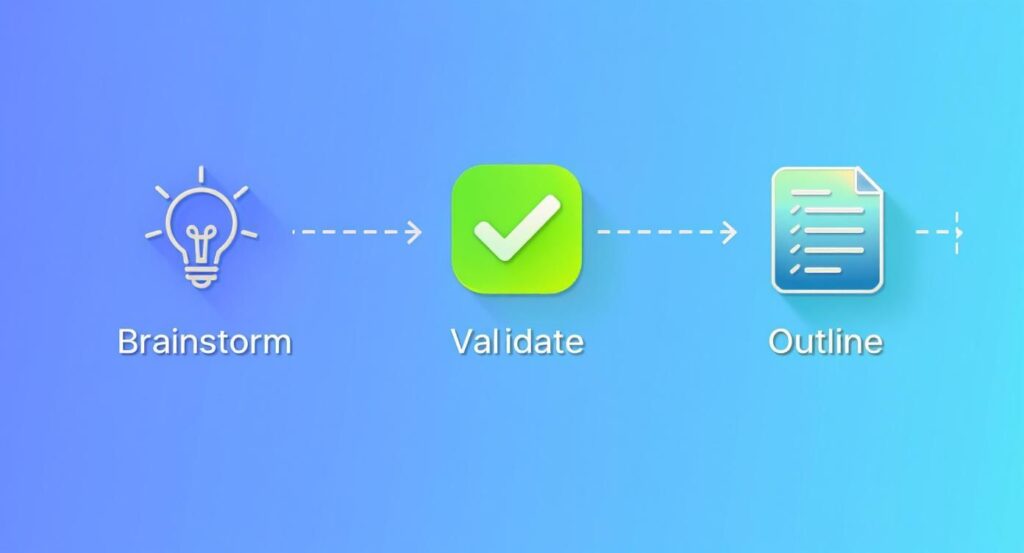
Following these steps ensures you’re building a course the market has already told you it needs, not just one you think people might want.
Choosing the Right Home for Your Online Course

Once your course idea feels solid, you’ll hit your first big technical hurdle: where are you actually going to host this thing? This decision is more than just a logistical detail. The platform you pick shapes your students’ entire experience and your own day-to-day life as a business owner.
I’ve used a handful of different platforms over the years, and trust me, they all have their quirks. The real goal is to find that sweet spot between powerful features, your budget, and how much tech you’re actually comfortable wrangling.
And make no mistake, you’re in the right place. The e-learning market is absolutely exploding. In 2023, the industry hit a global market value of about USD 316 billion. It’s projected to more than double to over USD 661 billion by 2032. This proves the demand for quality online learning is soaring.
All-In-One Platforms
The simplest path to getting your course online is with an all-in-one platform. Think of names you’ve probably heard, like Teachable, Kajabi, or Thinkific. These services are purpose-built for creators like us.
They take care of nearly everything right out of the box:
- Video Hosting: No need to mess with third-party video sites. Just upload your lessons directly.
- Payment Processing: They handle all the tricky sales and transaction stuff securely.
- Student Management: You get a clean dashboard to see who’s enrolled and track their progress.
These platforms are a godsend for beginners because they eliminate a ton of technical headaches. When you’re comparing them, look for ones that allow cool features like integrating interactive videos into platforms like Thinkific, which can seriously boost how much your students engage and retain.
The biggest win with an all-in-one platform is speed. You can go from an idea to a professional-looking, fully functional course in a single weekend without duct-taping a bunch of different tools together.
The Self-Hosted Route with WordPress
The other popular route is to build your course on your own WordPress site. This approach hands you the keys to the kingdom. You get maximum control and flexibility, but it definitely comes with a steeper learning curve.
To make this work, you’ll use a special tool called a Learning Management System (LMS) plugin. Popular ones include LearnDash and LifterLMS. This plugin essentially bolts all the necessary course functionality onto your existing website. You can customize the look and feel to perfectly match your brand, and you typically pay lower transaction fees on your sales.
This path is a fantastic choice if you already have a WordPress site you love or if you’re the type who wants total ownership over every pixel of your platform.
If you’re still weighing your options, our guide on the best platforms for selling online courses offers a much deeper comparison to help you decide.
Comparing Popular Online Course Platforms
Choosing a platform can feel overwhelming, so I’ve put together a quick comparison of the big players to help you see how they stack up. This table breaks down the best use case for each, their pricing models, and one standout feature to give you a clearer picture.
| Platform | Best For | Pricing Model | Key Feature |
|---|---|---|---|
| Teachable | Beginners and first-time course creators | Monthly/Annual Subscription + Transaction Fees | Excellent built-in marketing and affiliate tools. |
| Thinkific | Creators focused on building learning communities | Monthly/Annual Subscription (with a free plan) | Strong community features and student engagement tools. |
| Kajabi | Creators who want a true all-in-one marketing solution | Monthly/Annual Subscription (higher price point) | Includes email marketing, funnels, and website builder. |
| LearnDash | WordPress users who want total control and customization | Annual Plugin License | Deep integration with the entire WordPress ecosystem. |
Ultimately, the “best” platform is the one that fits your specific needs right now. Don’t get paralyzed by the options. Pick the one that feels most manageable and allows you to get your course out into the world. You can always migrate later as your business grows and your needs change.
Pricing Your Online Course for Profit and Value

Alright, let’s talk about the part of this process that makes everyone sweat a little: pricing.
Figuring out what to charge for your course can feel like walking a tightrope. Price it too low, and you devalue all the hard work you’ve poured into it. Go too high, and you might scare away the very people you’re trying to help. I’ve been there, staring at a number on a screen, second-guessing everything.
The truth is, there’s no single magic number. The right price depends entirely on your audience, the transformation you provide, and your own business goals.
And the opportunity is definitely there. The market for online courses is exploding. It’s expected to grow from USD 12.9 billion in 2025 to a staggering USD 49.9 billion by 2035. That’s a massive, growing demand for what you have to offer.
One-Time Payments vs. Subscriptions
Your first big pricing decision is how you’ll actually collect the money. The two most common models are one-time payments and recurring subscriptions, and each has its place.
A one-time payment is simple and clean. A student pays once and gets lifetime access to your course materials. This is a great model for courses with a clear beginning and end, like “Mastering Photoshop in 30 Days.”
On the other hand, subscriptions are perfect if you’re building a community or offering ongoing content. If you plan on adding new lessons every month or providing continuous support, a monthly or annual fee makes a lot of sense. It also creates a predictable, recurring revenue stream for your business, which is an absolute game-changer.
Finding Your Pricing Sweet Spot
So, how do you land on an actual dollar amount?
A good first step is to look at what other courses in your niche are charging, but don’t just copy them. Your goal is to understand the market’s perceived value, not to join a race to the bottom.
Instead, anchor your price to the value of the outcome you provide.
If your course helps someone land a job that pays $10,000 more per year, isn’t that transformation worth at least a few hundred dollars? Pricing based on the value you deliver is always a stronger strategy than pricing based on the length of your videos.
Another powerful strategy is offering tiered pricing. This lets you cater to different types of buyers with different budgets and needs. For example:
- Basic Tier ($97): Just the core course videos and materials.
- Pro Tier ($297): The course, plus a private community and monthly Q&A calls.
- Premium Tier ($997): Everything in Pro, plus one-on-one coaching sessions with you.
This approach gives people options and often bumps up your average order value, as many will naturally gravitate toward the middle tier. It’s a smart way to maximize your profit while delivering tailored value. For a deeper dive into these kinds of strategies, check out our guide on the smart way to price your online course for max profits.
And remember, don’t be afraid to experiment. Your initial price isn’t set in stone. You can always adjust it later based on student feedback and sales data. The key is to start with a price that feels fair to both you and your future students.
Marketing Strategies That Attract Eager Students

Creating a brilliant online course is a huge accomplishment, but let’s be real. It’s only half the puzzle. Now we have to get it in front of the people who actually need it.
The good news? You don’t need a massive marketing budget to start seeing enrollments. When I first started, my ad spend was exactly zero dollars. I had to get creative.
I leaned into a few core strategies that built a real audience and genuine excitement before I ever asked for a sale. This is where your hard work starts turning into real revenue.
Start with Content Marketing
Content marketing will become your best friend as a course creator. It’s the simple act of creating and sharing valuable free stuff—blog posts, YouTube videos, podcast episodes—to attract and engage your ideal students. It is how you build trust and prove you know what you’re talking about.
For instance, if your course is “Launch Your Freelance Business,” you could write blog posts like “5 Mistakes New Freelancers Make” or film a short video on “How to Write a Winning Proposal.” This content gives potential students a taste of the value you provide and shows them you’re the real deal.
It’s a slow burn, for sure. But this strategy builds a rock-solid foundation for your business that paid ads can’t replicate. It is about consistently showing up and solving small problems for your audience, so they trust you to solve their bigger ones inside your course.
Your Email List Is Everything
If you take just one piece of advice from this entire guide, let it be this: start building an email list from day one. I cannot overstate this. Your email list is the single most valuable asset you will ever own in your business.
Why? Because you can’t rely on social media algorithms to show your launch announcements to everyone. Your email list is a direct line to your most engaged followers. These are people who have explicitly asked to hear from you. You own it completely.
The real money is in your list. A random social media follower might see your launch post, but a loyal email subscriber has raised their hand and said, “I want to hear from you.” That attention is priceless.
To turn those subscribers into students, you’ll need a solid sales process. Using an integrated funnel builder can make a world of difference by automating the journey from signup to sale.
Using Social Media the Right Way
Social media isn’t just for posting pictures of your lunch. It’s a powerful tool for connecting with future students on a human level. The key is to figure out where your ideal audience hangs out online. Is it Instagram, LinkedIn, specific Facebook groups, or TikTok? Then show up there authentically.
Don’t just broadcast your course launch. That’s a fast track to getting ignored. Instead, share behind-the-scenes content, answer questions in relevant groups, and just be part of the conversation. The goal is to become a helpful, trusted member of the community. When you do that, people naturally become curious about what you offer.
The timing couldn’t be better. The market for these skills is exploding. By 2025, the U.S. e-learning market alone is projected to be worth around USD 100 billion. That’s a massive opportunity for creators who take the time to build genuine connections first.
How to Scale Your Course for Long-Term Success

Getting that first launch under your belt feels incredible, doesn’t it? You’ve officially proven your concept, and you’re making money online with your own course. But here’s the thing: a successful launch is an event, not a business.
The real goal is to build a system that generates revenue consistently, not just when you’re in the middle of a high-pressure sales push. This is where the mindset shifts from being a course creator to a true business owner. It is all about building assets that work for you 24/7, so your income isn’t chained to the hours you put in.
From One-Off Sales to Lifetime Value
Let me tell you a secret: your existing students are your single most valuable asset. They already know you, they like what you do, and they trust you. That makes them the most likely group of people to buy from you again. So, how can we serve them at a deeper level while also growing the business?
The answer is building out a value ladder. It sounds fancy, but it just means creating additional, higher-priced offers that solve the next problem your students are about to face.
Here are a few ideas to get the wheels turning:
- One-on-One Coaching: For students who want direct access to your brain, offer personalized guidance at a premium price.
- Advanced Workshops: Create a smaller, more intensive workshop that dives deeper into one specific module of your main course.
- A “Done-for-You” Service: If your course teaches a skill (like web design or copywriting), you could offer to actually do that skill for a select few clients who have more money than time.
This isn’t about squeezing every last dollar out of your audience. It is about providing more transformation for those who are hungry for the next step.
Your most successful students are a goldmine of information. They will literally tell you what they want to buy from you next if you just take the time to ask them.
Automating Your Sales and Growth
A live launch model is a fantastic way to start, but it can be absolutely exhausting. To truly scale, you need to build an automated, or evergreen, sales system. Think of it as a funnel that runs 24/7, turning new leads into students without your constant, hands-on involvement.
Typically, this looks like a simple email sequence that kicks off the moment someone downloads your free lead magnet. Over a series of days, you provide real value, build trust, and then introduce the offer for your course. It’s a way to replicate the energy and excitement of a launch, but on autopilot.
Another huge piece of scaling is using social proof. Don’t be shy about asking for testimonials from your happy students! A simple screenshot of a positive comment in your community or a short video testimonial can be incredibly persuasive for potential buyers who are still sitting on the fence.
By putting these systems in place, you create a business that can grow far beyond your direct efforts. You stop trading your time for money and start building a real asset that serves both you and your students for the long haul.
A Few Common Questions About Selling Online Courses
As you start piecing all of this together, questions are going to pop up. That’s a totally normal part of the process. I’ve been asked hundreds of questions over the years, and a few of them come up again and again.
So, here are my honest, no-fluff answers to some of the most common ones I hear about making a real income with online courses. My hope is they give you a little extra clarity and a boost of confidence.
How Long Does It Take to Create a Profitable Course?
This is the big one, and the honest-to-goodness answer is: it depends. Just planning, outlining, and creating the actual content for a solid course can take anywhere from one to three months. It really hinges on how complex your topic is and how much time you can realistically carve out each week.
Now, the “profitable” part is all about your marketing. I’ve seen people make their first sales during a pre-launch before the course was even finished. For others, it might take a few months of consistent effort after launch to see a steady stream of income. The key is to be patient with yourself and stick with the plan.
Do I Need to Be a Video Expert?
Absolutely not. Let me tell you, when I created my very first course, my entire setup was just my smartphone propped up on a stack of books and a simple microphone. You do not need a Hollywood-level budget to succeed.
Today, a good webcam and a decent USB microphone are more than enough to create videos that look and sound perfectly professional.
Your students care way more about the value you’re delivering and the clarity of your teaching than they do about fancy production. Just focus on clean audio and good lighting, and you’ll be golden. Don’t let the tech intimidate you.
What if Someone Else Is Already Teaching My Topic?
Honestly, that’s a fantastic sign. It means you’ve stumbled upon a topic with proven market demand. It is validation that people are already willing to open their wallets to learn about this very subject.
There is absolutely room for you.
Your unique voice, your personal stories, and your specific teaching style are what will make you stand out. No one else on the planet has your exact combination of experiences and perspective. Instead of seeing others as competition, see them as proof that you’re on the right track. Focus on what makes your approach different, and you will attract the right students for you.
How Much Money Can I Realistically Make?
This varies wildly, but the potential is enormous. Your income is a direct result of three things: the size of your audience, the price of your course, and how well you connect with people through your marketing.
Let’s do some simple math. Selling a $297 course to just 100 students is nearly $30,000. For some creators, a course becomes a wonderful source of side income, bringing in a few hundred or a few thousand dollars a month. For others, it grows into a multi-six or even seven-figure business.
Your income will grow as you build your audience and get better at telling people how you can help them. It all starts with that very first sale.