
SCORM vs xAPI for Course Creators
When you’re deciding between SCORM vs xAPI for your next course, the choice really boils down to your goals. I like to think of it this way: SCORM is the reliable veteran. It’s perfect for straightforward courses where you just need to track completions and scores inside a traditional LMS. On the other hand, xAPI is the modern innovator, built to track learning that happens anywhere, from mobile apps to real-world job tasks.
A Quick Comparison of SCORM vs xAPI
I know you’re busy, so let’s get right to it. When you’re building a course, the technical standard you choose can feel like a small detail. But it actually shapes what you can track and how your learners interact with your content. It’s the plumbing behind your learning experience.
Let’s start with SCORM. There’s a reason it has dominated the eLearning world for over two decades, with SCORM 1.2 still being the most widely used version. Its nearly 100% LMS support makes it a safe bet for any course creator who values compatibility above all else. You build it, and it just works.
The numbers back this up. Data shows that since 2012, millions of SCORM packages have been uploaded to SCORM Cloud compared to only about 27,000 xAPI packages. That statistic really highlights its market dominance. If you’re interested in the details, you can find a great breakdown in this analysis of SCORM’s continued relevance.
Then you have xAPI, which is all about flexibility and incredibly detailed data. It lets you track learning that happens far beyond the confines of a web browser and an LMS. Imagine tracking progress in a complex simulation, seeing how teams collaborate on a project, or even logging offline activities.
If you want deep insights into how your learners are interacting with your content and need to create more personalized learning paths, xAPI is the tool for you.
To give you a clearer picture, I’ve put together a quick breakdown of the core differences. This table should help you see at a glance where each standard shines.
SCORM vs xAPI At a Glance for Course Creators
This quick comparison should help you make an initial decision based on what you need to accomplish with your course.
| Feature | SCORM (The Veteran) | xAPI (The Innovator) |
|---|---|---|
| Primary Use Case | Tracking formal courses inside an LMS. | Tracking any learning experience, anywhere. |
| Data Tracked | Completion status, test scores, time spent. | Granular actions (e.g., watched a video, answered a specific question). |
| Flexibility | Limited to web browsers and an LMS. | Works with mobile apps, games, simulations, and offline learning. |
| LMS Support | Nearly universal support across all LMSs. | Growing support, but not as widespread as SCORM. |
| Setup Complexity | Simple, well-documented, and easy to implement. | More complex, often requiring a Learning Record Store (LRS). |
Ultimately, choosing SCORM means you’re prioritizing stability and universal compatibility. Choosing xAPI means you’re prioritizing data richness and the ability to track learning wherever it happens. Neither is inherently “better”. It all depends on the experience you want to create and measure.
Understanding SCORM and Its Enduring Popularity
Let’s start with the original standard of the eLearning world, SCORM. If you’ve been creating courses for any amount of time, you’ve definitely heard this acronym tossed around. It stands for Sharable Content Object Reference Model, which sounds a bit intimidating, but its purpose is actually pretty straightforward.
For us course creators, SCORM is the technical handshake that lets you build a course in one tool and feel confident it will work in your client’s Learning Management System (LMS). It’s all about interoperability, making sure your course can “talk” to the LMS without any major headaches. This is a huge deal when you’re selling or distributing your content to different customers who all use different systems.
How SCORM Works for You
Imagine you just finished building an amazing course. With SCORM, your authoring tool packages everything—your videos, quizzes, text, and images—into a single, neat ZIP file. This file also contains a special “manifest,” which is basically an instruction manual for the LMS that tells it what your course is, how it’s structured, and what to track.
When a client uploads this ZIP file into their LMS, the system reads that manual and knows exactly what to do. As a learner moves through the course, SCORM sends back basic but critical information.
This communication really only focuses on a few key data points:
- Completion Status: Did the learner finish the course? (e.g., incomplete, completed, passed, failed)
- Final Score: What was their score on the final quiz or assessment?
- Time Spent: How long did the learner spend inside the course?
Think of SCORM as a simple, reliable contract between your course and any LMS. It guarantees that the most essential tracking data will be recorded, which is often all a client needs for compliance or basic reporting.
This simplicity is precisely why SCORM remains so popular, especially for corporate training and mandatory compliance courses. When a company needs to prove that 100% of its employees completed their annual security training, SCORM delivers that information clearly and without any fuss. You can check out our guide on the best tools to create SCORM-compliant courses to see how easy it is to get started.
The biggest benefit for you as a course creator is predictability. Because it’s been the industry standard for over 20 years, support for SCORM is nearly universal. You can build one SCORM-compliant course and sell it to hundreds of clients, knowing it will work almost everywhere. This reliability is a massive advantage when your business model depends on wide distribution.
What Can xAPI Actually Do for Your Courses?
Alright, let’s shift focus to the new kid on the block: xAPI, also known as the Experience API. If SCORM represents the old guard of eLearning—reliable but rigid—then xAPI is the flexible, data-hungry successor built for how people learn today. Its entire reason for being is to track learning experiences, no matter where they happen.
For course creators stuck with the basic “pass/fail” or “completed/not completed” metrics of older standards, this is a complete game-changer.

Unlocking Granular Learning Data
The real magic of xAPI lies in its simple yet incredibly powerful structure. It captures learner actions using Actor-Verb-Object statements, like “Sarah watched the intro video” or “Jason completed the sales simulation.” This format allows for unbelievably detailed tracking that goes far beyond a simple completion certificate.
This is all made possible by the Learning Record Store (LRS). You can think of an LRS as a dedicated inbox that collects all these learning statements. Because it operates independently, it can pull in data from virtually anywhere, not just from inside your LMS.
This ability to pull data from multiple sources is what makes xAPI so potent. You can finally connect the dots between how learners interact with:
- Mobile learning apps and educational games
- Interactive VR/AR training simulations
- Team projects in platforms like Slack or Asana
- Videos watched on your website or YouTube channel
- Even offline activities, like attending a live workshop or mastering a physical skill
The fundamental shift with xAPI is moving from only tracking course completion to understanding the entire learning journey. It lets you see what’s truly resonating with your students and what’s falling flat.
If you run a membership or create highly interactive courses, this kind of data is invaluable. It’s how you spot opportunities to personalize content, understand learner behavior on a deep level, and finally prove the real-world impact of your training. If you want to get a better handle on all the activity happening in your system, you should check out our guide on how to audit LMS user activity.
xAPI isn’t just a theoretical concept. Its adoption is accelerating as creators see what’s possible. For example, Rustici Software reported that in a single year, their systems logged over 2.5 million xAPI statements from activities happening outside a traditional LMS. That was a 150% jump in just three years, proving that a massive amount of valuable learning data—from social learning to VR—exists beyond the confines of a typical course player.
A Detailed Comparison for Modern Course Creators
Alright, you get the basics of SCORM and xAPI. But theory is one thing. Running your course business is another. Now, let’s put these two standards head-to-head on the stuff that actually impacts your workflow, your students’ experience, and your bottom line. This is where we stop talking like engineers and start thinking like creators.
We’re moving past the technical jargon and into the practical trade-offs you’ll make every day.

To make this crystal clear, let’s lay it all out. Here’s a detailed breakdown comparing the two standards on the concerns that matter most to course creators.
Technical and Practical Showdown: SCORM vs. xAPI
This table cuts through the noise to show you exactly what you’re signing up for with each standard.
| Creator Concern | SCORM | xAPI | LearnStream’s Take |
|---|---|---|---|
| Data & Analytics | Basic. Tracks completion, score, and time spent. Good for compliance, but tells you almost nothing about how people learned. | Granular. Tracks almost any interaction: video plays, forum posts, simulation choices. Answers “How did they learn?” not just “Did they finish?” | If you want to iteratively improve your course based on real behavior, xAPI is a goldmine. If you just need to prove completion, SCORM is sufficient. |
| Learning Environment | Rigid. Content is locked inside a traditional LMS. It can’t track learning on your community platform, mobile app, or public website. | Flexible. Tracks learning anywhere. Gathers data from your course, app, community, and even offline events into one central record store. | For creators with a modern learning ecosystem (course + community + app), xAPI is the only way to get a complete picture of a student’s journey. |
| Mobile & Offline Use | Poor. Requires a constant, stable internet connection to the LMS. If the connection drops, tracking stops. A major headache for learners on the go. | Excellent. Designed for a mobile-first world. It stores learning data on a device and syncs it later when a connection is available. | If your audience includes field workers, frequent travelers, or anyone with spotty Wi-Fi, xAPI’s offline capability is non-negotiable. |
| Tool Support | Universal. As of 2026, virtually every authoring tool and LMS supports SCORM out-of-the-box. It’s the safe, easy, plug-and-play option. | Growing but not universal. Major tools support it, but not all LMSs have a built-in Learning Record Store (LRS), which is a required component. | SCORM is simpler to implement today. xAPI might require an extra step (setting up an LRS), but that complexity is dropping every year. |
Ultimately, this isn’t just a technical choice. It’s a strategic one that will shape what you can build, how you can measure success, and the kind of learning experience you can offer your students.
The Real-World Impact on Your Courses
Let’s dig a little deeper into what those table rows mean for you.
The Data You Get (Or Don’t Get)
This is the single biggest point of divergence. SCORM is like a bouncer at a club. It just checks if someone got in and when they left. It answers one simple question: did the learner complete the course? It reliably tracks:
- Completion status (e.g., passed, failed, incomplete)
- Final score on a quiz
- Time spent with the course window open
That’s fine for basic compliance training, but it’s a black box when it comes to understanding actual engagement.
xAPI, on the other hand, is like a team of ethnographers observing how people move through your entire learning world. It’s built to capture rich, specific actions.
With xAPI, you move from asking “Did they finish?” to “How did they learn?” It gives you the evidence to improve your courses based on real user actions, not just final scores.
For example, with xAPI, you can finally answer the questions that keep you up at night:
- Which videos are people re-watching? Maybe that’s a sign of a complex topic or a really great explanation.
- How did my top students navigate that difficult scenario-based question?
- Do learners who participate in the community forum score higher on the final project?
This isn’t just data. It’s a roadmap for making your courses more effective and proving their value.
Where Your Students Can Learn
Think about where learning actually happens in your business. SCORM was built for a world where everything took place inside one program—the Learning Management System (LMS)—on a desktop computer. Your content is basically chained to the LMS.
This is a massive handcuff for creators today. If you run a membership with a separate community, use a dedicated mobile app, or host content on a public site, SCORM can’t see any of it. Its world ends at the LMS login screen. If you’re currently trying to wrangle these limitations, our guide on how to choose the right LMS for your needs can help you find a platform that fits your broader ecosystem.
xAPI shatters those chains. It was designed from the ground up to track learning anywhere. You can pull data from your course platform, a mobile game, a simulation, your Circle community, and even an in-person workshop, sending it all to a central hub called a Learning Record Store (LRS). For creators building a true learning ecosystem, this is a game-changer.
Tooling and Technical Headaches
Let’s be honest. The coolest tech in the world is useless if you can’t get it to work without hiring a developer. This is where SCORM still holds a major advantage. It’s the industry default. Pretty much every authoring tool you can find and every LMS on the market supports SCORM. It just works.
xAPI support is widespread and growing fast, but it’s not quite as foolproof yet. While major authoring tools like Articulate Storyline and Adobe Captivate have powerful xAPI features, you’ll find that some learning platforms don’t have a built-in LRS. This means you might need to connect to a third-party LRS, adding a small layer of technical setup and potential cost. As you explore more advanced creation methods, it’s also worth seeing how other technologies can help, like these free AI tools for content creators.
All the technical details are fine, but the real question is simple: When does SCORM make sense, and when should you go all-in on xAPI? The best way to answer that is to stop talking theory and start looking at how this plays out for actual course creators.
Let’s walk through a few common business models. By seeing these standards in action, you’ll be able to spot your own situation and make a choice based on what you actually need, not just what’s technically possible.
The Compliance Course Creator
First up, let’s talk about the creator who lives in the world of mandatory training. You’re building courses on HR policies, workplace safety, or industry regulations. Your clients don’t need a deep dive into learner behavior. They need one thing and one thing only: proof of completion.
For this scenario, SCORM is your best friend. Period.
It’s simple, reliable, and does exactly what you need it to do. You can build a course, wrap it up in a SCORM ZIP file, and have total confidence that it will plug into your client’s LMS and report whether an employee passed or failed.
- Why SCORM Wins: It was literally built for this. The “pass/fail” and “completed/incomplete” data points are the foundation of compliance reporting, and SCORM delivers them flawlessly.
- No Extra Hassle: You don’t need the complexity of a Learning Record Store (LRS) or the headache of writing custom xAPI statements. You get a straightforward, predictable outcome every single time.
If your business model revolves around selling courses where a checkmark in a compliance box is the main goal, stick with SCORM. It’s the most direct, cost-effective, and universally supported way to get the job done.
The Membership Site Owner
Now, let’s look at a completely different business. You run a membership site with a mix of courses, a community forum, live Q&A sessions, and a library of downloadable guides. Your biggest challenge isn’t just selling courses. It’s keeping members engaged month after month to reduce churn.
Here, xAPI is the clear winner because it sees the entire picture.
SCORM is blind to anything happening outside of a formal course launched from an LMS. It has no idea if a member is active in your community, showing up for live events, or downloading your templates. xAPI, on the other hand, can track all of it.
You can send xAPI statements to a Learning Record Store (LRS) from all those different touchpoints. This lets you answer the questions that actually drive your business, like:
- Do members who participate in the community also complete more courses?
- Which downloadable resources are most popular with my highest-value students?
- Are people who attend live Q&As more likely to renew their subscriptions?
This holistic view is priceless. It helps you understand what truly keeps members around and proves the value of your entire offering, not just a single course.
The Blended Learning Specialist
What if your programs blend online modules with real-world experiences? Maybe learners complete self-paced work online and then attend an in-person workshop or a live virtual coaching session. Your goal is to measure the impact of the whole program, not just the elearning component.
For this, xAPI is the only game in town.
SCORM’s world ends the second a learner closes the course window. It has absolutely no way of knowing if someone attended a workshop, what they did there, or how they performed.
With xAPI, you can finally connect these dots. A learner finishes an online module (tracked via xAPI). Then, at the live workshop, the instructor uses a simple mobile app to record their attendance and a few key performance notes, sending another xAPI statement to the same LRS. Suddenly, you have one unified record of the entire learning journey, allowing you to measure the true effectiveness of your blended program.
The Mobile-First Entrepreneur
Finally, picture a business built entirely on a mobile app. You deliver short, bite-sized lessons that your users squeeze in during their commute or a coffee break. For your audience, the ability to learn offline is non-negotiable.
This business model is fundamentally broken by SCORM’s limitations but is a perfect match for what xAPI was built to do.
SCORM needs a constant, active internet connection to an LMS to function. That’s a deal-breaker for any true mobile or offline learning scenario. xAPI, however, was designed from the ground up with offline in mind. A learner’s progress can be stored right on their device and then synced to the LRS the next time they’re connected to the internet. This creates a seamless experience for the user and ensures you never lose a single piece of valuable learning data.
Making the Right Choice for Your Course Business

Alright, we’ve waded through the technical weeds of SCORM and xAPI. Now comes the hard part: making a choice that won’t come back to bite you in a year. My goal here isn’t to push you toward the new shiny object. I want to help you pick the right tool for the job you actually have.
This decision really boils down to a few honest questions about your business, your learners, and where you see your courses heading in the future. Get these right, and the path forward becomes surprisingly clear.
The Three Questions That Settle the Debate
Think of this as a quick gut check before you commit to your next project. There are no wrong answers, only what’s right for your specific situation.
What level of data do you really need? Be brutally honest with yourself. If your primary goal is to prove learners finished a course and passed a quiz for compliance, SCORM is your simple, dependable workhorse. But if you want to know how they learned, where they stumbled, and what they skipped, you’re asking questions only xAPI can answer.
Where does your learning actually happen? If your entire course ecosystem lives and dies within a single LMS, SCORM is perfectly adequate. But the moment learning spills out into a community, a mobile app, or offline worksheets, xAPI is the only thread that can tie all that scattered data together into a single, coherent story.
What’s your real-world tech stack and budget? Let’s be practical. SCORM is the definition of plug-and-play. It’s easier, faster, and almost always cheaper to get running because everything supports it out of the box. xAPI often requires more setup—like configuring a Learning Record Store (LRS)—which can add layers of technical complexity and cost you might not be ready for.
This flowchart cuts through the noise and maps out the core decision.
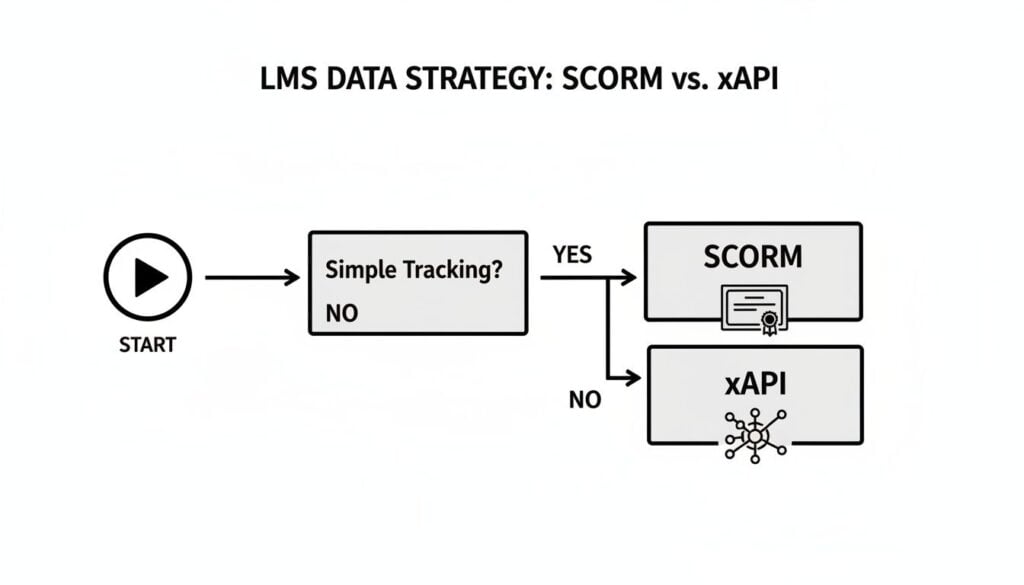
It really is that simple. The choice hinges on whether you need basic completion tracking or a much deeper, more nuanced view of the entire learning journey.
You Don’t Have to Go All-In: The Hybrid Approach
This isn’t a winner-take-all battle. For many established course businesses, a hybrid model offers the most practical path forward, giving you stability and innovation at the same time.
You can keep using SCORM for your core, formal courses inside your main LMS. This guarantees maximum compatibility for your bread-and-butter offerings without disrupting what already works.
Simultaneously, you can start using xAPI to track the rich, informal learning happening around that core content. Think of tracking engagement with specific videos on your blog, participation in a members-only forum, or the use of a mobile flashcard app.
A hybrid strategy lets you keep the rock-solid stability of SCORM while you experiment with the powerful data from xAPI where it counts. You get to innovate without having to tear down your entire house and rebuild it from scratch.
Of course, no technical standard can salvage a boring course. Your first job is always to make educational videos that actually teach and keep your audience engaged. The tech is just there to support great content, not replace it.
Ultimately, your decision aligns your technical foundation with your business vision. If your priority is a fast, simple launch with maximum compatibility, SCORM is the safe, smart bet. If you’re building a data-driven learning ecosystem and want to track experiences far beyond the LMS, investing in xAPI will pay dividends for years to come.
When you start digging into the nitty-gritty of eLearning standards, the same questions always pop up. It’s easy to get lost in the technical details.
Let’s cut through the noise and tackle the big questions I hear from course creators all the time when comparing SCORM vs. xAPI.
Can I Convert My Old SCORM Courses to xAPI?
Yes, but “convert” is the wrong word. It’s really a rebuild. There’s no magic button in your authoring tool that can flip a SCORM file to an xAPI package and suddenly start tracking all the rich, detailed data you’re after.
To get the real value out of xAPI, you have to go back to the drawing board with your course design. This means opening up your authoring tool and adding new triggers to define the specific learner actions you want to track. Instead of just knowing the final quiz score, you’ll need to set up custom statements to record things like how a learner answered each question, which videos they rewatched, or the specific path they chose in a branching scenario.
Think of it less like translating a document and more like adapting a book into a movie. You’re keeping the core story, but you have to completely rethink the structure to take advantage of the new medium’s capabilities.
Do I Need an LRS If My LMS Is xAPI Compliant?
This is a fantastic and critical question. Just because a Learning Management System (LMS) vendor slaps an “xAPI-compliant” sticker on their website doesn’t mean it has a powerful Learning Record Store (LRS) built-in.
Often, that compliance just means the LMS can receive xAPI statements. It acts like a mailbox, but it doesn’t necessarily have the tools to open, sort, and make sense of all the mail inside.
A dedicated LRS is where the real work gets done. It’s a specialized database built not just to store xAPI statements, but to give you the reporting and analytics tools to understand all that data. An LMS might show you basic completion data, but a true LRS lets you build custom dashboards, query for specific behaviors, and spot trends across all your learning activities—even those that happen outside the LMS. For deep insights, you’ll almost certainly want both.
Which Authoring Tools Are Best for xAPI?
The good news is that most modern authoring tools have embraced xAPI, so you have options. Tools like Articulate Storyline 360 and Adobe Captivate both have very solid support, but they come at it from slightly different angles.
- Articulate Storyline 360: Known for its user-friendly approach. You can use its visual trigger system to send custom xAPI statements without writing a single line of code, which makes it incredibly accessible if you’re just getting started.
- Adobe Captivate: This tool gives you a bit more granular, advanced control. It offers more flexibility if you’re comfortable getting your hands dirty with variables and light scripting to craft your statements.
When you’re choosing a tool with xAPI in mind, the most important feature to look for is how easily it lets you create custom statement triggers. The more straightforward it is to define your own “Actor-Verb-Object” statements for unique interactions, the more powerful and insightful your learning data will ultimately be.