10 Student Engagement Strategies for Online Courses

Ever launch an online course you poured your heart into, only to see engagement drop off after the first week? It’s a common frustration for course creators and educators. We’re all looking for that secret formula to keep learners excited, participating, and actually finishing the material. The good news is, it’s about having the right toolkit.
I’ve spent years building and refining digital learning experiences, and I’ve learned that deep engagement isn’t a happy accident. It’s the direct result of thoughtful, intentional design. That’s why I’ve put together this comprehensive guide. We are going to break down 10 powerful student engagement strategies that work across different formats, from self-paced courses and microlearning modules to live webinars and community memberships.
These aren’t just abstract theories. They are practical, actionable methods you can start implementing today to transform passive viewers into active, thriving learners.
For each strategy, we will cover the “what,” the “why,” and the “how,” including specific implementation steps, common pitfalls, and ways to measure success. To ensure long-term success and truly hook your students, explore these cutting-edge strategies that focus on boosting engagement. You can find more ideas in this guide to Top Interactive Learning Strategies for 2025 Success.
This article is designed to be your go-to resource for creating a more interactive and effective learning environment. Let’s dive in and find the right strategies to revitalize your courses and captivate your audience.
1. Active Learning Techniques
Active learning is one of the most powerful student engagement strategies because it moves students from being passive listeners to active participants.
Instead of just absorbing information from a lecture, students engage directly with the material through problem-solving, discussions, and hands-on activities. This process helps them construct their own understanding and forge deeper neural connections with the content.
The core principle is simple: students learn more effectively by doing. This approach is highly versatile and can be adapted to almost any subject or course format, from a synchronous webinar to an asynchronous module.
How to Implement Active Learning
Getting started with active learning doesn’t require a complete course overhaul. You can integrate small, effective activities into your existing lessons.
- Think-Pair-Share: Pose a thought-provoking question. Give students a minute to think individually, then have them discuss their thoughts with a partner before sharing with the larger group. This is a low-stakes way to encourage participation.
- Case Study Analysis: In a business or ethics course, provide a real-world case study for small groups to analyze and present their solutions. This connects theoretical concepts to practical applications.
- Interactive Polls and Quizzes: During a live session, use polling software to ask questions and gauge understanding in real-time. This keeps students focused and provides you with immediate feedback.
Pro Tip: Begin with lower-risk activities like anonymous polls or brief pair discussions. As students become more comfortable with participation, you can introduce more complex group projects or debates.
Measuring Success and Avoiding Pitfalls
To see if your active learning strategies are working, use formative assessments like short reflection prompts or “minute papers” where students summarize the key takeaway. You can also track participation rates in discussions and group activities.
A common pitfall is providing unclear instructions, which can lead to confusion and disengagement. Always give specific directions, time limits, and a clear learning objective for each activity.
Beyond the classroom, encouraging students to learn about effective study habits can further enhance their engagement and retention. For specialized subjects, understanding how to study math effectively can make a huge difference in a student’s confidence and performance.
Active learning is a cornerstone of modern pedagogy. You can learn more about why we learn by doing and how to apply it in your own teaching.
2. Gamification
Gamification is a powerful student engagement strategy that uses game design elements in educational settings.
By incorporating features like points, badges, leaderboards, and progress bars, you can tap into students’ natural desires for achievement, competition, and recognition. It transforms learning from a passive task into an exciting and interactive challenge.
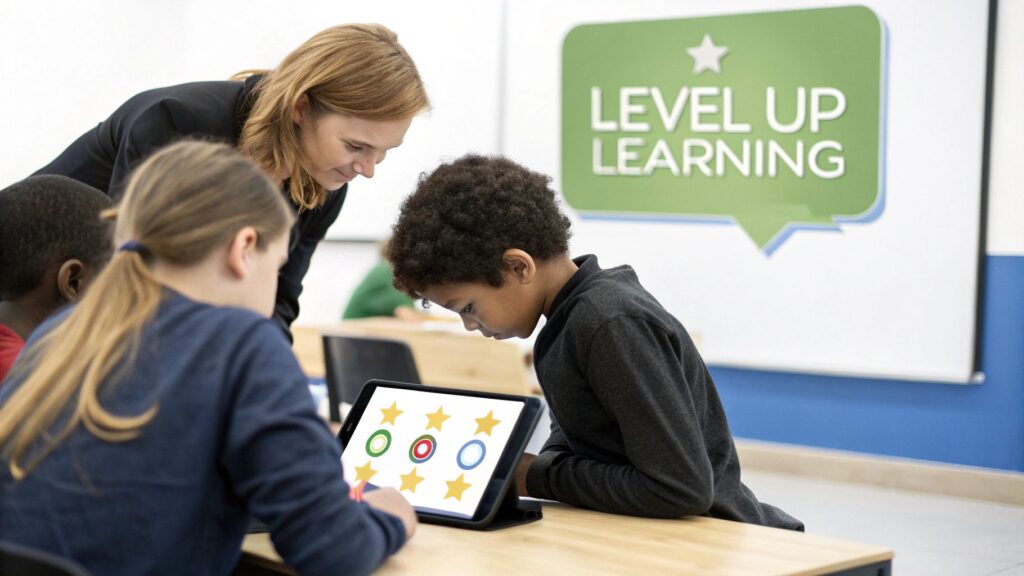
The core idea is to make learning more motivating and enjoyable. This approach works well in various formats, from a semester-long course to a short corporate training module, because it frames progress in a visually engaging way.
How to Implement Gamification
You don’t need to build a complex video game to gamify your course. Start by integrating simple game mechanics that align with your learning goals.
- Create a Points System: Award points for completing assignments, participating in discussions, or helping peers. Students can accumulate points to “level up” or unlock new content, providing a clear sense of progression.
- Use Digital Badges: Design badges for mastering specific skills or completing challenging modules. This provides a tangible, shareable form of recognition for achievements, much like the popular language app Duolingo.
- Introduce Leaderboards: A leaderboard can foster friendly competition by showing top performers. To ensure it’s inclusive, you can create leaderboards for different metrics, like “most improved” or “most helpful contributor”.
Pro Tip: Balance competition with collaboration. Introduce team-based quests or group challenges where students must work together to earn points or badges. This encourages teamwork and prevents a purely competitive environment.
Measuring Success and Avoiding Pitfalls
Track the impact of your gamification efforts by monitoring assignment completion rates, participation levels in forums, and student login frequency. You can also use surveys to ask students if the game elements make the course more motivating.
A common pitfall is making the game mechanics feel disconnected from the learning objectives. The points and badges should reward genuine understanding and effort, not just task completion. Also, ensure the challenges are attainable for all skill levels to avoid discouraging students who are struggling.
Gamification, when thoughtfully implemented, can be one of the most effective student engagement strategies. You can learn more about its psychological foundations from experts like Yu-kai Chou and his Octalysis framework, which breaks down the core human motivation drivers.
3. Project-Based Learning (PBL)
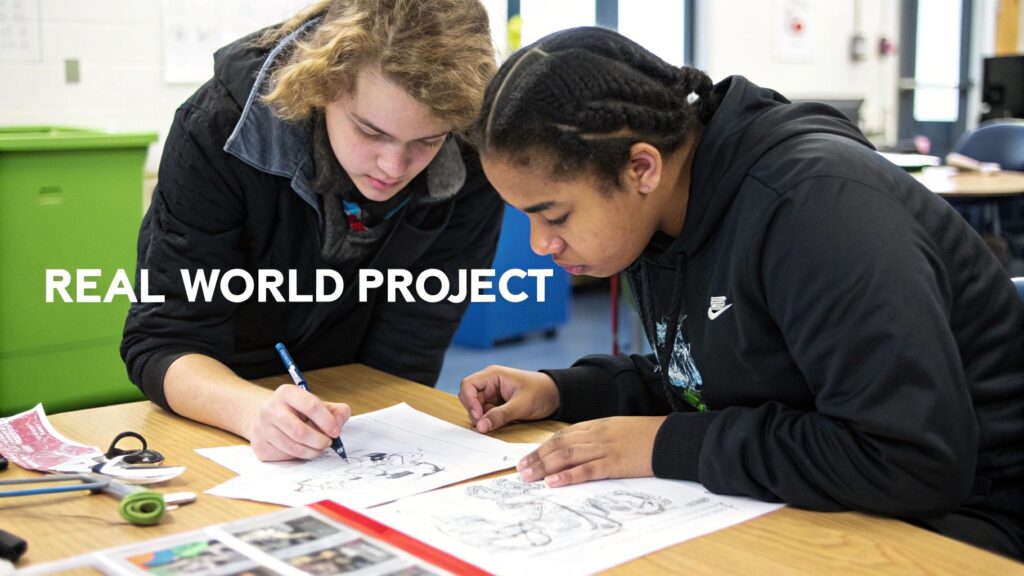
Project-based learning (PBL) is a dynamic student engagement strategy that immerses learners in a real-world problem or challenge over an extended period.
Instead of learning discrete facts, students gain knowledge and skills by developing a tangible solution or product. This approach fosters deep learning, critical thinking, and collaboration as students drive their own investigation to answer a central question.
The magic of PBL is that it transforms learning from a passive reception of information into an active, student-led journey of discovery. It’s a powerful method for any course format because it frames content around a meaningful goal, making the learning process both relevant and memorable.
How to Implement Project-Based Learning
Integrating PBL can feel like a big shift, but you can start by redesigning a single unit or module around a core project. The key is providing structure while allowing for student autonomy.
- Design a Historical Documentary: In a social studies course, have students work in groups to research, script, and produce a short documentary on a specific historical event. This requires them to analyze primary sources, synthesize information, and present a compelling narrative.
- Build a Community-Focused Business Plan: For an entrepreneurship module, challenge students to develop a business plan for a venture that addresses a local community need. This connects business principles to social impact.
- Engineer a Solution: In a robotics or STEM course, present a design challenge like building a small-scale water filtration system. This pushes students to apply scientific principles to solve a practical problem.
Pro Tip: Begin with a clear and compelling “driving question” that frames the project. A good question is open-ended, sparks curiosity, and requires students to apply core concepts to answer it.
Measuring Success and Avoiding Pitfalls
To measure the effectiveness of PBL, use a detailed rubric that assesses both the final product and the process. This includes skills like collaboration, critical thinking, and project management. Incorporating milestones with peer and self-assessment checkpoints helps keep students on track.
A common pitfall is a lack of scaffolding, which can leave students feeling overwhelmed and lost. To avoid this, break the project into smaller, manageable phases with clear deadlines and regular check-ins. Provide necessary resources, templates, and access to experts to support their investigation.
Project-based learning is a transformative approach that builds competence and confidence. You can explore more in-depth resources from PBLWorks to find project ideas and planning tools for your specific subject area.
4. Peer Teaching and Collaborative Learning
Peer teaching and collaborative learning are powerful student engagement strategies that turn learners into teachers.
This approach encourages students to learn from and with each other through structured group work, peer tutoring, and collaborative projects. When students explain concepts to their peers, they reinforce their own understanding and identify gaps in their knowledge.
The core idea is that teaching is a profound form of learning. This strategy builds a supportive community, develops communication skills, and empowers students to take ownership of their educational journey. It works well in any learning environment, from a live workshop to a self-paced online course.
How to Implement Peer Teaching and Collaborative Learning
You can introduce collaborative elements without redesigning your entire curriculum. The key is to provide clear structure and defined roles.
- Jigsaw Technique: Divide a complex topic into smaller subtopics. Assign each subtopic to a small “expert” group. After mastering their piece, students regroup into new “jigsaw” groups, where each member teaches their expert topic to the others.
- Peer Review Workshops: In a writing or design course, have students provide structured feedback on each other’s work using a rubric or guided questions. This improves the quality of the final product and teaches students to give and receive constructive criticism.
- Study Groups: Form small, dedicated study groups that meet regularly to review material, solve problems, or prepare for assessments. Provide them with discussion prompts or a clear agenda to guide their sessions.
Pro Tip: Intentionally structure groups to ensure a balance of skills and personalities. Provide sentence stems or discussion starters, such as “Can you explain that in another way?” or “I agree with that point because…”, to facilitate productive conversations.
Measuring Success and Avoiding Pitfalls
To gauge effectiveness, you can observe group interactions, review the quality of collaborative projects, and ask students to complete a peer evaluation or self-reflection on the group process. Tracking improvements in assessment scores after collaborative sessions is also a strong indicator.
A common pitfall is unequal participation, where one or two students do most of the work. To avoid this, assign specific roles within each group (like facilitator, note-taker, or time-keeper) and establish clear individual accountability for the final outcome. For additional structure, you can explore cooperative learning models popularized by thinkers like Spencer Kagan, whose work offers dozens of frameworks for successful group work.
5. Personalized and Adaptive Learning
Personalized and adaptive learning is a game-changing student engagement strategy that tailors the educational journey to each individual.
Instead of a one-size-fits-all approach, this method adjusts content, pacing, and learning pathways based on a student’s unique needs, strengths, and real-time performance. This customization makes learning more relevant and efficient, keeping students motivated by meeting them exactly where they are.
The core idea is that technology can help create a unique learning path for every student. Adaptive systems use data and algorithms to dynamically change the difficulty of tasks, ensuring a student is always challenged but never overwhelmed. This approach is powerful in diverse classrooms where students have varying levels of prior knowledge.
How to Implement Personalized and Adaptive Learning
You can introduce personalization with or without complex technology, though adaptive tools make it easier to scale. The goal is to make the learning experience feel unique to each student.
- Use Adaptive Learning Platforms: Tools like Carnegie Learning’s MATHia or Knewton’s platform use algorithms to present students with problems and content suited to their current skill level. They provide targeted feedback and remediation when a student struggles.
- Create Learning Profiles: At the beginning of a course, have students complete a survey about their interests, learning preferences, and goals. Use this information to offer choices in assignments or recommend specific resources.
- Offer Flexible Pathways: In an online module, allow students to “test out” of content they have already mastered. You can also provide a menu of project options that all meet the same learning objective but appeal to different interests.
Pro Tip: Start by personalizing one or two key assignments. For example, allow students to choose the topic for a research paper within a broader theme or select from a list of case studies. This gives them a sense of agency without requiring a full curriculum redesign.
Measuring Success and Avoiding Pitfalls
Success with this strategy is evident when students show greater ownership of their learning and improved performance on key metrics. You can track progress through adaptive platform dashboards, which often show skill mastery and time-on-task. Pre- and post-assessments can also reveal growth in specific competency areas.
A common pitfall is over-relying on technology and losing the human element. Data should inform your professional judgment, not replace it. Always combine high-tech tools with high-touch instruction, like one-on-one check-ins or small group discussions. Ensure any technology you use is accessible to all learners.
Personalized learning is a cornerstone of modern, student-centered education. You can explore a variety of tools and platforms to find what works best for your students and learn more about adaptive learning software to get started.
6. Student Voice and Agency
Empowering students with voice and agency is one of the most transformative student engagement strategies. It shifts the learning dynamic from a top-down model to a collaborative partnership.
Student voice means actively seeking and acting on their feedback and perspectives, while student agency gives them meaningful control and choice over how and what they learn.
When students feel their input matters and they have a stake in their own education, their motivation and ownership increase dramatically. This strategy fosters critical thinking, self-advocacy, and a deeper sense of belonging within the learning community, making it powerful for any course format.
How to Implement Student Voice and Agency
You can integrate these principles by offering structured choices and creating clear channels for feedback. This doesn’t mean abandoning the curriculum, but rather co-creating the learning path with your students.
- Offer Choice Boards: Create a grid of assignment options for a specific unit. Students can choose a set number of tasks to complete, allowing them to select activities that align with their interests and strengths, such as writing an essay, creating a podcast, or designing a presentation.
- Establish Feedback Loops: Use simple surveys or discussion forums to regularly ask students what’s working and what isn’t. Ask specific questions like, “Which activity this week helped you learn the most?” and then share how you’re using their feedback to adjust the course.
- Implement Passion Projects: Dedicate time for students to pursue a topic of their own choosing related to the course content. This gives them full control over a project from proposal to final presentation, fueling intrinsic motivation.
Pro Tip: Start small with low-stakes choices, like letting students vote on the topic for the next discussion or choose their own small-group members. This builds trust and helps them practice decision-making skills in a supported environment.
Measuring Success and Avoiding Pitfalls
Track the success of this strategy by observing participation in choice-based activities and analyzing the quality of student feedback. You can also use pre- and post-surveys to gauge their sense of ownership and influence over their learning.
A common pitfall is offering “token” choices that don’t genuinely impact the learning experience. To avoid this, ensure the options you provide are meaningful and that you visibly act on the feedback students give. It’s crucial to provide clear guidelines and support to help students make informed decisions, balancing their newfound freedom with clear academic expectations.
For more on creating student-centered environments, explore the work of organizations like Students at the Center, which provides extensive research on this topic.
7. Formative Assessment and Feedback
Formative assessment is a game-changer for student engagement because it shifts the focus from a final grade to the ongoing process of learning.
It involves checking for understanding along the way, providing real-time feedback that helps students see exactly where they are and what they need to do next. This continuous loop of assessment and feedback makes learning a dynamic, supportive conversation rather than a one-way lecture.

The core idea is to gather evidence of learning as it happens. When students know their progress is being monitored to help them improve, not just to judge them, they feel more invested and are more willing to participate and take intellectual risks. This approach makes your instruction more responsive and tailored to student needs.
How to Implement Formative Assessment
Integrating formative assessment into your teaching can be simple and highly effective. These quick checks provide invaluable insights into student comprehension.
- Exit Tickets: At the end of a lesson, ask students to answer a short prompt like, “What was the most important concept you learned today?” or “What question do you still have?” This gives you a snapshot of class understanding.
- One-Minute Papers: In a live session or asynchronous module, ask students to take one minute to write down a summary of the key takeaway. This encourages them to synthesize information on the spot.
- Student Portfolios: Have students collect their work in a digital portfolio. This allows them to reflect on their growth over time and helps you provide holistic feedback on their development.
Pro Tip: Make feedback timely and specific. Instead of saying “good job,” try “You did an excellent job explaining the ‘why’ behind the concept, and a next step would be to add a specific example.”
Measuring Success and Avoiding Pitfalls
The success of these student engagement strategies is visible in improved student work and deeper participation in class discussions. You can also track student responses on exit tickets or minute papers to identify common points of confusion that need to be revisited.
A frequent pitfall is collecting assessment data but not using it to adjust instruction. The goal is to close the loop by using the insights you gather to inform your next teaching moves. Always share the assessment results with students in a constructive way, focusing on growth and what comes next in their learning journey.
8. Culturally Responsive Teaching
Culturally responsive teaching is a powerful student engagement strategy that centers students’ cultural identities and experiences within the learning environment. This involves intentionally designing instruction that affirms who students are, builds on their unique cultural strengths, and makes learning relevant to their lives.
When students see their backgrounds and perspectives reflected in the curriculum, they feel a stronger sense of belonging and validation. This connection makes them more likely to engage deeply with the material because it speaks directly to their experiences and worldview.
How to Implement Culturally Responsive Teaching
You can weave culturally responsive practices into your teaching without a massive overhaul. The goal is to make your learning environment more inclusive and reflective of your students.
- Diverse Course Materials: Audit your curriculum to include authors, researchers, and historical figures from a wide range of backgrounds. Instead of only teaching the traditional literary canon, include works from contemporary authors of color.
- Student Identity Projects: Assign projects where students can explore and share their cultural heritage, family histories, or personal identities. This not only engages the student but also enriches the entire learning community.
- Leverage Community Knowledge: Invite guest speakers from the local community who can share expertise and perspectives relevant to your students’ backgrounds. This demonstrates that valuable knowledge exists both inside and outside the classroom.
Pro Tip: Start by examining your own cultural lens and potential biases. Understanding your own perspective is the first step toward creating a truly inclusive space for others.
Measuring Success and Avoiding Pitfalls
Gauging the success of culturally responsive teaching often involves qualitative measures. Use student surveys or small group discussions to ask students if they feel their identity is respected and represented in the course. You can also observe participation levels, noting if a more diverse range of students is contributing to discussions.
A common pitfall is superficial inclusion, often called “tokenism,” like celebrating a single holiday without integrating cultural perspectives into the core curriculum. Ensure cultural references are authentic and meaningful. Another challenge is making assumptions about a student’s culture. Always create opportunities for students to share their own stories rather than relying on stereotypes.
This approach, pioneered by scholars like Geneva Gay and Zaretta Hammond, creates a classroom where all students feel seen, heard, and valued.
9. Technology-Enhanced Learning
Technology-enhanced learning is a student engagement strategy that thoughtfully integrates digital tools into the educational experience. It’s about using platforms like learning management systems, interactive simulations, and virtual labs to create more dynamic and accessible learning opportunities. When used effectively, technology can deepen understanding and cater to diverse learning styles.
The goal is to leverage digital tools to support, rather than replace, proven instructional methods. From a simple polling app to an immersive virtual reality field trip, technology can transform a passive lesson into an interactive journey, making abstract concepts tangible and engaging for every student.
How to Implement Technology-Enhanced Learning
You can start small by incorporating one or two digital tools into your existing course structure before expanding.
- Interactive Simulations: Use platforms like PhET or Labster to provide virtual science labs. Students can conduct experiments, manipulate variables, and see outcomes in a safe, controlled digital environment. This is perfect for complex or hazardous topics.
- Collaborative Platforms: Leverage tools like Google Classroom or Microsoft Teams to facilitate group projects and discussions. Students can co-edit documents, share resources, and provide peer feedback in real time, fostering a sense of community.
- Virtual Field Trips: Take your students on an immersive journey with Google Expeditions or Unimersiv. Exploring the Roman Colosseum or the human circulatory system in VR can create a memorable and impactful learning experience.

Pro Tip: Focus on the pedagogical purpose first. Select a tool because it solves a specific teaching challenge or enhances a learning objective, not just because it’s new and flashy.
Measuring Success and Avoiding Pitfalls
Measure the impact of technology by tracking metrics like assignment completion rates on a learning platform, participation levels in online forums, or performance on quizzes administered through a specific tool. You can also gather direct feedback through student surveys about their experience with the new technology.
A common pitfall is inequitable access. Always ensure that any required technology is accessible to all students, or provide alternatives. Another challenge is overwhelming students with too many different platforms. Stick to a few core tools and provide clear, simple instructions for each. The benefit of technology in education is maximized when it is implemented with purpose and a focus on the human connection.
10. Social-Emotional Learning (SEL)
Social-emotional learning (SEL) is a powerful student engagement strategy that goes beyond academics.
It focuses on developing the essential skills students need to understand and manage their emotions, set and achieve positive goals, feel and show empathy for others, establish and maintain positive relationships, and make responsible decisions. When students feel safe, understood, and emotionally regulated, they are far more capable of engaging deeply with academic content.
The core principle here is that learning is not just an intellectual activity, it’s an emotional one too. Integrating SEL helps create a supportive and resilient learning environment where students are equipped to handle challenges, collaborate effectively, and invest themselves fully in their education. This approach builds a foundation for lifelong success, both in and out of the classroom.
How to Implement Social-Emotional Learning
You can weave SEL into the fabric of your course without creating an entirely separate curriculum. The key is to be intentional and consistent.
- Restorative Circles: Begin a class or week with a check-in circle where each student shares how they are feeling or responds to a low-stakes prompt. This builds community and gives you insight into your students’ emotional states.
- Mindfulness Moments: Start a lesson with a one-minute breathing exercise or a brief mindfulness activity. This helps students center themselves, reduce anxiety, and prepare their minds for learning.
- Explicit Skills Instruction: Use a framework like the Zones of Regulation to teach students how to identify their emotional state and use strategies to self-regulate. For example, you can discuss what it feels like to be in the “yellow zone” (frustrated or anxious) and what tools can help them return to the “green zone” (calm and focused).
Pro Tip: Model the SEL skills you want to see. When you acknowledge your own feelings, demonstrate active listening, and manage challenging moments with composure, you provide a powerful example for your students to follow.
Measuring Success and Avoiding Pitfalls
Gauging the impact of SEL involves both qualitative and quantitative observations. Use self-assessment surveys where students reflect on their own emotional intelligence or relationship skills. You can also track behavioral changes, like a decrease in classroom conflicts or an increase in collaborative participation.
A common pitfall is treating SEL as a separate, isolated lesson rather than integrating it into the daily classroom culture. If SEL is just a 20-minute activity on Fridays, it loses its impact. To be effective, it must be part of every interaction. Ensure you consistently use the language of SEL, reinforce skills throughout all academic subjects, and create a truly safe climate where students feel comfortable being vulnerable.
SEL is not just another initiative. It is fundamental to creating an environment where deep learning can happen. By prioritizing these skills, you are investing in the whole student, which is one of the most effective student engagement strategies you can employ. You can find robust frameworks and resources at organizations like CASEL.
10-Point Comparison: Student Engagement Strategies
| Method | Implementation complexity | Expected outcomes | Ideal use cases | Key advantages |
|---|---|---|---|---|
| Active Learning Techniques | Moderate — needs planning and facilitation skills | Improved retention, critical thinking, engagement | Lectures, labs, seminars, class discussions | Strong comprehension gains; immediate feedback; diverse engagement |
| Gamification | Low–moderate — design game mechanics thoughtfully | Higher motivation and participation; risk of extrinsic focus | Practice drills, formative quizzes, motivation boosts | Increases engagement; clear progress markers; frequent reinforcement |
| Project-Based Learning (PBL) | High — long-term planning, scaffolding and assessment design | Deep understanding, real-world problem solving, 21st-century skills | Capstones, interdisciplinary units, long-term investigations | Authentic application; sustained student ownership and creativity |
| Peer Teaching & Collaborative Learning | Low–moderate — requires structure and role training | Academic gains for both tutors and tutees; social skill development | Tutoring programs, jigsaw activities, peer review workshops | Cost-effective; immediate peer feedback; builds communication skills |
| Personalized & Adaptive Learning | High — data systems, integration with instruction | Individualized progress, narrowed gaps, efficient pacing | Differentiation at scale, remediation, self-paced study | Tailored pathways; real-time adaptation; targeted interventions |
| Student Voice & Agency | Moderate — shifts in classroom routines and decision-making | Increased motivation, ownership, relevance of learning | Choice boards, passion projects, student-led conferences | Boosts engagement and responsibility; makes learning relevant |
| Formative Assessment & Feedback | Moderate — requires assessment literacy and routines | Early gap identification and improved learning outcomes | Ongoing lessons, mastery learning, standards-based grading | Timely, actionable feedback that guides instruction |
| Culturally Responsive Teaching | Moderate–high — ongoing PD and curriculum revision | Greater belonging and improved outcomes for marginalized students | Diverse classrooms, equity-focused curricula and units | Validates identity; narrows achievement gaps; builds cultural competence |
| Technology-Enhanced Learning | Moderate — depends on tool complexity and integration | Expanded access, multimedia learning, analytics for instruction | Blended/hybrid courses, virtual labs, remote learning | Scalability, rich media, data-driven insights |
| Social-Emotional Learning (SEL) | Moderate — requires consistent practice and cultural change | Improved academics, behavior, mental health, attendance | Whole-school programs, advisories, restorative practices | Stronger school climate; life skills; reduced behavioral issues |
Putting These Engagement Strategies Into Action
I’ve walked you through a wide array of powerful student engagement strategies. From the active, hands-on approach of Project-Based Learning to the competitive fun of gamification and the deep connection fostered by Social-Emotional Learning, it’s clear there isn’t a single magic bullet. Instead, true student engagement comes from building a dynamic and responsive learning ecosystem.
The ultimate goal is to shift the student’s role from a passive spectator to an active participant, a co-creator in their own educational journey. When you leverage peer teaching, you communicate to students that their knowledge is valuable. When you implement formative assessments and feedback loops, you show that their progress matters more than a final score.
Your First Steps: A Practical Action Plan
Feeling overwhelmed by the options? That’s completely normal. The key is to avoid trying to implement everything at once. True transformation happens through small, consistent steps.
My advice is to start by picking just one or two strategies from our list that genuinely excite you and align with your students’ needs.
Here’s a simple framework to get started:
- Select Your Strategy: Review the list. Does gamifying your quizzes sound fun? Or maybe introducing a “student voice” survey to guide the next module feels more impactful? Choose what resonates.
- Define a Small Pilot: Don’t overhaul your entire course. Instead, select one specific area for a test run. For example, you could apply a culturally responsive lens to a single lesson or use a technology-enhanced tool like a collaborative whiteboard in your next live session.
- Communicate with Your Students: Let them know you’re trying something new. Frame it as an experiment you’re doing together. This transparency builds trust and can even increase their buy-in.
- Gather Feedback: After the pilot, ask them what they thought. A simple two-question survey can work wonders: “What did you like about this new activity?” and “What could be improved next time?”
- Iterate and Expand: Based on the feedback and your own observations, refine the strategy. If it was a success, consider where else you can apply it. If it fell flat, analyze why and either adjust it or try a different strategy.
Key Takeaway: The most effective student engagement strategies are about creating an environment where students feel seen, heard, and valued as active contributors to their learning.
The Bigger Picture: Beyond Completion Rates
It’s easy to measure success in terms of course completion rates or quiz scores, and these strategies will certainly help improve those metrics. But the real impact runs much deeper.
When you master these student engagement strategies, you’re doing more than just teaching a subject. You are building a resilient, vibrant learning community. and equipping your students with critical skills like collaboration, problem-solving, and self-advocacy that will serve them long after they’ve finished your course.
You move from being a simple content provider to a true facilitator of transformation. Your course becomes more than just a collection of videos and PDFs, it becomes an experience. It becomes the program that students not only complete but also recommend to their friends and colleagues.
This journey of improving student engagement is an ongoing process of creativity, empathy, and iteration. It’s a craft you will hone over time. So, take that first small step today. Choose your strategy, launch your pilot, and start building the course your students can’t stop talking about.