Choosing Your Subscription Pricing Models

Picking a subscription pricing model isn’t just about slapping a price tag on your digital learning membership. This is one of the most fundamental decisions I think you’ll make for your business. It’s one that shapes who you attract, how they perceive your value, and ultimately, how long they stick around.
Why Your Pricing Model Is Your Most Important Decision
Let’s get one thing straight, your pricing is your strategy. It’s the foundation everything else is built on. It sends a powerful message about the value of your content before a member ever logs in.
Think of it as a handshake between you and your customer. A well-designed model creates a perfect win-win. Your members get predictable costs and uninterrupted access to your amazing content, while you get a stable, recurring revenue stream.
That financial stability is a total game-changer. It lets you stop chasing one-off sales and start investing that energy back into making your membership even better.
This isn’t just a small trend, either. The move to subscriptions is a massive economic shift. The global subscription e-commerce market is on an absolute tear, projected to rocket from $278 billion in 2024 to an incredible $6.37 trillion by 2033. This explosion proves just how much people value the convenience and ongoing relationship that subscriptions provide.
The Foundation for Growth
Your pricing model is directly wired into your growth potential. A smart strategy acts as your best marketing tool, pulling in the right kind of members who see the long-term value and are less likely to churn.
When you nail your pricing, you create a system that scales right alongside your business. As you grow, your revenue grows with you, without you having to constantly reinvent the wheel. This single decision sends ripples through every part of your operation, from product development right down to customer support.
Your pricing model isn’t just a financial tool. It’s a strategic lever for customer acquisition, retention, and long-term business health. Getting it right from the start is non-negotiable.
Choosing that initial model is critical, and you can see this echoed in advice on how to monetize mobile apps for maximum revenue, where the upfront choice has massive downstream effects. At the end of the day, the right structure ensures your business isn’t just surviving, it’s built to thrive.
Alright, we’ve established why getting your price right is so critical. Now for the fun part, let’s break down the actual pricing models you’ll see in the wild.
Think of this as your field guide to subscription pricing. We’ll walk through the most common strategies, one by one, so you can spot them, understand their DNA, and figure out what makes them tick. I’ll keep it practical, using real-world examples to show you how they work.
We’ll start with the simplest and work our way to the more nuanced approaches.
The Flat-Rate Pricing Model
First up is the Flat-Rate model, and it’s exactly what it sounds like. It’s the all-you-can-eat buffet of the subscription world. You pay one single, straightforward price, and you get access to absolutely everything.
No confusing tiers, no weird usage caps. Just one price for one product. That simplicity is its superpower. It makes it dead simple for customers to know what they’re getting and how much it costs, which removes a ton of friction from the buying decision.
For a digital learning membership, this could be a single monthly fee that unlocks all your courses, your entire community, and every live event you host. It’s a clean, no-fuss approach that works beautifully if your membership delivers a clear, singular value proposition.
A flat-rate model excels at transparency. It removes decision fatigue for the customer, making the sign-up process quick and painless.
This model is a perfect match for businesses with a highly focused product. If you do one thing and you do it exceptionally well, a single price point reinforces that confident, simple message.
But its simplicity can also be its biggest weakness. A one-size-fits-all price means you can’t cater to different customer segments, like a solo learner versus a large corporate team. You risk leaving money on the table by not charging heavy users more, or you might price out smaller customers who only need a fraction of what you offer.
The Per-User Pricing Model
Next, let’s look at the Per-User Pricing model, often called per-seat pricing. This one is everywhere in the software world, and for good reason. The total cost scales directly with the number of people using the service.
Think of it like buying movie tickets. Going solo? You buy one ticket. Bringing the whole family? You buy a ticket for each person. Simple.
This is a fantastic fit for any tool built around collaboration or team access. For a learning platform, you might charge $20 per user per month. A small team of five would pay $100, while a department of twenty pays $400.
The main advantage here is that the value metric is crystal clear. As a client’s team grows, the value they get from your platform grows too, making the increased cost feel natural and justified. It also makes your revenue incredibly predictable. As your clients grow, so do you.
The flip side? It can sometimes discourage wider adoption within a company. A manager might hesitate to add more team members because of the direct cost increase, even if those employees would benefit. It can also tempt people into bad habits like password sharing, which is a headache you definitely want to avoid.
The Usage-Based Pricing Model
Now we get to Usage-Based Pricing, which is all about “pay-as-you-go.” Instead of paying a flat fee for access, customers are billed for what they actually consume.
This is a lot like your home electricity bill. You don’t pay a fixed price for being connected to the power grid. You pay for the exact amount of electricity you used that month.
In an online learning context, this could mean charging based on the number of courses a member takes, the hours of video they stream, or how many coaching calls they book. The price is tied directly to consumption. This model is gaining serious momentum. A 2023 study found that 61% of SaaS companies now use some form of usage-based pricing, a huge jump from just 34% a few years ago.
Customers tend to see this as a very fair model because they never feel like they’re paying for features they aren’t using. It’s a great way to lower the barrier to entry for smaller customers, letting them start small and scale their spending as their needs grow.
But this model comes with its own set of headaches. The biggest one is predictability, for both you and your customer. Your revenue can swing wildly from one month to the next, and your customers may have a hard time budgeting if their usage is inconsistent. That uncertainty can be a deal-breaker for some businesses.
Comparing Core Subscription Pricing Models
To help you see how these models stack up at a glance, here’s a quick comparison table. It breaks down how each one works, where it shines, and its core strength.
| Model | How It Works | Best For | Main Advantage |
|---|---|---|---|
| Flat-Rate | One fixed price for unlimited access to all features. | Memberships with a single, clear value proposition. | Simplicity and transparency for the customer. |
| Per-User | Price is calculated based on the number of individual users. | Collaborative tools and B2B learning platforms. | Predictable revenue that scales with customer growth. |
| Usage-Based | Customers pay based on their consumption of specific metrics. | Platforms where value is directly tied to consumption. | Attracts a wide range of customers with varying needs. |
| Hybrid | Combines two or more models (e.g., per-user fee + usage). | Businesses serving diverse customer segments. | Flexibility to capture value from different user types. |
This table is just a starting point. The best model often comes from understanding the core value your customers get and aligning your price to that metric.
The Hybrid Pricing Model
Finally, we have the Hybrid Model. This isn’t a distinct model on its own, but rather a smart combination of two or more of the strategies we’ve just covered. It’s all about getting the best of multiple worlds.
A classic example is blending a per-user model with a usage-based component. A project management tool might charge $15 per user per month, which includes up to 10 GB of file storage. If a team needs more space, they can pay an extra fee based on that additional usage.
This approach strikes a fantastic balance. It provides a stable, predictable revenue base from the per-user fees while also capturing additional revenue from your heaviest users. It gives you the best of both worlds with predictability and scalability.
The key is to keep it from getting too complicated. A poorly designed hybrid model can quickly become a confusing mess for potential customers, causing them to abandon the signup process altogether. The goal is to blend the elements in a way that feels logical, transparent, and clearly aligned with the value your customers receive at every step.
A Closer Look at Tiered and Freemium Strategies
Alright, let’s zoom in on two of the heavyweights in the subscription world: Tiered and Freemium pricing. You’ve definitely seen both of them in the wild, and they deserve a closer look. When you get them right, they are absolute powerhouses for growth.
We’ll kick things off with the one you see just about everywhere.
The Psychology of Tiered Pricing
The Tiered Pricing model is your classic “Basic, Standard, Premium” setup. It works by offering different levels of features, access, or value at different price points. Think of it like buying a car. You can get the base model, or you can add packages for leather seats, a killer sound system, or advanced safety features.
Each tier is carefully designed to appeal to a specific type of customer, from the budget-conscious beginner to the power user who wants all the bells and whistles. This kind of structure lets you serve a much wider audience than a single flat-rate price ever could.
This visual map helps clarify where popular models like Flat-Rate, Per-User, and Usage-Based pricing fit into the bigger picture.
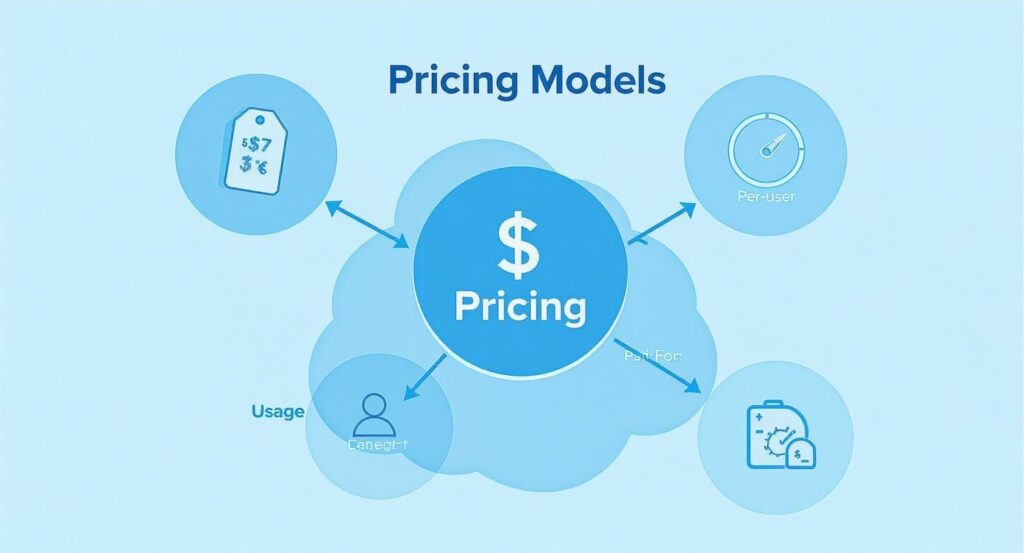
As you can see, these distinct strategies branch out from the core idea of subscription pricing, each one catering to different customer needs and business goals.
The real magic of a great tiered strategy is that it creates a natural upgrade path for your members. As their needs grow or their business expands, they can seamlessly move up to the next level. This is exactly why it’s become the go-to model for so many digital platforms. In fact, by 2025, tiered subscription models are expected to be the dominant approach, perfected by giants like Netflix and Spotify to cater to a massive range of budgets and keep people subscribed.
The secret to making tiered pricing work is to be incredibly intentional about what goes into each package. You have to really understand your customers to know which features they value most and what they’re willing to pay for.
The goal is to guide customers to the plan that’s the best fit for them right now, while showing them a clear path for the future.
Unlocking Growth with the Freemium Model
Next up is the Freemium model. This is where you offer a basic, feature-limited version of your product completely free, forever. The whole idea is to attract a massive user base with a zero-cost entry point, then convert a small percentage of those free users into paying customers.
Think of it as a permanent free sample. It lets people experience the core value of your membership without any financial risk. And let’s be honest, “free” is a pretty hard price to argue with, making this an incredibly powerful tool for getting new users in the door.
For a digital learning membership, a freemium plan might look something like this:
- Access to one or two introductory courses: This gives them a real taste of your teaching style and content quality.
- Limited access to community forums: They can see the vibrant community conversations but might not be able to post or reply.
- A monthly newsletter with tips: This keeps them engaged and reminds them of the value you provide, even if they aren’t paying.
The biggest challenge with freemium is striking the perfect balance. You have to give away enough value in the free plan to be genuinely useful and attract users, but hold back enough premium features to create a compelling reason to upgrade.
Careful with Free Plans
If your free plan is too generous, no one will ever feel the need to pay. But if it’s too restrictive, no one will stick around long enough to see why upgrading is worth it.
This model works exceptionally well for products with network effects, where the value of the service increases as more people use it. Think of tools like Slack or Dropbox. The more people who use the free version, the more valuable the platform becomes for everyone, including the paying customers.
When you’re thinking about a freemium model, it’s also worth comparing it with other low-barrier options. For a more detailed analysis, you can explore our guide on the differences between free trials and low-entry fees for memberships. This will help you decide which approach lines up best with your specific business goals.
Ultimately, a successful freemium strategy is about building a reliable pipeline to convert the right users into happy, paying members.
How to Choose the Right Model for Your Business

Alright, we’ve covered the main subscription pricing models out there. Now for the million-dollar question: which one is right for your business? This is where the theory hits the road, so let’s walk through how to figure this out.
Choosing a model isn’t about just picking what looks trendy or copying what your biggest competitor is doing. It’s about finding that perfect sweet spot where your product, your customers, and your business goals all align.
Get this right, and your pricing will feel like a natural, fair exchange of value for everyone involved.
Start by Analyzing Your Product
First things first, take a good, hard look at what you’ve actually built. The way your membership delivers value is one of the biggest clues to how you should price it.
Ask yourself a few key questions:
- Is value tied to access or usage? Do members get value just by having a key to the entire library of content? Or does the value come from how much they use something, like coaching hours or API calls? The first scenario leans toward a flat-rate or tiered model, while the second practically screams for a usage-based approach.
- Is it built for individuals or teams? If your platform is all about collaboration, a per-user model just makes sense. The cost naturally scales up as a company adds more people to their team.
- Does your product have a clear upgrade path? If you have very distinct levels of features, content, or support, a tiered model is a no-brainer. It gives members a clear runway to grow with you as their needs evolve.
Thinking through these points helps you connect your pricing structure directly to the value you provide. It makes the price tag feel logical to your customers, not arbitrary. For a practical guide on setting up your prices, check out this excellent free digital product pricing ebook.
Understand Your Ideal Customer
Once you know your product inside and out, it’s time to shift your focus to the people you built it for. Your pricing model has to work for their budget, their expectations, and how they think about value.
You can’t just guess at this stuff. You have to know your audience.
Your pricing model should be a reflection of your customers’ success. When they get more value, your revenue should grow with them. This creates a true partnership.
Think about your ideal member. Is it a solo creator on a shoestring budget, or a massive corporation that needs to train hundreds of employees? A model that’s a perfect fit for one would be an instant deal-breaker for the other.
A solopreneur would probably love a simple, affordable flat-rate plan. An enterprise client, on the other hand, would likely expect a per-user model that makes it easy to manage team access and control costs. Knowing your customer is the key to avoiding a painful mismatch.
Align Pricing with Your Business Goals
Finally, your pricing strategy has to be a tool that helps you achieve your most important business objectives. What are you trying to accomplish right now?
Your goals will point you straight to the right model:
- Goal: Rapid Growth & User Acquisition: A Freemium plan or a super low-cost introductory tier is your best bet here. It smashes the barrier to entry and gets as many people as possible to give your product a try.
- Goal: Maximize Revenue & Profitability: A well-designed Tiered or Usage-Based model will almost always do a better job of capturing the most value from different customer segments, especially from your power users who are willing to pay more.
- Goal: Predictability & Stability: Looking for smooth, predictable monthly recurring revenue? A Flat-Rate or Per-User model is your friend. They make it much easier to forecast your finances and plan for the future.
By looking at your product, your customer, and your goals together, you can move from a confusing list of options to a confident, strategic decision. This is a foundational piece you have to get right when you build a membership site, because your pricing will shape the entire experience.
The perfect subscription pricing model is out there. It’s the one that creates a win-win for both you and the members you’re here to serve.
Learning from Real World Pricing Success Stories

Talking about subscription models in theory is one thing, but the real lightbulb moments happen when you see them in the wild. When you look at how successful companies put these strategies to work, everything just clicks.
These pricing pages aren’t just random choices. The biggest names in the game have poured a ton of thought into connecting their price directly to the value their customers get. So, let’s break down a few examples to see what makes their approach so effective and what we can steal for our own memberships.
Slack: The Master of Freemium and Per-User Pricing
First up is Slack. Their pricing is a brilliant one-two punch, combining a Freemium entry point with a Per-User model that scales. It’s a huge reason they became the go-to communication tool for countless businesses.
Their free plan is genuinely useful. It lets a small team dive in, experience the core product, and see just how much better it is than being buried in endless email chains. This creates a no-risk way for millions of users to get hooked.
But then, once a team starts to grow or needs more powerful features, they bump up against the limits of that free plan. The most logical next step? Upgrade. This is where the per-user model seamlessly takes over.
Slack’s strategy just makes sense because the price scales perfectly with the value. As a team gets bigger and leans on Slack for its daily work, paying a small fee for each person feels completely fair.
This hybrid approach does two things perfectly:
- It fuels massive user acquisition: The free plan is a powerful marketing engine, pulling in a huge audience without a monster ad spend.
- It creates a natural upgrade path: The free plan’s limitations are carefully chosen to nudge growing teams toward a paid subscription.
Slack’s success is a masterclass in how a well-designed freemium model can be the ultimate customer acquisition tool when you pair it with a scalable pricing structure.
Netflix: How a Tiered Model Serves Millions
Next, we have the undisputed king of tiered pricing: Netflix. With hundreds of millions of subscribers around the globe, they need a model that works for everyone. From a single student on a tight budget to a large family wanting the best possible viewing experience.
Their “Basic, Standard, Premium” tiers are a textbook example of smart customer segmentation. Each tier offers a clear step-up in value, built around two key things people actually care about: stream quality and the number of simultaneous screens.
This approach is incredibly powerful because it lets customers pick the plan that fits their life and their wallet. A single person might be perfectly happy with the Basic plan, while a family of four will see the immediate value in jumping up to Premium.
There’s a great lesson here for any learning membership. Think about what different segments of your audience value most. Is it the number of courses they can access? The level of community interaction? Maybe it’s one-on-one coaching. When you build your tiers around those value metrics, the decision to upgrade becomes a no-brainer for your members.
Amazon Web Services: The Usage-Based Empire
Finally, let’s look at Amazon Web Services (AWS). They built a multi-billion dollar empire on a pure usage-based model. With AWS, you only pay for the computing resources you actually use, things like data storage, processing power, and bandwidth.
This “pay-as-you-go” approach completely changed the game. It allowed tiny startups to access the same world-class infrastructure as massive corporations without any huge upfront investment. They could start small and have their costs scale perfectly in lockstep with their business growth.
The genius of this model is its profound sense of fairness and flexibility. Customers never feel like they’re paying for something they aren’t using. For businesses with fluctuating needs, this is a massive advantage over being locked into a fixed subscription fee.
Seeing these examples in action makes it crystal clear that the best pricing strategies aren’t just about picking a number. They’re about deeply understanding your customers and aligning your price with the value you deliver, every step of the way.
Common Pricing Mistakes and How to Avoid Them

It’s so easy to get caught up in the excitement of launching your membership and just slap a price tag on it. But trust me, a few common missteps in pricing can really hamstring your growth right out of the gate. I want to walk you through these pitfalls so your pricing strategy can be a source of strength, not a constant headache.
One of the biggest mistakes I see is creating pricing that’s just too complicated. When a potential member lands on your pricing page and feels like they need a PhD in mathematics to figure out what they’re paying for, you’ve already lost them. Simplicity sells. Your plans should be so clear that the decision to sign up feels easy and obvious.
Another classic error is just copy-pasting what your competitors are doing. What works for them could be a disaster for you. Their business goals, their cost structure, and the specific audience they’re serving are almost certainly different from yours. Pricing without a deep understanding of your own unique value is like trying to navigate a new city without a map.
Setting It and Forgetting It
This is probably the most common mistake of all, treating your pricing as a one-and-done task. Your subscription pricing models should never be set in stone. The market is always changing, your program is evolving, and what your members need today might be different six months from now.
Your pricing strategy should be a living, breathing part of your business. It needs regular check-ins and adjustments to stay aligned with the value you deliver and the goals you’re trying to hit.
Failing to revisit your pricing can cause some serious problems down the road. You might be leaving a ton of money on the table. Even worse, you could be seeing high turnover because your pricing no longer feels fair or relevant to your members. High churn is a silent killer for subscription businesses, and outdated pricing is often a primary culprit. If you’re looking for ways to keep members happy and subscribed, we have an entire guide on how to reduce churn rate that can help.
To avoid this trap, get into the habit of reviewing your pricing at least once a year. It doesn’t have to be a massive overhaul every time.
- Talk to your members: Actually ask them what features or content they value most. You’ll be surprised by what you hear.
- Analyze your usage data: Look at what people are actually using. Are they all flocking to one specific course? Are they ignoring a feature you thought was a huge selling point?
- Keep an eye on the market: Stay aware of what’s changing in your niche. Are new competitors popping up? Are customer expectations shifting?
By staying engaged with your own business, you can make small, informed tweaks that keep your pricing healthy, your members happy, and your business growing for the long haul.
Answering Your Top Subscription Questions
Alright, let’s wrap this up by hitting some of the most common questions I hear about subscription pricing. My goal here is to clear up any lingering doubts and give you the confidence to move forward with a solid plan.
Think of this as a quick-fire round to tackle the practical, “what-if” scenarios you’re probably wrestling with.
What Is the Best Model for a New Startup?
When you’re just starting a digital learning membership, simple is almost always better. A Flat-Rate model or a dead-simple Tiered model (think two or three tiers, max) is your safest bet. Why? Because these are easy for you to manage and, more importantly, a breeze for your first members to understand.
Your main goal right now is to validate your idea and get that first wave of customers in the door. Overly complex pricing creates friction right when you need momentum the most. You can always get fancier later on as you learn more about what your members truly value.
How Often Should I Update My Prices?
There’s no magic number here, but you absolutely should treat your pricing as a living, breathing part of your business. A good rule of thumb is to conduct a thorough review at least once a year. This doesn’t mean you have to change your prices annually, but you should be digging into the data and asking the tough questions.
Keep an eye on your churn rates, listen to what your customers are saying, and pay attention to the market. A major product update or a shift in your business goals are perfect triggers to put your pricing under the microscope.
Pricing is a process of continuous learning and refinement. The biggest mistake you can make is to set your prices once and then never think about them again.
This constant attention is what keeps your pricing aligned with the value you’re delivering.
How Do I Handle Customers Switching Plans?
Make it as easy as humanly possible. When a member wants to upgrade or downgrade, the process should be smooth, self-service, and take about 30 seconds. A clunky experience can frustrate a happy customer who is actively trying to give you more money or find a plan that better suits their needs.
Most modern platforms will automate prorated charges for upgrades, which is the fairest and most transparent way to handle the switch. When it comes to downgrades, consider asking for a quick, optional reason. This feedback is pure gold for understanding why members are changing their minds.
This kind of flexibility is becoming the new standard. In fact, weekly subscription plans have surged in popularity, now capturing 47% of all subscription revenue globally as of 2025. This signals a huge shift in consumer behavior toward shorter-term commitments. On top of that, tools like free trials have been found to increase customer lifetime value by up to 64%. You can learn more about how subscription trends are dominating in 2025.