
Mastering Transfer of Learning in Your Courses

Here’s the simple truth: if your students can’t take what you taught them and use it in the real world, your course has failed. I know that’s a hard pill to swallow, but it’s the most important one.
This ability to take knowledge from one context and apply it successfully in another is called transfer of learning. It’s the critical bridge between knowing something and actually doing something with it.
Why Learning Transfer Is Your Most Important Metric
Let’s think about this with an analogy. Imagine you teach someone how to read a map. They memorize all the symbols, learn the street names, and can even ace a quiz on the city’s major landmarks. That’s knowledge.

But can they actually use that map to navigate a bustling city during rush hour, find a decent parking spot, and get where they need to go without having a meltdown? That’s transfer of learning.
For us as course creators, this is everything. This is the difference between a student who gets a certificate and a student who gets a new career.
You’re Selling Results, Not Just Information
The internet is absolutely drowning in free information. Your students aren’t paying you for more facts they could find on Google. They’re investing in a tangible result, a meaningful change, or a valuable new skill.
Focusing on learning transfer is how you actually deliver on that promise.
The ultimate goal isn’t for learners to simply complete a course. It’s for them to confidently apply their new skills to solve real-world problems long after the final lesson is over. This is the true measure of an effective educational program.
Shifting your focus to transfer has a massive ripple effect on your business and, more importantly, your students’ lives. When people get real, tangible results from your program, a few amazing things happen:
- You get powerful, authentic testimonials that go way beyond “this was a great course.”
- You build a rock-solid reputation based on actual outcomes, not vanity metrics like completion rates.
- Student motivation skyrockets because they see a direct line between the lessons and their personal goals.
- You cultivate a vibrant community of successful alumni who become your most passionate advocates.
Designing for Application, Not Just Completion
So, how do we make this happen? It all starts by accepting that transfer is not an accident. It has to be intentionally designed into the very DNA of your course.
Throughout this guide, we’ll dig into the evidence-based strategies that ensure your students don’t just learn the map but become expert navigators in their own lives. Getting a handle on the core ideas behind how people learn is a fantastic starting point.
This is about designing smarter experiences that build that crucial bridge between knowing and doing. When you nail learning transfer, you create programs that genuinely change lives. Isn’t that why we got into this business in the first place?
When we talk about getting students to use what they learn, we often act like it’s a single outcome. In reality, our brains take what we’ve learned and apply it in two completely different ways.
Understanding these two paths is the key to designing courses that actually get results for your students. Think of it like this: some skills become completely automatic, while others demand conscious thought and problem-solving. This distinction is at the heart of how real learning sticks.
Low Road Transfer: The Path of Automaticity
The first path is what researchers call low road transfer. I just call it building muscle memory. It’s the kind of learning that happens when you practice a specific skill so many times it becomes second nature. You don’t have to think about it anymore, you just do it.
A perfect example is learning a new feature in a software program. The first few times, you’re carefully following a checklist, trying to remember where to click. But after you’ve done it 20 or 30 times, your fingers just know where to go. The action becomes automatic, freeing up your mental bandwidth for more important tasks.
Low road transfer is all about creating near-automatic responses through extensive, consistent practice. The learning environment needs to mimic the real-world environment where the skill will be used as closely as possible.
For course creators, this is your go-to for teaching specific, repeatable procedures. If you’re showing someone how to set up a social media ad, edit a podcast intro, or use a specific formula in a spreadsheet, you’re aiming for low road transfer. The secret is focused, repetitive practice until the skill is completely locked in.
High Road Transfer: The Path of Deliberate Application
The second path, high road transfer, is a completely different animal. This is about taking a big-picture concept or principle and consciously adapting it to a new, unfamiliar situation. This is where abstract thinking and mindful problem-solving come into play.
Imagine a manager who goes through your leadership program on giving constructive feedback. They can’t just memorize a script, because every employee and every situation is unique. Instead, they have to take the core principles you taught them, like focusing on behavior instead of personality, and deliberately figure out how to apply them in a tough conversation with a new team member. That’s high road transfer in action.
This distinction between automatic and adaptive learning was famously explored by researchers David Perkins and Gavriel Salomon. They found that low road transfer works best when the learning and application contexts are nearly identical, making repeated practice the obvious strategy. High road transfer, on the other hand, is essential when judgment is required and skills must be adapted to different circumstances. This calls for varied practice and deliberate reflection on how the learning applies in the real world. You can find more detail on how to design for these situations in a great piece from the Learning Guild on real-world application.
Choosing the Right Path for Your Course
So, which path should your course aim for? The answer depends entirely on the outcome you’re promising.
Here’s a simple way to think about it:
- Are you teaching a specific, repeatable task? Then you need to design for low road transfer. Focus on clear instructions, drills, and practice exercises that are almost identical to the final application.
- Are you teaching a broad principle or a complex skill? Then you’re designing for high road transfer. Use diverse case studies, real-world scenarios, and reflection questions that force learners to think critically and adapt what they’ve learned.
Getting this right is crucial. A micro-course on a single software function needs a completely different design than a comprehensive program on strategic thinking. Recognizing whether your students need automatic skills or adaptive problem-solving is the first step toward building a truly effective course that delivers on its promises.
How to Design Content That Transfers
Understanding the theory of learning transfer is one thing, but putting it into practice is where the real magic happens. So, how do you actually design a course that ensures your students can take what you teach and use it in the real world? It all comes down to being incredibly intentional from the moment you start outlining your content.
This is where we move past simply delivering information and start creating genuine learning experiences. I’m going to walk you through some powerful, evidence-based methods to weave transfer of learning directly into the fabric of your course.
Use a Wide Variety of Examples
One of the best ways to foster that effortful, high-road transfer is to shower your students with a wide range of examples. If you only show one way to apply a concept, you’re essentially teaching them to follow a single, rigid recipe. They’ll be lost the second an ingredient changes.
Instead, you want to teach them the principles of cooking, the why behind the recipe. When you provide diverse examples, you help learners spot the underlying patterns and core ideas. This is absolutely critical for them to adapt their knowledge to the new and unexpected challenges they’ll face long after your course ends.
The goal isn’t just to show learners how to do something. It’s to help them understand why it works, so they can apply that understanding in countless different contexts.
This approach builds a much more flexible and resilient understanding. It’s the difference between memorizing a few phrases in a foreign language and actually understanding the grammar enough to form your own sentences.
This is what researchers mean when they talk about “Low Road” vs. “High Road” transfer. The low road is automatic, almost unconscious, while the high road is a conscious, deliberate effort to apply knowledge in a new way. Your job is to build that high road.
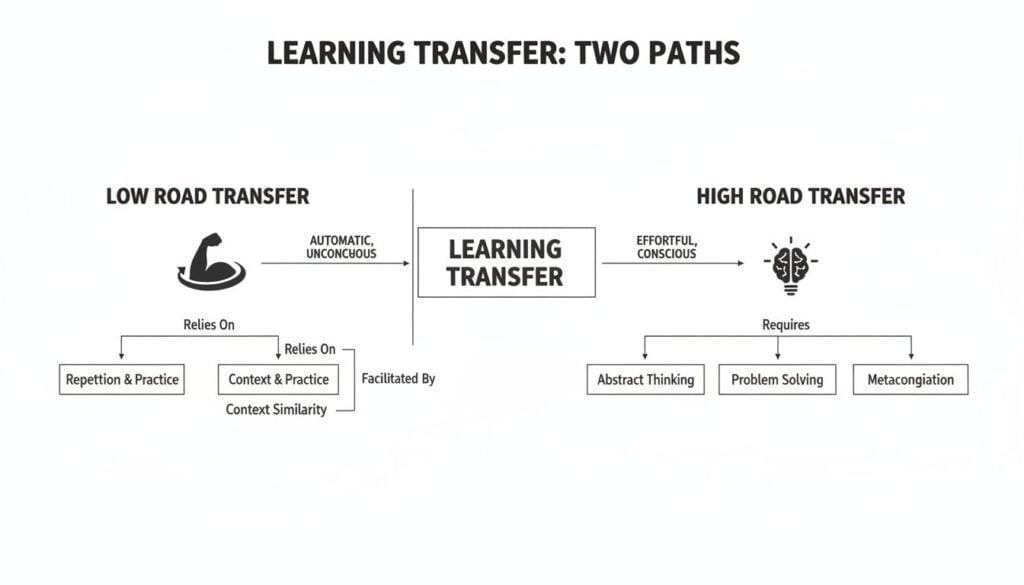
As you can see, designing for high road transfer requires a more conscious, mindful approach, and varied examples are one of the most powerful tools in your toolbox.
Create Realistic Case Studies and Scenarios
Your students didn’t sign up to solve textbook problems. They signed up to solve real-world problems. Your course content needs to reflect that reality. Generic, oversimplified exercises simply won’t prepare them for the messy, complex situations they’ll actually face.
You need to build case studies and scenarios that mirror the real world. For example, instead of a multiple-choice quiz on ad metrics, present them with a situation like this:
- The Scenario: “A client’s new ad campaign is tanking. The click-through rate is terrible and they’re burning through the budget. Here’s the ad copy, the targeting data, and their goals. What are the first three steps you take?”
- The Task: Have them analyze the data and lay out a concrete action plan.
- The Reflection: Follow up by asking why they chose those steps, forcing them to justify their decisions and connect their actions back to the principles you taught.
This pushes learners out of simple recall and into the vital skills of critical thinking and application. When you’re designing these scenarios, remember that memory is a key part of the puzzle. Incorporating actionable techniques for memory retention can make these realistic exercises even more powerful and lasting.
Weave in Reflection and Storytelling
Finally, never underestimate the power of a good prompt. Learning transfer requires thinking about what you’ve done. You need to build in regular moments that ask learners to connect the course material directly to their own lives.
Simple questions can make all the difference:
- “How could you use this exact technique on your current project?”
- “What’s the biggest roadblock you can see to applying this idea at your company?”
- “Think about a past situation where this concept would have been a game-changer. What would you have done differently?”
These prompts force students to do the mental work of transfer themselves. They are actively building the bridge between your content and their world, which is a muscle that needs to be exercised.
Storytelling and relatable analogies are another fantastic way to make abstract ideas feel concrete and memorable. As you plan your next module, think about how you can create these moments of connection. You might also find our guide on using spaced repetition in your online courses helpful for making these key concepts stick long after the lesson is over.
All this theory about high road and low road transfer is great, but what does it actually look like inside a course? It’s one thing to understand the concepts, but it’s another thing entirely to build them into your lessons. Let’s get practical.
We’re going to break down how to structure your modules and activities to build that crucial bridge between learning and doing. I’ll show you how to design for both the automatic, muscle-memory skills and the complex, adaptive problem-solving that your students really need. These are simple structures you can steal and adapt for your own courses, no matter what platform you’re using.

A Simple Template for Low Road Transfer
Let’s imagine you’re teaching a technical skill, like how to properly color-correct a video in Adobe Premiere Pro. This is a perfect scenario for low road transfer. The goal is to make a specific technical process feel fast, repeatable, and almost automatic. Deep creative expression can come later.
For this, repetition and immediate feedback are your best friends. Your module could follow a simple loop:
- Short “How-To” Video (3-5 minutes): First, show them exactly how it’s done. Record your screen as you walk through the process, explaining each click and adjustment clearly but without getting lost in the weeds of color theory. Keep it focused on the “how.”
- Guided Practice with a Downloadable File: Now, it’s their turn. Give them a short, raw video clip to download and a simple task: follow the exact steps from your video to correct the footage. This immediate application is what cements the skill.
- Instant Feedback Loop: As soon as they finish, give them a way to check their work. This could be a “solution” video or even just a “before and after” image showing what the correctly graded footage should look like. They can instantly compare their version and see where they nailed it or went slightly off track, reinforcing the correct process.
This simple “watch, do, check” cycle is incredibly powerful for building procedural muscle memory. You’re creating a smooth, paved road for the brain to follow, which is the whole point of low road transfer of learning.
A Project Framework for High Road Transfer
Now for the tricky stuff. Let’s say you run a business coaching program where you’re teaching founders how to pitch their company to investors. You can’t just hand them a script to memorize because that would be a disaster. Every business is unique, and every investor meeting is different. This demands high road transfer.
Instead of a simple loop, you need a multi-stage project that forces them to grapple with the concepts. Here’s a project structure that could unfold over several weeks:
- Initial Concept Draft: The student starts by writing their first draft. They take the core principles you’ve taught them about storytelling, identifying the market opportunity, and presenting financial projections, and they apply it to their own business.
- Peer Feedback Session: Next, they share that draft in a small group with 2-3 other founders. Using a structured feedback rubric you provide, they give and receive constructive criticism. This is huge because they see how the same principles are being applied to totally different businesses.
- Guided Self-Reflection: After getting feedback, the student completes a guided reflection. You ask them pointed questions like, “What was the single most common piece of feedback you received?” and “Based on that, what’s one specific change you will make to your pitch?” This forces them to think critically, not just react.
- Final Submission & Expert Review: Finally, they submit their revised, polished pitch to you. Your job is not to grade it “right” or “wrong.” It’s to provide expert feedback on how well they applied the core principles to their unique context.
This multi-step process encourages learners to actively grapple with the concepts, see them applied in different contexts through their peers’ work, and deliberately adapt their own approach based on feedback. This is the essence of building high road transfer.
This is a world away from just watching a video and taking a quiz. It’s an active, challenging, and sometimes messy process that forces them to bridge the gap between theory and their own reality. This is how you prepare your students for the real world.
How to Measure Real Learning Transfer

You’ve done the hard work of building a course designed for real-world results. Now comes the million-dollar question: how do you actually know if it’s working? If you’re just using standard multiple-choice quizzes, you’re only seeing a tiny fraction of the story.
Those tests can tell you if someone memorized a concept, but they reveal nothing about whether that person can actually apply it under pressure. To measure genuine transfer of learning, we have to get smarter about how we assess our students.
Move Beyond Quizzes to Performance Tasks
The only real way to measure transfer is to see it happen. This means designing performance-based assessments that force learners to tackle the same kinds of tasks they’ll face in the real world.
Think back to the project-based approach we talked about for high-road transfer. A final project, a portfolio piece, or a recorded presentation are all fantastic ways to gauge true competence. You’re not just looking for a right or wrong answer. You’re evaluating how well a student can use the principles you taught to solve a new, unscripted problem.
For instance, you could have them:
- Analyze a realistic dataset and present their findings.
- Develop and submit a complete marketing plan for a fictional company.
- Record themselves performing a physical skill, like a complex cooking technique or a specific workout.
This gives you concrete proof that a student can take what they’ve learned and put it into action. For a deeper look at different assessment strategies, you might want to check out our guide on how to measure training effectiveness.
The Power of Post-Course Surveys
Another incredibly powerful tool is a well-designed post-course survey. I’m not talking about asking if they “enjoyed” the course. I’m talking about asking targeted questions about application, long after they’ve finished the lessons.
Send out a survey 30, 60, or even 90 days after the course wraps up. This timing is crucial. It gives students a real chance to go out into the world and actually use what they’ve learned.
Your goal is to collect specific stories and data points that prove your course’s long-term impact. This is where you’ll find your most powerful testimonials and the undeniable proof of your program’s ROI.
Ask direct questions that get them thinking about their own progress:
- “What’s one specific thing you’ve done differently at work as a direct result of this course?”
- “Can you share an example of a problem you solved using a technique you learned with us?”
- “Have you seen any measurable results (like time saved, revenue generated, or costs reduced) since applying these new skills?”
These qualitative answers are pure gold. They show you exactly how learning is translating into real-world results and give you the most authentic success stories you could ever ask for.
This focus on applicable skills is becoming a massive global priority. We’re seeing a huge demand for education that crosses borders and prepares people for diverse, real-world challenges. In fact, between 2000 and 2019, the number of students studying abroad more than tripled, from 2 million to 6 million. This trend signals a worldwide shift toward flexible, practical learning, and it’s why online courses that deliver transferable skills are in such high demand. You can discover more insights about this global education trend and what it means for creators.
Your Top Questions About Learning Transfer
Whenever I talk about designing for learning transfer, a few key questions always pop up. Let’s dig into the ones that course creators and membership owners ask the most, so you can move from theory to action with confidence.
How Much Extra Work Is This, Really?
This is more about working smarter than working harder. The initial shift in how you think about course design can feel like a bigger lift, but it’s really just redirecting your effort to where it counts the most.
Instead of spending hours creating five different videos that all explain the same concept from slightly different angles, you might create two core videos and then build a hands-on activity where your students have to actually apply that concept. That upfront work in designing a great application exercise pays dividends.
You’ll see it in your students’ success and in your course’s reputation, which ultimately saves you a ton of time on marketing and student support down the line.
Can I Apply These Principles to a Membership Site?
Absolutely. In fact, a membership is arguably the perfect environment for learning transfer because you have the luxury of time.
You can design your entire membership as a continuous loop of application, getting feedback, and reflecting with the community. This becomes a core part of your value proposition that keeps members sticking around month after month, instead of just being a nice-to-have.
Here are a few ideas to get you started:
- Run monthly “application challenges” that push members to use a specific skill in their real world that month.
- Create a dedicated channel or forum space for “wins and struggles,” where people can share how they’re applying the material and get help when they get stuck.
- Host “live implementation” workshops where you’re not just teaching a concept, but actively guiding members as they apply it to their own projects in real-time.
What Is the Biggest Mistake to Avoid?
The single biggest mistake I see is simply assuming transfer will happen automatically. It’s a surprisingly common and costly oversight.
So many creators pour their heart and soul into creating beautiful, polished content. They have the best lighting, the crispest audio, and stunning slides. But they completely forget to build the bridge between knowing something and doing something with that knowledge. They’ve drawn a perfect map but haven’t given their students a car, a destination, or even a reason to take the trip.
You have to be intentional. Force yourself to ask this question for every single lesson: “What is the specific activity my students will do to practice this skill in a realistic context?” Forgetting to answer that is why so many courses, even well-produced ones, fail to deliver real-world results.
The most dangerous assumption in education is that just because something was taught, it was learned. The second most dangerous is that because it was learned, it can be applied. Intentional design for transfer is the only way to close that gap.
Why Is This So Critical for Online Courses Today?
In a market flooded with content, students aren’t just looking for more information. They’re looking for transformation. Let’s be honest, most information is just a Google search away, and it’s free.
People open their wallets and invest in an online course because they are buying an outcome. They’re paying for a result, whether that’s a new capability, a better job, or a solved problem. Focusing on learning transfer is how you actually deliver on that promise.
This is a global trend, not just a hunch. Analysis from UNESCO highlights a worldwide “learning quality crisis,” showing that just giving people access to information doesn’t mean they’re actually learning or able to apply it. This gap creates a massive opportunity for course creators who can prove their programs lead to genuine skills. You can read more on this trend from the World Bank.
At the end of the day, creators who can show their programs lead to real-world achievements have a huge competitive edge. Focusing on the transfer of learning is what shifts you from being a “content seller” to a “results provider,” and that’s exactly what today’s learners are desperate to find.