
Unlock Vygotsky’s Sociocultural Theory for Engaging Online Learning

At its core, Vygotsky’s sociocultural theory boils down to a simple yet profound idea: we don’t learn in a vacuum. We learn from each other. Our minds are shaped through conversations, collaborations, and the shared culture of our communities. In this view, learning is fundamentally a team sport.
A New Way to Think About Learning
Have you ever been completely stuck trying to figure something out on your own? Maybe you were wrestling with new software, trying to get a grasp on a foreign language, or even just attempting to assemble a piece of furniture. Then, a friend or a more experienced colleague points out one simple thing, and suddenly, it all makes sense.
That “aha!” moment is the very essence of Vygotsky’s theory in action.
This is about a deeper truth: our thinking processes themselves are forged through our social experiences. As someone who builds online courses, I find this concept incredibly powerful. It’s a constant reminder that just dumping information on learners isn’t enough. We have to design spaces where they can learn together.
The Man Behind the Theory
To really get what Lev Vygotsky was talking about, it helps to understand his world. He was a psychologist working in the Soviet Union during the early 20th century, a time of immense social upheaval following the 1917 Revolution. This backdrop is crucial, as it heavily influenced his focus on how society and culture mold individual development.
While many of his contemporaries believed children learn primarily through solo discovery, Vygotsky saw it differently. He argued that learning is a social activity from the very beginning. He proposed that every function we master appears twice. First, it happens between people in a conversation, a shared activity, or a lesson. Only then does it become internalized as part of an individual’s own thinking.
Vygotsky famously wrote: “Every function in the child’s cultural development appears twice: first, on the social level, and later, on the individual level.”
This idea is a game-changer. It shifts the focus from the isolated learner to the rich web of interactions surrounding them. Our community, through tools like language and symbols, gives us the very building blocks for thought.
Why His Ideas Are More Relevant Than Ever
Though Vygotsky’s life was cut short in 1934 at the young age of 37, his ideas have found a new and urgent relevance in the world of online education. His work provides the “why” behind so many features we now see as essential: community forums, peer review assignments, cohort-based courses, and group projects.
His theory is the blueprint for transforming passive content consumption into active, collaborative learning.
Understanding this foundation is the first step toward creating online learning that actually sticks. For a wider look at how this fits with other major educational concepts, check out our complete guide on the major theories of learning. The rest of this article will show you how to put these powerful ideas into practice.
The Three Core Concepts You Should Know
To actually use Vygotsky’s theory in your course design, you need to get your hands dirty with its three core building blocks. These are the practical tools that will help you build more effective and deeply engaging online courses. Once you see how they connect, you’ll start spotting opportunities for powerful learning moments everywhere.
This simple concept map lays out the fundamental flow: an individual learner engages in social interaction, which is the engine that actually constructs knowledge.
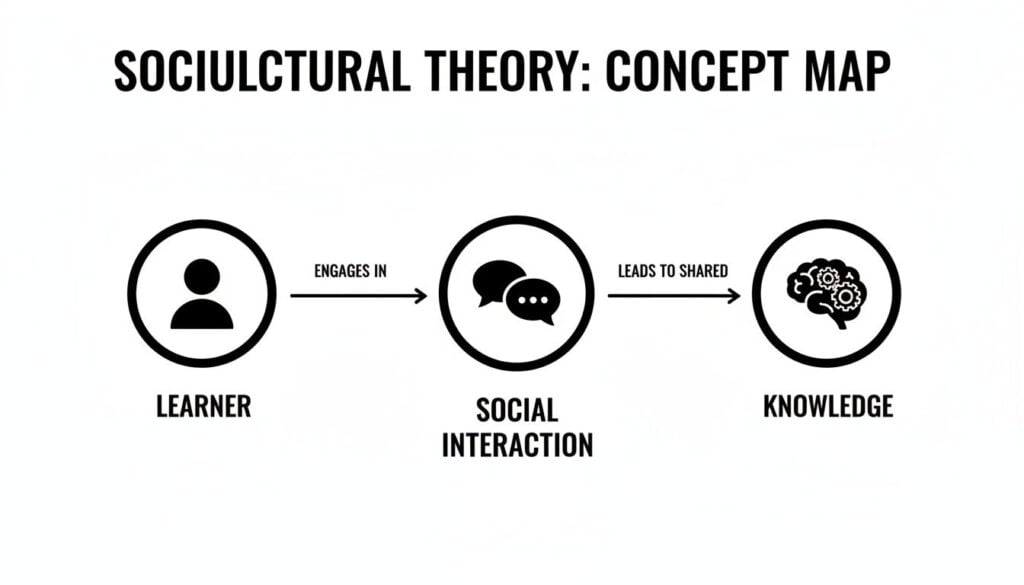
The map drives home a key point. Learning ignites through connection and interaction with others. Let’s break down the concepts that make this happen.
The More Knowledgeable Other (MKO)
First up is the More Knowledgeable Other, or MKO. It sounds a bit technical, but the idea couldn’t be simpler. An MKO is anyone who has a better understanding or a higher ability level than the learner for a specific task, process, or concept.
When you hear “MKO,” your mind probably jumps straight to a teacher or an industry expert. You’re not wrong, but that’s just the tip of the iceberg. The definition is much broader and more flexible than that.
An MKO can be:
- An instructor or mentor providing direct, structured guidance.
- A peer or fellow student who’s just one step ahead and has already figured out a skill you’re trying to learn.
- A well-designed AI assistant or even a software tutorial that walks you through a complex process.
- Even a younger person who is more fluent in a specific domain. Think of a child patiently showing a parent how to use a new app.
The key is about who holds the necessary knowledge for that specific moment of learning. In your online course, you’re the primary MKO, but the real magic happens when you design opportunities for your students to become MKOs for each other.
The Zone of Proximal Development (ZPD)
The MKO concept leads us straight to Vygotsky’s most famous idea: the Zone of Proximal Development (ZPD). This is the space where real, meaningful learning actually ignites. I like to think of it as the ultimate learning “sweet spot.”
The ZPD is the gap between what a learner can do all by themselves and what they can achieve with guidance and encouragement from a More Knowledgeable Other.
Imagine a student trying to get the hang of new video editing software. There are things they can already do on their own (like opening the program and importing clips) and things that are completely out of reach for now (like complex color grading or motion graphics). The ZPD is the territory in between, like learning to use multi-cam editing with the help of a step-by-step tutorial.
Vygotsky’s theory argues that learning is most potent when it happens inside this zone. A task should be challenging enough to be engaging but not so difficult that it leads to burnout and frustration.
As a course creator, your job is to become an architect of the ZPD. You need to design activities that push students just past their current comfort zone while providing the exact support they need to bridge that gap and succeed.
Scaffolding
So, how do you actually guide a learner across their Zone of Proximal Development? The answer lies in our third concept: scaffolding.
Scaffolding is the temporary support structure you build to help a learner cross that gap in their ZPD. The classic analogy is learning to ride a bike. Training wheels are a perfect example of scaffolding. They provide physical support while the child develops the crucial skills of balance, steering, and confidence.
Once they get it, you take the training wheels off. The support is removed because it’s no longer needed. That’s precisely how scaffolding should work in your course.
In an online learning environment, scaffolding can take many forms:
- Checklists and templates to guide students through a multi-step project.
- Step-by-step video tutorials that break a difficult technical task into manageable bites.
- Live Q&A calls or office hours where you can offer real-time support and clarification.
- Peer review assignments where students get constructive feedback from one another.
These supports are never meant to be permanent fixtures. As your students become more competent and confident, you gradually dismantle the scaffolding, empowering them to perform the task entirely on their own.
Together, these three concepts, MKO, ZPD, and Scaffolding, form the practical engine that drives Vygotsky’s sociocultural theory in a modern learning context.
When you think about language, you probably think of it as a tool for communication, a way to share ideas with others. But for Lev Vygotsky, it was something much more fundamental. He saw language as the primary tool we use for thinking.
Think about the last time you were wrestling with a tough problem. Did you find yourself quietly muttering to yourself? Maybe something like, “Okay, if I move this piece here, then I can tackle that part next.”
That simple act of talking yourself through a challenge is Vygotsky’s theory in action. Using words, even just in your head, is how we organize chaotic thoughts, give structure to new ideas, and ultimately master a new skill. For anyone designing an online course, this concept is a game-changer.
The Journey from Social Talk to Inner Thought
Vygotsky realized our relationship with language evolves as we grow. He mapped out a three-stage journey that shows how we take knowledge from the social world around us and make it our own.
Here’s how that progression works:
- Social Speech: This is where it all starts. Babies and toddlers use language to get what they need and connect with people. Think cries, babbles, and first words. It’s all about external communication.
- Private Speech: As kids get a bit older, they start talking to themselves out loud. You’ll see them narrating their playtime or talking themselves through a puzzle. This is self-guidance. They’re using language to direct their own actions and thoughts.
- Inner Speech: Eventually, that external monologue goes quiet. It moves inside, becoming the silent inner voice we all use to think, reason, and problem-solve. Language has now become a tool for internal thought and self-regulation.
This journey from external chatter to internal dialogue is the blueprint for how we learn to think. When we encourage our students to “talk it out,” we’re tapping into this fundamental process to help them build real, lasting understanding.
Creating Language-Rich Learning Environments
This insight from Vygotsky’s sociocultural theory gives us a powerful, practical mission as online course creators. If language is the engine of thought, our job is to build a learning environment where that engine can run at full throttle. We need to create structured moments for our students to use language, speaking, writing, and debating, to process our content.
According to Vygotsky, language doesn’t just reflect thought, it actively shapes it. By giving learners opportunities to speak and write about what they’re learning, you are giving them the tools to think more deeply about it.
This lines up perfectly with modern learning principles like comprehensible input, which shows that we acquire language best when we understand messages just slightly beyond our current level, usually with some social support. That’s exactly what happens when we use language-based activities as a scaffold in our courses.
Research confirms just how critical this is. Vygotsky’s emphasis on language as a cultural tool is crucial for internalizing thought. One fascinating study showed that in higher socioeconomic families, where cognitive stimulation is 2.5 times greater, children tend to internalize private speech 30% faster. This acceleration is directly linked to better academic outcomes down the road. You can dive deeper into these findings at ISU Pressbooks.
Practical Ways to Boost Learning with Language
So, what does this look like in your actual online course? The goal is to get students beyond passively watching videos and into active, language-based experiences.
Here are a few actionable ideas you can implement right away:
- Design Active Discussion Forums: Don’t settle for a generic “Questions?” thread. Create specific, structured prompts that force learners to articulate their understanding, challenge each other’s assumptions, and debate different approaches to a problem.
- Host Live Q&A Sessions: Live calls are the perfect venue for social speech. Students get to ask questions in real-time, hear how others frame their challenges, and absorb the group’s collective thinking. It turns learning from a solo activity into a shared one.
- Encourage Peer-to-Peer Feedback: Build assignments where students review each other’s work. This simple exercise is incredibly powerful. It forces both the reviewer and the creator to use precise language to explain their reasoning, justify their choices, and make constructive suggestions.
When you integrate features like these, you start seeing community for what it truly is: a fundamental learning tool that drives comprehension and makes your course content stick.
Applying Vygotsky’s Theory to Your Online Course Design
Alright, we’ve unpacked the big ideas behind Vygotsky’s work. Now for the fun part: turning that powerful theory into a practical blueprint for your online course. This is where the academic concepts get their hands dirty and start creating real results for your students.
We’re moving beyond just creating content and into designing genuine learning experiences. The goal is to architect a journey that’s just challenging enough to be exciting, with the perfect amount of support to ensure success.

Designing for the Zone of Proximal Development
The Zone of Proximal Development (ZPD) is where the magic happens. It’s that sweet spot where a task is just beyond a learner’s current ability but totally achievable with the right guidance. Your job as a course creator is to build a learning path that lives almost entirely within this zone.
Think of yourself as a great personal trainer. You’d never ask a brand-new client to bench press their max weight on day one. That’s a recipe for failure and frustration. Instead, you start with a weight they can handle, focus on their form, and then gradually add more plates to the bar as they get stronger. That’s precisely how you should design your course.
To do this effectively, you need to:
- Engineer early wins. The first few modules must be designed to build confidence and give learners a tangible sense of accomplishment.
- Increase complexity in stages. Each new lesson should feel like a natural next step, building directly on the skills mastered in the previous one.
- Keep the end goal in sight. Constantly remind learners of the amazing outcome they’re working towards. This makes the challenging middle sections feel purposeful, not just difficult.
When you structure a course this way, you pull learners forward instead of pushing them into overwhelm. This principle is a cornerstone of effective instructional design for online courses and is the practical heart of Vygotsky’s theory.
Implementing Digital Scaffolding
So, how do you support students while they’re navigating that challenging ZPD? The answer is scaffolding. These are the temporary support structures you put in place to help learners bridge the gap between what they know and what they’re trying to learn.
In an online course, scaffolding takes many digital forms. Think of drip-fed modules that prevent overwhelm or interactive forums that foster guided discussion. These features mimic Vygotsky’s concept beautifully, and the data backs it up. E-learning reports show membership sites that use collaborative, scaffolded modules see 35% better completion rates.
The best scaffolding feels like a helpful guide, not a crutch. It’s there when needed but fades into the background as the learner gains confidence and skill.
Here are some powerful examples of digital scaffolding you can build into your course:
- Drip-fed Content: Releasing modules on a set schedule (e.g., weekly) prevents the “content mountain” that overwhelms new students. It creates a manageable pace and keeps the entire cohort moving forward together.
- Downloadable Checklists and Templates: For a complex project, a simple checklist can turn a daunting task into a series of manageable steps. A well-designed template gives students a starting point, saving them from the terror of a blank page.
- Step-by-Step Video Tutorials: When teaching a technical skill, nothing beats a screen-share video that walks learners through the process click-by-click. They can pause, rewind, and re-watch until the concept clicks.
These tools are your way of being there for your student, guiding them through the struggle, even when you’re not physically present.
Fostering Peer-to-Peer Learning
One of the most powerful and often overlooked applications of Vygotsky’s sociocultural theory is tapping into the collective wisdom of your students. You don’t have to be the only expert in the room. In fact, your course becomes stronger when you aren’t.
Your students can act as More Knowledgeable Others (MKOs) for each other. When you intentionally create opportunities for peer-to-peer interaction, you do more than just build a strong community. You deepen everyone’s understanding. The act of explaining a concept to a fellow student forces the “teacher” to solidify their own knowledge.
Here are a few ways to make peer learning a central part of your course:
- Launch a “buddy system.” At the start of your course, pair up learners to act as accountability partners. They can check in with each other, offer encouragement, and troubleshoot small problems together.
- Facilitate guided group projects. Use a community platform like Circle or a dedicated Slack channel to host a group project where learners must collaborate to produce a final outcome.
- Encourage sharing “wins” and “struggles.” Create weekly threads where students post their progress. This gives members who are excelling a chance to offer advice and lets those who are struggling see they aren’t alone.
When you design for social interaction, your course transforms from a static library of information into a living, breathing learning ecosystem.
To help you connect these ideas to concrete features, here’s a table that translates Vygotsky’s core concepts into practical elements you can build into your LearnStream products.
Applying Vygotsky’s Concepts to Online Course Features
| Vygotskian Concept | Online Course Feature | Example Implementation | Expected Learner Outcome |
|---|---|---|---|
| Zone of Proximal Development (ZPD) | Sequenced & Tiered Modules | A course on SEO starts with “Keyword Basics” before moving to “Advanced Link Building.” | Learners feel challenged but not overwhelmed, leading to steady progress and higher completion rates. |
| Scaffolding | Worksheets & Templates | Providing a downloadable “Business Plan Template” for an entrepreneurship course. | Reduces initial friction and cognitive load, allowing learners to focus on applying concepts, not formatting. |
| More Knowledgeable Other (MKO) | Live Q&A and Office Hours | Weekly live sessions with the instructor to answer questions and clarify difficult concepts. | Students get expert guidance exactly when they need it, preventing them from getting stuck. |
| Collaborative Learning | Peer Review Assignments | Students submit their project drafts and provide structured feedback to two of their peers. | Deepens understanding through teaching and reinforces community bonds. |
| Cultural Tools | Shared Digital Whiteboard | Using a tool like Miro for a group brainstorming session on marketing ideas. | Fosters a shared language and collaborative problem-solving culture within the course community. |
By weaving these features into your course, you’re not just teaching a subject. You’re creating an environment where deep, lasting learning is almost inevitable.
How to Build a Thriving Social Learning Community
A course that’s just a collection of videos and PDFs is like a library with no librarians and no study groups. The information is there, but the actual learning is missing. We’ve come to understand that learning is deeply social, a concept championed by Vygotsky’s sociocultural theory. It’s time to stop just delivering content and start building a real community around it.
This is about deliberately designing a space where your members feel connected, supported, and motivated to help each other cross the finish line. Let’s walk through how to turn your course from a one-way information broadcast into a living, breathing ecosystem.
Choose the Right Home for Your Community
Your first big decision is where this community will live. This is about curating an environment. Are you aiming for a focused, library-like forum or a dynamic, coffee-shop-style chat?
- Dedicated Community Platforms: Tools like Circle.so or Heartbeat are built for this from the ground up. They offer organized discussion threads, live event features, and direct messaging, which is perfect for creating a branded, focused experience.
- Integrated Course Platform Tools: Many platforms now have built-in community features. This puts everything under one roof, which is incredibly convenient for your students and keeps them from having to juggle multiple logins.
- Real-Time Chat Apps: Apps like Slack or Discord create a fast-paced, conversational vibe. They’re fantastic for quick check-ins and getting immediate answers, but they can feel a bit like a firehose if not managed carefully.
Remember, a Vygotsky-inspired environment thrives on strong interpersonal communication. Understanding the fundamentals of social skills training for adults can be a huge asset for you as a leader and for your members as they learn to interact effectively.
Spark and Sustain Meaningful Conversations
Once you’ve built the house, you need to make it a home. The real work is getting members past the polite “Great post!” comments and into discussions where the lightbulbs really go on. As the course creator, you’re the primary MKO (More Knowledgeable Other), and it’s your job to get the ball rolling.
A thriving community is a place where students feel safe enough to ask “stupid” questions and confident enough to share their own insights. This is the social bedrock where Vygotsky’s theory comes to life.
The data backs this up. According to e-learning trend reports from sources like ISU Pressbooks, platforms that actively apply these principles see 28% higher engagement. Even more telling, communities built on tools like Heartbeat report 45% more daily active users than courses that just offer siloed video content. The learning happens in the conversation.
Proven Prompts and Moderation Strategies
You can’t just hope for this kind of rich interaction. You have to engineer it. Don’t leave it to chance.
Here are a few prompts that consistently get people talking:
- The “Weekly Win” Thread: Ask members to share one thing they accomplished this week, no matter how small. It builds positive momentum and shows everyone that progress is being made.
- The “Struggle Bus” Post: Create a dedicated, safe space for people to admit what they’re stuck on. This is where the magic happens, as it gives other students the perfect opportunity to step up and become MKOs for each other.
- The “Show Your Work” Challenge: Ask students to post a draft, a screenshot, or a work-in-progress. This invites peer feedback and makes the learning process feel transparent and collaborative, not isolated.
As the community moderator, your role is to be a guide, not a lecturer. Gently steer conversations back on track, tag students who might have valuable insights for others, and always, always celebrate the members who step up to help. For a deeper dive, our guide on how to build community in an online course has even more concrete steps you can take.
Let’s connect the dots. All this talk about Vygotsky and social learning is a direct line to the health and profitability of your online education business. When you build a course buzzing with real interaction, you’re not just improving how people learn. You’re building a powerful, defensible asset.
The next logical step is to think about how this asset makes you money. The social features you’ve built, and especially the community that forms around them, can be translated directly into new revenue streams. Your role as the primary MKO (More Knowledgeable Other) is your most valuable product, and it’s time to package it that way.
Turning Your MKO Status Into Revenue
One of the cleanest ways to do this is by creating tiered memberships. Your standard course might include all the core content and access to the general community forum. A premium tier, however, could offer much more direct access to you.
Here are a few ways you can structure this:
- Small-Group Coaching: Offer weekly or bi-weekly video calls for a small, exclusive group of premium members. This creates an intimate, high-value setting where you can give personalized guidance and they can learn from each other’s questions.
- Personalized Feedback Packages: Let learners submit their work, like a project, a business plan, or a piece of writing, for your direct review. This is a classic MKO function, and people will happily pay a premium for an expert’s eyes on their work.
- Exclusive “Ask Me Anything” (AMA) Sessions: Host private Q&As just for your top-tier members. This gives them a direct line to your expertise that isn’t available to the general student population.
This model creates a clear and fair value proposition. Everyone gets the benefit of the course and the wider community, but those who crave more focused support from the main expert, you, have a clear path to get it. It’s a brilliant way to scale your time while dramatically increasing your revenue per student.
A strong, engaged community is a core asset that justifies higher course prices, boosts perceived value, and significantly reduces churn.
The data backs this up. A 2019 meta-analysis covering 50 different studies found that educational programs built on Vygotsky’s ideas significantly boosted student achievement, especially in collaborative settings. In the US, where social learning is becoming a standard in many schools, these methods correlate with a 25% higher retention rate in certain subjects. You can dig into how Vygotsky’s influence is measured by reading the full research.
Ultimately, embracing Vygotsky’s sociocultural theory does more than just make your course engaging. It transforms your business from a simple content-for-cash transaction into a living, breathing ecosystem that gets stronger and more valuable with every new person who joins.
Your Top Questions About Vygotsky’s Theory, Answered
As you start wrapping your head around Vygotsky’s sociocultural theory, it’s completely normal for a few practical questions to pop up. Moving from theory to real-world course design is where the rubber meets the road.
I’ve seen course creators hit the same sticking points time and again. Let’s tackle the big ones so you can move forward with confidence.
How Is Vygotsky Different From Piaget?
This is the classic question, and for good reason. The difference between Lev Vygotsky and Jean Piaget really comes down to a single, fundamental disagreement about what comes first in learning.
Piaget saw children as little scientists, making sense of the world mostly on their own. For him, learning was an inside-out job. A child explores, has an internal “aha!” moment, and then social interaction helps refine that understanding.
Vygotsky flipped that idea on its head. He argued that learning is social first. We learn from our parents, teachers, and peers, and only then do we internalize that knowledge and make it our own. For Vygotsky, social interaction is the very source of our thinking.
Can You Apply This With Hundreds of Students?
It’s easy to picture social learning in a small workshop, but how does it work when your course has hundreds, or even thousands, of students? It can feel like an impossible task, but you absolutely can do it. The secret is to stop thinking of yourself as the only guide.
Your job is to build the systems that allow students to effectively become guides for each other.
Here are a few ways to make that happen:
- Create small peer groups: Break your big community down into smaller, more intimate “pods” or accountability circles. These groups can tackle projects together and act as the first line of support for each other.
- Use targeted forums: Ditch the single, massive discussion board. Instead, create specific forums for each module or a common challenge. This helps students find others who are working on the exact same thing.
- Appoint community leaders: Keep an eye out for your most engaged and helpful students. Give them an official role as “community leaders” or “mentors.” They can become powerful MKOs for their peers, answering questions and sparking conversations.
What If Community Engagement Starts Low?
You’ve built the perfect community space, you post your first welcome message, and… crickets. It’s a fear every course creator has, but it’s completely fixable. Low engagement right out of the gate is normal. It just means you need to be more intentional about kickstarting the interaction.
When students see the community as a place where real learning happens, they will show up. Make interaction a non-negotiable part of the learning experience, not just an optional extra.
If your engagement is slow to build, you have to seed the conversation yourself. Create weekly rituals, like a “Wins Wednesday” thread or a “Stuck on Sunday” post to build consistency. You can also use highly specific prompts that tie directly into the week’s lesson, asking students to share a key takeaway or a specific hurdle they’re facing. As members see others getting real value from these discussions, they’ll start to participate on their own without needing as much of a nudge.