What Is a Self-Paced Course System and Its Benefits?
Imagine a learning library that never closes. One where you can check out lessons whenever you want, move through chapters at your own speed, and only advance when you’re truly ready. That’s the core idea behind a self-paced course system. It’s an educational model built entirely around the learner.
The Freedom of Learning on Your Own Terms
Have you ever been in a class and felt rushed, wishing you had more time to grasp a tricky concept? Or the opposite, bored and tapping your foot, waiting for the instructor to cover material you already know? These are the exact frustrations a self-paced system is designed to eliminate.
The whole approach is built on a simple but powerful principle: learner autonomy. Instead of locking everyone into the same rigid schedule, it hands the keys over to the student.
It’s a bit like comparing a guided bus tour to a road trip. The bus tour is efficient, and everyone sees the same sights at the same time. But a road trip? That’s your adventure. You decide where to stop, how long to linger, and which scenic detours to take. You still reach the destination, but you do it your way, on your timeline.
This kind of flexibility is a massive reason why the online education world has exploded, growing an unbelievable 900% since 2000. By 2026, it’s expected to be a $370 billion industry. The numbers show that people crave this freedom. Study after study finds that 58-78% of learners pick self-paced formats when given the choice. You can see more on these trends and their impact at elearningstats.education.
Core Principles of Self-Paced Learning
So, what makes this system actually work? It really just comes down to a few core elements that put the student in control:
- On-Demand Access: All the course materials, like videos, guides, and worksheets, are available from the moment you start. No waiting for content to be “unlocked” on a specific date.
- No Hard Deadlines: Students can work through assignments and quizzes at their own pace, free from the pressure of a looming due date breathing down their neck.
- Flexible Timeline: Whether it takes someone a week or three months to finish a course, the timeline is theirs to decide.
The real magic of a self-paced course is that it meets learners where they are. It respects their busy lives, prior knowledge, and unique learning speed, making education more accessible for everyone.
This is a fundamental shift in how we teach. It’s a model that finally acknowledges that everyone’s learning journey is different.
For course creators, this opens up the ability to serve a global audience across every time zone without the logistical nightmare of scheduling live sessions. For students, it removes the barriers that once made learning impossible. It allows them to gain a new skill while juggling a full-time job, family, or anything else life throws their way. Next, we’ll dig into exactly who benefits from this and why.
The Benefits for Your Learners and Your Business
So, why even bother with a self-paced course? The short answer is that it creates a genuine win-win. It’s a fantastic experience for your students, which in turn fuels the growth and success of your business. Let’s dig into what that actually looks like.
For your learners, the single biggest advantage is flexibility. We all lead busy lives, juggling work, family, and everything in between. A self-paced system gets rid of the stress of fixed schedules and looming deadlines. It empowers people to learn whenever it works for them, whether that’s first thing in the morning or late into the night.
This simple shift puts them back in the driver’s seat of their own education.
How Learners Thrive with Flexibility
When students aren’t pressured to keep pace with a group, they can take the time they need to truly wrap their heads around complex topics. This naturally leads to a much deeper understanding and better retention of what you’re teaching.
- Reduced Pressure: No more anxiety about falling behind. Learners can pause, rewind, and re-watch lessons as many times as they need without feeling rushed or judged.
- Personalized Pace: Students who are already familiar with a topic can breeze through it, while others can spend extra time on the tricky parts. This ensures nobody is left behind, and nobody is held back.
- Improved Comprehension: The ability to learn at an optimal speed helps the information stick. In fact, interactive self-paced content can lead to an 85% improvement in retention rates compared to old-school methods.
The demand for this model is undeniable. The global online learning market, which is largely driven by self-paced formats, is on track to hit $61.59 billion in revenue by 2026. People want to learn on their own terms, from wherever they happen to be.
If you’re wondering when this model is the right call, this decision tree makes it pretty clear. For modern learners with packed schedules, self-paced is often the only realistic option.
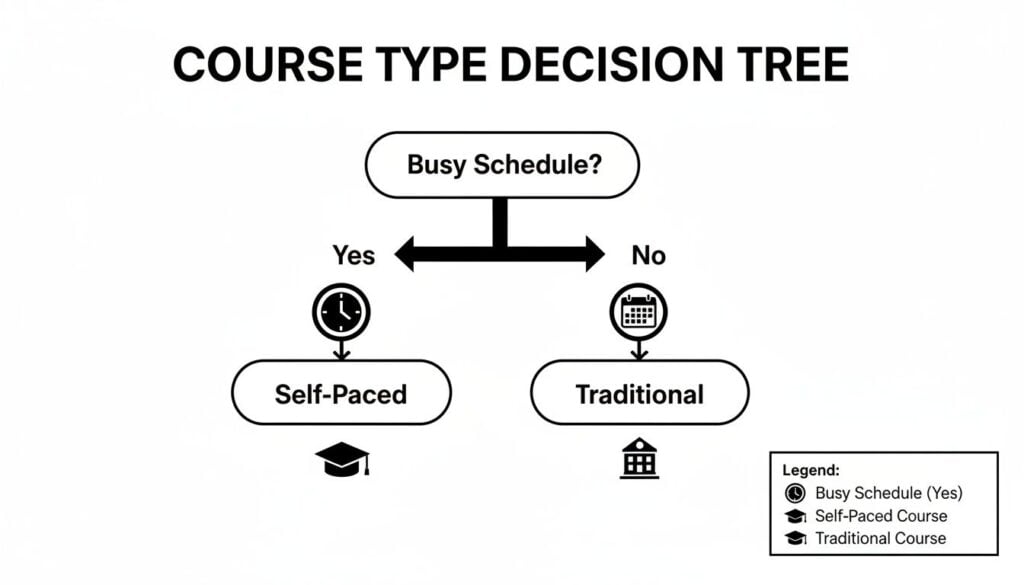
As you can see, when time is the biggest hurdle, self-paced learning opens doors that scheduled formats simply can’t.
The Big Wins for Your Business
Now, let’s switch gears and talk about you, the course creator. Happy, successful students are great, but the business benefits are just as powerful. A self-paced model is a smarter way to run an education business.
One of the biggest advantages is scalability. With a self-paced system, you build the course once, and you can sell it to an unlimited number of students without adding to your workload. No live classes to schedule, no conflicting time zones to manage. You can serve a global audience, 24/7.
A self-paced course system transforms your business from one that trades time for money into one that generates passive income. It becomes an asset that works for you, even while you sleep.
This model also means lower operational costs. You save a ton on the software and staff needed to run live sessions, and you can automate most of the student management process.
Finally, remember that student satisfaction is your single best marketing tool. When learners feel empowered and actually get results, they leave glowing testimonials and tell their friends about your course. This word-of-mouth marketing is incredibly powerful and helps you build a strong, trusted brand. For a deeper dive, check out our guide on the overall benefits of elearning.
At the end of the day, a self-paced system creates a direct line between your learners’ success and your business’s bottom line.
Essential Features of an Effective Self-Paced System
Putting together a great self-paced course is about more than just uploading a few videos and calling it a day. A truly effective self-paced course system has several key pieces that work together to create an experience that feels supportive and motivating, not lonely or confusing.
Let’s break down the must-have features that turn a simple content library into a powerful learning engine.
A Clear and Logical Structure
First things first, your course needs a solid foundation. The structure is everything. Without it, students feel lost and overwhelmed, which is the fastest way to get them to quit.
Think of your course like a book. It needs chapters and sections. You should organize your content into clear modules and lessons. Each module tackles a major topic, and the lessons within it break that topic down into small, manageable steps.
This step-by-step progression acts as a guide, giving learners a sense of momentum as they move from one piece to the next.
Visual Progress Tracking
We all love that little dopamine hit we get from checking an item off a to-do list, right? It’s a powerful motivator, and a good self-paced course system taps directly into that feeling of accomplishment.
Visual progress tracking is non-negotiable. This can be as simple as:
- Completion Checkmarks: A little green check that appears next to a lesson once a student finishes it.
- Progress Bars: A bar that fills up as they move through the course, showing them they’re 60% of the way to the finish line.
These elements give students a clear, visual cue of how far they’ve come and what’s left to do. It transforms a long journey into a series of small, satisfying wins. This is critical for keeping motivation high when there’s no instructor setting deadlines.
Interactive Quizzes and Knowledge Checks
Let’s be honest, passively watching hours of videos gets boring. To keep learners engaged and, more importantly, to help them actually retain what you’re teaching, you need to sprinkle in some interactive elements.
Quizzes and knowledge checks are perfect for this. They do two things really well. They break up the monotony of just consuming content, and they give students a chance to test their understanding before moving on.
An effective self-paced system doesn’t just deliver content. It creates a feedback loop. Quizzes are the simplest way to let learners know, “Yes, you’ve got this,” or, “Maybe you should review that last video one more time.”
These don’t need to be high-stakes exams. Simple multiple-choice questions or short fill-in-the-blanks can be incredibly effective at reinforcing key concepts.
Easy Access to Resources
Finally, a great system makes it effortless for students to find all the supplemental materials you provide. I’m talking about a dedicated resource library or a simple “Downloads” section within each lesson.
This is where you can put things like:
- Worksheets and checklists
- Presentation slides
- Reading materials or helpful links
- Templates and code snippets
Having all these resources organized and easy to find saves your students from the frustration of hunting for a file. It makes your course feel much more valuable and complete, giving them all the tools they need to succeed in one convenient place.
Designing for Engagement to Boost Completion Rates
Let’s be honest. One of the biggest ghosts haunting any self-paced course is the drop-off rate. Without a live instructor setting deadlines or a classroom full of peers providing accountability, it’s incredibly easy for students to lose steam. When learners feel isolated or just plain overwhelmed, they disappear.
The good news? This is a design problem, not a student problem.
Our job is to turn what could be a lonely, passive content library into an active, motivating experience. Here are a few battle-tested strategies that go beyond just dumping information and actually pull students across the finish line.
Break It Down with Microlearning
Ever opened a project file and felt a wave of paralysis wash over you? That’s what a student feels when they log in and see a list of hour-long video lectures. It’s just too much. The antidote to this is microlearning.
Microlearning is all about breaking down huge topics into tiny, manageable pieces. We’re talking five to ten-minute videos, quick readings, or lessons focused on a single, core idea.
This approach is powerful for two reasons. First, it makes the material far less intimidating. Second, and maybe more importantly, it creates a constant feeling of forward momentum as students knock out one small lesson after another.
Make It Stick with Storytelling
Here’s a simple truth. We forget facts, but we remember stories. Weaving narrative into your lessons is one of the most effective ways to make your teaching memorable and genuinely relatable.
You don’t need to be a Hollywood screenwriter to pull this off. It can be as simple as:
- Sharing a personal anecdote about your own struggles with the topic.
- Using a case study to illustrate how a real company or person applied your concepts to get results.
- Creating a simple analogy that connects a complex idea to something everyone already gets.
Stories forge an emotional connection, and that connection acts like an anchor for the information in a student’s brain. It’s a small shift that makes a massive impact.
Create Momentum with Gamification
Who doesn’t feel a little jolt of satisfaction from earning an award or climbing a leaderboard? Gamification is simply the art of applying game-like elements to your course to make the learning process more fun and intrinsically motivating. It’s all about engineering those “small wins” that keep people hooked.
A self-paced course shouldn’t feel like a lonely homework assignment. By adding elements of challenge and reward, you can tap into a learner’s natural desire for achievement and make the whole experience more enjoyable.
Here are a few easy ways to add a taste of gamification:
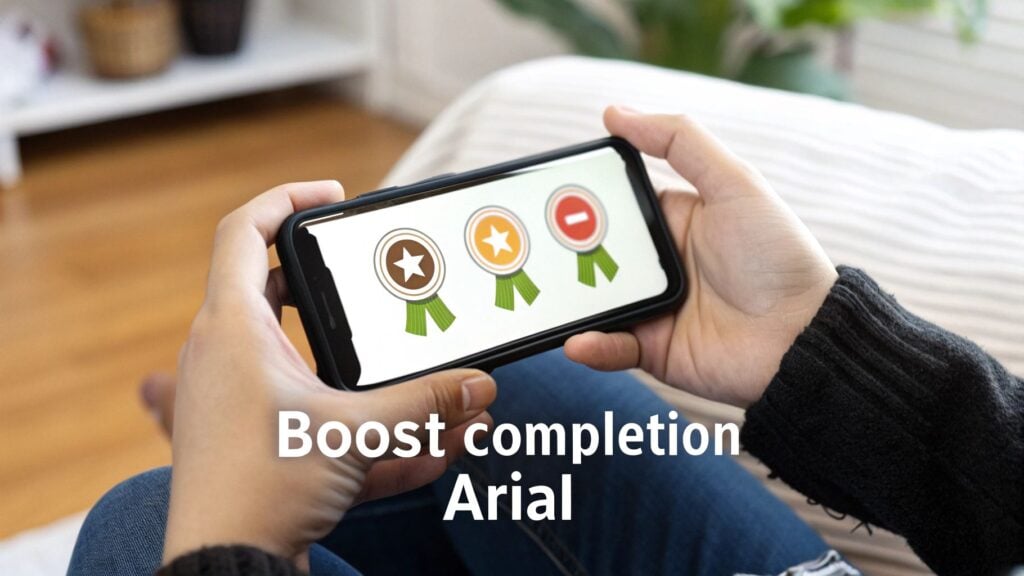
- Achievement Badges: Award a digital badge when someone completes a module, aces a quiz, or hits a specific milestone. It’s a simple visual pat on the back that feels surprisingly good to earn.
- Points and Leaderboards: Assign points for completing lessons or activities. A leaderboard adds a fun, competitive dynamic for those who are driven by seeing their name in lights.
- Progress-Based Unlocks: While the core curriculum should always be accessible, you can offer bonus materials or special resources that only unlock after a student finishes a key section.
These features provide immediate, positive feedback and transform the learning journey from a chore into a challenge. As you’ll find in these tips for student engagement in online learning, the goal is to shift students from passive consumption to active participation.
Foster Connection with a Community
Even the most dedicated introvert can feel like they’re on an island in a self-paced course. Building a community space, like a private forum, a Slack channel, or a dedicated chat group, is one of the most powerful ways to combat this isolation. It turns a solo mission into a shared adventure.
A community gives students a place to ask questions, celebrate their wins, and connect with people on the exact same path. This sense of belonging can be the single biggest factor in whether a student sees your course through to the end. As an added bonus, it often reduces your support load, as students start helping each other solve common problems. For a deeper dive, check out our guide on how to increase learner engagement.
By thoughtfully weaving these elements into your course architecture, you’re not just delivering content. You’re creating a supportive and motivating ecosystem that will absolutely transform your completion rates.
Choosing the Right Technology for Your Course

Feeling a bit overwhelmed by all the tech options out there? I totally get it. Picking the right tools to build your self-paced course can feel like you’re trying to assemble furniture with the instructions written in another language.
My goal here is to cut through that noise. I’ll give you a simple way to think about your options so you can put together a toolkit that works for you without causing a major headache.
Let’s start with the two main paths you can take. The first choice is an all-in-one platform, often called a Learning Management System (LMS). Think of this as the “course in a box” solution. The second is a more custom-built approach, usually pieced together using a tool like WordPress with specialized plugins.
All-In-One Platforms
All-in-one platforms are designed to make your life easy. They handle everything from hosting your videos and processing payments to tracking student progress. The biggest benefit here is simplicity. You get all the core features you need in one place, which is a huge time-saver.
Of course, this convenience usually comes at a cost. These platforms often charge a monthly fee, and some might take a percentage of your sales. You also give up some control over the design and deeper functionality.
The Custom-Built Approach
On the other hand, you have the more flexible, do-it-yourself route. This path usually involves building your course on a website you control, like one powered by WordPress, and then adding plugins to get the features you need.
This gives you complete control over the look, feel, and functionality of your course. It can often be more affordable in the long run, but it definitely requires more technical confidence to set up and maintain.
The right choice isn’t about which tech is “best” overall. It’s about which tech is best for you, your budget, and your comfort level. A simpler system that you actually launch is always better than a complicated one that stays on your to-do list forever.
To help you decide, let’s look at the essential tools you’ll need, no matter which path you take. These are the non-negotiables for any effective self-paced course.
- Video Hosting: You need a reliable place to store your video lessons. While you can upload them directly to your site, using a dedicated service like Vimeo or Wistia provides a much better experience for your students, with faster loading and no ads.
- Payment Processor: You have to get paid, right? A secure way to accept payments is critical. Stripe and PayPal are the industry standards and integrate with just about every course platform and plugin out there.
- Community Platform: As we’ve discussed, community is vital. This could be a simple private Facebook Group, a dedicated Slack channel, or a more advanced community platform that integrates directly into your course.
Making this decision can feel like a big commitment. To help you navigate the options, you can check out our guide on how to choose an LMS, which breaks down the pros and cons even further. By starting with your own needs, you can confidently build a tech stack that empowers you to launch a successful course.
Smart Pricing and Monetization Models
You’ve poured your expertise into creating an incredible course. Now for the million-dollar question: what’s it worth? Pricing can feel like a shot in the dark, but it doesn’t have to be. With the right strategy, you can land on a price that feels good to you and makes perfect sense to your students.
Let’s walk through the most common ways to sell your self-paced course so you can pick the best path forward.
One-Time Fee vs. Recurring Subscription
The most straightforward way to sell a course is with a one-time fee. A student pays a single price upfront and gets lifetime access to everything. It’s simple, clean, and easy for everyone to understand.
This model is a fantastic fit for courses that teach a specific, evergreen skill, like “Introduction to Photography” or “Learn to Knit.” Customers love the clarity. They pay once and own it forever. No strings attached.
On the other side of the coin, we have the recurring subscription model, which has absolutely exploded in popularity. Here, students pay a smaller monthly or annual fee for ongoing access to your course, plus any new content you add along the way.
This approach creates a predictable, recurring revenue stream, which is a game-changer for any business. It works exceptionally well for topics that are always changing, where you can provide continuous value through regular updates, new lessons, or a thriving community.
The right pricing model isn’t just about the number. It’s about the value proposition. A one-time fee sells a product, while a subscription sells an ongoing relationship and continuous value.
Making Your Course More Accessible
Let’s be real. Not everyone can drop a large sum on a course in one go. That’s where payment plans come in to save the day. By letting someone split a $600 course into three monthly payments of $200, you immediately open the door to a much wider audience.
This one simple tweak can dramatically boost your conversion rates without cheapening your content.
Another powerful strategy is to create pricing tiers. This lets you offer different levels of access and support at different price points, meeting people where they are.
For example:
- Basic Tier: Just the core video lessons. Perfect for the self-starter.
- Pro Tier: The videos, plus downloadable workbooks and access to your community forum.
- Premium Tier: Everything from Pro, plus a one-on-one coaching call with you.
This approach allows customers to choose the level of investment that feels right for them, which ultimately maximizes your potential revenue.
Increasing Your Average Customer Value
Once you have a couple of courses in your library, bundling becomes your best friend. It’s simple. Package two or three related courses together and offer them at a discounted price.
You could bundle your “Beginner Photography” and “Photo Editing 101” courses into a single “Complete Photography Masterclass” package. This gives the student a better deal and a more complete learning path, while you increase the average amount each customer spends. It’s a true win-win.
Of course, managing all these moving parts, like subscriptions, payment plans, and bundles, requires a solid system on the backend. Getting paid is just as important as setting the price. Using a dedicated tutoring billing software can automate the invoicing and payment collection, saving you a ton of administrative headaches.
By mixing and matching these strategies, you can build a flexible, smart monetization model that reflects the true value of your expertise while making your course accessible to the people who need it most.
Comparing Pricing Models for Your Course
Here’s a quick look at the pros and cons of the three main ways to sell your self-paced course.
| Pricing Model | Best For | Pros | Cons |
|---|---|---|---|
| One-Time Fee | Courses with evergreen content or a defined, finite skill. | Simple for customers to understand. Predictable upfront revenue for you. | No recurring revenue. Income can be inconsistent “feast or famine” cycles. |
| Subscription | Topics that require ongoing updates, or courses with a strong community element. | Creates a stable, predictable monthly recurring revenue (MRR). | Requires continuous content creation to justify the ongoing cost for members. |
| Tiered Pricing | Courses that can offer different levels of support, content, or access. | Caters to different budgets, maximizing your total addressable market. | Can be more complex to manage and market effectively. |
Ultimately, there’s no single “best” model. The right choice depends entirely on your content, your audience, and your long-term business goals. Don’t be afraid to start with one and experiment as you grow.
Got Questions? Let’s Get Them Answered.
You’ve made it this far, which tells me you’re getting serious about building a self-paced course. That’s fantastic. But I’ll bet you still have a few nagging questions buzzing around in your head.
That’s totally normal. To help you feel even more confident moving forward, I’ve rounded up some of the most common questions I hear from creators just like you.
How Much Support Should I Actually Offer?
This is a big one, and the honest answer is it depends entirely on your price point and who you’re serving. For a lower-cost, entry-level course, a completely self-service model is often perfectly fine. Students get the core content and maybe a community forum, and that’s it.
But when you start charging premium prices, your students will (and should) expect more. Think about including monthly live Q&A sessions or even offering direct one-on-one email support. The golden rule here is to align the level of support with the price point. More direct access to you should always equal a higher price.
What if My Students Don’t Finish the Course?
It can feel a little disheartening to see low completion rates, but try not to take it personally. It’s almost never a sign of a “bad” course. It’s usually a symptom of a design or engagement issue.
If you see a lot of people dropping off, it’s time to put on your detective hat. Look for the patterns. Is everyone getting stuck on the same lesson? Is a particular module just too long or confusing?
This is where student feedback becomes pure gold. Send out a simple survey asking why they stopped. You’ll be surprised how often a few small tweaks, like chopping a long video into shorter clips or adding a new downloadable worksheet, can make a massive difference in getting people across the finish line.
Can a Self-Paced Course Even Have a Community?
Absolutely. In fact, building a community is one of the most powerful things you can do to boost engagement and keep students from feeling like they’re on a solo mission. A self-paced course doesn’t have to mean a lonely course.
Here are a few simple ways to bake that connection right in:
- A Dedicated Forum: Set up a private space where students can ask questions, celebrate their wins, and connect with others who are on the same path.
- Optional Live Calls: Hosting monthly or quarterly group Q&A calls gives everyone a chance to connect in real-time and feel like part of something bigger.
- Study Groups: You don’t have to run these yourself. Simply encourage students to form their own small, self-organized study groups to tackle the material together.
A strong community transforms your course from a simple digital product into a living, breathing ecosystem. It adds a ton of value and gives people a compelling reason to stick around long after they’ve finished the lessons.
At the end of the day, a successful self-paced course is all about hitting that sweet spot between flexibility and support. By thinking through these common challenges ahead of time, you can design a learning experience that not only empowers your students but also sets your business up for success in the long run.