
A Course Creator’s Guide to Theories of Learning

Let’s be honest, the phrase “learning theories” can sound a bit stuffy and academic. But what if I told you these ideas are the secret weapon behind online courses that people actually finish, remember, and get real results from?
Forget the dry textbook definitions. This guide is all about turning theory into your most practical, results-driven tool.
Why Learning Theories Are Your Course Creation Blueprint
I like to think of learning theories as the architectural plans for a house. You could just start building. Put up some walls, add a roof, and it might look okay from the outside. But without a solid blueprint, the rooms might feel awkward, the plumbing might not connect, and the foundation could be shaky.
The same exact thing happens when you create a course without understanding how people learn.
These theories help you answer the big questions. How should I structure my lessons? What kinds of activities will actually make an impact? How do I design content that truly sticks? This is the difference between dumping information on your students and guiding them through a genuine transformation. If you’re working with adults, this is especially critical, as we cover in our guide on adult learning theory principles.
A Quick Look Back
These concepts aren’t brand new. While the formal, scientific study of learning kicked off in the 1800s, the core ideas have roots stretching back over 2,000 years to ancient philosophers trying to figure out how we know what we know. That long history, from simple speculation to actual science, is what makes these ideas so powerful. You can read more about the history of learning theories to see how they’ve evolved.
So, what does this ancient history have to do with your course today? Everything. It gives us a reliable framework for answering the make-or-break questions every course creator faces:
- How should I organize my modules for the best possible flow?
- What kinds of activities will keep my students clicking, thinking, and engaging?
- How do I make sure the most important lessons are the ones they remember weeks later?
When you apply these frameworks, you stop guessing what might work. You start using proven strategies to build a more effective, engaging, and valuable learning journey for every single student. It’s a roadmap for creating courses that don’t just teach, but truly transform.
Alright, let’s get into the “big three” learning theories that have really shaped how we all design courses and training. These are the foundational ideas you’ll see popping up everywhere, and really getting them is a game-changer for any course creator.
Think of them as different blueprints for building a learning experience.
First up is Behaviorism. At its heart, this is the “practice makes perfect” model. It’s all about observable actions and suggests that learning is simply a reaction to our environment.
It’s a bit like training a puppy. When the puppy sits on command, it gets a treat. That positive reinforcement makes it more likely to sit again in the future. Behaviorism applies this same logic to human learning through repetition, clear feedback, and rewards.
This concept map breaks down how these core theories influence the structure, impact, and engagement of your course.
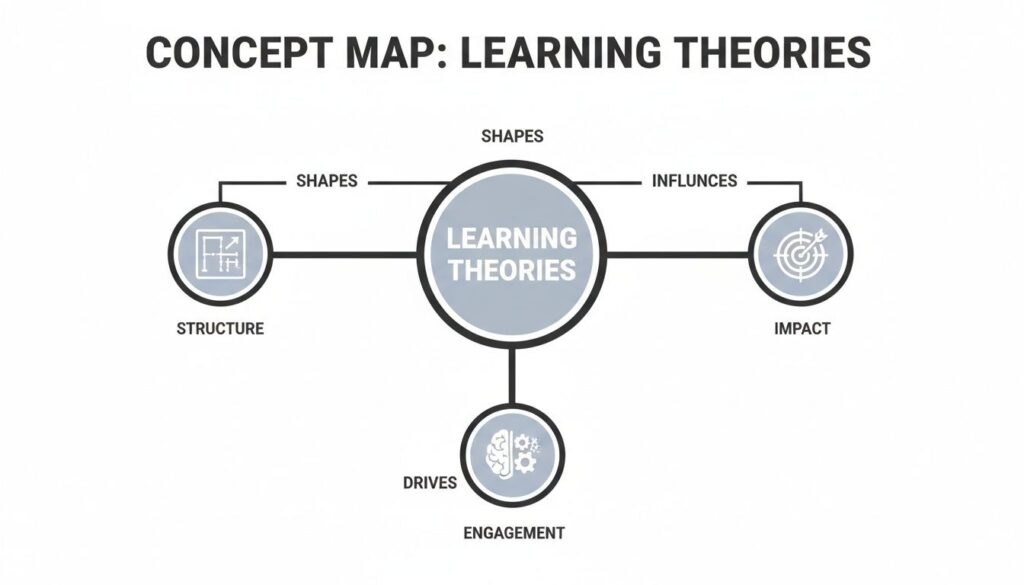
As you can see, each theory gives you a completely different lens for how you build your lessons and connect with your students.
Behaviorism: The Practice and Reward Model
In an online course, a Behaviorist approach is fantastic for teaching foundational, concrete skills. It’s focused on mastering specific actions or information until they become second nature.
Here’s how you might see it used in the real world:
- Flashcard-style quizzes: Perfect for drilling vocabulary or key terms. The immediate feedback (“correct” or “incorrect”) reinforces the right answer on the spot.
- Progress bars and badges: Seeing a progress bar fill up or earning a badge for completing a module acts as positive reinforcement, tapping into our motivation to keep going.
- Skill drills: If you’re teaching software, a series of short, repetitive exercises that build on each other is a classic Behaviorist technique for building muscle memory.
The main idea with Behaviorism is that learning is proven through a change in behavior. It’s straightforward, measurable, and highly effective for building automatic recall.
Cognitivism: The Brain’s Filing System
While Behaviorism looks at external actions, Cognitivism shifts the focus inward. It’s all about the mental processes happening inside a learner’s head, like thinking, memory, and problem-solving. This theory essentially treats the brain like a computer that processes and organizes information.
Think of it like setting up a super-organized digital filing system. You don’t just dump files randomly onto your desktop. You create clear folders, use logical naming conventions, and structure everything so you can find what you need later. That’s Cognitivism in a nutshell.
This shift toward focusing on internal processes was a massive deal. In fact, the cognitive revolution of 1956 is seen as a major turning point in learning history, marking the birth of cognitive science as a direct response to Behaviorism’s limitations. It moved the conversation away from simple stimulus-response models toward understanding the complex mental work involved in learning. You can explore more insights on this historical shift and its impact.
In a course, Cognitivism helps you design lessons that are easy to process and remember. Some examples include:
- Breaking down complex topics: Presenting information in small, digestible chunks (like microlearning) prevents cognitive overload and helps the brain process it.
- Using analogies and stories: These connect new information to something the learner already understands, making it much easier to “file” away in their long-term memory.
- Visual aids and mind maps: Charts, diagrams, and mind maps help students see the connections between ideas and organize the information visually.
Constructivism: The Learn-by-Doing Approach
Finally, we have Constructivism. This theory proposes that people actively construct their own understanding and knowledge through their experiences and interactions with the world. It’s the ultimate “learn by doing” philosophy.
Instead of just passively receiving information from an instructor, learners are challenged to build their own mental models. It’s like giving someone a box of LEGOs without instructions. They have to experiment, see what fits together, and create something unique based on their own ideas and discoveries.
A Constructivist approach in an online course is all about active, hands-on learning.
- Project-based assignments: Asking students to build a real website, create a marketing plan, or write a short story forces them to apply what they’ve learned in a practical, meaningful context.
- Case study analysis: Presenting a real-world problem and asking students to analyze it and propose solutions encourages critical thinking and messy, real-world application.
- Group discussions and collaborations: When students debate ideas and build on each other’s knowledge, they are actively constructing a shared understanding of the topic together.
Key Learning Theories at a Glance
Feeling a little overwhelmed by the “isms”? Don’t worry. This table gives you a quick side-by-side comparison to help you see the core differences and decide which approach fits your immediate needs.
| Theory | Core Idea | Learner’s Role | Best Used For |
|---|---|---|---|
| Behaviorism | Learning is a change in observable behavior caused by external stimuli. | Passive recipient of information who responds to rewards and repetition. | Memorizing facts, mastering procedures, and building foundational skills. |
| Cognitivism | Learning is an internal mental process of acquiring, organizing, and storing information. | Active processor of information who organizes knowledge in their mind. | Understanding complex concepts, problem-solving, and making connections. |
| Constructivism | Learning is an active process of constructing one’s own knowledge through experience. | Active creator of knowledge who builds understanding through exploration. | Developing critical thinking, applying skills to real-world projects, and collaborative learning. |
Each of these core theories offers a different lens through which to view your course design. By understanding their strengths, you can start to intentionally mix and match strategies to create a much more effective and engaging experience for your students.
Exploring Modern and Social Learning Approaches

While the “big three” theories give us a fantastic foundation, learning is rarely a solo sport. We’re social creatures, and a huge chunk of our knowledge comes from watching, interacting with, and getting feedback from other people.
Modern and social learning approaches really lean into this human connection. They zoom out from the individual’s brain to look at the bigger picture of how we learn together in groups, communities, and networks.
Social Learning Theory: The Power of Observation
Ever figured out how to assemble IKEA furniture just by watching a YouTube tutorial? If so, you’ve experienced Social Learning Theory firsthand. Championed by Albert Bandura, this theory’s core idea is that we learn an incredible amount by observing others and then modeling what they do.
But it’s not just simple copycatting. True social learning involves four key steps: paying attention to the behavior, remembering what you saw, being able to physically reproduce the action, and being motivated to do it in the first place.
This is a game-changer for online courses.
- Expert Demonstrations: Recording a screencast where you walk through a process step-by-step is pure social learning. Students learn by watching you, the expert, model the exact skill they need to pick up.
- Peer Examples: Showcasing fantastic work from past students can be incredibly powerful. It provides a realistic model and shows current learners what’s actually possible, motivating them to reach for a similar result.
Social learning reminds us that a course is about the content you create and also the examples and models you provide to guide your students’ actions.
Humanism: Putting the Person First
Next up is Humanism, a theory that puts the individual learner at the absolute center of the experience. It’s less concerned with stimulus-and-response or mental filing systems. It’s more focused on the whole person, including their feelings, motivations, and desire for personal growth.
Thinkers like Carl Rogers pioneered this approach, which emphasizes creating a supportive and empowering learning environment. The goal is to help learners feel seen, respected, and motivated from within, not just by external rewards like grades or badges.
I like to think of this as creating a psychologically safe space for learning. It’s an environment where students feel comfortable taking risks, asking “dumb” questions, and being vulnerable without fear of judgment. This trust is what unlocks deep, meaningful learning.
In an online setting, a humanistic approach might look like:
- Offering Choice: Letting students choose their own project topics or the format of their final assignment gives them a real sense of ownership over their learning.
- Emphasizing Self-Assessment: Encouraging students to reflect on their own progress helps them build self-awareness and take responsibility for their growth.
- Building a Supportive Community: This is probably the biggest one. Fostering a space where students can support and encourage each other is pure Humanism in practice. We’ve written a whole guide on how to build community in an online course that dives deeper into this.
Connectivism: Learning in the Digital Age
Finally, let’s talk about the newest theory on the block: Connectivism. This idea was born directly from our increasingly digital and networked world. It suggests that knowledge doesn’t just live inside our heads. It exists across a network of connections, and learning is the ability to navigate and grow those networks.
Think about how you solve a problem today. You might search Google, ask a question in a Slack channel, watch a quick video, and then message a colleague who’s an expert. According to connectivism, the learning isn’t just the final answer you land on. The real learning is the entire process of tapping into that network to find the information.
George Siemens, a key thinker in this area, argues that our ability to find what we need to know is more important than the knowledge we currently possess. In this model, your course community, your social media connections, and the online resources you curate are all part of the learning environment.
This is a powerful mindset for modern course creators. It shifts the focus from just delivering content to building a vibrant learning ecosystem. You become less of a sage on the stage and more of a guide and connector, helping students build their own networks and find their own answers.
How to Apply Learning Theories in Your Course
Okay, let’s get practical. All this talk about different theories is great, but what does it actually look like when you’re building your course? This is where we turn those big ideas into concrete, actionable steps you can use right away.
Think of this as your playbook for making smarter course design choices. I’ll show you exactly how to pull levers from each theory to create a more effective and engaging experience for your students.

Applying Behaviorism for Skill Building
Behaviorism is your best friend when you’re teaching foundational skills that need to become second nature. It’s all about creating clear, immediate connections between an action and its result.
The goal here is simple: use repetition and instant feedback to build strong habits and muscle memory. This is perfect for things like learning software shortcuts, memorizing vocabulary, or mastering a step-by-step process.
Here are a few ways to put Behaviorism to work:
- Quizzes with Instant Feedback: Set up short quizzes at the end of a lesson. The moment a student gets an answer right, that positive reinforcement kicks in. If they get it wrong, the immediate correction helps them learn without letting bad information sink in.
- Gamification Elements: Things like progress bars, badges, or points for completing modules are classic Behaviorist tools. They provide a clear, visible reward that motivates students to take that next step.
- Drill and Practice: If you’re teaching a technical skill, create short exercises that let students practice the exact same action multiple times. That repetition is the key to building automaticity.
The core idea is simple: reward the behavior you want to see. When students complete a task and get that small hit of dopamine from a “Correct!” message or a new badge, they’re far more likely to keep going.
Using Cognitivism to Make Ideas Stick
While Behaviorism focuses on what students do, Cognitivism is all about what they think. This theory helps you structure your content in a way that respects the brain’s natural processing limits, helping learners build strong mental connections.
Think of yourself as an information architect. Your job is to present complex ideas in a way that’s easy for the brain to file away and retrieve later. This is where good instructional design for online courses becomes so critical.
Here’s how to apply Cognitivist principles:
- Break It Down: Avoid long, dense video lessons or massive walls of text. Present one core idea at a time in short, focused chunks. This prevents cognitive overload and gives the brain time to actually process each piece.
- Use Powerful Analogies: Connect a new, complex concept to something your student already gets. Saying, “An email list is like having a direct phone line to your customers,” instantly makes an abstract idea feel concrete and understandable.
- Leverage Visuals: Use diagrams, charts, and mind maps to show the relationships between ideas. Our brains process visuals much faster, creating stronger memory hooks than text alone can.
When applying learning theories, many course creators produce audio content like podcasts. High-quality audio is non-negotiable for keeping learners engaged, so it’s worth looking at resources on choosing the best microphone for podcasting to make sure your message is heard loud and clear.
Fostering Constructivism Through Active Learning
Constructivism is all about learning by doing. It marks the shift from passively consuming information to actively creating meaning from it. As a course creator, your role is less of a lecturer and more of an experience designer, challenging students to get their hands dirty.
This approach is perfect for teaching higher-level skills like critical thinking, problem-solving, and creativity. You’re not just giving them a fish. You’re guiding them as they learn how to build their own fishing rod.
Here are some powerful Constructivist activities:
- Project-Based Assignments: Instead of a final quiz, have students build something real, like a small website, a business plan, or a piece of art. The very act of creating forces them to apply all the concepts you’ve taught in an integrated way.
- Case Study Analysis: Present a real-world problem and ask students to analyze it. Have them break down what went wrong, what went right, and what they would do differently. This encourages them to think like a professional in your field.
Building Connections with Social Learning
Finally, let’s not forget that we learn a ton from each other. Social Learning Theory reminds us that a huge part of learning comes from observation, imitation, and interaction. You can build this directly into your course.
- Peer-Review Activities: Have students share their project drafts and give constructive feedback to one another. This not only improves their own work but also helps them learn by critically analyzing someone else’s.
- Group Discussions: Pose a thought-provoking question in your community forum and encourage a real debate. When students have to articulate and defend their ideas, they build a much deeper, more robust understanding of the topic.
- Expert Walkthroughs: A simple screencast where you model a process is incredibly effective. Students learn by watching an expert (you!) demonstrate the skill, which is often far more powerful than just reading about it.
By mixing and matching these strategies, you can design a well-rounded learning experience that appeals to different people and, most importantly, gets better results for your students.
Choosing the Right Theory for Your Course Content

So, with all these different “isms” floating around, how do you actually pick the right one? It’s easy to get lost in the academic weeds, but the secret is simpler than you think. It all comes down to what you’re teaching and what you want your students to be able to do when they’re done.
There’s no single “best” theory that works for every situation. A great course creator knows how to mix and match these ideas to fit the goal of a specific lesson. My goal here is to help you get the confidence to do just that.
Matching Theories to Your Teaching Goals
Let’s cut through the noise with one simple question: are you teaching concrete skills or abstract concepts? This one distinction will help you narrow down your choices almost instantly.
Are you teaching someone how to use a specific piece of software, follow a recipe, or learn basic vocabulary? These are tangible, procedural skills. The goal is for the student to perform a specific action correctly and consistently.
On the other hand, are you teaching something more abstract, like business strategy, creative writing, or leadership? These are conceptual topics. The goal here is for your student to understand complex ideas, think critically, and apply principles in unique situations.
Think of it this way: are you giving your students a map with a clear route (a skill), or are you teaching them how to read any map and navigate any terrain (a concept)? The answer points you straight to the right learning theory.
When to Use a Behaviorist Approach
If your course is all about building concrete skills, a Behaviorist approach is a fantastic fit. This is the theory of practice, repetition, and reinforcement. It shines when you need students to build muscle memory or achieve automatic recall.
Consider using Behaviorism if you’re teaching:
- Software and Tools: Guiding a student through the steps of using Canva or a CRM.
- Procedural Tasks: Teaching a step-by-step process like setting up a basic ad campaign.
- Language Basics: Helping students memorize vocabulary with flashcards and drills.
The focus here is on clear feedback and repetition. Quizzes with instant “correct” or “incorrect” answers, skill drills, and progress bars are all classic Behaviorist tools that work incredibly well for this type of learning.
When to Use a Cognitivist or Constructivist Approach
Now, if you’re teaching more abstract, complex topics, you’ll want to lean on Cognitivism and Constructivism. These theories are designed for deeper understanding, not just mimicry. They help students build their own mental models and apply knowledge in new and creative ways.
These approaches are perfect when your goal is to teach:
- Strategic Thinking: Helping a student develop a marketing strategy or a business plan.
- Creative Skills: Teaching principles of design, storytelling, or musical composition.
- Problem-Solving: Presenting case studies where students must analyze a situation and propose a solution.
A Cognitivist approach helps you structure the information logically with analogies and visuals to make it stick. Then, a Constructivist approach challenges students to apply that information through projects, group discussions, and real-world problem-solving. This is where you move from just knowing something to truly understanding it.
Matching Learning Theories to Your Course Goals
This table breaks down the core theories to help you make a quick decision based on what you want your students to achieve. Think of it as a cheat sheet for designing more effective lessons.
| If Your Goal Is… | Consider Using This Theory | Example Activity |
|---|---|---|
| Skill Mastery and Memorization | Behaviorism | A series of short quizzes with immediate feedback to reinforce correct answers. |
| Deep Conceptual Understanding | Cognitivism | Using a mind map to visually break down a complex system and show how its parts connect. |
| Real-World Application | Constructivism | A project where students must build a personal budget using the financial principles taught. |
| Learning from Others | Social Learning Theory | A peer-review session where students provide feedback on each other’s work based on a rubric. |
Ultimately, the most effective courses often blend these theories of learning. You might use a Behaviorist approach to teach the fundamental vocabulary in your first module. Then you could shift to a Constructivist project in the final module to let students apply everything they’ve learned in a meaningful way.
Common Questions About Learning Theories
Alright, let’s get into some of the questions I hear all the time from course creators. These are the things that can make applying learning theory feel a bit heavy or intimidating.
My goal here is to give you straight answers that cut through the academic noise and help you move forward. I promise, it’s more straightforward than you think.
Do I Need an Education Degree to Use These Ideas?
Absolutely not. While a formal background is great, you don’t need a degree to put these powerful concepts to work. The best way to start is just by being a curious observer of your own students.
Pay attention to where they get stuck. Notice what kinds of activities they actually seem to enjoy. What leads to those “aha!” moments? Thinking about the theories of learning simply gives you a framework for understanding why certain things click and others fall flat. It’s about being intentional, not academic.
Can I Mix Different Learning Theories?
Yes, and you absolutely should! The most effective courses are almost always a blend of different approaches. Trying to stick rigidly to one theory is like trying to cook a gourmet meal with only one ingredient. It just doesn’t work.
For example, you could easily:
- Use a Behaviorist approach with short quizzes in an early module to help students memorize key terms.
- Then, switch to a Constructivist model by assigning a final project where they have to apply those terms to solve a real-world problem.
The real skill is in knowing when to use each approach. Think of these theories as different tools in your teaching toolkit. You wouldn’t use a hammer to saw a board, right? You pick the right tool for the task at hand.
How Do I Know If My Approach Is Working?
This is the most important question of all. The best way to know if your strategies are landing is to look at your students’ results and just ask for their feedback.
Are people actually finishing your course? Are they achieving the outcomes you promised on your sales page? Don’t be afraid to send out a simple survey asking what they found most helpful or what parts felt confusing.
You can also look at the data. A huge drop-off rate on a particular video might mean it’s too dense (a Cognitivist problem). Low engagement in your community could be a sign you need more Social Learning opportunities. Your students’ behavior will always tell you what you need to know.
Ultimately, these theories of learning aren’t rigid rules you have to follow perfectly. Think of them as guides to help you make more thoughtful, student-centered decisions. Start small, be willing to experiment, and always keep your students’ success as your number one priority. You’ve got this.