What Is Interactive Learning and How Does It Work?

Let’s get straight to it. Interactive learning is an approach that flips the script on traditional education. It swaps passive listening for active participation.
It’s built on the simple but powerful idea that we learn best by doing, not just by consuming. This means your students aren’t just watching from the sidelines. They’re in the game, actively involved through clicking, dragging, solving problems, and discussing ideas with their peers.
What Is Interactive Learning, Really?
Think about learning to ride a bike. You wouldn’t just watch a bunch of YouTube videos and expect to hop on and pedal away. You have to get on the bike, feel the wobble, push the pedals, and maybe even take a tumble or two.
That hands-on experience is interactive learning in a nutshell. It’s any method that requires learners to physically or mentally engage with the material, make decisions, and see what happens next.
Instead of just handing your students a wall of text or a long, droning video, you create an experience. This active participation is the secret sauce that helps information stick. It moves knowledge from short-term memory into long-term understanding where it can actually be used.
From Passive To Active Engagement
The real difference comes down to the role of the learner. In traditional, passive learning, the student is a spectator. They read, they watch, they listen. It’s a one-way street.
With interactive learning, the student becomes a participant. They’re in the driver’s seat, making choices that directly influence their learning path. This shift is absolutely crucial for keeping people motivated, especially online where a million other tabs are begging for their attention.
A passive approach might be a video explaining customer service techniques. An interactive approach is a simulation where the student has to choose the right response to a tricky customer complaint and see the immediate consequence of their choice.
The big idea here is simple: When learners are actively involved, their brains connect with the material differently. Knowledge isn’t just stored, it’s integrated. This leads to much better retention and application of skills.
This “doer effect” is well-documented. Studies show that when students complete more online interactive practice activities, their outcomes improve significantly. It just works.
A Clear Comparison of Methods
To make this crystal clear, I’ve put together a table that shows the difference between passive and interactive activities. As you’ll see, the interactive method always pushes the student to apply knowledge, which should be the ultimate goal of any course worth its salt. This comparison really sets the stage for everything we’ll cover, showing how you can start transforming your own content.
Passive vs Interactive Learning Activities
| Passive Activity (The Old Way) | Interactive Activity (The New Way) | Key Student Benefit |
|---|---|---|
| Reading a chapter in a PDF | Answering questions embedded right in the text | Immediate knowledge checks & reinforcement |
| Watching a long video lecture | A video with clickable hotspots or quick quizzes | Deeper engagement with the content |
| Viewing a static infographic | A drag-and-drop sorting activity | Hands-on practice and better recall |
| Listening to an audio lesson | A branching scenario based on the audio | Builds critical thinking & decision-making skills |
The pattern is pretty obvious, isn’t it? The “new way” is about creating moments where students have to stop, think, and act on what they’re learning. That’s where the magic happens.
Why Interactive Learning Is a Game Changer
So, we know what interactive learning is, but why should you really care? It boils down to this: making your courses and memberships interactive directly fuels your students’ success, which in turn builds your reputation. We’re talking about real, measurable benefits that go far beyond just keeping people from dozing off.
When learners actively participate, their brains connect with the material in a completely different way. Think of it like looking at a map versus actually driving the route. With the map, you see the path. When you drive it, you learn the turns, the landmarks, and the feel of the road.
Knowledge gets woven into their understanding instead of being stored away in some mental filing cabinet. This is the difference between remembering a fact for a test and truly mastering a concept you can use for years.
Making Learning Stick
The biggest win is simple: interactivity makes learning stick. Our brains are wired to remember things we do far better than things we just see or hear. When a student solves a problem, makes a choice in a scenario, or debates a topic with peers, they’re building stronger, more durable memory pathways.
This active involvement is a powerful psychological tool. It boosts knowledge retention in a big way, which is the ultimate value you can offer your students. When the learning sticks, they get the results they paid for, and they’re far more likely to become your biggest fans.
Interactive learning transforms students from passive spectators into active participants. This shift is crucial for improving retention and for sharpening the critical thinking and problem-solving skills they need to succeed.
This is why we’re seeing such a huge shift in the education space. The global interactive learning market is projected to grow from USD 22.98 billion in 2025 to USD 37.39 billion by 2032, all driven by the demand for more effective, self-paced learning. It’s a massive movement.
Keeping Students Motivated and Engaged
Let’s be honest. One of the biggest challenges for any online course creator is keeping students from dropping off. A static, non-interactive course can feel lonely and overwhelming pretty fast.
Interactivity fights this by creating a sense of progress and accomplishment. Here’s how:
- It provides immediate feedback: Quizzes and simulations tell learners right away if they’re on the right track, which is incredibly motivating.
- It breaks up the monotony: Clicking, dragging, and deciding are far more engaging than just watching a video for an hour straight.
- It builds confidence: Each small interactive win gives students the confidence to tackle the next part of the course.
These factors are vital for slashing dropout rates and boosting course completion. To really tap into the power of online education, it’s crucial to understand the proven best practices for online teaching. By focusing on engagement, you create an experience that students not only finish but also rave about to others.
Popular Interactive Formats You Can Use
Alright, let’s get practical. We’ve covered the “what” and the “why,” so now it’s time to dig into the “how.” Think of this section as your toolbox, filled with some of the most effective interactive formats you can start building into your courses today.
These are the concrete building blocks you can use to turn a passive lesson into an active, memorable experience for your students.
Branching Scenarios and Simulations
Ever read one of those “choose your own adventure” books as a kid? That’s the core idea behind a branching scenario. You present a student with a situation and a few choices, and their decision sends them down a unique path with realistic consequences.
This format is fantastic for teaching decision-making skills in a safe space. For instance, a sales course could feature a tough client conversation where each dialogue choice leads to a different outcome. Maybe it’s a closed deal, a frustrated customer, or a request for more information.
Simulations take this a step further. They create a virtual sandbox where students can practice complex skills without any real-world risk. A student learning to code might use a simulation to fix a buggy piece of software, or a budding project manager could practice allocating a budget in a simulated project.
Quizzes and Knowledge Checks
Quizzes aren’t just for final exams anymore. When used as an interactive tool, they become powerful instruments for cementing knowledge as students go. I’m not talking about long, stressful tests, but quick, low-stakes checks to make sure your students are still on the right track.
The goal of an interactive quiz is to help the student check their own understanding. Immediate feedback is key, letting them know why an answer was right or wrong so they can correct misunderstandings on the spot.
You can get really creative here to keep things fresh:
- Drag-and-drop activities: Have students match terms with their definitions or put the steps of a process in the correct order.
- Click-and-reveal: Use interactive flashcards or labeled diagrams where students click to reveal more info. This works great for breaking down complex concepts.
- Fill-in-the-blank questions: These demand active recall, which is far more effective for long-term memory than just recognizing an answer in a multiple-choice list.
These small activities, often part of a microlearning strategy, can be sprinkled throughout your lessons to keep engagement high. For more on this, check out our guide on finding the perfect example of microlearning for your content.
Gamification and Collaborative Learning
Gamification is all about applying game-like elements to your course. Think points, badges, and leaderboards. It taps into our natural desire for competition and achievement, making the learning process feel a lot less like work and a lot more like fun.
This approach can turn even the driest subjects into addictive adventures. And the stats back it up. The global gamification education market is projected to leap from USD 1.55 billion in 2025 to a massive USD 18.63 billion by 2033, all thanks to its incredible impact on engagement.
Finally, never underestimate the power of people. Collaborative learning builds a strong sense of community by getting students to interact with one another. This can happen in a few different ways:
- Peer discussions: Post a thought-provoking question in a forum and let students hash out their different viewpoints.
- Group projects: Assign a task to small groups, forcing them to practice teamwork and communication skills.
- Peer reviews: Have students provide constructive feedback on each other’s work, which helps both the reviewer and the person being reviewed.
Interactive learning can take all sorts of forms, from simple quizzes to elaborate Web3 treasure hunt events that turn education into a full-blown game. The key is to pick the format that best serves your specific learning goal.
Alright, let’s roll up our sleeves and actually build something. The thought of creating interactive content can feel a little intimidating, but I promise it’s more straightforward than you think. You don’t need to be a coding wizard or a graphic design pro to get started.
Our goal here is simple. We’re going to take a standard, passive video lesson and walk through the steps to transform it into an engaging, interactive experience. This is a practical, step-by-step guide to get you moving.
Start with a Clear Objective
Before you even think about quizzes or fancy animations, you have to ask one critical question: What do I want my student to be able to do after this module?
Notice the keyword there is “do.”
Your objective shouldn’t be “students will understand the topic.” That’s way too vague. It needs to be something concrete and measurable.
For example, instead of a fuzzy goal, aim for something like this:
- Weak Objective: “Students will learn about conflict resolution.”
- Strong Objective: “Students will be able to identify the three core types of workplace conflict and choose the appropriate de-escalation tactic for each in a simulated scenario.”
See the difference? A strong objective gives you a clear target. It naturally points you toward the right kind of interactivity. The second one practically screams “I need a scenario!”
Choose Your Interactive Format
Once your objective is locked in, picking the right format gets much easier. The format should always serve the goal. Don’t just tack on a quiz because you feel like you should.
Let’s stick with our conflict resolution objective. We need students to “identify” and “choose.” What are some good options?
- A Simple Knowledge Check: After explaining the three conflict types, you could drop in a quick quiz with short scenarios. Ask students to pick which conflict type each scenario represents.
- A Branching Scenario: This is a fantastic step up. You can present a video of a conflict brewing. Then, pause it and offer the student three dialogue choices for how to respond. Their choice dictates what happens next in the video.
- A Drag-and-Drop Activity: You could create three columns (one for each conflict type) and a list of different conflict examples. The student has to drag each example into the correct column.
The key is to match the action you want the learner to take with the tool you use. For a deeper look at your options, you can explore some great interactive content creation tools that make this process much easier.
Storyboard the Learner’s Journey
You wouldn’t film a movie without a script, right? The same goes for an interactive module. A storyboard is just a simple plan that maps out what the learner sees, what they do, and what happens next. It can be as simple as a few bullet points in a document.
A storyboard is your blueprint. It ensures your interactive elements are purposeful and create a smooth, logical flow for the learner, preventing them from getting confused or lost along the way.
This planning stage saves you a massive amount of time later on. It helps you catch awkward transitions or confusing instructions before you’ve invested hours building the actual thing. This is where you decide where to place your interactive checks and how you’ll deliver feedback.
The growth in the smart learning market, which is expected to hit USD 178.62 billion by 2030, is largely fueled by software that makes this kind of planning and execution scalable. You can read more about the smart learning market’s growth on marketsandmarkets.com.
Measuring the Success of Your Interactive Content
You’ve built some awesome interactive elements, but here comes the big question: Is any of it actually working? To figure this out, we need to look at the data. I’m not talking about simple vanity metrics, but the numbers that truly show if your efforts are making a difference.

This is all about proving the value of your work and, more importantly, finding ways to make your learning experience even better over time. Let’s dive into what you should be tracking.
Looking at Engagement Metrics
First, we need to see how learners are actually interacting with your new content. These engagement metrics give you a direct window into what’s capturing their attention and where they might be getting stuck.
Instead of just glancing at page views, we’re going deeper. Here are a few key metrics to watch:
- Completion Rates: For quizzes and scenarios, what percentage of learners who start actually finish? A high completion rate is a fantastic sign that your content is engaging and well-paced.
- Time Spent: How long are learners spending inside your simulations or branching scenarios? More time often indicates deep engagement, showing they’re exploring different paths and outcomes.
- Participation Levels: In forums or group discussions, are people just lurking, or are they actively posting? Tracking the number of comments and replies shows you how strong your learning community is becoming.
Think about the process of creating a module. Each step offers a point where you can gather data to see if you’re hitting the mark.
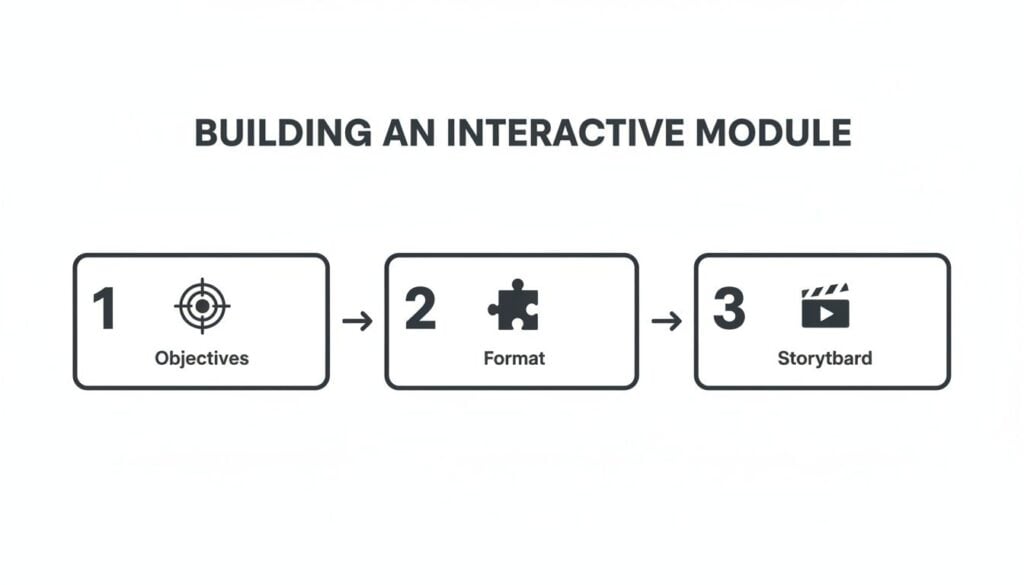
When you plan with clear objectives from the start, it becomes much easier to measure success down the road.
Measuring Knowledge Retention
Engagement is great, but the real goal of interactive learning is to make sure the information sticks. This is where measuring knowledge retention comes in. How can you tell if your students are actually learning and remembering more?
A simple and powerful way to do this is with pre- and post-assessments. Give students a short quiz on a topic before they go through your interactive module. Then, give them a similar quiz after they complete it. The difference in their scores is a clear, hard-to-argue-with indicator of knowledge gain.
The goal is to see if a learner’s click led to a real change in their understanding. Tracking progress this way gives you concrete proof that your interactive methods are effective.
Using A/B Tests to Improve
If you really want to prove the impact of your work, A/B testing is your best friend. It sounds technical, but the idea is simple. You offer two different versions of a lesson to two different groups of students and see which one performs better.
For example:
- Group A (The Control): This group gets your standard, non-interactive video lesson.
- Group B (The Test): This group gets the same core information but through an interactive branching scenario.
Afterward, you compare the results. Look at their quiz scores, their completion rates, and maybe even ask for their feedback. This direct comparison is the ultimate way to prove the ROI of your efforts and find out exactly what works best for your audience. For a more detailed look, you can learn more about how to measure training effectiveness with these methods.
Interactive Learning in Action
Theory is one thing, but seeing how these ideas play out in the real world is where things get interesting. Let’s look at a couple of short, relatable examples. They show you don’t need a massive budget or a team of developers to make a real impact with interactive learning. These stories prove that even small changes can lead to huge wins.
Case Study 1: The Membership Site That Slashed Churn
I know a membership site owner who runs a community for freelance writers. She was dealing with a problem that plagues so many membership businesses. People would join, binge-watch a ton of content in the first month, and then cancel. Her churn rate was frustratingly high.
Instead of just pumping out more content, she decided to focus on interaction. Her strategy was simple but brilliant.
- Weekly Knowledge Quizzes: After her main weekly lesson, she started adding a short, five-question quiz. It was framed as a fun “check your understanding” activity.
- Community Polls: She started posting a weekly poll in the community forum, asking members to vote on topics for the next live Q&A or share their biggest business challenge of the week.
The results were incredible. The quizzes gave members a little hit of accomplishment and proved they were actually learning something. The polls made them feel heard and gave them a real stake in the community’s direction. Within three months, her monthly churn rate dropped by over 30%.
Case Study 2: The Course Creator Who Built Real-World Confidence
Next up, an online course creator who teaches a technical skill: social media ad management. Her students got the theory, but they were terrified of making a costly mistake on a real client’s account. This fear was a massive roadblock to their success and was killing her course completion rate.
Her solution? She built a branching scenario simulation.
In the simulation, students got a fictional client, a budget, and a goal. They had to make a series of decisions, just like they would in a real campaign.
They could choose their target audience, write ad copy, and allocate their budget. Each choice led to a different outcome, showing them the realistic consequences of their decisions, good and bad, without spending a single real dollar.
This “safe sandbox” was a total game-changer. Students could experiment, mess up, and learn from their mistakes without any real-world risk.
Her testimonials started glowing with newfound confidence. Students weren’t just saying they “learned a lot.” They were saying they “felt ready” to take on clients. Her course completion rates jumped significantly because students were finally overcoming their biggest fear. These two examples show exactly what interactive learning is all about.
Got Questions About Interactive Learning?
As you start wrapping your head around interactive learning, a few questions always bubble to the surface. It’s totally normal. Let’s clear up some of the common hurdles so you can move forward feeling confident.
Doesn’t This Take a Ton of Time and Money to Build?
This is probably the biggest question I get, and the honest-to-goodness answer is: it can, but it absolutely doesn’t have to. You can start small and still see a huge difference in how your students learn.
For instance, adding a quick knowledge-check quiz after a video lesson might take you ten minutes using the tools already built into your course platform. You don’t need a fancy budget for that. While a massive, complex business simulation could be expensive, many of the most powerful interactive activities are incredibly low-cost.
The key is to start with your learning goal. Always choose the simplest interactive tool that helps your student get where they need to go. Purposeful interaction beats expensive gimmicks every single time.
Think about things you can do right now:
- Moderated discussions: Posing one thoughtful question in your community can ignite incredible conversations and peer-to-peer learning.
- Simple polls: These take seconds to set up and give your members an immediate sense of involvement and voice.
- Peer reviews: Creating a simple system for students to give feedback on each other’s work costs you nothing but delivers immense value and reinforces learning.
What’s the Difference Between Gamification and Interactive Learning?
This is a fantastic question because these two terms get tangled up all the time.
The easiest way to think about it is that interactive learning is the big umbrella. It’s any type of learning that requires your student to do something other than just watch or read.
Gamification, on the other hand, is just one specific flavor of interactive learning. It’s the strategy of using game-like elements like points, badges, leaderboards, or friendly competition to motivate people.
So, a branching scenario where a student makes decisions is interactive learning, but it isn’t automatically gamification. But if you added a point system and a leaderboard to that same scenario? Then you’d be using gamification as part of your interactive learning strategy.
How Do I Know Which Type of Interactivity Is Right for My Topic?
This brings us right back to the golden rule: always, always start with your learning objective. What, specifically, do you need your student to be able to do when the lesson is over?
The verb in your objective is your compass. Just match the activity to that verb.
Here are a few quick examples to show you what I mean:
- If your objective is for students to practice a process with multiple steps, a hands-on simulation is a brilliant choice.
- If you want them to understand the real-world consequences of different decisions, a branching scenario is perfect.
- If the goal is to simply recall key facts or vocabulary, interactive quizzes and digital flashcards are super effective.
- If you need them to analyze different perspectives, a structured group discussion or a formal debate is ideal.
When you connect the activity directly to the skill you’re trying to build, your interactivity will always feel purposeful and effective. It ensures you’re actually helping your students learn, not just keeping them busy with clicks.