Micro Credentials vs Traditional Certifications for Creators

You’ve finished a solid course. The lessons are sharp, the worksheets are useful, and the student feedback is encouraging. Then the awkward question lands right in the middle of your launch plan.
What exactly are you awarding at the end?
A certificate of completion looks thin. A full certification program sounds impressive, but it also sounds like a mountain of work. A micro-credential feels modern and marketable, but you already know the risk. If it looks flimsy, learners won’t trust it and employers won’t care.
That’s the core tension inside micro credentials vs traditional certifications for creators. This isn’t just a branding decision. It affects how you design assessments, how you position the offer, how much you can charge, and whether your credential becomes a genuine asset or just a decorative badge.
I’ve seen creators get stuck here because they treat credentialing like the final layer of a course build. It isn’t. It shapes the whole product. If you choose the wrong model, you end up with a mismatch between the promise, the learner effort, and the market value.
Your Next Big Question as a Course Creator
You’re probably in one of two situations right now.
Either you’ve built a course and want a better way to validate learning than a generic completion certificate. Or you’re planning a new offer and wondering whether you should build something more formal from day one.

Both situations lead to the same question. Should this be a traditional certification, with broader scope and a heavier assessment model, or a micro-credential, with tighter skill focus and faster turnaround?
That question matters more now than it did a few years ago. According to the 2025 ETS Human Progress Report on global credentialing trends, 80% of respondents worldwide agree that evidence of newly acquired skills through certifications and micro-credentials will be valued as much as traditional university degrees by 2035, and 96% of employers believe micro-credentials strengthen a candidate’s job application.
That changes the conversation for course creators.
You’re no longer choosing between “serious credential” and “lesser alternative.” You’re choosing between two different signal types. One says, “This person has covered a broad body of knowledge.” The other says, “This person can do a specific job or task.”
Practical rule: The best credential format is the one that matches the buying decision your learner needs to influence.
If your learner needs to prove current, narrow competence fast, a micro-credential can fit beautifully. If your learner needs credibility in a field where gatekeeping, compliance, or standardization matter, the heavier option often wins.
Creators who get this right don’t just issue nicer badges. They build clearer products, stronger offers, and more believable outcomes.
Understanding the Two Credentialing Philosophies
The easiest way to think about this is to compare a toolbox with a single tool.
A traditional certification is the toolbox. It usually covers a broad skill domain, expects more study, and signals a deeper level of preparation across a whole subject area.
A micro-credential is the single tool. It validates one specific capability, often tied to a task, workflow, platform, or narrow competency.
What traditional certifications are built to do
Traditional certifications work best when the market expects common standards. They usually involve a defined blueprint, a wider body of knowledge, and an assessment process designed to confirm that learners understand the field, not just one action inside it.
That’s why this format fits topics like regulated finance training, formal IT pathways, healthcare-related instruction, or project management frameworks where employers expect recognizable structure.
Think of a traditional certification as teaching someone how to run a whole kitchen. You don’t just test knife skills. You test food safety, timing, planning, process, and judgment under pressure.
Typical traits include:
- Broader scope that covers a discipline rather than a single task
- Longer design cycle because the curriculum map and assessment blueprint need tighter alignment
- Stronger standardization so different learners are measured against the same expectations
- Higher credibility ceiling in industries where consistency matters
What micro-credentials are built to do
Micro-credentials are narrower by design. They focus on a skill that can be observed, practiced, and validated quickly.
That might mean “build a dashboard in a BI tool,” “configure a workflow in an LMS,” or “produce an AI-assisted content brief using a defined method.” The promise is tighter, which is part of the appeal.
They’re good at helping learners show movement. Not broad career identity, but immediate capability.
A strong micro-credential should answer one practical question clearly. What can this person now do that they could not do before?
That’s where many creators go wrong. They create micro-credentials around topics instead of competencies. “Email marketing basics” is a topic. “Build and QA a welcome sequence in Kit or Mailchimp” is a competency.
Why the distinction matters for creators
If you blur these two philosophies, the offer gets messy.
A narrow course with a giant “certification” label can feel inflated. A broad, serious program sold as a little badge can undersell the work and confuse buyers. The credential type should match the learning architecture, the assessment style, and the market expectation.
Once you see the difference, product decisions get easier. You stop asking, “Which one sounds better?” and start asking, “Which signal does this audience need?”
A Side-by-Side Comparison for Learning Professionals
Here’s the fast read before we go deeper.
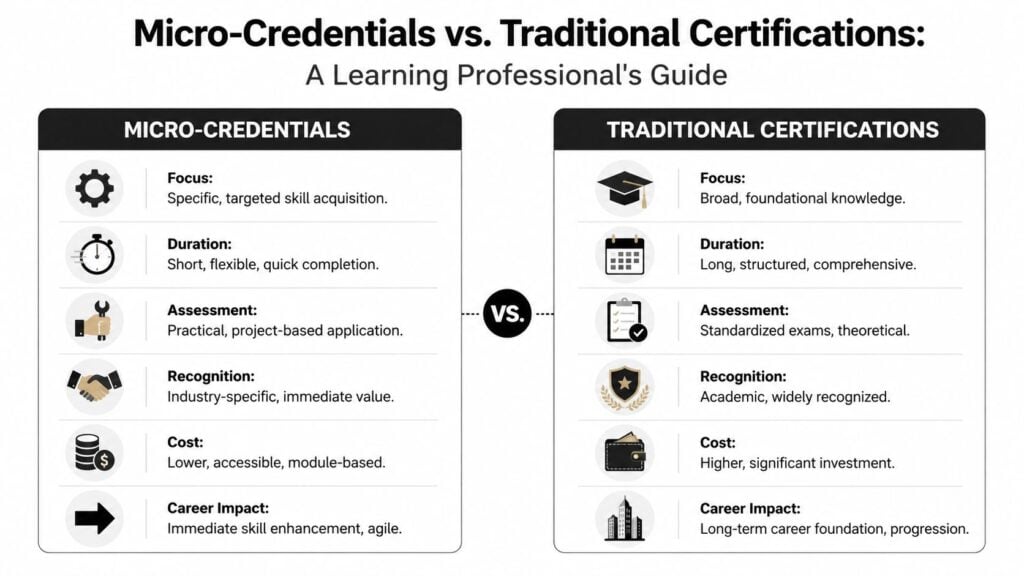
| Criteria | Micro-credentials | Traditional certifications |
|---|---|---|
| Primary focus | Narrow, task-specific skill validation | Broad domain knowledge and capability |
| Typical use case | Rapid upskilling, tool-specific proof, current skills | Career foundation, compliance, recognized professional standing |
| Study load | Shorter and more flexible | Heavier and more structured |
| Assessment style | Performance tasks, projects, demonstrations | Blueprinted exams, broader evaluation, sometimes mixed formats |
| Best fit for creators | Memberships, academies, cohort add-ons, stackable pathways | Signature programs, premium offers, industry-facing training |
| Main risk | Low trust if evidence is weak | Slow build and heavy maintenance burden |
Time and development pressure
Most creators first notice the distinction at this stage.
Traditional certifications can require substantial learner preparation. The benchmark often cited for these programs is 40–200 hours of study, while micro-credentials can compress competency validation into a few hours of coursework, often with costs between $50–$500, according to this breakdown of micro-credentials and traditional certifications in technical industries.
That gap affects your production model too.
If you build a full certification, you need a wider curriculum map, more rigorous version control, tighter exam logic, and clearer retake policies. You’re building an institution-like product.
If you build a micro-credential, you can move faster. In technical environments, equipment-specific badges, MES or ERP function credentials, and robotics task badges can be deployed in weeks, as that same analysis notes. That speed matters when the underlying tools change quickly.
Scope and learner promise
The scope should tell the truth about the promise.
A traditional certification says the learner has covered a larger scope. That’s valuable if they need broad confidence or if employers want evidence that the learner understands the system, not just the button clicks.
A micro-credential says something smaller and sharper. It works best when the learner wants proof tied to a tool, task, or workflow that has immediate job relevance.
For example, compare a broad project management credential with a series of smaller badges focused on sprint planning, risk logging, stakeholder reporting, or using a specific project platform. The first offers range. The second offers immediacy.
Assessment and evidence
Weak programs expose themselves in these instances.
Traditional certifications often rely on standardized testing because they need comparable outcomes across many candidates. The challenge is making sure the exam reflects real-world skill, not just recall.
Micro-credentials usually perform better when the assessment is visible and practical. If the learner claims they can build something, configure something, analyze something, or improve something, the assessment should produce that evidence.
If your learner can pass without demonstrating the skill, your credential is probably weaker than your sales page suggests.
Recognition and buyer psychology
Recognition isn’t only about market prestige. It’s also about how easy the credential is to understand.
Traditional certifications are easier for conservative buyers to process. They look familiar. They feel standardized. In some industries, that familiarity carries real weight.
Micro-credentials work well when the skill is current, urgent, and close to application. For many creators serving digital fields, that’s a major advantage.
If you want a useful benchmark for what recognized technical pathways look like on the formal side, browsing established IT certifications can help you see how mature programs frame scope, requirements, and specialization.
What usually works best
For many learning businesses, the answer isn’t either-or.
A solid pattern is using a traditional certification model for foundational or compliance-heavy learning, then layering micro-credentials on top for narrower operational skills. That gives learners a strong base and gives you more product flexibility.
Creators who force one model onto every topic usually end up overbuilding simple skills or under-validating complex ones.
How to Design a Credential That Employers Actually Trust
A lot of micro-credentials fail for one simple reason. They look like attendance awards.
That’s not a design problem at the visual layer. It’s a credibility problem in the assessment layer.

The trust gap is real. According to this review of employer attitudes toward micro-credentials, 70% of hiring managers say they’d consider micro-credentials if skills matched, but nearly 80% of research articles express employer concerns about consistency and integrity. The same source points to two practical trust builders. Credentials should show “completion and mastery of project-based education” and use systems that can “trace and verify micro-credentials certification.”
Start with observable competence
Don’t begin by asking what badge you want to issue. Start by asking what someone must produce, fix, perform, or decide to earn it.
For a micro-credential, I like assessments that generate evidence somebody else can inspect:
- A finished deliverable such as a dashboard, storyboard, SOP, automation map, or lesson prototype
- A recorded walkthrough where the learner explains their decisions and shows the work
- A scenario-based performance task that forces judgment, not just recall
- A rubric-scored project with visible criteria tied to the claimed competency
For traditional certifications, the design usually needs more layers. You may still include projects, but you also need a clear exam blueprint, domain weighting, item standards, and governance around versioning and retakes.
Build the verification layer early
This part gets skipped far too often.
If an employer or client can’t verify who earned the credential, when they earned it, what they had to do, and whether the credential is still current, trust drops fast. Verification shouldn’t be an afterthought buried in your LMS settings.
Use unique credential IDs, issue dates, metadata about the demonstrated skill, and a public verification page if possible. If you’re working in competency-based learning, I’d also map every badge claim to a formal skills framework. That makes your criteria easier to defend. This guide on competency-based training frameworks is a useful reference point if you’re formalizing those mappings.
Design cue: A badge graphic is marketing. A transparent evidence trail is credibility.
A lot of learners also want help turning credentials into employability signals. If your audience is career-focused, point them toward tools that help them present verified skills well. Resources that streamline your job applications with AI can support that handoff without forcing you to become a career services provider.
Use media and documentation to make standards visible
Here, a lot of creators can separate themselves from the badge factory crowd.
A short explainer video, a published rubric, and a sample evidence portfolio can do more for trust than fancy badge art ever will.
Here’s a practical example of the kind of thinking creators should apply when making the standards visible:

If learners know the bar in advance, stronger candidates self-select in, weaker candidates understand the effort required, and employers get a cleaner signal at the end.
Choosing Your Tech Stack for Issuing Credentials
A credible credential needs infrastructure. Not enterprise theater. Actual infrastructure.
That means issuing, storing, verifying, and updating credentials in a way that doesn’t fall apart the first time a learner shares one on LinkedIn or an employer asks for proof.
What the stack needs to do
At minimum, your credential system should handle four jobs well:
- Issue the credential cleanly inside or alongside your LMS
- Store useful metadata such as earning criteria, issue date, and status
- Support verification so outsiders can confirm the credential is real
- Handle updates and expiration when the skill area changes
If your current setup only emails a PDF, you don’t have a credential system. You have a document delivery system.
Common setup options
Some creators start inside their LMS using built-in certificate or badge features. That’s fine for simple completion signals, especially when the audience mainly wants personal motivation or internal recognition.
For stronger portability, many teams move toward Open Badges-compatible tools or dedicated credential platforms. The practical benefit is learner ownership. The learner can carry the badge beyond your platform, and the metadata travels with it.
Dedicated credentialing tools usually offer better verification and public display options. LMS-native tools usually offer simpler administration and lower operational friction. Which one matters more depends on your business model.
If you’re comparing the mechanics of certificate automation inside your broader course operation, this walkthrough on tools to automate course completion certificates is a helpful starting point.
When verification gets more technical
Some creators want stronger anti-fraud measures or more durable proof models. That’s where blockchain-backed credentialing enters the conversation.
You don’t need blockchain for every badge. In many businesses, standard verifiable badge infrastructure is enough. But if your audience includes employers, licensing-adjacent use cases, or high-stakes skill proof, stronger traceability may be worth the complexity.
If you go down that path, work with people who understand both the technical side and the credentialing use case. Teams exploring that route sometimes look for partners who can scale your blockchain projects without treating education credentials like a generic crypto app.
Pick the lightest tech stack that still protects trust. Overbuilt systems create admin pain. Underbuilt systems create doubt.
Monetization Models and Building Career Pathways
The business model changes when you stop thinking about a credential as a course accessory and start treating it as product architecture.
A traditional certification usually pushes you toward a premium, one-time offer. The scope is bigger, the learner commitment is heavier, and the assessment process takes more work to administer. That often supports higher pricing, but it also raises buyer hesitation and delivery complexity.
Micro-credentials give you more packaging options.

Why stacking works so well
The strongest monetization play for many creators is stacking.
According to Syracuse University Professional Studies, learners want “short, practical, and up-to-date courses for their chosen career path”, and for creators, designing interconnected micro-credential sequences that build toward advanced competencies can increase customer lifetime value and position the business as a “micro-credential academy” rather than a one-off course seller, as described in this guide to micro-credentials and modern professional learning paths.
That’s the key shift. You’re not selling isolated lessons. You’re building progression.
A learner might start with a badge in one narrow skill, then move into adjacent badges, then gain access to a higher-level pathway or capstone. Each step has standalone value, but together they form a career narrative.
Practical monetization formats
This doesn’t need to be complicated. A few models work especially well:
- Membership inclusion where monthly subscribers earn credentials as they complete defined pathways
- Standalone badge offers that act as low-friction entry products
- Bundle ladders where several micro-credentials roll into an advanced program
- Assessment fees charged separately for learners who want official validation after training
- Corporate packages where managers buy team access to targeted badge pathways
I’ve found that stack design also improves retention. Learners stay longer when the next logical step is visible and worthwhile.
Don’t sell disconnected badges
A pile of unrelated badges feels like a junk drawer.
A better approach is to design sequences around job progression. Beginner to operator. Operator to specialist. Specialist to lead. When the pathway is coherent, the credential catalog becomes easier to market and easier for learners to justify.
If you run a membership or academy model, your pricing has to match that progression logic. This guide on subscription pricing models is useful if you’re trying to decide whether pathways should sit inside a recurring offer or be sold as separate upgrades.
A credential stack should feel like a career map, not a supermarket shelf.
A Decision Framework for Your Learning Business
Most creators don’t need a philosophical answer. They need a decision they can act on this quarter.
Here’s the cleanest framework I know for micro credentials vs traditional certifications.
Choose a traditional certification if
This path makes sense when your topic has broad scope, your buyers expect formal structure, and your credibility depends on consistency.
Choose it if:
- Your industry is regulated or conservative and learners need a credential that feels standardized
- The skill domain is broad enough that a narrow badge would undersell what learners must know
- You can support rigorous assessment operations including blueprinting, exam quality control, retakes, and updates
- Your offer is premium by design and learners are willing to commit to a longer path for stronger recognition
This route usually works best for signature programs, professional upskilling with external-facing credibility, and training businesses that can sustain formal governance.
Choose micro-credentials if
This path fits speed, specificity, and modular growth.
Use micro-credentials when:
- The skill changes quickly and your content must stay current
- The learner needs proof of a specific capability rather than broad field mastery
- You want stackable offers that can feed a membership, academy, or pathway model
- You can assess through real work samples and make the evidence visible
This format tends to work well in digital skills, software workflows, creator tools, AI usage, data tasks, marketing operations, and internal team capability building.
Choose a hybrid model if
A hybrid model is often the smartest commercial move.
You might build one broad certification as the anchor product, then offer smaller micro-credentials for specializations, refreshers, or tool-specific updates. Or you may start with a stack of micro-credentials and later package them into a more formal advanced certification once the curriculum matures.
That hybrid structure also helps with product laddering. You get a lower-friction entry point and a stronger premium destination.
A quick test
Ask these four questions before you build:
- What job outcome does the learner need to influence?
- What kind of evidence would convince a skeptical outsider?
- How often will the skill area change?
- Do I want one flagship credential or an expandable pathway business?
If your answers lean toward speed, proof, and modular growth, micro-credentials are usually the better fit.
If they lean toward standardization, breadth, and formal market recognition, build the certification.
Frequently Asked Questions
Can I offer both micro-credentials and traditional certifications?
Yes, and in many cases you should.
They serve different purposes. A traditional certification can anchor your authority, while micro-credentials create accessible entry points and ongoing specialization tracks. The important part is clarity. Learners should understand what each credential proves, how it’s earned, and where it fits in the larger pathway.
How should I handle updates and versioning?
Treat credentials like products with maintenance requirements.
For fast-moving topics, publish issue dates, review periods, and update notes. If the competency changes materially, rather than editing the existing version, issue a new one. For traditional certifications, version control matters even more because learners expect stable standards and defensible assessment criteria.
A simple rule works well here. If the evidence required to earn the credential would change, the credential version should probably change too.
Are micro-credentials recognized internationally?
Recognition depends more on clarity, verification, and issuer reputation than on geography alone.
Traditional certifications are often easier to understand across borders because the format is familiar. Micro-credentials can still travel well when the competency is explicit, the evidence is strong, and the credential is easy to verify. If your audience is global, write the skill claim in plain language, avoid internal jargon, and make the verification page public and easy to understand.
What’s the biggest mistake creators make?
They issue credentials before defining the standard.
The badge comes first, the criteria come later, and the result feels hollow. Start with the demonstrated competency, build the assessment around observable evidence, then choose the credential format that matches the market need.