
Ad on Instagram Cost: A Guide for Course Creators
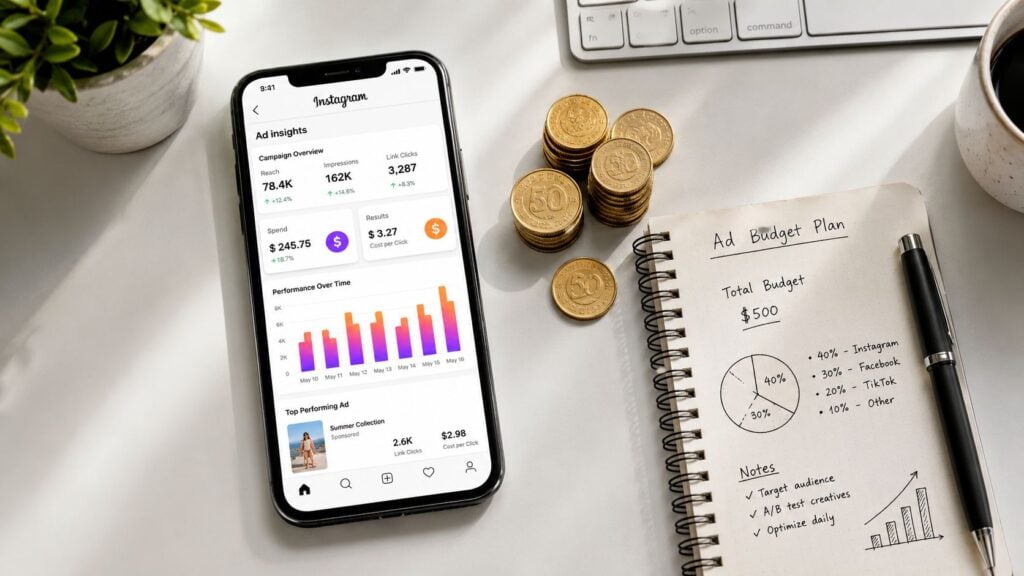
You’ve got a course that can help people, maybe even a membership idea that’s already half-built, and now you’re staring at the Boost Post button wondering whether Instagram ads are a smart next move or a fast way to burn cash. That hesitation makes sense. The ad on Instagram cost question is confusing because the price changes with your goal, your audience, and even the placement you choose.
For course creators, the key question isn’t just what Instagram charges. It’s whether you can buy enough attention, clicks, or leads to turn ad spend into enrollments without guessing your way through the budget. A good starting point is to separate the myth of a “cheap ad” from the reality of a workable campaign, which is why guides like Market With Boost on paid social strategy are useful when you’re deciding whether to boost or run a real campaign, and why it helps to compare that choice with campaign ideas for digital advertising.
Is Hitting “Boost Post” Worth It
A boosted post feels simple because it asks for very little from you. Upload content, add a budget, and let Meta do the rest. That convenience is exactly why a lot of educators start there, especially when they’re trying to sell a first course, fill a webinar, or move a small membership offer.
The problem is that simplicity can hide weak decision-making. A boosted post often gets treated like a shortcut, but if your message, offer, and audience are fuzzy, you’re paying for visibility without much control over what happens next. For a course creator, that can mean spending money to get likes when what you really needed was qualified leads.
I usually tell creators to think of boosting like putting a flyer on a busy notice board. People may see it, but you still need the offer to be clear enough that someone walks over and signs up.
Practical rule: if you can’t explain who the ad is for, what it sells, and what action you want next, don’t spend yet.
The better move is to treat paid social as a system, not a button. Once you start building campaigns with one clean goal, you can judge whether Instagram is helping you sell seats in a live cohort or recurring memberships in a way that makes business sense. If you want the shortest path to confusion, boost first and think later. If you want a budget you can trust, start by understanding how Instagram prices attention.
Decoding Instagram Ad Pricing Models
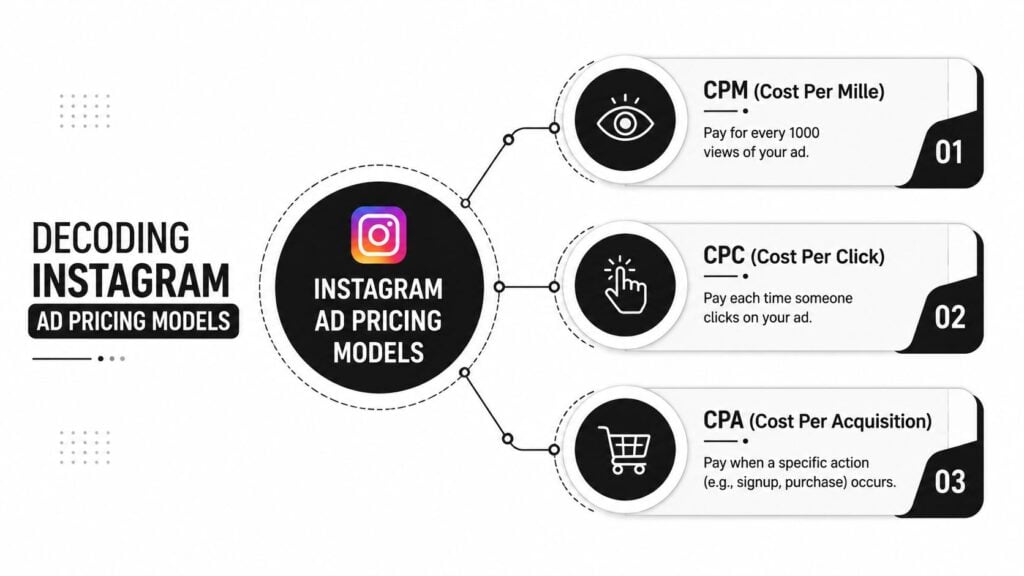
Instagram doesn’t charge in one fixed way. It uses auction-style pricing, which means you’re not buying a slot at a posted rate, you’re competing for attention based on what you’re willing to pay and how relevant your ad looks to the platform. That’s why the ad on Instagram cost can look cheap in one campaign and stubbornly high in another.
CPM, CPC, and CPA in plain English
CPM means you pay for exposure. This is comparable to renting a billboard on a highway, where you’re paying for everyone who passes by, not just the people who stop to read it. That model makes sense if you’re building awareness for a new course launch or pushing a membership brand people haven’t seen before.
CPC means you pay when someone clicks. That’s more like paying for store visits, because the person has taken a real step toward your offer. For course creators, CPC is often easier to judge than raw impressions because clicks tell you whether the creative and hook were interesting enough to earn a response.
CPA means you pay for an actual action. That could be a signup, a lead, or a sale, depending on what your campaign is optimizing for. It’s the closest thing to paying commission, which is why it feels attractive for product sellers, but it usually costs more because you’re asking the platform to find people ready to act.
Simple test: if your offer needs awareness, CPM can make sense. If you need proof that the ad is getting interest, CPC is cleaner. If you’re chasing actual enrollments, CPA is the business metric that matters most.
These models are the foundation for everything else. Once you know what you’re buying, you can stop comparing ads as if they all work the same way and start choosing the setup that fits your funnel.
The 4 Key Factors Driving Your Ad Cost
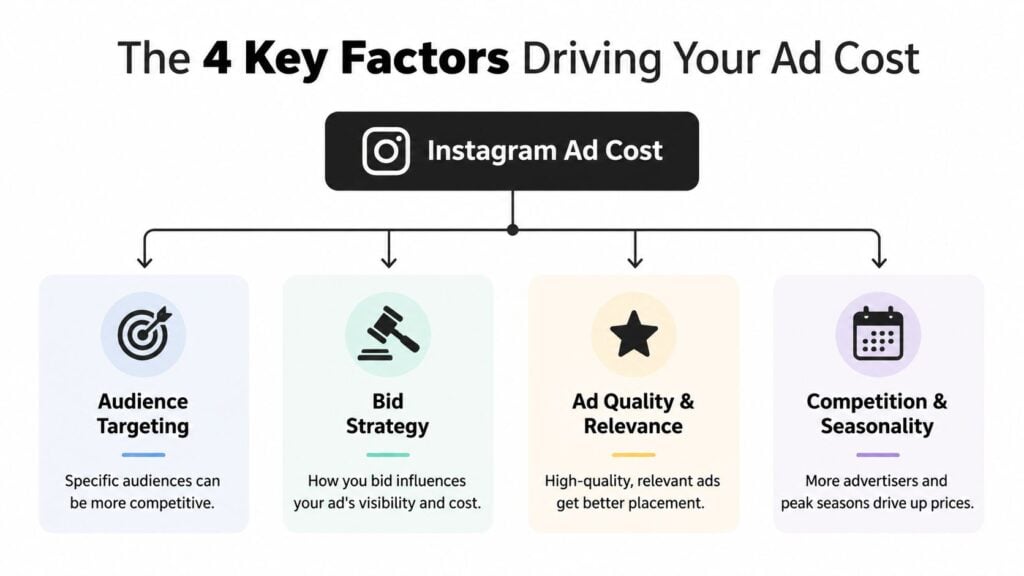
Instagram ad pricing moves like an auction because that’s exactly what it is. Four levers do most of the work: audience targeting, bid strategy, ad quality and relevance, and competition and seasonality. If one of those shifts, your cost can move with it.
Audience and location
Who you target matters a lot, and where they live matters even more than many beginners expect. Independent Meta ad benchmarks reported a global average CPM of $6.59, while the U.S. averaged $23.00 CPM and Nigeria was about $1.50 CPM, with CPC ranging from $2.69 in the U.S. to $0.12 in Nigeria according to country-level Meta ad benchmarks. For a course creator selling online, that means location can shape efficiency fast, especially if your audience spans multiple countries.
That’s also why understanding audience targeting is so valuable before you put real money behind a launch. A tight audience can help with relevance, but it can also become expensive if everyone else is chasing the same people.
Placement, creative, and bidding
Placement changes cost too. In January 2025, Instagram Stories ads averaged $7.25 CPM, $0.94 CPLC, and 0.77% LCTR, while Reels ads averaged $4.29 CPM, $1.21 CPLC, and 0.35% LCTR according to Gupta Media’s Instagram ad cost data. That gap shows why placement is more than a formatting choice, it changes the economics of your campaign.
Creative quality matters because the auction rewards relevance. If your ad looks native, speaks to the right person, and gets a solid response, the platform has less reason to make you pay up.
A campaign that feels too broad can waste money, but a campaign that feels too narrow can get trapped in expensive competition. The sweet spot is usually a message that speaks clearly to one audience segment without overcomplicating the offer.
Bid strategy matters too, because you can let the system optimize or constrain it with a cap. For a first launch, that usually means learning the market before trying to control every variable.
Instagram Ad Cost Benchmarks for 2026
The safest way to read Instagram pricing benchmarks is as a map, not a promise. They give you a range to compare against, but your actual costs will depend on your audience, objective, and creative quality. For course creators and membership owners, those ranges become useful when you’re trying to decide whether your campaign is underperforming or operating in a pricier niche.
| Metric | Average Cost Range |
|---|---|
| CPC | $0.70–$2.50 |
| CPM | $8–$18 |
| CPL | $4–$12 |
| CPA | $10–$35 |
A 2026 Hootsuite guide said Instagram ad pricing in 2025 typically landed around $1.31 CPC and $15.26 CPM, and it listed 2026 benchmarks of $11.31 CPL and $0.067 CPE. The same guide also summarized a broader 2025 market range of $0.70–$2.50 CPC, $8–$18 CPM, $4–$12 CPL, and $10–$35 CPA from Hootsuite’s Instagram ads guide.
For an educator selling a digital product, the most useful number in that table is often CPA. If a webinar registration costs one amount and a course purchase costs another, you can quickly see whether you’re paying for traffic that has a chance to turn into revenue.
The other number worth watching is CPL, because lead-gen campaigns often act as the bridge between cold attention and a sale. If your course doesn’t convert on the first click, a lead form or free resource can still make the economics work.
Budgeting for Your Course or Membership Launch
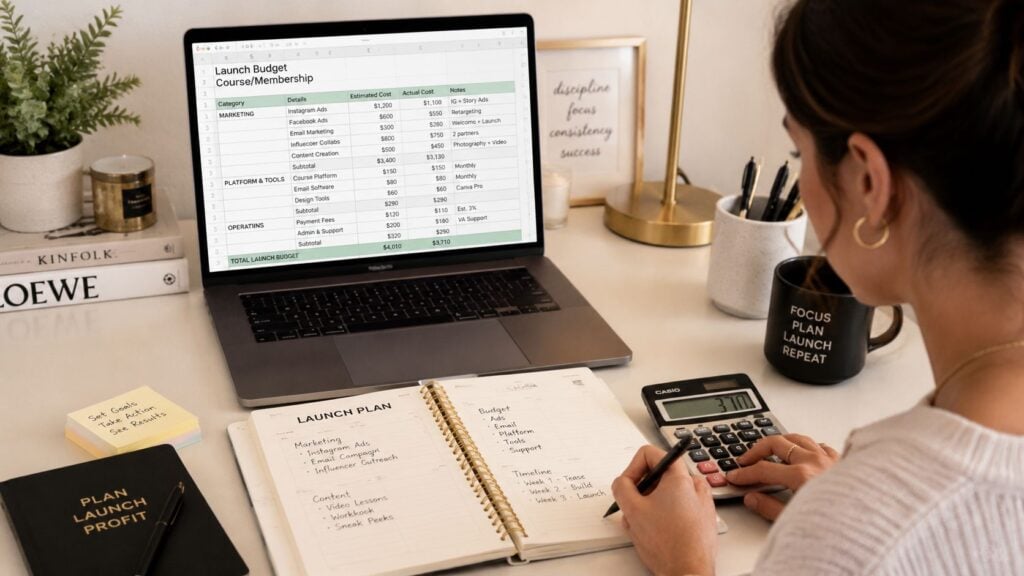
A launch budget should answer one question first. How much can I spend to learn something useful without starving the offer of enough data? That matters because many small campaigns are too thin to tell you much.
Most coverage says ads can start around $1-$5/day, but Meta’s recommended floor is about $5/day, and meaningful optimization typically needs $5-$10 per ad set according to Zapier’s budget guidance. If you split a tiny budget across too many ad sets, the algorithm doesn’t get enough signal to work with, and you end up with noise instead of insight.
A simple launch budget framework
Start with one core goal. If you’re selling a course, decide whether the first campaign is meant to generate leads, sales, or simple traffic to a warm-up page. Then attach a budget that gives each ad set enough room to breathe.
A low-risk test budget might focus on one offer, one audience, and one main creative angle. A more confident launch budget usually adds more room for testing, but still keeps the structure tight enough that you can tell what’s working.
If you want a practical example, take a $297 course and a target CPA of $30. That means you need roughly 10 sales to generate $2970 in revenue, which gives you room to cover ad spend and still leave margin for delivery costs and your own profit. The math matters less than the discipline, because a course creator who knows the target CPA can decide in advance whether the campaign is worth scaling.
For broader planning, paid media examples can help you think through what a launch structure looks like before you spend. I’d rather see a creator run one clear experiment than scatter a small budget across five half-finished ideas.
Simple Ways to Lower Your Ad Spend
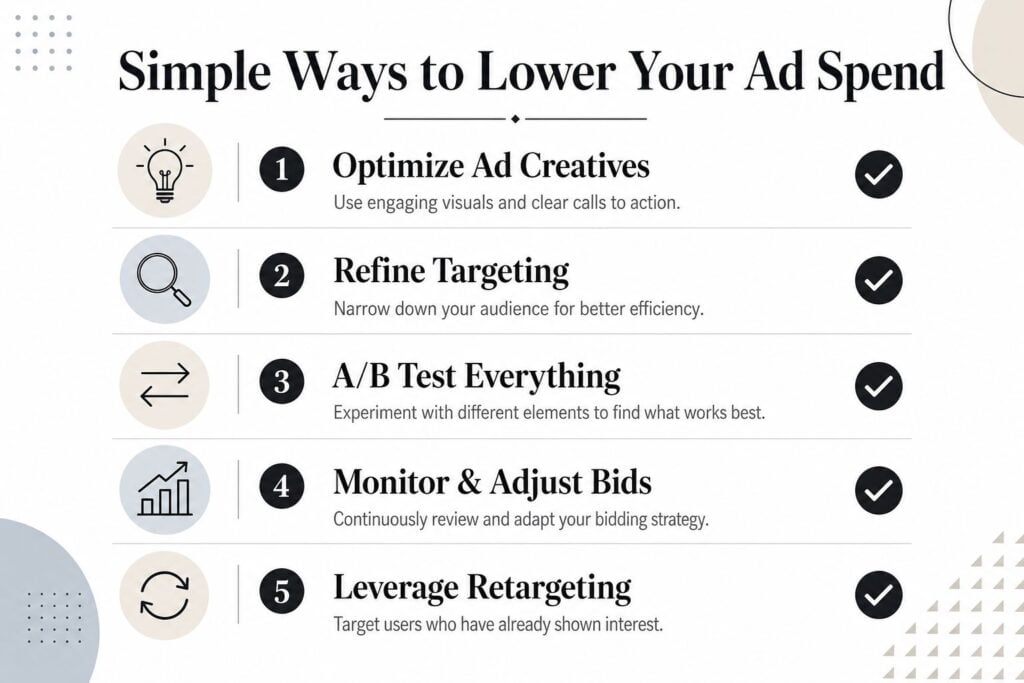
Instagram costs are not fixed, which is good news if you’re willing to improve the parts that matter. Better-performing campaigns can land in the lower end of the benchmark ranges, with CPC around $0.40–$2.00 and CPM around $2–$6 for stronger campaigns, according to WordStream’s Instagram ads cost guide. That tells you there’s real room to lower unit costs if the ad is relevant and the audience fit is solid.
What usually helps first
- Optimize ad creatives: Use short hooks, clean visuals, and one clear call to action. For course sales, a simple promise often beats a cluttered design.
- Refine targeting: Build around the people most likely to care about the outcome, not just the topic.
- A/B test everything: Test headlines, thumbnails, and offers one variable at a time so you know what changed.
- Monitor and adjust bids: If costs creep up, review your objective and bid approach before raising budget.
- Utilize retargeting: People who already visited your sales page or watched part of your content usually need less convincing than cold traffic.
The part many creators miss is that optimization is a creative process as much as a technical one. If you can make your course promise feel more concrete, show the result faster, or use creator-style content that feels native to the feed, you usually give the auction less reason to charge you more.
A useful habit is to treat your ad dashboard like a feedback loop. One version of your message may attract clicks, another may attract actual enrollments, and your job is to separate the two.
For more testing ideas, split-testing your course sales page can strengthen the rest of the funnel so your ad spend isn’t doing all the heavy lifting.