
8 Course Description Examples That Convert

A prospective student opens a course catalog and sees several options that appear almost identical. Each promises expert instruction, practical skills, and a better result. Within moments, they’re deciding which description feels relevant, credible, and easy to understand.
That’s why strong course description examples do more than summarize lessons. They connect a learner’s problem to a believable outcome, make the format easy to scan, set accurate expectations, and use the natural language people search for. A vague list of topics leaves the buyer to do too much interpretation. A clear description helps them recognize the course as a sensible next step.
The right format depends on the niche, the length of the course, the learning outcomes, and how aware the buyer already is of their problem. A beginner may need reassurance and context, while an experienced professional may want proof of relevance and a precise curriculum.
Below, I’ll compare eight formats as conversion tools, explain where each one works best, and show how to adapt them for microcourses, cohort programs, memberships, and professional training. I’ll also turn the strongest elements into short, long, and reusable versions that LearnStream readers can apply when planning digital learning experiences.
For related search-focused writing, see this practical guide on how to write meta descriptions.
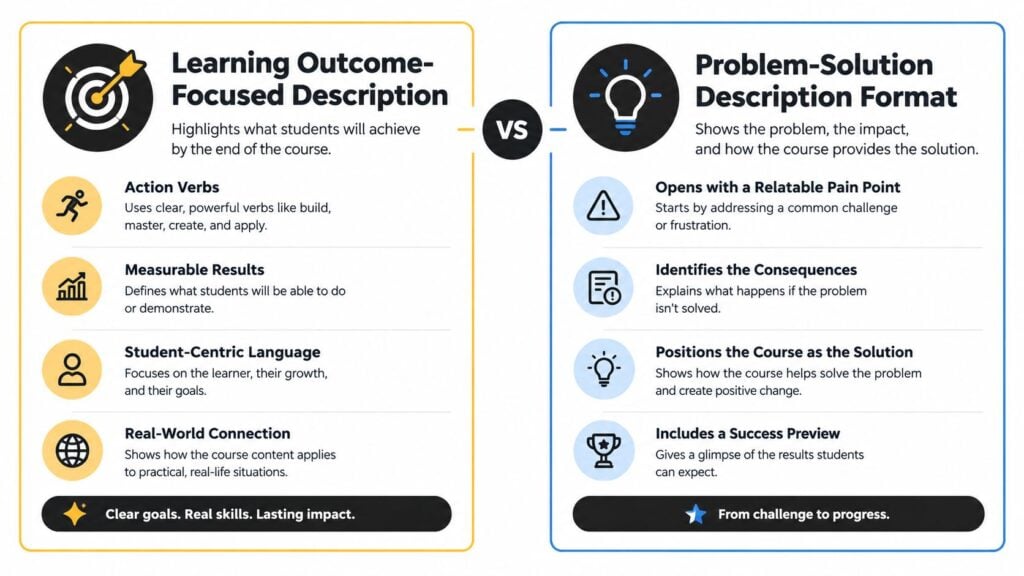
1. The Learning Outcome-Focused Description
An outcome-focused description answers the buyer’s most important question quickly, “What will I be able to do after this course?” It puts observable skills ahead of broad topic coverage.
A weak version says, “This course covers web development, JavaScript, and React.” A stronger version says, “Build a working React app from scratch, connect it to an API, and deploy it for real users.” The second version gives the learner something concrete to evaluate.
This format works especially well for technical courses, professional training, exam preparation, and skills-based microcourses. A course about Excel could promise that learners will create pivot tables, summarize business data, and present findings clearly. A creative writing course might help students develop a story premise, draft a complete manuscript plan, and revise a finished chapter.
The promise has to match the actual curriculum. If the course only introduces a tool, don’t describe the result as professional mastery. Course descriptions should reflect the level, purpose, and assessable competencies of the course. Guidance from Northern Illinois University on writing measurable learning outcomes supports student-centered actions that can be assessed through assignments, quizzes, exams, or projects.
Make the outcome easy to test
Start each bullet with a strong verb such as build, analyze, write, configure, plan, evaluate, or present. Avoid verbs such as “understand” or “learn” when you can describe the visible action that proves competence.
- Build: Create a responsive landing page using semantic HTML and CSS.
- Analyze: Compare campaign data and identify the strongest channel.
- Present: Explain a recommendation to a non-technical stakeholder.
- Apply: Use a repeatable editing process on a real photograph.
A course description focused entirely on outcomes can fall short when the learner is still unsure whether the course fits their situation. Add one sentence about the audience, level, or format before the bullets. For search visibility, use the phrase learners naturally search for, such as “React course for beginners” or “Excel data analysis course,” but keep it readable.
LearnStream readers who want to connect outcomes to cognitive difficulty can use this resource on Bloom’s Taxonomy and learning objectives.
2. The Problem-Solution Description Format
This format opens with the learner’s current frustration and then positions the course as a practical response. It works because relevance comes before explanation. A student who recognizes the problem has a reason to keep reading.
For a social media course, the opening might be, “You’re spending hours publishing posts manually, but your content still feels inconsistent.” The course can then introduce scheduling workflows, content planning, and platform management. An email marketing course could begin with, “You’ve built a landing page, but your subscriber list isn’t growing.” A launch strategy course might address creators who have already made a course but can’t explain its value clearly enough to sell it.
The problem should be specific enough that the right learner recognizes it without feeling judged. “Are you struggling with marketing?” is too broad. “You have useful content, but your launch page lists features instead of explaining what students will achieve” gives the reader a sharper point of connection.

Match the problem to the promise
A useful structure is:
- Name the problem: Describe the situation in plain language.
- Show the consequence: Explain what makes the situation costly, frustrating, or limiting.
- Introduce the solution: State how the course helps.
- Clarify the result: Describe what the learner can do next.
For example:
You’re tired of opening your analytics dashboard and seeing numbers you can’t explain. This course teaches you how to organize key reports, interpret visitor behavior, and turn findings into practical content decisions.
The trade-off is that problem-solution copy can become too emotional or sales-heavy. Avoid dramatizing a minor inconvenience or promising a complete business transformation from a short course. Use customer interviews, learner questions, support tickets, and enrollment conversations to identify the words people already use.
This approach is strongest when buyers know they have a problem but don’t yet know which course format or method will solve it. If they’re already comparing advanced options, lead with outcomes or differentiation instead.
3. The Module-Based Breakdown Description
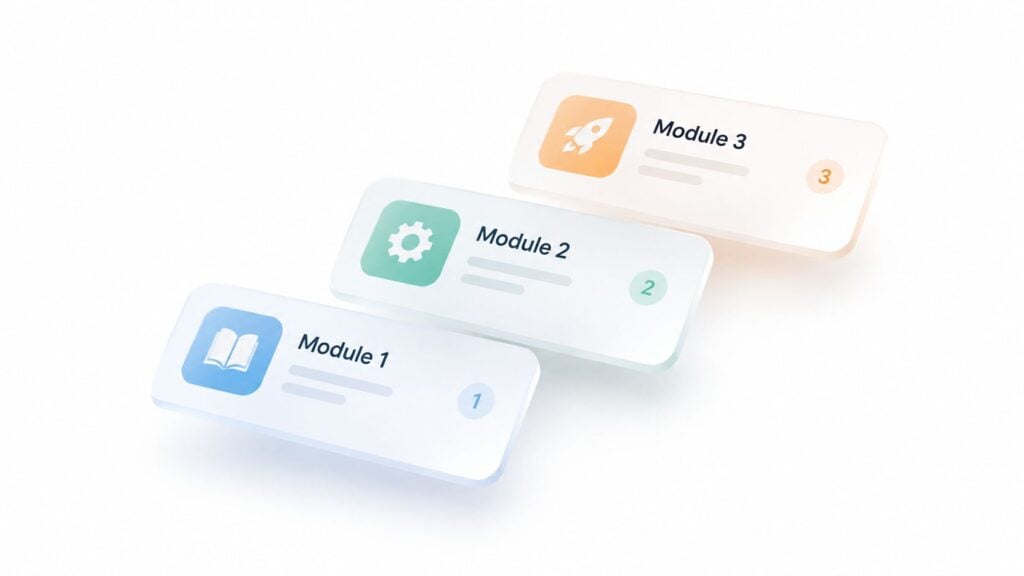
A module-based description gives buyers a clear view of the learning path. It reduces uncertainty by showing what comes first, what follows, and how the pieces fit together.
This format suits longer programs, corporate training, cohort-based courses, and subjects with a clear progression. A beginner photography course might move from camera settings to composition, lighting, shooting practice, and editing. A professional leadership program could progress from feedback conversations to team planning, conflict management, and performance reviews.
Don’t paste the internal syllabus into the sales page. The description should show the course architecture without overwhelming the reader with every lesson title. Module names should help the learner understand the purpose of each stage.
Show progression, not just contents
Compare these two approaches:
- Module 1, Introduction
- Module 2, Intermediate Techniques
- Module 3, Advanced Applications
That outline is familiar, but it doesn’t tell the buyer much. A more useful version could be:
- Find your starting point: Assess your current workflow and identify the biggest source of wasted effort.
- Build the core system: Create a repeatable process for planning, producing, and reviewing your work.
- Apply the system: Use the process on a real project and adjust it based on results.
The second version combines structure with outcomes. It also gives search engines and course platforms meaningful context without stuffing keywords into every line.
A module breakdown can fall short for a small, focused course. A short course on writing a professional bio probably doesn’t need a detailed curriculum map. It may convert better with a problem, a clear result, and three outcome bullets. For longer offers, however, a visible path reassures buyers who want to understand the commitment before enrolling.
Before writing the description, map every module to the intended competencies. LearnStream readers can use this guide on how to create a curriculum to check whether the promised progression matches the learning experience.
4. The Storytelling or Journey-Based Description
A journey-based description gives the learner a role in a narrative. The course becomes a sequence of decisions, discoveries, and practical turning points rather than a container of lessons.
This format works well for creative writing, entrepreneurship, coaching, personal development, and creator-led education. A writing course might begin with a blank page, move through choosing a premise and developing characters, and end with a revised chapter ready for feedback. An entrepreneurship course could follow the path from observing a customer problem to testing an offer and refining the business model.
The learner should remain the central character. The instructor provides the map, examples, feedback, or challenge, but the description should focus on what the student experiences and produces.
Use vivid details carefully
A journey-based opening might read:
You have a promising idea, a folder full of notes, and no clear path to a finished draft. You’ll begin by shaping the idea, test its structure through guided exercises, and develop a writing routine that helps you move from scattered scenes to a coherent chapter.
That copy feels more engaging than a list of writing topics because it gives the learner a recognizable starting point. It also makes room for “aha” moments, such as discovering the central conflict in a story or identifying the audience for a new product.
The main risk is atmosphere without information. Phrases such as “step into your creative power” may sound appealing but don’t tell buyers what they’ll do. Pair the narrative with concrete outcomes, format details, and a clear audience statement.
A journey format is also less suitable for buyers who need a fast, factual comparison. Someone choosing compliance training may care more about prerequisites, assessment, delivery method, and competencies than a dramatic transformation story. Use storytelling as the entry point, then support it with evidence about the actual learning path.
5. The Comparison or Differentiation Description
In a crowded category, buyers need a reason to choose one course instead of another. A differentiation-focused description makes the trade-off visible without attacking competing products.
A self-paced course might say that learners can work through short lessons without attending live sessions. A cohort program might distinguish itself through scheduled group practice and instructor feedback. A practitioner-led course could explain that it uses real project examples rather than abstract demonstrations.
The strongest differences are specific and verifiable. “A better way to learn” isn’t a meaningful distinction. “You’ll complete guided exercises, receive written feedback, and revise the same project during the course” tells the buyer what makes the experience different.
Be honest about the compromise
Every format has a downside. Self-paced learning offers flexibility, but some students may need external accountability. Live cohorts create momentum and interaction, but they require learners to attend at particular times. A low-touch membership gives ongoing access to content, while a high-support program may provide more direct guidance.
State the difference in terms of fit:
- Choose self-paced learning: You need flexible access and prefer to work independently.
- Choose a cohort experience: You want deadlines, peer discussion, and scheduled feedback.
- Choose a membership: You expect your needs to evolve and want continued resources or community access.
This honesty helps filter the audience. A description shouldn’t persuade every visitor to enroll. It should help suitable learners see why the offer fits and help unsuitable learners avoid a frustrating purchase.
Comparison copy works best for experienced or solution-aware buyers who are already evaluating alternatives. For beginners, start with the problem and outcome before explaining the distinction. Avoid naming a competitor negatively, making unsupported claims, or presenting a feature as a benefit without explaining why it matters.
6. The Authority or Expertise-Led Description
An expertise-led description makes the instructor’s relevant experience part of the value proposition. This is particularly effective when learners choose the teacher because they want access to a specific perspective, method, or body of practice.
A course taught by an experienced SEO consultant could mention the kinds of audits, content systems, or client problems the instructor regularly handles. A product management course might introduce an instructor who has led launches, interviewed users, and managed cross-functional teams. The important detail is relevance. A long biography filled with unrelated credentials won’t make the course feel more credible.
Credibility rule: Explain why this instructor is qualified to teach this specific skill, then show how that experience shapes the lessons.
The description should still lead with the learner’s needs. A bio belongs after the course promise, not in place of it. Students want to know what they’ll gain before they read a complete career history.
Turn experience into teaching value
Instead of writing, “I’m an award-winning consultant with extensive experience,” connect the background to the course:
- Relevant practice: “You’ll work through the same type of content brief I use when planning a search-focused article.”
- Useful perspective: “The lessons explain where new analysts commonly misread a report and how to check the conclusion.”
- Honest context: “The course includes failed approaches and revisions, not only polished final examples.”
The plan notes for this format mention well-known figures such as Gary Vee and Seth Godin as examples of personality-led education. The broader lesson is that a recognizable instructor can attract attention, but recognition alone doesn’t guarantee a good fit. Authority must support a clear curriculum and realistic outcomes.
Where appropriate, place a short instructor introduction below the main description. Keep it focused on teaching relevance, practical experience, and the perspective learners will receive. A video can add warmth and context, but it shouldn’t replace written information that buyers need to scan.
7. The Benefit-Driven Description
A benefit-driven description translates course content into changes the learner cares about in daily life or work. It moves beyond “you’ll study presentation skills” and explains the practical difference those skills can make.
For a productivity course, the description might show a learner planning projects with less last-minute scrambling. A presentation course could focus on speaking clearly in front of senior colleagues. A creative business course might help a participant move from an unfinished idea to a publishable offer.
The best benefit statements remain connected to course activities. If learners practice outlining, record presentations, or complete a project plan, the description can show how those tasks support the wider result. Without that connection, benefit-driven copy can sound like lifestyle advertising.
Keep the vision believable
A useful pattern is:
You’ll learn [specific skill] through [specific activity], so you can [credible practical benefit].
Examples include:
- You’ll organize campaign data into a repeatable reporting workflow, so weekly performance reviews take less guesswork.
- You’ll practice a clear presentation structure and record short rehearsals, so you can review your delivery before an important meeting.
- You’ll build a simple content calendar and test it on your own business, so publishing becomes easier to manage.
This format resonates with buyers who understand the desired result but may not care about the technical subject itself. A business owner may not want to “learn email segmentation.” They may want to send more relevant messages without manually sorting every subscriber.
The risk is overpromising. Avoid implying guaranteed income, effortless success, or a total life change unless the course can directly support that claim. Benefits should describe a plausible improvement in capability, confidence, clarity, or workflow. Pair aspirational language with specific outcomes and realistic expectations about practice.
For a short course, a benefit-led paragraph plus a few bullets may be enough. For a broader program, add modules, support details, prerequisites, and workload information so the promise has a credible foundation.
8. The Community and Support-Focused Description
Some learners buy access to people as much as they buy access to content. A community-focused description explains how participants will ask questions, receive feedback, share progress, and stay accountable.
This format works especially well for cohort-based courses, membership sites, group coaching, and professional development programs. It can also support a self-paced course if learners receive meaningful discussion access or instructor help.
Be precise about the experience. “Join a supportive community” is too vague. Explain whether members can attend live sessions, post work for review, join peer groups, participate in challenges, or ask questions in a dedicated space. If Circle.so or Mighty Networks is central to the experience, name the platform only when that information helps the buyer understand how participation works.

Describe support as a system
A strong description might say:
You’ll complete the lessons independently, then bring questions and work-in-progress examples to the private discussion space. Weekly group sessions give you a place to review common challenges, compare approaches, and decide what to improve next.
That tells the reader what participation looks like. Add practical details about when support is available, who provides feedback, and whether community access continues after the core lessons.
This format can fall short when the community is mostly decorative. A discussion forum with no clear activity plan won’t create a useful learning experience. Don’t promise networking, accountability, or personalized feedback unless the course team has the time and process to deliver it.
Community copy is especially valuable for buyers who have tried learning alone and want structure. It may matter less to an independent learner choosing a short reference course. LearnStream readers can explore this guide on how to build an online community when the support experience is a core part of the offer.
8-Format Course Description Comparison
| Format | Expected outcomes | Ideal use cases | Key advantages |
|---|---|---|---|
| The Learning Outcome-Focused Description | Clear, measurable learner skills and performance | Skill-based courses, professional training, career programs | Higher conversions; easy to measure success; attracts motivated learners |
| The Problem-Solution Description Format | Immediate relevance and higher engagement | Funnels, membership sites, audiences with clear pain points | Strong emotional connection; increases engagement and urgency |
| The Module-Based Breakdown Description | Transparent expectations and predictable progression | Comprehensive courses, academic-style, corporate training | Reduces buyer uncertainty; easy to update; clarifies scope |
| The Storytelling or Journey-Based Description | Deep emotional investment and memorability | Premium courses, creative subjects, brand-focused offerings | Highly memorable; builds loyalty and differentiation |
| The Comparison or Differentiation Description | Clear reason to choose this course over alternatives | Saturated or competitive niches, premium/niche courses | Addresses objections; reduces decision paralysis; highlights uniqueness |
| The Authority or Expertise-Led Description | Rapid trust-building and perceived credibility | Personal-brand courses, high-ticket training, expert-led programs | Builds trust quickly; justifies premium pricing; signals expertise |
| The Benefit-Driven Description | Strong aspirational appeal and envisioned life changes | Personal development, lifestyle, career transformation courses | Emotional pull; communicates lifestyle and long-term value |
| The Community and Support-Focused Description | Improved retention, peer learning, ongoing engagement | Cohort-based courses, memberships, group coaching | Increases retention and referrals; adds perceived ongoing value |
Turn the Best Format Into Your Own Description
The strongest course description usually combines formats instead of relying on one. Start by identifying the learner’s main problem. A beginner who doesn’t know where to start may need problem-solution copy. A professional comparing specialist programs may respond better to outcomes and differentiation. A membership buyer may need support details before they care about the module list.
Write the short version first. Keep it focused on the audience, the problem, the course promise, and the most important outcome. This gives you a useful description for a course catalog, landing page card, or learning platform search result.
Then expand only where the buying decision requires more context. Add a module overview when the course has a meaningful progression. Add format and support details when delivery affects the learner’s schedule or confidence. Add a concise instructor bio when expertise is part of the reason people are considering the offer.
Finish with specific learning-outcome bullets. University guidance commonly recommends active, student-centered language that can be assessed through course activities. A useful description should tell readers what they’ll be able to create, analyze, apply, explain, evaluate, or complete, rather than leaving them with a list of subjects.
A reusable course description framework
Use this sequence as a starting point:
Audience: This course is for [specific learner] who wants to [relevant goal].
Problem: You’re dealing with [recognizable challenge], and [practical consequence].
Promise: You’ll learn how to [credible transformation] through [format or method].
Learning outcomes: By the end, you’ll be able to:
- Outcome one: [Observable action]
- Outcome two: [Observable action]
- Outcome three: [Observable action]
Course path: You’ll move through [main stages or modules], with [relevant exercises, projects, feedback, or resources].
Fit details: This course is [level], requires [prerequisites or tools], and suits learners who [important expectation].
The length should match the decision. A short description can be concise and reusable, while a detailed sales page can answer questions about workload, format, assessment, support, and instructor credibility. One Drew University guideline recommends keeping a course description to no more than 125 words, while St. Olaf’s registrar guidance sets a 75-word limit for the narrative description. These are useful editorial benchmarks, not universal rules for every digital course page.
Edit for clarity and conversion
Use this final review before publishing:
- Natural keywords: Include the course topic and audience language where it fits naturally.
- Readable length: Remove background detail that doesn’t help the learner decide.
- Credible promises: Check every outcome against the curriculum and assessment.
- Scannable formatting: Use short paragraphs, bold outcomes, and clear labels.
- Accurate expectations: State the level, format, workload, tools, and support requirements when they affect fit.
- Curriculum alignment: Make sure the description reflects what students will experience.
Test two versions if you can, such as a problem-solution opening against an outcome-focused opening. Keep the underlying promise consistent, then compare which version produces clearer questions, stronger engagement, or more relevant enrollments. Don’t change the course promise and the description at the same time, or you won’t know what caused the difference.
LearnStream’s focus on creating and refining digital learning experiences makes this process especially practical. Whether you’re building a course catalog, a cohort program, or a membership, treat the description as part of the learning design. Write it before launch, review it against the finished course, and update it whenever the audience, curriculum, or delivery experience changes.
Choose one course you’re preparing to publish and rewrite its description using the framework above. Start with the learner’s problem, add three observable outcomes, and state exactly how the course is delivered. Then review the final copy inside your catalog or LMS and refine it until the right learner can understand the offer without guessing.