Self-Assessment Tools: Boost Online Course Engagement

You built the course carefully. The lessons are solid, the worksheets are useful, and the videos explain the topic better than most live workshops.
Then you open your dashboard and see a familiar pattern. People start strong. A few click through the first modules. Then activity thins out, questions get vague, and completion stalls.
I’ve seen this happen even in very good programs. Usually the issue isn’t weak content. It’s that learners can’t tell where they stand. They don’t know what they understand, what still feels shaky, or what “progress” should look like in real terms. When that fog sets in, motivation drops fast.
That’s where self-assessment tools earn their keep. Done well, they give learners a way to notice growth, name confusion, and make decisions about what to do next. They also give you something your analytics alone can’t show. They reveal the learner’s point of view.
Why Your Best Content Still Needs Self-Assessment Tools
A while back, I worked with a course creator who had done almost everything right. Her lessons were polished. Her examples were practical. Her students said they loved the material.
Still, they drifted.
When we looked closer, the problem wasn’t hard to spot. Learners were consuming the course like a playlist. They watched, nodded, and moved on. But they rarely paused to ask themselves, “Can I do this yet?” Without that moment of reflection, every lesson felt the same. Useful, yes. Sticky, no.
Content alone doesn’t create momentum
A learner can enjoy a lesson and still feel lost. That’s the trap.
If your course only delivers information, people often confuse exposure with progress. They think, “I’ve seen this before,” when what they really need is, “I can use this in a real situation.” Self-assessment tools create that checkpoint.
Here’s the shift I try to make in every learning experience:
- From passive viewing: learners watch the content
- To active noticing: learners judge what they understand
- To purposeful action: learners pick the next step based on that reflection
That’s one reason interactive learning strategies matter so much. Interaction isn’t just about clicks and quizzes. It’s about helping people think about their own thinking while they learn.
Practical rule: If learners can’t see their own progress, they’ll often assume they aren’t making any.
Self-assessment surfaces the “why” behind disengagement
Your dashboard might show a drop-off after lesson three. A self-assessment can tell you whether learners felt overwhelmed, overconfident, or unclear about expectations.
Those are very different problems. Each needs a different fix.
That’s why I treat self-assessment as a design layer, not a bonus feature. It helps learners feel oriented. It helps instructors respond with precision. And it turns a course from a content library into a guided experience.
What Self-Assessment Is Really About
Often, the term “self-assessment” brings to mind a quiz, a score, or some corporate form nobody wants to fill out. I think of it as a mirror for learning.
A good mirror doesn’t flatter or shame you. It reflects what’s there. In learning, that means helping someone see current strengths, areas of confusion, and the path forward.
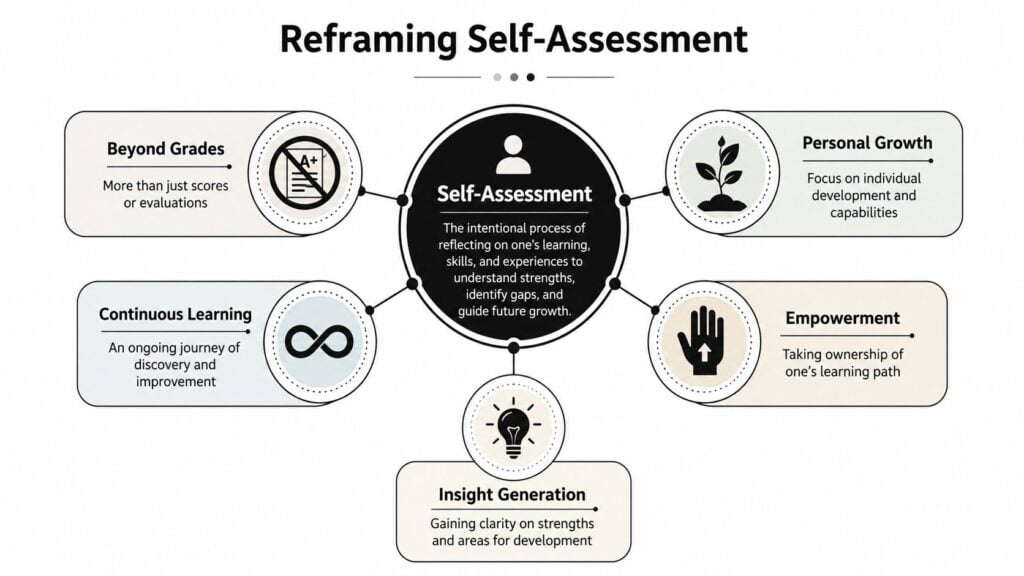
A mirror, not a verdict
That distinction matters because many learners already carry baggage around evaluation. If your self-assessment feels like a hidden test, people either rush through it or perform confidence instead of honesty.
A better approach is to frame it like this:
- Where am I now?
- What evidence do I have for that judgment?
- What should I do next?
That’s much more useful than “What grade did I get?”
When learners answer reflective prompts tied to real behaviors, they stop acting like spectators. They become participants in their own development.
These tools can be rigorous
Some educators still treat self-assessment tools like informal add-ons. That undersells them.
A validation study of a self-assessment tool for data literacy, conducted with over 1,800 university students, established its reliability for gauging self-efficacy. It shows that well-designed self-assessment tools can be scientifically sound instruments for measuring a learner’s confidence and belief in their own abilities, as described in this data literacy self-efficacy validation study.
That matters because confidence affects behavior. A learner who believes “I can handle this” approaches challenge differently from someone who thinks “I’m probably not good at this.” Self-assessment helps bring that hidden layer into the open.
A strong self-assessment doesn’t just measure recall. It helps a learner make sense of their own capability.
What learners actually gain
When I build these into courses, I’m usually aiming for a mix of outcomes:
- Clarity: learners can name what they know and what they don’t
- Direction: they can choose the next lesson, practice task, or support resource
- Ownership: they start seeing progress as something they can influence
- Language: they gain words for their strengths, struggles, and goals
That last one is easy to overlook. A learner who can say, “I understand the concept but can’t apply it under pressure,” is in a far better position than someone who just says, “I’m bad at this.”
That’s the core work of self-assessment. It turns vague feeling into usable insight.
A Tour of Different Self-Assessment Tool Types
Not all self-assessment tools do the same job. I like to think of them the way I think about kitchen tools. A chef’s knife, a whisk, and a thermometer all matter, but you wouldn’t use them interchangeably.
If you pick the wrong tool, the assessment feels awkward. If you pick the right one, learners get useful feedback with very little friction.
Quick checks for knowledge and confidence
The simplest format is a short self-check quiz. I’m not talking about high-pressure grading. I mean a few questions that help learners compare what they think they know with what they can recall or apply.
These work well when your goal is to sharpen awareness after a lesson.
Use them for:
- Knowledge checks: “Can I explain this concept in plain language?”
- Confidence checks: “How sure am I about doing this without notes?”
- Decision points: “Should I review, practice, or move on?”
Rubrics are another strong option, especially for messy skills like coaching, writing, speaking, design, or leadership. A rubric gives learners criteria. That alone can reduce confusion because it answers the question many students never ask out loud: “What does good look like here?”
Reflective and developmental tools
For longer programs, reflective journals work beautifully. They help learners notice changes over time, which is hard to capture in a one-off quiz.
I often prompt journal reflection with questions like:
- Before and after: What did I believe about this skill at the start, and what do I believe now?
- Friction points: Where did I hesitate or avoid action this week?
- Transfer: Where did I use this outside the course?
Career-focused learning benefits from broader self-assessment categories. Institutions like MIT structure self-assessment around four components: Values (what’s important), Interests (what you love), Personality (what motivates you), and Skills (what you’re good at), with tools such as the O*Net Interest Profiler connecting those reflections to occupational paths, as outlined in MIT’s self-assessment guide.
That framework is useful far beyond career coaching. It helps learners understand that performance isn’t just about skill gaps. Sometimes the issue is fit. A learner may have the skill but not the motivation, or the interest but not the confidence.
Choosing the right tool
Here’s the comparison I use most often.
| Tool Type | Best For | Example Use Case |
|---|---|---|
| Knowledge check quiz | Immediate understanding | End of a lesson on email copywriting |
| Rubric | Complex performance | Self-rating a sales call or design critique |
| Reflective journal | Growth over time | Weekly leadership reflections in a cohort |
| Peer and self-rating | Communication or teamwork | Rating contribution in a group project |
| Values, Interests, Personality, Skills inventory | Direction and fit | Career planning or role alignment |
| Automated diagnostic | Fast feedback at scale | A course intake form that recommends a learning path |
If you’re building more interactive experiences, tools discussed in this guide to interactive content creation tools can help you turn simple reflection into something learners will complete.
The key is to hire each assessment for a specific job. Don’t use a journal when you need a clear performance standard. Don’t use a rubric when a two-minute confidence check will do.
How to Design a Self-Assessment That Actually Works
A bad self-assessment creates two problems at once. It gives the learner fuzzy feedback, and it gives you misleading information. That’s a rough combination.
I’ve found that effective self-assessment tools usually share a small set of design principles. They’re clear, grounded in real performance, and built to reduce wishful thinking.
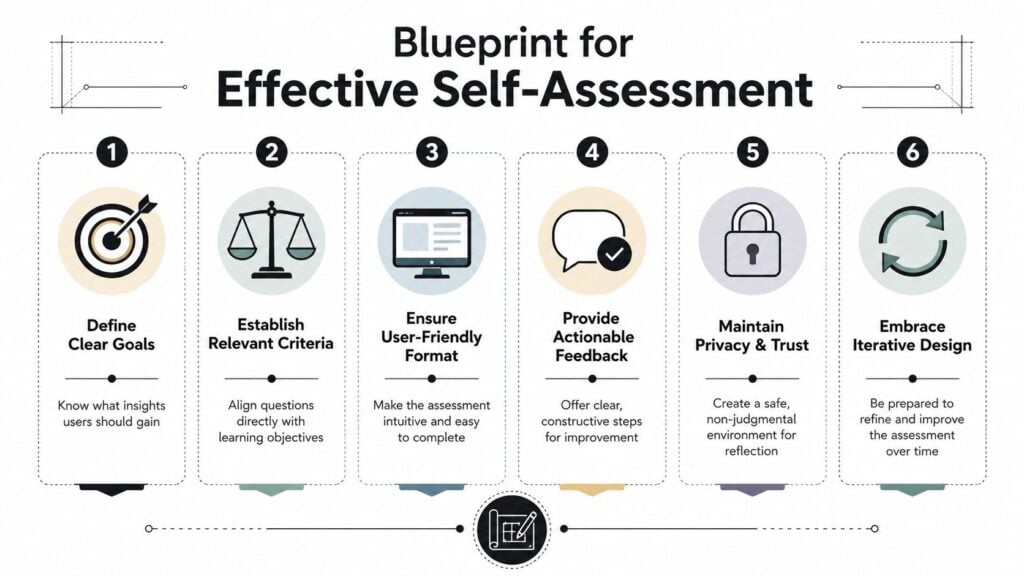
Four requirements I never skip
Research on product development self-assessment tools identified four requirements for effectiveness: they should focus on proven best practices, follow a formalized implementation process, include customization guidelines, and integrate with other process improvement approaches, as discussed in this product development self-assessment requirements paper.
I use those same four ideas in education.
Base it on proven practice
Don’t invent criteria because they sound nice. Tie prompts to the actual behaviors or standards learners need to demonstrate.Give it a process
A self-assessment tossed into a course at random won’t do much. Place it at meaningful moments such as onboarding, midpoint reflection, project review, or completion.Allow customization
A beginner and an advanced learner shouldn’t always answer identical prompts. Context matters. Skill level matters. Role matters.Connect it to improvement
Reflection without follow-up tends to die on the page. Pair the result with a next action, a practice task, a resource, or a coaching prompt.
The bias problem most tools ignore
Here’s where many self-assessment tools fall apart. They ask broad questions like “How good are you at communication?” or “Rate your leadership ability.” That wording invites people to define success in whatever way protects their ego.
Research into competency-based tools identifies a bias mitigation gap. Many tools allow self-serving redefinition of vague traits, which leads to positive bias. The fix is to ask learners to evaluate specific, measurable, externally generated outcomes, which reduces overconfidence, as explained in this research on bias-resistant assessment design.
Design test: If a learner can answer your question without pointing to evidence, the prompt is probably too vague.
Here’s the difference in practice:
- Weak prompt: “I’m a confident presenter.”
- Better prompt: “I delivered a presentation this week and kept to the time limit.”
- Weak prompt: “I’m good at giving feedback.”
- Better prompt: “In my last team review, I named one specific behavior and one next step.”
Those better prompts are less glamorous, but they’re far more honest.
A simple blueprint you can use
If you want a practical build sequence, this is the one I return to:
- Start with one decision: What should learners do differently after they complete this?
- Write observable criteria: Use behaviors, outputs, or completed actions
- Choose a simple response format: scale, checklist, short reflection, or rubric
- Add a next-step prompt: “Based on your answers, what will you practice next?”
- Review for bias: remove vague traits and replace them with evidence-based wording
If you use rubrics often, this guide on how to create rubrics is a helpful companion because rubric design and self-assessment design overlap more than is commonly understood.
The secret sauce is straightforward. Make the learner look at evidence. Then make the next action obvious.
Beyond Measurement Building Learner Identity
A lot of assessment design stops at measurement. Did the learner improve? Can they perform the task? Did they meet the benchmark?
Those are fair questions. They’re just not the whole story.
The deeper opportunity is identity. Self-assessment tools can help a learner move from “I’m trying this” to “This is part of who I am.”
Why identity changes behavior
Think about the difference between someone who says, “I’m learning to write” and someone who says, “I’m a writer.” The second person usually approaches practice differently. They notice examples more often. They persist longer. They interpret setbacks as part of the craft, not proof they should quit.
That shift doesn’t happen because of one compliment. It develops through repeated experiences where the learner reflects, acts, and sees evidence of growth.
A 2025 study argues that digital self-assessment should be a dynamic process that develops students’ digital agency and gives them control over identity formation, positioning assessment as a tool for transformation rather than just performance evaluation, as described in this study on digital self-assessment and digital agency.
Designing for digital agency
When I design for identity, I ask different questions than usual.
Instead of “Can the learner complete this task?” I also ask:
- What kind of person are they becoming through this process?
- Do my prompts help them notice that change?
- Do they have language for their evolving identity?
That can look simple in practice. A coding course might ask, “Which debugging habit do you now use without prompting?” A fitness membership might ask, “What does a consistent week look like for you now?” A leadership program might ask, “Which conversations do you initiate today that you avoided before?”
Assessments shape identity when they help learners recognize patterns in their own behavior.
Why this matters in memberships and communities
For membership site owners, this approach is especially powerful. People don’t stay because they completed a worksheet. They stay because the space supports the person they want to become.
A static score can tell someone where they landed today. An identity-aware self-assessment helps them see a longer arc. It gives continuity to the journey.
That’s one reason iterative assessments work so well. A repeated prompt answered monthly can reveal a story. And stories keep people engaged far longer than isolated grades do.
Examples and Simple Integration Tips
You don’t need a custom platform or a development team to start using self-assessment tools well. Some of the best ones are lightweight.
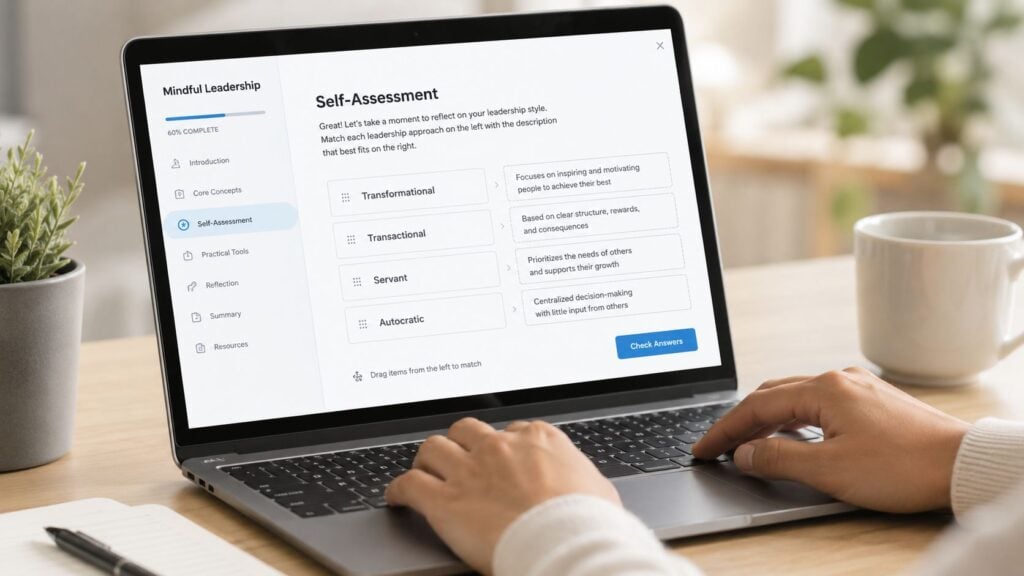
I like starting with mechanics that feel almost too simple. They lower resistance, and learners use them.
Three easy formats that work online
Classroom strategies adapt nicely to digital settings. These include Traffic lights, where learners color goal statements by confidence, Exit cards, where they note what they learned and what still feels confusing, and Snowball activities, where anonymous peer review helps surface shared questions, as described in this guide to peer and self-assessment tools.
Here’s how I’d translate each one into an online course:
- Traffic lights: Put a list of learning goals in a form and ask learners to mark each one green, yellow, or red. Green means “I can do this.” Yellow means “I’m getting there.” Red means “I need support.”
- Exit cards: End each lesson with two boxes. “What clicked?” and “What still feels muddy?” This gives you useful language for FAQs, follow-up emails, or office hours.
- Snowball: Use anonymous posting in a discussion space. Ask learners to submit one challenge, then invite peers to suggest a tactic or example.
These aren’t fancy. That’s the point.
Where to place them in your workflow
The easiest integration points are usually the ones you already have:
- At enrollment: use a short intake form to understand confidence, goals, and starting habits
- After each lesson: add one reflection prompt inside your LMS quiz or lesson wrap-up
- Before a live session: ask learners to self-rate readiness so you can teach to the room
- After a project: use a rubric plus one reflective question about what they’d improve next time
If you run a tutoring or test-prep operation, systems that track student progress and scores efficiently can also support these reflective checkpoints, especially when you want staff to combine performance data with learner self-ratings.
A short example helps. Say you teach presentation skills. At the end of module one, ask learners to upload a short video, score themselves against a simple rubric, and answer one prompt: “What did you improve from your last attempt?” That single move combines evidence, reflection, and forward motion.
For a quick look at how one digital format can support this kind of reflection, this short video is worth a watch.

If you want a practical software route, you can do this with Google Forms, a quiz tool in your LMS, community polls, or a platform such as LearnStream when you’re planning more interactive digital learning experiences. The important part isn’t the tool itself. It’s placing reflection where learners naturally pause.
Your Next Step and Curated Resources
The biggest shift is simple. Use self-assessment tools to help learners see themselves clearly, not just to collect answers.
When educators treat reflection as part of the learning process, engagement changes. Learners notice growth sooner. They can name what they need. And over time, they start identifying with the skills they’re building.
If you’re just getting started, keep it small. Add one short self-check at the end of a lesson. Replace one vague confidence prompt with an evidence-based question. Turn one project rubric into a self-rating exercise before feedback goes out.
Start with one moment of honest reflection. Build from there.
A few non-commercial resources I’d keep close:
- The data literacy self-efficacy validation study for a grounded view of how self-assessment can be designed with rigor
- MIT’s self-assessment framework for thinking beyond skill into values, interests, personality, and direction
- Research on bias-resistant competency assessment if you want to write stronger prompts that reduce overconfidence
- Work on digital agency in self-assessment if you’re building memberships or programs centered on identity transformation
- Classroom self-assessment routines for easy formats you can adapt to online learning without much setup
The strongest courses don’t just teach. They help people recognize who they’re becoming while they learn. That’s where self-assessment starts pulling far more weight than most creators expect.