
Adaptive Microlearning: How Short Lessons Adapt to Learners

Your new hire opens a 40-minute safety module, recognizes half the material, and starts clicking ahead by minute ten. Meanwhile, a colleague taking the same course gets stuck on a procedure the lesson barely explains. If you're building training, that's a frustrating pair of problems: the same course can bore one learner and lose another.
Shortening the module might help with scheduling. But to address those different starting points, you need a way to change what each person does next.
What Adaptive Microlearning Means for Busy Learners
Adaptive microlearning combines short, focused lessons with decisions based on learner performance. After each activity, the system uses evidence of understanding to select a useful next step.
Think of a good tutor. They don't make you read a textbook straight through when you already understand the opening chapters. They ask questions, notice where you hesitate, and choose an explanation or challenge that fits.
A short lesson with a purpose
For the new hire, a micro-unit might cover recognizing an unsafe storage arrangement. Instead of watching a broad presentation, the learner examines a workplace image and chooses what needs fixing.
A confident, correct response could lead to a more demanding scenario. A mistake could lead to a brief explanation of the relevant hazard, followed by another example.
The experience should feel focused rather than fragmented.

The decision matters as much as the lesson
I find it helpful to separate the design into its essential parts:
- The micro-unit: A self-contained lesson or activity addressing a specific skill.
- The next-step decision: A rule for choosing what the learner needs afterward.
You might plan units lasting two to ten minutes, but treat that as a design choice, not a definition. A lesson should be long enough to make sense without burying its main point.
For a familiar revision context, Theory Bookings' theory revision support for UK learners provides a resource to consider alongside targeted driving-theory practice. The instructional question is which topic a learner should practise next, rather than how much content they can consume.
The 2024 Microlearning Strategic Industry Report covers the wider microlearning market, but a market forecast can't tell you whether a particular course makes useful decisions. That distinction starts with how the course chooses its lesson sequence.
Adaptive and Standard Microlearning Side by Side
Standard and adaptive microlearning can look identical on screen. Both might use a short video, a workplace scenario, or a quiz. The difference is how the next lesson gets chosen.
Standard and adaptive microlearning compared
| Feature | Standard microlearning | Adaptive microlearning |
|---|---|---|
| Lesson order | Same sequence for every learner | Chosen from each learner's results |
| Data used | Completion and sometimes a final quiz | Confidence ratings, accuracy, response time and item-level errors |
| Review timing | Fixed calendar or none | Scheduled from the learner's retention target |
| Best fit | Policy refreshers and single-message updates | Mixed-skill groups and skills that must work on the job |
The table describes common designs, not strict technical limits. A standard course can collect detailed assessment results without using them to change the learning path.
Likewise, an adaptive course can collect plenty of information and still make poor decisions. Weak explanations don't become useful just because software selects them.
Choose the simpler design when it fits
Say you're announcing a change to an expense-submission process. Everyone needs the same instruction, the same example, and the same confirmation that they understand it. A fixed micro-course may be entirely appropriate.
Now consider teaching spreadsheet troubleshooting to employees with different levels of experience. Some need help recognizing a formula reference. Others are ready to diagnose a broken report. Sending everyone through identical practice creates unnecessary repetition for some and missing foundations for others.
Before adding adaptive routing, ask:
- Is preparation uneven? Learners should have meaningfully different needs.
- Are there useful alternative activities? Each branch needs suitable content.
- Will a different path improve practice? Branching should serve a skill, not decorate a course.
A shorter course is easier to schedule. An adaptive course also needs a defensible reason for every change of direction.
A fixed sequence is easier to author, review, and maintain. Choose adaptation when the learning problem justifies those extra decisions, rather than because the platform offers the feature.
Run this practical test on your existing course: if every learner sees the same sequence regardless of their answers, it's standard microlearning, even if the lessons are short and the dashboard calls them personalized.
How the Feedback Loop Picks Each Next Lesson
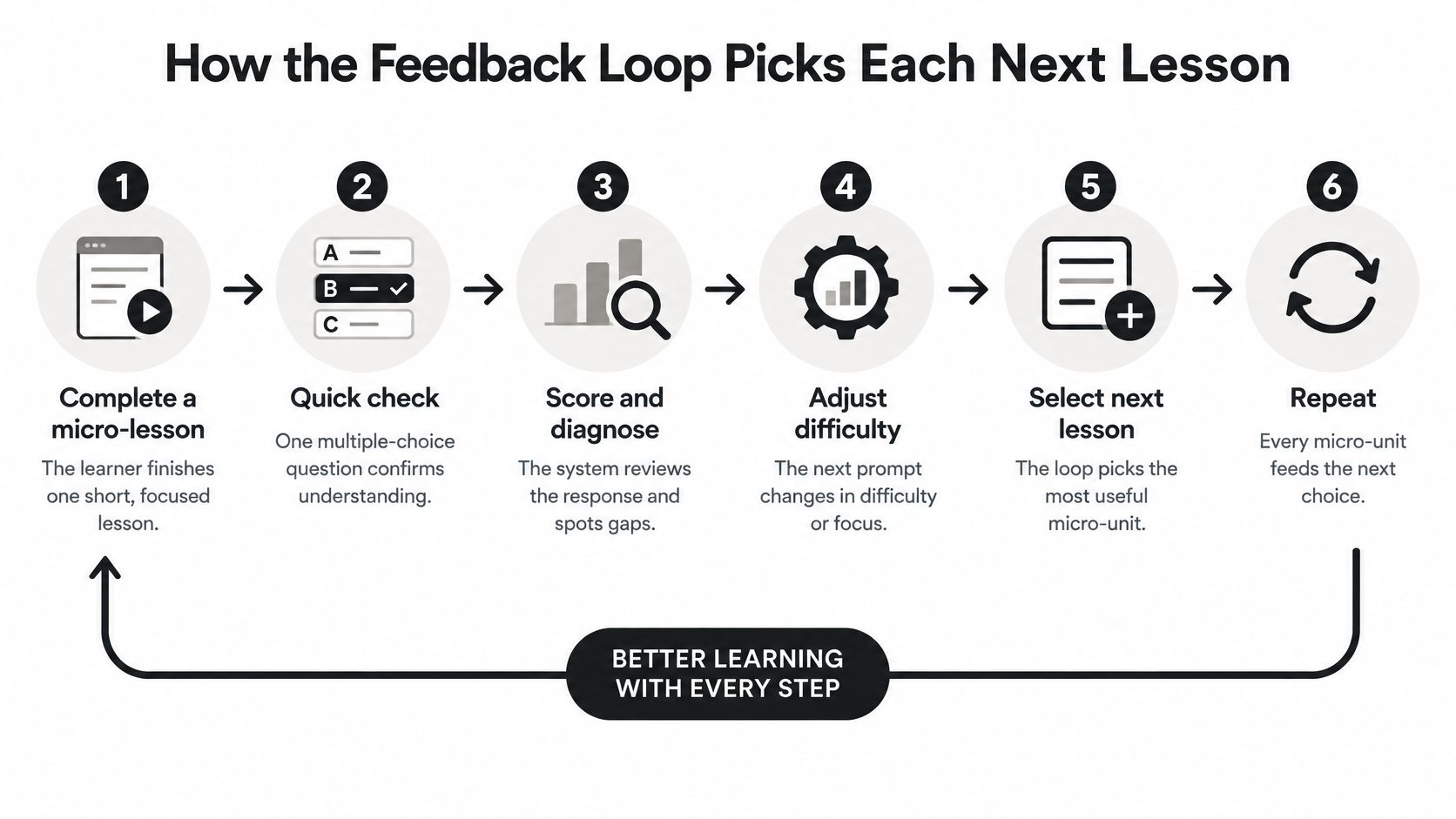
An adaptive system runs a feedback loop: collect evidence, update an estimate of understanding, and select an activity. The learner sees a lesson. Behind it, the designer has defined what different responses should trigger.
A higher-education adaptive-microlearning paper describes personalized guidance intended to accommodate differences in learners' educational backgrounds and reports significant learning-outcome improvement across data collected over three consecutive years. That supports investigating adaptive sequencing, without establishing that every routing algorithm works equally well.
Follow the decision through
-
Complete a lesson and a quick check. The learner studies a focused concept, then answers a relevant question or gives a confidence rating. A common slip is checking a minor detail instead of the skill the lesson was supposed to teach.
-
Record the evidence. Capture correctness, response time, and the skill associated with the item so the result has instructional meaning. The slip here is storing only an overall quiz score, which hides the particular prerequisite causing trouble.
-
Update the learner model. The model is a working estimate of mastery for each skill, informed by accumulated responses. Don't let an isolated mistake erase a consistent record of understanding.
-
Apply the routing rule. Compare that estimate with a designer-set mastery threshold and check whether essential prerequisites are secure. Setting the threshold too low can allow successful guessing to substitute for understanding.
-
Select the next micro-unit. Choose prerequisite remediation, more practice at the current level, or an applied task when the evidence supports advancement. A frequent mistake is sending every struggling learner back to the same explanation, even when it hasn't resolved the confusion.
-
Repeat until the goal is demonstrated. Continue collecting evidence as the learner works toward the intended performance. Don't confuse reaching the final screen with demonstrating the skill independently.
The loop is easier to discuss when everyone can see its moving parts.
Make each decision inspectable
Keep the routing record separate from the learner's completion record. You should be able to explain which evidence caused a branch and whether the learner succeeded afterward.
For planning how assessment findings become actionable feedback, consider Edvdo assessment feedback reports. Use that planning question to distinguish a score summary from feedback that tells someone what to practise.
When mapping personalized learning pathways, write the prerequisite skills and mastery rules before building screens. Otherwise, you risk producing attractive lessons first and inventing reasons to connect them afterward.
Learner Signals and the Next Step They Trigger
The most useful learner signals are often straightforward to collect: item-level accuracy, response time, confidence, and repeated errors. You don't need an elaborate profile to identify a gap in understanding.
A quasi-experimental study of adaptive microlearning compared adaptive and conventional formats among 111 in-service personnel, finding significantly better learning adaptability in the adaptive group. For course design, the relevant mechanism is matching instructional demand to demonstrated competence, rather than shortening content alone.
The following table is a starting set of proposed routing rules, not a universally validated scoring system.
Learner signals and the routing decision they trigger
| Learner signal | Likely meaning | Next micro-unit |
|---|---|---|
| Wrong answer on a prerequisite item | Gap in the foundation skill | Remediation lesson on the prerequisite |
| Three correct answers in a row, fast | Mastery of the current skill | Advance to an applied task |
| Correct answer but slow response | Shaky understanding | Repeat with new examples at the same level |
| Same error on the same item twice | Misconception | Short explanation followed by a retrieval prompt |
| High confidence rating with a wrong answer | Overconfidence | Targeted check before any advancement |
Read signals together
The word likely matters. A slow answer could reflect careful thinking, a screen reader, an interruption, or unfamiliar wording. It doesn't establish weak understanding by itself.
As a design heuristic, look for two or three signals pointing in the same direction before making a substantial change. Accurate responses across different examples are more persuasive than fast answers to nearly identical questions.
Also preserve a minimum common core. Every learner should encounter essential concepts and demonstrate required skills, even when optional explanations and practice differ.
Keep the learner involved
Explain a branch in plain language: the next activity revisits a prerequisite because the latest response suggests uncertainty. Give learners a way to request another explanation or challenge the recommendation.
For background on how consequences can shape behaviour, Orange Neurosciences on operant conditioning offers a useful companion topic. Keep the distinction clear: rewarding participation and diagnosing understanding are different design jobs.
Before authoring content, write your own signal table. For every proposed branch, record the evidence, alternative explanations, next activity, and route back to the main learning path.
Why Spacing Review Beats One Long Session
Think about cramming for an exam versus studying a little at a time. Which material could you still explain a month later, without opening your notes?
Spaced practice means returning to material across separate sessions. The learner has an opportunity to retrieve it after a gap, rather than repeatedly encountering it while it's still fresh.
A spaced-practice summary published by Nerdsip describes a review of 254 studies involving more than 14,000 participants, with learners recalling roughly 47% after spaced practice versus about 37% after a single massed session at the same total study time. The same summary gives a planning rule of review intervals around 10% to 20% of the intended retention period, or approximately three to six days for a one-month goal.
Schedule for when the skill is needed
That guidance gives you a starting point, not a universal timetable. A learner preparing for an upcoming procedure has a different retention need from someone who must recall a rarely used emergency response.
In an adaptive course, start with the retention target and then adjust the review plan using subsequent performance. Don't release the entire course at once and call the resulting collection of short lessons spaced learning.
Say an employee is learning an incident-reporting process. An initial activity might ask them to identify a reportable event. A later review could ask them to choose the correct reporting route in a different situation.
The later prompt should require remembering and applying the rule, rather than recognizing the same screenshot.
Practical rule: Schedule review around the future use of the skill, then use retrieval evidence to adjust the workload.
Avoid review that becomes busywork
After setting the initial schedule, use earlier retrieval attempts to estimate when memory may need support. Bring learners back when that evidence suggests fading recall, rather than repeatedly assigning material they can still apply reliably.
You can't directly observe forgetting between sessions. You're making an estimate from previous responses, so keep the schedule adjustable and let learners request additional practice.
For course-level planning, a spaced repetition strategy for online courses can help connect lesson delivery with later review. Keep completion deadlines separate from retention goals, since finishing the course and remembering its content are different outcomes.
Why Quizzing Beats Rereading
In a classic experiment summarized by New Dynamics, learners who read a passage once and completed three recall tests retained approximately 62% after one week, compared with about 39% among those who read the passage four times. It's a widely cited experiment pointing toward the value of retrieval practice, not a guarantee of those results in your course.
Retrieval practice asks learners to bring an idea to mind instead of viewing the explanation again. That gives the designer evidence of what they can recall without the answer in front of them.
Turn recall into an interaction
Say you create a three-minute lesson about a fictional retailer's refund policy. The policy requires proof of purchase and an eligible product condition. Ask learners to name both requirements before revealing them.
If someone omits the condition requirement, provide a short explanation and a contrasting example. Bring the question back later, preferably with different wording or a customer scenario.
A repeated misconception should trigger a targeted explanation followed by a retrieval prompt. Replaying the entire lesson makes the learner search for the relevant correction.
Make practice safe
Use interactive and engaging course quizzes to support practice, not to turn every interaction into a high-stakes assessment.
- Offer hints: Let learners recover when they're stuck.
- Explain errors: Identify the mistaken idea rather than displaying only a cross.
- Allow another attempt: Use a fresh example to check whether the explanation helped.
Keep feedback calm and specific. Learners should feel comfortable exposing uncertainty, because hidden confusion gives you nothing useful to respond to.
Where Adaptive Microlearning Works in Practice
Say a support team takes a refresher on account access. Experienced agents click through familiar password-reset instructions, while new hires struggle to distinguish routine requests from possible account compromise.
A useful redesign gives those learners different practice while preserving the same service standard. The team setting might look like this.

Match the branch to a real task
Compliance refreshers can let employees bypass optional explanations when an initial check demonstrates understanding. Keep required material and required assessments intact, especially where your organization mandates them.
For software onboarding, separate administrator and end-user tasks first. Then adapt within each role. An administrator who can create accounts may still need practice assigning permissions safely, while an end user needs help completing everyday work.
In a technical or language course, unfamiliar terminology can block an otherwise manageable task. A missed vocabulary check could trigger a short definition and contextual practice before the learner returns to the procedure.
A membership course can use a diagnostic to offer advanced application modules to prepared members. Keep foundational resources accessible so advancement doesn't remove useful support.
For a visual companion to these training examples, you can watch the following video.

Reduce effort that doesn't serve the task
A study involving 111 in-service personnel, summarized by Headway, found significantly lower unnecessary cognitive load in adaptive microlearning than in conventional microlearning. The adaptive format adjusted learning conditions according to performance.
That matters because a learner's effort can go into deciphering confusing instruction rather than understanding the procedure. Repetitive material can also make it harder to identify what genuinely needs attention.
Use the finding carefully. It supports designing instruction that better fits learner needs. It doesn't establish that your employees will make fewer workplace mistakes because their lessons adapt.
To pursue that outcome, connect practice with actual work:
- Use realistic decisions: Ask support agents to choose an escalation route from a plausible ticket.
- Provide job aids: Keep approved procedures available during unfamiliar tasks.
- Add human reinforcement: Ask a supervisor to observe the target behaviour and give specific feedback.
Plan the benefit around workplace application, not just successful course navigation. A learner needs an opportunity to perform the skill outside the training environment before you can assess practical improvement.
Limits, Privacy Questions and Common Myths
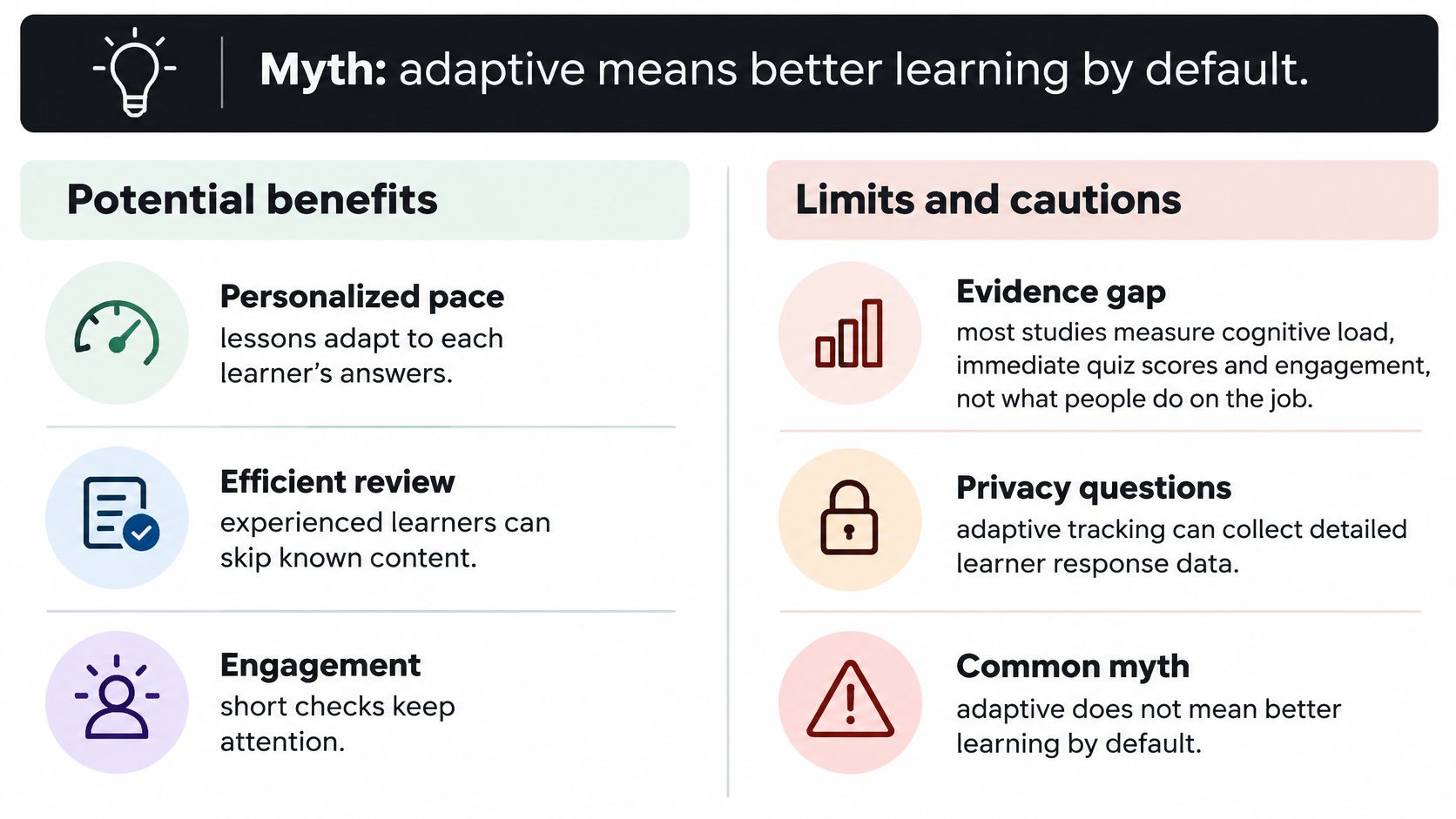
The most common myth is that adaptive automatically means better learning. A smoother session, stronger engagement, or a higher immediate quiz score still leaves an important question unanswered: can the learner perform the task later?
The workplace adaptive-microlearning study primarily measures cognitive load and learning adaptability, rather than long-term workplace behaviour. That leaves an evidence gap between improvements during training and durable changes on the job.
Measure beyond the session
For your own evaluation, you might schedule checks after 30, 60, or 90 days. Treat those as proposed measurement points, then choose outcomes that match the task, such as report accuracy, procedural errors, or observed escalation behaviour.
A 2025 systematic review of 142 empirical studies identifies privacy, algorithmic bias, scalability, and the dominance of monolingual or monocultural contexts as continuing limitations. It also notes that adaptive systems may use behavioural logs, assessment results, and potentially biometric signals.
The balance between potential benefits and unresolved questions deserves attention before launch.
Collect less and explain more
A system built around a particular language or assessment style may mistake hesitation for low ability. Disability-related interaction patterns or unreliable connectivity can also complicate interpretation.
Build safeguards into the pilot:
- Minimize collection: Record only signals you use for routing.
- Set retention rules: Decide when detailed response records will be deleted.
- Offer an alternative: Provide a usable path without optional tracking.
- Allow human review: Let learners dispute a recommendation.
- Check fairness: Compare routing and outcomes across learner groups, languages, and accessibility needs.
Don't collect sensitive information merely because a platform permits it. The best adaptive course should still work for a learner who doesn't want to be tracked.
Pick Your First Pilot Lesson Set
Choose a skill with a clear performance outcome, such as submitting an incident report correctly. Break it into prerequisites, then sketch a small set of micro-units.
For a manageable pilot, you might create five to eight units, each with a check question and a retrieval prompt. Define a mastery threshold, document the routing rules, and schedule a 30-day retention check as part of your proposed evaluation.
Compare learning, not just completion
Give a comparison group the standard version of the same content. Keep the target skill and assessment comparable, and include an applied task so you can distinguish recall from practical performance.
Before choosing software, check:
- Signal capture: Can it record item-level responses and the evidence your rules require?
- Export: Can you retrieve those records through supported SCORM or xAPI workflows?
- Fit: Does its price and administration workload suit your team?
Our guide comparing learning management systems for employee training covers team size, pricing, SCORM and xAPI support, use case, and a pilot plan.
Write down the first skill you'll test this month. Name the observable outcome beside it, then draft the check that would convince you someone can do it.