
How to Write Learning Outcomes You Can Assess

Suppose you built a module called Essential Communication Skills, wrote a ten-question definitions quiz, and watched most of the cohort pass it. Then a member emails: they froze when a client asked for a brief. You reread the syllabus and feel the floor tilt.
A learning outcome closes that gap. It is one sentence about a performance, written so another person can watch it happen and score it.
I treat an outcome as a promise with a receipt attached. If I cannot grade the receipt, I have not made a promise. I have made a brochure. Once AI tools and narrow cultural examples enter the room, the conditions are what keep that promise honest.
Why Your Module Title Is Not an Outcome
A module title names a subject. Essential Communication Skills tells a buyer what the folder is called. It tells nobody what they'll be able to do at the end of it.
An outcome does the opposite. It names one performance, in a shape another person can watch and score. That's the difference between a brochure and a promise.
The blank I fill in every time
The working template: By the end of [scope], learners will [observable verb] [content or performance] under [conditions] to [standard].
Cornell's teaching center runs a longer frame that does the same work. As a result of participating in [course or program], students will be able to [action verb] [learning statement] (Cornell Center for Teaching Innovation). Both versions force a person, an action, and something to look at afterward.
Here's the test I run on every line. Can I name the task a learner will do? Not the topic. The task. If I can't point at a thing a grader can open, watch, or read, the line goes back to the bench.
That failure is usually quiet. A healthy pass rate on a definitions quiz tells you people can match terms. It doesn't tell you they can hold a client conversation.
The scene I keep in mind while drafting the promise looks like this.

What real syllabi look like
Fuller sentences are more normal than creators assume. A 2024 analysis of 636 university major-course syllabi found that 62.3 percent of learning-outcome statements used a content-plus-behavior format, while 20.7 percent used brief itemized statements (Korean Citation Index analysis). The version with conditions and a standard is the mainstream form, not the fussy one.
There's a second half to the promise. A tight outcome doesn't help anyone who never reaches module two, so it's worth pairing the sentence with the habits covered in this guide to stay motivated in independent online learning.
What you leave with is a six-level verb chart, six moves for drafting one sentence, an alignment grid to fill in before launch, and two checks that keep the promise honest once AI and cultural context enter the room.
A Verb Chart and a Sentence You Can Grade
A scorable outcome reads like a promise with four blanks: a deadline, a verb, the conditions, and a standard. Here is a model sentence you can adapt to almost any module.
Worked example: By the end of the pricing lesson, learners will calculate a break-even membership price from fixed costs, variable costs, and a target margin, using the provided spreadsheet, with at least 90 percent accuracy.
Set that beside the line course builders often write first. Cover subscription models. One sentence describes a learner at a keyboard producing an artifact. The other describes the instructor talking near a whiteboard. A grader can score the first. For the second, they can only nod.
The conditions inside the worked example do quiet work. "Using the provided spreadsheet" tells the learner exactly which tools are allowed, so the promise means the same thing whether they do the arithmetic by hand or let software do it. Leave that blank and the promise goes hollow, because a learner can meet it in ways you never intended to grade.
Where the six levels come in
The verb does most of the work, which is why the 2001 revision of Bloom's taxonomy matters more than the module name. It replaced six noun categories with six verb-based processes, remember, understand, apply, analyze, evaluate, and create, and moved attention from what learners supposedly possess to what they can demonstrate after instruction (Carnegie Mellon Eberly Center). The same revision lifted create to the top of the ladder, above evaluate, where the 1956 version had placed synthesis.
| Level | Useful verbs | Learner performance | Example fragment |
|---|---|---|---|
| Remember | define, identify, list, recall | Retrieve a fact or term | list the four parts of a membership offer |
| Understand | explain, illustrate, interpret, paraphrase, summarize | Restate meaning in their own words | summarize a pricing page for a new member |
| Apply | calculate, demonstrate, implement, use | Carry out a procedure in a set situation | calculate break-even from given costs |
| Analyze | compare, differentiate, examine, organize | Break material into parts and relationships | compare two drip schedules for drop-off risk |
| Evaluate | critique, judge, justify, prioritize | Judge against stated criteria | justify a tool choice against three criteria |
| Create | design, compose, develop, produce | Produce an original work | design a one-week onboarding sequence |
Two levels deserve extra words, because they are where most membership courses live. Remember verbs include define, identify, list, and recall. Understand verbs include explain, illustrate, interpret, paraphrase, and summarize (Bowling Green State University assessment resources). Bowling Green's guidance is to select the action verb at the highest level of thinking students are expected to show, rather than the level that sounds impressive on a sales page.
How to choose the level
Pick the highest level you will really assess. If the task is a spreadsheet graded against an answer key, calculate is honest and evaluate is decoration. I'd rather read a plain calculate with a firm standard than an evaluate nobody plans to score.
One verb per outcome. Two verbs mean two promises, which means two rows in your grid and probably two assessments. Split them and score each one.
The standard inside the sentence becomes the top band of your rubric. The walkthrough on writing rubric descriptors a second reviewer can apply shows how to word that band so a grader can score it without calling you for clarification.
Choosing the verb is the whole argument. Everything after it is evidence.
How to Write One Outcome From Scratch
Start with a promise you can score. A module usually carries two to four outcomes. A full course usually needs one per major unit plus a final performance that pulls the units together.
If you'd rather watch the routine before reading it, this session covers the same ground.
The six moves
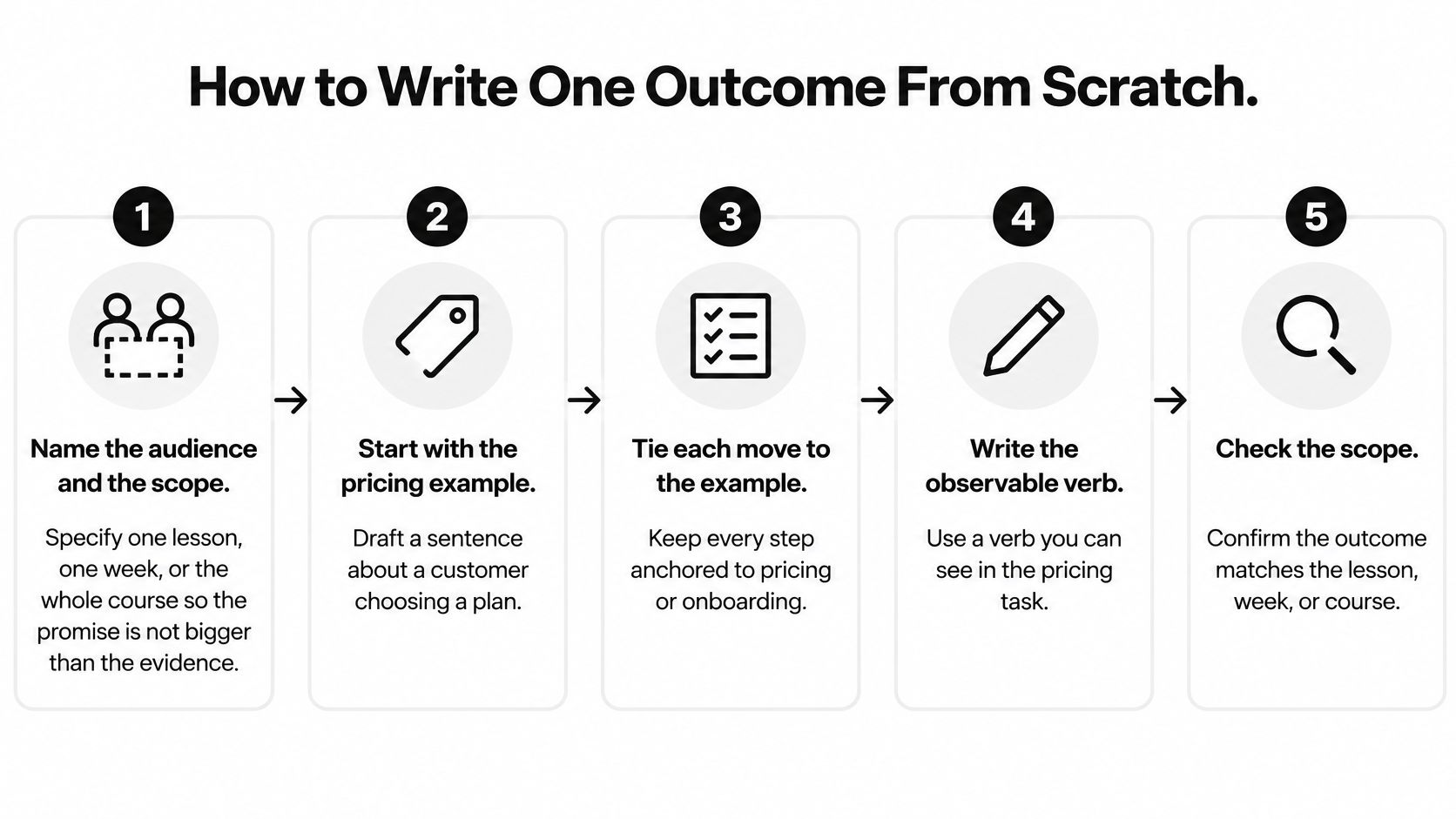
- Name the audience and the scope. One lesson, one week, or the whole course. A promise cannot outrun the time and feedback you have.
- Choose one observable verb from the chart at the highest level you'll assess, not the fanciest verb on the list.
- Add the content and the conditions. Name the dataset, the template, the tool, the source list, the time limit, and whether AI help is allowed. Conditions are part of the promise because they tell the grader what counts.
- Set a degree a stranger could score. 90 percent accuracy on three cases, a rubric score of 3 out of 4, both fixes named in a short note.
- Name the evidence before you design activities. The artifact decides whether the verb is honest. A reflection claiming the learner now understands pricing proves only that a reflection was submitted.
- Read the line as a learner. What will I do, what proves it, what standard applies, and what help may I use. If you'd need to be in the room to explain the answer, keep editing.
The workflow under those moves
The moves map onto a four-stage constructive-alignment routine. State what learners will do with an observable verb, define the evidence that would demonstrate it, choose activities that let learners produce that evidence, then design instruction and feedback to support the performance (Monash University constructive alignment). Monash puts outcomes first, then assessment, then activities, and asks for alignment at course, unit, weekly, and session level.
Here's the same routine as a single picture.
A before and after
Weak line. Learners will understand onboarding.
Working line. By the end of week one, learners will sequence five onboarding emails for a new member, using the brand voice sheet, so each email has one job and a clear next step.
The second version tells me what to film, what goes into the practice, and what the grader opens on Friday. The first gives me a topic, and a topic gives a grader nothing to score.
The pitfall to watch is writing what you will cover. Cover subscription models feels like a plan because it's easy to say out loud. It's a topic list wearing a sentence's clothes.
Once you can do the task, your own steps go quiet. If you want a parallel outside course design, TrueFire's advice for first-time guitar teachers speaks to skilled players who are about to explain their craft to beginners. In your module, the fix is the same: write the step a grader can see.
Once a few units have outcomes, the sequencing question takes over, and this guide to how to create a curriculum covers ordering units and spacing practice.
You should now have one finished sentence you can paste into a syllabus today.
Match Every Outcome to an Assessment
An outcome that asks learners to evaluate competing tools can't be checked with a multiple-choice quiz about feature names. The verb names a judgment. The quiz asks for recall. They have nothing in common.
That mismatch turns up often in membership courses, and it's cheap to catch before launch.
Build the grid first
Give every outcome one row in a small matrix and fill five columns: cognitive level, assessment task, scoring criterion, learning activity, and feedback method (outcome-to-assessment alignment resources). The rule underneath the grid is simple. The task has to demand the same content and the same mental move the verb names.
| Outcome verb | Assessment that fits | Assessment that misses | Minimum evidence |
|---|---|---|---|
| Calculate | Spreadsheet scored with an answer key | Quiz that only defines fixed cost | 90 percent accuracy on three cases |
| Compare | Short written analysis with a rubric | Multiple choice on vocabulary | Two differences tied to a stated metric |
| Justify | Written or oral defense against criteria | Recall of feature lists | A decision plus two evidence-backed reasons |
| Design | Submitted sequence a reviewer can run | Reflection that claims they understand design | A complete sequence meeting a checklist |
Heavier tasks mean more submissions to track, and the enrollment and student progress tools in Tutorbase keep that from turning into a spreadsheet of guesses.
Rewrite the invisible words
Any line holding know, understand, learn, be familiar with, realize, or appreciate goes back for edits. The University of Washington's teaching center recommends cutting those words because they describe an internal state nobody can watch directly (UW Center for Teaching). Swap in what the learner does to show understanding. For vocabulary, that might be matching terms to correct definitions in examples they haven't seen.
Check coverage, not just wording
Course alignment is the degree to which objectives, assessments, activities, and materials pull in the same direction (University of Illinois Chicago teaching guide). So read the grid sideways. If the quiz scores material you never taught, the lesson changes. If the practice never lets anyone attempt the stated performance, the outcome or the activity changes.
One more pass before you record. Read each row the way a learner would, and narrow anything that only makes sense with you sitting beside them. When you're choosing formats for the tasks themselves, this guide to course assessment methods covers quizzes, projects, and peer review.
Keep Outcomes Fair When AI Is Allowed
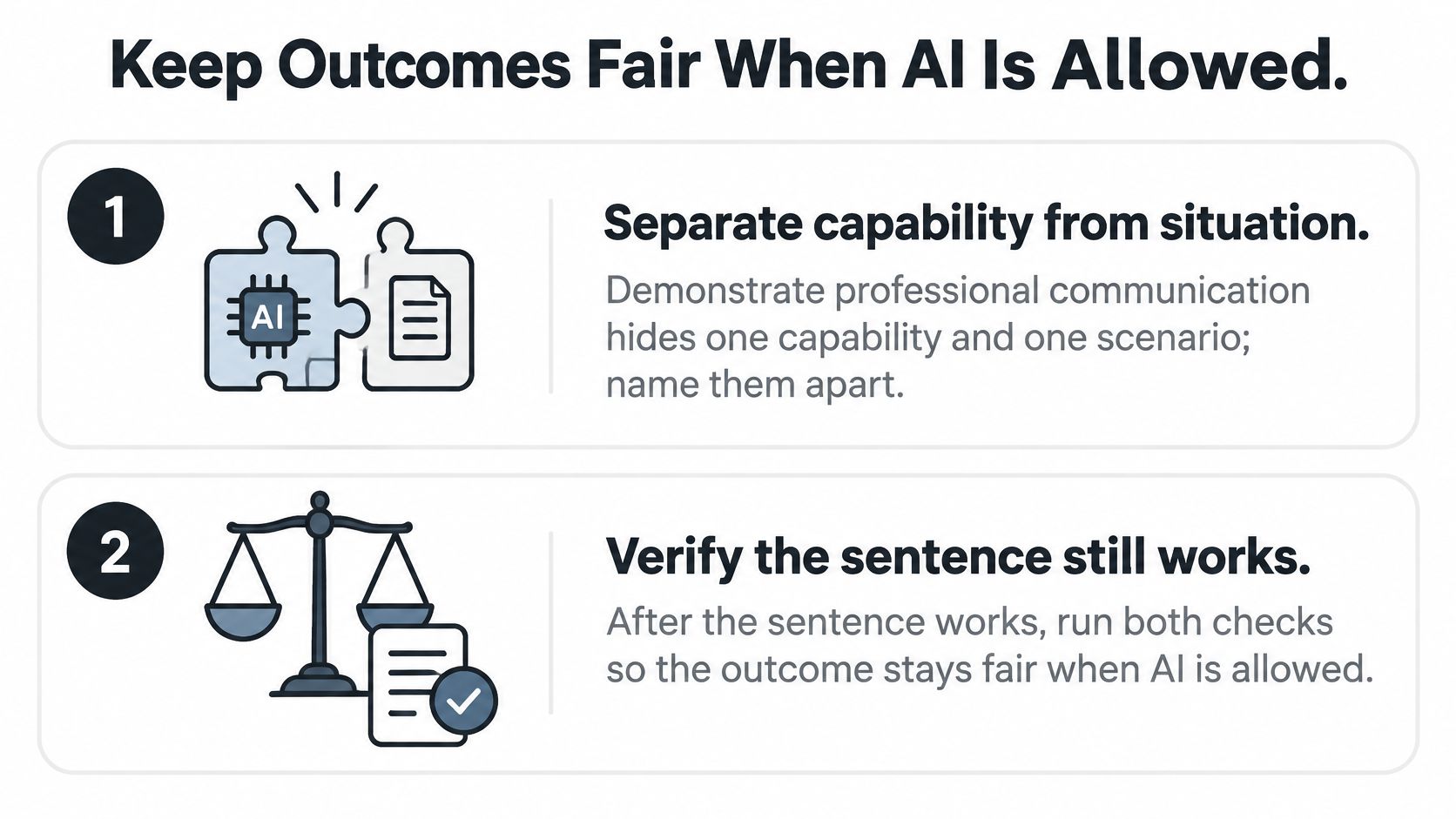
A scored promise only stays a promise when every learner can reach it under the same rules. Two checks protect that, and both run after the sentence already works. Neither one rescues a vague verb.
Check one. Separate the capability from the situation
Demonstrate professional communication hides a lot inside four words. One culture, one accent, one approved style, one idea of what a professional sounds like.
Rewrite it so the capability stays and the situation becomes a choice. Adapt a message for two specified audiences, using evidence and a structure that fits each one, then let learners pick which audiences matter in their own work. Fairness in outcome assessment is an active concern in the field, not a style preference (AALHE national survey study).
Observable alone doesn't guarantee fair. A precise line still shuts people out when it assumes expensive software, unfamiliar cultural references, native-level fluency, or one approved mode of expression.
A driver's test offers a useful analogy. The standard is whether you can merge safely, not which car you arrive in. Keep the condition and the degree explicit, because the ABCD structure treats audience, behavior, condition, and degree as separate parts. Then offer equivalent routes to the same competence. A short recording and a written brief can both be scored on one rubric when that rubric grades the structure and the evidence rather than the polish.
Check two. Decide what human judgment you still need
A ban you can't enforce isn't a design decision. Ask instead what the learner must show when generative AI is allowed. A stronger line requires them to check an AI-generated explanation against authoritative sources, find the errors, revise it for a named audience, and justify every edit. Researchers are already testing GenAI-supported formative assessment in real online courses, so an outcome that names the judgment will age better than one that names a tool.
Watch the conditions for quiet distortion. A demand for a lengthy written explanation can measure access to a generator more than mastery of the subject. Name the permitted tools inside the outcome itself, then name the evidence you'll grade: process notes, version history, a source critique, or a live performance. A line that names evidence survives a tool change. A line that bans a product name doesn't.
Grade the judgment, and let more than one valid path reach the same standard.
Rewrite One Outcome Before You Film the Lesson
Open the syllabus you're working from this week and circle the weakest line. It's usually the one with understand, know, or learn in it.
Rewrite that single line tonight with the pieces from this guide. Scope, one verb, the performance, the conditions, and a standard a stranger could score. Then add one row to the matrix and check that your existing assessment matches.
If the quiz only checks recall, change the task before you record the lesson or open enrollment. I'd rather push a video by a day than teach toward a promise I can't grade.
Here's the size of the edit. Learners will know the community guidelines becomes: By the end of the welcome lesson, learners will revise one community post so it matches two written guidelines, using the posted examples, with both fixes named in a short note.
Same lesson, same twenty minutes of content. One version asks a grader to trust a feeling. The other hands them a post and a note to read.
If the new task needs a different home, our guide comparing learning management systems for employee training covers team size, pricing, SCORM and xAPI support, and use case, plus a pilot plan for trying one before you commit.
Choose the activities that produce the evidence, build the lesson around them, then film.
Tonight, circle one line in your current course and rewrite it with the five parts: scope, verb, performance, conditions, standard. Tomorrow, hold your existing assessment against that sentence and change whichever one is easier to fix. Record the lesson after both exist. A specific promise is the only kind anyone can score, and it's the only kind worth putting your name on.