
Applying Adult Learning Theory Principles in Training

Adult learning theory isn’t just academic jargon. It’s the core set of ideas that explains how grown-ups actually learn. The big takeaway? Adults are self-directed, bring a ton of experience to the table, and are laser-focused on learning things that solve immediate, real-world problems.
Why Adult Learning Is Different
Ever sat through a training session that felt like a high school lecture? It probably didn’t stick. That’s because you can’t just copy and paste teaching methods designed for kids and expect them to work for busy professionals. Adults learn in a fundamentally different way.
The entire field dedicated to this is called andragogy, which is really just a formal term for the methods and principles behind adult education. Think of it as a shift from a top-down, “listen to the expert” model to a collaborative partnership where everyone is solving problems together. When we get these core ideas right, we can create courses and training that actually make a difference.
This isn’t some brand-new concept. While the term ‘andragogy’ was first coined way back in 1833, it was the educator Malcolm Knowles who really championed these ideas in the 1960s and 70s. He laid out a handful of key assumptions about adult learners that are still incredibly relevant today.
The Foundation of Effective Training
At its heart, adult learning is about respect. It’s about respecting that the person taking your course has a job, a family, and years of life experience that have shaped their worldview. They aren’t blank slates waiting to be filled with information.
They’re busy people who need to see the value in what you’re teaching them, and they need to see it fast.
Ignoring these principles is exactly why so much corporate training falls flat. A few of the biggest reasons adults mentally check out of a learning experience include:
- Lack of Relevance: The content has no clear connection to their daily tasks or career goals.
- Passive Learning: They’re forced to just sit and listen instead of actively participating.
- Ignoring Experience: The instructor doesn’t acknowledge or tap into the knowledge already in the room.
The secret to creating effective learning experiences is respecting an adult’s background, goals, and independence. This approach transforms a one-sided lecture into a dynamic partnership where everyone contributes.
Understanding the different learning styles in adults is another massive piece of this puzzle. When you combine that knowledge with the core principles of andragogy, you’ve got a powerful formula for designing training that truly resonates.
Andragogy vs Pedagogy Key Differences
Here’s a quick comparison of the core differences between teaching adults (andragogy) and teaching children (pedagogy).
| Concept | Approach for Adults (Andragogy) | Approach for Children (Pedagogy) |
|---|---|---|
| Learner’s Role | Self-directed, independent, and responsible for their own learning. | Dependent on the instructor for direction, guidance, and evaluation. |
| Experience | A rich resource for learning, and new knowledge is built on past experiences. | Limited life experience and seen as a “blank slate” for new information. |
| Motivation | Internally motivated by the need to solve problems or achieve personal goals. | Externally motivated by grades, parental approval, or teacher feedback. |
| Orientation to Learning | Problem-centered and focused on applying knowledge to immediate, real-life situations. | Subject-centered, where learning is organized by topics and concepts for future use. |
| Readiness to Learn | Learns when they have a need to know or do something new in their life or work. | Readiness is based on biological development and societal expectations (e.g., age). |
Seeing these side-by-side makes it clear why a one-size-fits-all approach to education just doesn’t work. Throughout the rest of this guide, we’ll break down these principles and show you exactly how to put them into practice.
The Six Pillars of Adult Learning
To really get what makes adult learners tick, you need to understand the principles Malcolm Knowles laid out when he popularized the concept of andragogy. Think of these as the foundational truths of how we, as adults, approach learning anything new.
Once you see these pillars in action, you’ll start to recognize why some courses are incredibly effective while others just fall flat. Let’s break down each of the six.
1. The Need to Know
Ever been stuck in a training session wondering, “Why am I here?” It’s a terrible feeling. Adults are pragmatic. Before we invest our precious time and energy into learning something, we need a compelling reason.
This is the classic “What’s in it for me?” question. It comes from being efficient with our mental resources, not from being selfish. We need to see a direct line from the course content to a real-world benefit, like making a job easier, solving a nagging problem, or getting a promotion.
As a course creator, your first and most important job is to answer that “why.” Right from the start, make it crystal clear what problem your course solves or what goal it helps learners achieve.
2. The Learner’s Self-Concept
This one boils down to a single word: respect. As adults, we see ourselves as self-directed and independent. We run our own lives, make our own decisions, and take responsibility for the outcomes.
So when a learning environment treats us like kids and dictates every single step without our input, our natural instinct is to resist. We want to be partners in our own education, not empty jars waiting to be filled. This is a huge reason the old-school, top-down lecture often fails so spectacularly with adult audiences.
This infographic does a great job of showing the contrast between the learning approaches for adults and children.
You can really see the shift from a teacher-led, dependent style (pedagogy) to a self-directed, experience-driven model (andragogy).
3. The Role of Experience
This pillar is a game-changer. Adults don’t walk into a classroom as blank slates. They bring decades of life and professional experience with them. This is your single greatest teaching asset and shouldn’t be ignored.
That rich background acts as a mental scaffolding where new information can be attached. When we can link a new concept to something we’ve already gone through, it clicks. It’s like trying to hang a picture. It’s a lot easier if there’s already a nail in the wall. Our experiences are those nails.
Tapping into this collective wisdom through group discussions, case studies, and shared stories makes the learning stickier and more meaningful for everyone in the room.
4. Readiness to Learn
Timing is everything. An adult is most open to learning something new when it directly addresses a challenge or a life transition they are facing right now.
For instance, someone who just got their first management role is suddenly incredibly ready to learn about leadership skills. A person launching their first business is primed and ready to soak up everything they can about marketing. Their readiness is triggered by an immediate, real-world need, not some abstract requirement for the future.
This means your training has to be relevant to their current situation. The learning must directly align with the roles and responsibilities they’re juggling today.
5. Orientation to Learning
When we were kids, learning was subject-centered. We learned math, then we learned history, then science, all in separate, neat boxes. As adults, our learning becomes problem-centered.
We rarely learn just for the sake of knowing something. Instead, we learn to solve a specific problem, to perform a critical task, or to navigate a real-life situation more effectively. We want knowledge we can apply the minute we walk out of the classroom.
This means your course content should be organized around practical applications and challenges, not just academic topics.
- Weak Example: A course titled “An Introduction to Accounting Principles.”
- Strong Example: A course titled “How to Manage Your Small Business Finances and Stay Profitable.”
See the difference? The second one is oriented around solving a tangible problem that keeps someone up at night.
6. Motivation
Finally, let’s talk about what gets us to the finish line. While external rewards like a pay raise or a better title can get us to sign up, the most powerful and sustainable motivation for adult learners comes from within.
That deep-seated drive comes from things like gaining more job satisfaction, boosting self-esteem, achieving personal growth, or feeling a real sense of accomplishment. These internal rewards will keep someone engaged long after the novelty of an external perk wears off.
When you start weaving these six principles into the DNA of your courses, you stop just transferring information. You start creating experiences that are truly effective and resonate deeply with your adult audience.
Bringing Adult Learning Principles to Life
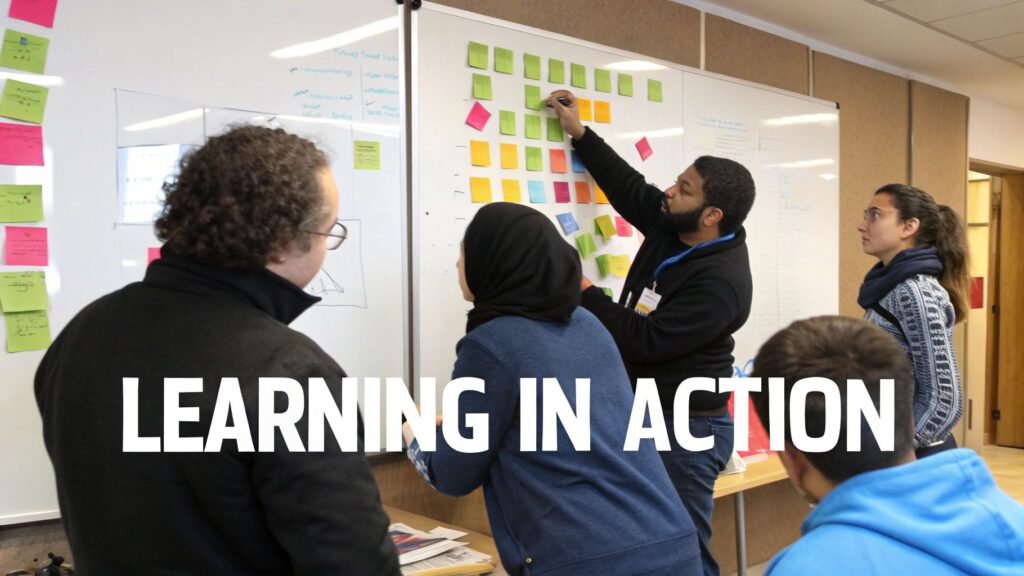
Knowing the six pillars is a great start, but theory only gets you so far. The real magic happens when you see these principles in action. Let’s shift from the “what” to the “how” with some concrete, real-world examples you can use right away.
My goal here is to hand you a toolbox of practical ideas you can adapt for your own courses, workshops, and training. These are simple, powerful shifts in your approach that make a world of difference, not complicated, high-level strategies.
Answering the “Why” for Maximum Impact
Remember the Need to Know principle? Adults need a compelling reason to tune in. The fastest way to give them one is by anchoring your content in a story or problem they instantly recognize.
Imagine you’re running a cybersecurity training for a company. You could open with a dry slide packed with scary data breach statistics. Yawn.
Or, you could kick things off with a detailed, true-to-life story about a similar company that suffered a massive breach. This could show how it cost them millions and torched their reputation. Suddenly, it’s a real, tangible risk, not an abstract threat. It makes every employee sit up a little straighter. They now get exactly why they need to pay attention for the next hour.
Here are a few more ways to nail the “why”:
- For a Time Management Course: Instead of leading with theory, start by asking everyone to share their single biggest time-wasting challenge from the past week. This immediately connects your course content to their daily frustrations.
- For a Software Update Training: Don’t just list the new features. Show a short video demonstrating how a common, annoying task from the old version is now 70% faster with the new update.
This simple shift respects their time and intelligence by proving the value from the very first minute.
Tapping into the Wisdom in the Room
The Role of Experience is probably the most powerful, and most underused, asset in any adult learning setting. Your learners aren’t empty vessels. They walk in the door with years, sometimes decades, of professional and personal experience. You should use it.
Let’s say you’re leading a sales workshop. The typical approach is to just teach a new closing technique. A much better way? Ask the group to share their toughest, most common client objections.
Write them all on a whiteboard. This move does two crucial things. First, it validates their experience and makes them feel heard. Second, it creates the perfect context for you to introduce your new technique as a direct solution to the exact problems they just shared.
By facilitating a space where learners share their experiences, you transform a lecture into a collaborative problem-solving session. The learning becomes stickier because it’s attached to real memories and challenges.
This works wonders online, too. In an e-learning course for new project managers, you could include a discussion forum prompt like, “Describe a time a project went completely off the rails. What was the core reason?” The shared stories become a rich, user-generated library of case studies for everyone.
Making Learning Problem-Centered and Relevant
Finally, let’s tie together the principles of Readiness to Learn and Orientation to Learning. Adults are motivated when they can see how learning solves an immediate problem. Your course structure should reflect this reality.
Think about designing a course for new managers. Instead of creating modules named “Giving Feedback,” “Delegation,” and “Conflict Resolution,” frame them around the actual headaches a new manager faces.
Here’s how that small change in framing plays out:
| Traditional Module Title | Problem-Centered Module Title |
|---|---|
| Principles of Delegation | How to Delegate Tasks Without Micromanaging |
| Giving Effective Feedback | Handling Difficult Conversations with Your Team |
| Conflict Resolution Styles | What to Do When Two Team Members Don’t Get Along |
See the difference? It shifts the focus from learning abstract concepts to acquiring practical skills for real-world scenarios. It speaks directly to their immediate needs, making the learning feel both urgent and essential.
You can also boost this effect by including activities that mirror their actual work. Adding interactive elements makes this even more potent. You can learn more about how to make training fun and engaging by checking out our guide to gamification for training. Turning a learning objective into a challenge or a mission taps directly into that problem-solving drive. It’s a fantastic way to make even complex topics more approachable and engaging.
Applying These Principles to E-Learning Design
Okay, so we’ve got the theory down. But how do we actually translate these timeless adult learning principles into the courses we’re building online? This is where the rubber meets the road.
Designing an online course that adults will actually start, engage with, and finish requires more than just uploading a few videos. You need to build an experience that respects their time, taps into their existing knowledge, and solves a problem they have right now. Let’s get into some practical ways you can apply these ideas to your e-learning design.

Build in Flexibility and Self-Direction
Adult learners are juggling careers, families, and a million other things. A rigid, one-size-fits-all course that marches everyone down the same path at the same speed is a one-way ticket to high dropout rates. Instead, we need to honor their need for self-direction by building flexibility right into the learning experience.
Think about offering your content in different formats. One person might love watching video lessons, but another prefers reading a transcript or listening to an audio-only version on their commute. Giving them these options puts the learner back in the driver’s seat.
Another powerful move is to create flexible learning paths. Instead of one long, mandatory sequence of modules, you could structure your course around specific outcomes or skill levels.
- Beginner Path: A guided tour through all the foundational concepts.
- Intermediate Path: Lets learners test out of the basics and jump straight to more advanced material.
- Problem-Solver Path: Organizes content around specific challenges, so users can find the exact lesson they need in the moment.
This approach acknowledges that your learners are showing up with different backgrounds and immediate goals.
Make Learning a Shared Experience
Just because the learning is happening online doesn’t mean it has to be a lonely journey. We can honor the Role of Experience by creating digital spaces where learners can connect, share what they know, and learn from each other. This shifts the dynamic from passive content consumption to an active, collaborative process.
Discussion forums are a perfect starting point. Pose a thought-provoking question tied to a lesson and watch as your learners bring their own real-world examples to the table. Suddenly, your course content is ten times richer, infused with unique case studies from the community itself.
By creating opportunities for peer interaction, you tap into the collective wisdom of your learners. Their shared experiences become one of the most valuable parts of the course.
You can take this even further. Think about peer-review assignments where learners give constructive feedback on each other’s work. Or what about interactive case studies that require small groups to team up and solve a problem? These strategies make learners feel seen and valued for the expertise they already possess.
Deliver Relevant, On-Demand Solutions
Adults are driven by an immediate Need to Know. They don’t sign up for a course for fun. They sign up because they have a problem they need to solve today. This is where the power of microlearning comes into play for e-learning design.
Instead of creating massive, hour-long video lessons, break your content down into bite-sized modules that focus on a single topic, usually around 5-10 minutes long. This structure makes it incredibly easy for a busy professional to find a quick, targeted solution to a specific challenge they’re facing on the job.
This on-demand approach directly supports the problem-centered Orientation to Learning that drives adults. They aren’t looking for a semester-long academic deep dive. They’re looking for an answer that helps them perform a task better, right now.
Foster Motivation Through Mastery and Progress
Finally, let’s talk about Motivation. While a certificate of completion is nice, the most powerful driver for adults is internal. That feeling of genuinely making progress and mastering a new skill is far more rewarding than just collecting points.
This is where meaningful gamification comes in. A good system is about designing a way to clearly visualize a learner’s progress and skill acquisition, not just slapping flashy badges on everything.
- Progress Bars: Show learners exactly how far they’ve come and what’s left to complete in a module or the course.
- Skill Checkpoints: Use short quizzes or practical challenges after key lessons to help learners confirm they’ve nailed the concept before moving on.
- Unlockable Content: Make advanced modules available only after a learner has demonstrated they’ve got the fundamentals down.
This approach creates a deeply satisfying feedback loop that builds confidence and fuels their intrinsic desire to keep learning. The whole experience becomes a journey of mastery, not just a race to a finish line.
Exploring instructional design best practices can offer more insight into how these theories translate into tangible educational content. You can also dive deeper into specific frameworks by exploring different instructional design models for e-learning.
Common Myths About Adult Learning

Whenever an idea like andragogy gets popular, it’s bound to pick up a few myths. Some of these misconceptions sound right on the surface, but they can steer you down the wrong path when you’re trying to design effective training.
Let’s clear the air on a few of the most common ones. By understanding what these principles don’t mean, you can apply them more effectively and sidestep some common traps that can unintentionally make your courses weaker.
Myth 1: You Should Never Lecture Adults
This is probably the biggest misunderstanding of them all. Because adult learning focuses so heavily on self-direction and getting your hands dirty, a lot of people assume that lecturing is completely off-limits. That’s just not the case.
The real problem is the passive, one-way drone of a traditional college lecture. A well-placed, punchy lecture can be a powerful tool for kicking off a new topic, providing essential context, or tying complex ideas together. A focused, 10-minute explanation can perfectly set the stage for a much more productive hands-on activity.
A lecture is just one tool in your toolbox, not the whole toolbox. You can use it to efficiently deliver core information, then immediately hand the reins back to the learner for an activity where they can apply that new knowledge.
Myth 2: Every Learning Activity Must Be 100% Self-Directed
This myth is born from a good place. It comes from the core principle of respecting an adult’s independence. But when you take this idea to its extreme, you can actually create a ton of frustration.
While adults are self-directed, they still need and appreciate clear guidance, especially when diving into something new and complex. Imagine trying to learn a brand-new software application with zero instructions or structure. It would be chaotic and incredibly inefficient.
True self-direction means providing a solid structure and offering meaningful choices within that structure. It doesn’t mean tossing your learners into a sea of content and wishing them luck.
- Offer clear learning paths that guide them toward a specific outcome.
- Provide optional resources for those who want to go down the rabbit hole on a particular topic.
- Give them control over the pace at which they move through the material.
Guidance and autonomy aren’t opposites. In fact, giving learners a clear framework is what builds the confidence they need to explore and direct their own journey effectively.
Myth 3: All Prior Experience Is Beneficial
Honoring a learner’s experience is a cornerstone of adult learning theory. We know that connecting new ideas to things people already know is what makes learning stick. But it’s a huge mistake to assume that all prior experience is an asset.
Sometimes, old habits and deeply ingrained mindsets can create serious resistance to new information. A seasoned pro might be thinking, “I’ve been doing it this way for 20 years, why should I change now?” This kind of experience can become a barrier to learning, not a bridge.
Your job as an instructor is to navigate this delicate situation with grace. Start by acknowledging their experience and expertise. Then, create a safe space for them to question old assumptions and see the clear benefits of a new approach. Case studies, success stories from peers, and low-stakes practice activities are perfect for this.
By tackling these misconceptions head-on, you’ll gain a more balanced and practical view of how to put these powerful principles to work.
Your Questions About Adult Learning Theory Answered
As we wrap up our deep dive into the world of adult learning, I wanted to tackle some of the most common questions I hear from course creators and trainers. Getting the theory down is one thing, but knowing how to handle specific situations is what really builds confidence.
Let’s get into some practical answers that will help you put these powerful ideas to work.
What Is the Biggest Difference Between Andragogy and Pedagogy?
The single biggest difference boils down to two things: self-direction and experience. Think of it this way.
Pedagogy, the method for teaching kids, assumes the instructor is the expert who holds all the knowledge. The student is seen as a relatively blank slate, so the teacher leads and the student follows a predetermined path. It works because kids don’t have a deep well of life experience to draw from yet.
Andragogy, the approach for adults, completely flips that script. It starts with the assumption that learners are independent people who bring a whole lifetime of experience, successes, and failures to the table. In this model, the instructor acts more like a facilitator or a guide. They help learners connect new information to what they already know to solve real-world problems.
It’s a fundamental shift in perspective. Adults are actively involved in a process of learning to solve a problem instead of being passively taught a subject.
How Can I Apply These Principles to Technical Skills Training?
I love this question because adult learning theory principles are incredibly effective for technical topics, which can often feel dry or intimidating. Let’s say you’re teaching a new piece of software.
Instead of just demonstrating a feature, start by explaining what annoying, time-consuming daily task it makes easier. That immediately answers the Need to Know. You’ve hooked them. Then, let your learners practice in a safe environment, like a test database where they can’t break anything important. This honors their Self-Direction and lets them learn from their own Experience without fear.
Finally, frame the entire training around completing a tangible task. Instead of a lesson called “A Tour of the Reporting Menu,” title it “How to Create a New Client Report in Under Five Minutes.” This Problem-Centered Orientation makes the technical skill feel immediately useful and relevant to their job.
Are Adult Learning Principles Still Relevant with New AI Tools?
They are more important than ever. AI is an incredibly powerful tool, but it’s only effective if it’s designed around the way people actually learn. Technology is the “how,” but adult learning principles provide the essential “why” that makes it all click into place.
For example, AI can create personalized learning paths that adapt to an adult’s specific needs and skill gaps, which is a perfect way to support their Readiness to Learn. It can also generate realistic, complex problem-solving scenarios for learners to tackle. This is a fantastic fit for a Problem-Centered Orientation.
AI can even assess a learner’s existing knowledge right from the start, so you don’t waste their time covering what they already know. This is a perfect application of respecting the Role of Experience.
When exploring the diverse needs of adult learners, questions often arise about conditions like ADHD. Delving deeper into understanding learning differences like ADHD can help you better tailor your approach to be even more inclusive and effective for everyone.
In short, these principles give us the human-centered blueprint for using new technology in a way that truly serves the learner, not the other way around.