10 Powerful Learning Goals Examples

Let’s be real, starting a new course or training program without clear goals is like trying to build furniture without instructions. You might end up with something, but it probably won’t be what you wanted.
Setting the right learning goals from the start is a total game-changer. It gives you, your students, or your team a clear roadmap of where you’re all heading.
I’ve spent years designing courses and I can tell you firsthand, a well-written goal is the foundation of any successful learning experience. It turns a vague idea like ‘get better at marketing’ into something tangible and measurable. Think of them as a contract between you and your learner. This contract clearly states what they will be able to do by the end of the lesson, module, or entire course. This clarity eliminates confusion and focuses everyone’s effort on what truly matters.
This guide is built to be your go-to resource for practical learning goals examples. I’m not going to bore you with dense academic theory. Instead, you’ll find a massive collection of copy-and-paste templates and actionable examples tailored for different contexts.
We will cover ten distinct categories, including:
- SMART and Bloom’s Taxonomy-aligned goals
- Subject-specific examples for K-12 and higher ed
- Short-term and long-term professional development goals
- Skill-based goals for both technical and soft skills
My goal is to give you everything you need to write effective learning objectives that drive real results, whether you’re creating an online course, a corporate training session, or an individualized education program. Let’s dive in.
1. SMART Learning Goals
Kicking off our list of learning goals examples is a true classic, the SMART framework. This method is a powerhouse for creating goals that are clear, actionable, and trackable. It’s an acronym that stands for Specific, Measurable, Achievable, Relevant, and Time-bound.
The beauty of the SMART framework is its structure. It forces you to move beyond vague aspirations like “get better at coding” and define exactly what success looks like. This approach eliminates ambiguity for both the instructor and the learner, creating a shared understanding of the target.
Strategic Breakdown
Let’s break down a typical learning goal using this framework.
- Goal Idea: Learners will improve their research skills.
This is a good start, but it’s not a SMART goal. It lacks clarity and a finish line.
- SMART Goal Version: By the end of the 12-week semester, students will write a 5,000-word research paper on a pre-approved topic, correctly applying APA formatting with fewer than five major errors.
See the difference? This version has all the components:
- Specific: It details the task (write a 5,000-word research paper), the format (APA), and the quality standard (fewer than five major errors).
- Measurable: The word count (5,000), deadline (end of semester), and error count (fewer than five) are all quantifiable metrics.
- Achievable: A 12-week semester provides a reasonable timeframe for students to research and write a paper of this length.
- Relevant: The goal directly relates to a core academic skill required for the course.
- Time-bound: The deadline is clearly set for the “end of the 12-week semester.”
Actionable Takeaways
To apply this to your own courses, start with the end in mind. What specific, observable skill do you want learners to demonstrate? Once you have that, build the SMART components around it.
For corporate training, this method is especially effective for tying learning directly to business outcomes. For concrete examples of how to apply the SMART framework, explore these actionable SMART goals examples that work well in a professional context. Using this structured approach ensures your training programs deliver tangible results.
2. Bloom’s Taxonomy-Aligned Learning Goals
Next up is a framework beloved by educators and instructional designers, Bloom’s Taxonomy. This approach categorizes learning into different levels of cognitive complexity, from basic recall to advanced creation. Structuring your learning goals around this hierarchy ensures you are building a complete learning experience. You can guide students from foundational knowledge to higher-order thinking.
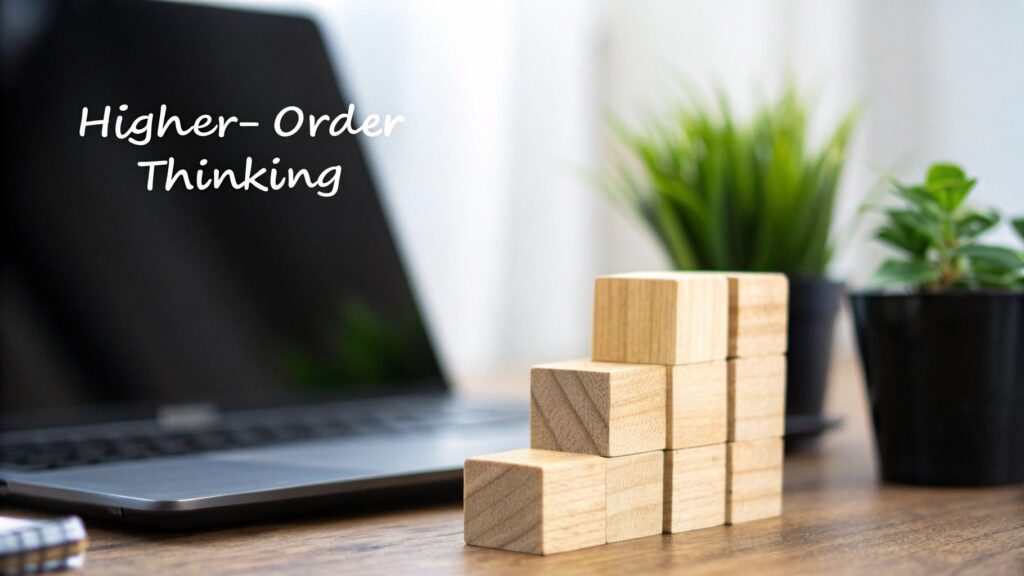
The power of Bloom’s Taxonomy is in its progressive structure. It helps you design a curriculum that challenges learners to analyze, evaluate, and ultimately create something new, not just memorize facts. This method provides a clear roadmap for developing deeper, more meaningful understanding.
Strategic Breakdown
Let’s break down how to create a series of learning goals that climb the taxonomy’s ladder.
- Learning Topic: Understanding sustainable business practices.
This topic is broad. We can use Bloom’s to build a scaffolded learning path with precise objectives at each level.
- Bloom’s-Aligned Goals Version:
- Remember: List the three pillars of sustainability (environmental, social, and economic).
- Understand: Explain the concept of a circular economy in your own words.
- Apply: Calculate the carbon footprint for a fictional small business using a provided template.
- Analyze: Compare and contrast the sustainability reports of two competing corporations.
- Evaluate: Critique the effectiveness of a company’s green marketing campaign.
- Create: Design a business model for a new startup focused on zero-waste principles.
This progression moves the learner from simple recall to complex, creative problem-solving, ensuring a comprehensive grasp of the topic.
Actionable Takeaways
To apply this, start by mapping your lesson’s key concepts to the different levels of the taxonomy. Use action verbs that correspond to each level to write your objectives. For example, use “Define” and “List” for remembering, but “Design” and “Construct” for creating.
This approach is invaluable for creating balanced assessments that test more than just memorization. By including questions that target analysis, evaluation, and creation, you get a much clearer picture of your learners’ true capabilities. To get a deeper look at this method, explore these Bloom’s Taxonomy learning objectives and the verbs associated with each level.
3. Subject-Specific Learning Goals
Moving beyond general frameworks, we arrive at subject-specific learning goals. These are goals tailored to the unique content, skills, and standards of a particular field of study, like mathematics, literature, or biology. They reflect the core competencies and ways of thinking that define a specific discipline.
This approach is essential because what “learning” looks like is very different in a history class compared to a computer science lab. These goals anchor your instruction in the authentic practices and expectations of the subject. They ensure learners are actually learning to think and act like a practitioner in that field instead of just memorizing facts.
Strategic Breakdown
Let’s see how a general skill becomes a powerful, subject-specific goal.
- Goal Idea: Students will learn about the American Revolution.
This is far too broad. It doesn’t specify what aspect of the revolution students should focus on or what skill they need to demonstrate.
- Subject-Specific Goal Version: By the end of the unit, students will compare and contrast the primary causes and long-term outcomes of the American and French Revolutions, citing at least three scholarly sources for each in a 5-page analytical essay.
This goal is much stronger because it demands a specific historical thinking skill (comparison) and sets clear parameters.
- Specific: The task is an analytical essay comparing the causes and outcomes of two distinct historical events (American and French Revolutions).
- Measurable: The requirements are quantifiable: a 5-page length and a minimum of three scholarly sources for each revolution.
- Achievable: For a history unit, this is a reasonable expectation that builds on research and writing skills.
- Relevant: This directly assesses a core competency in history, analyzing events, understanding causality, and using evidence to support an argument.
- Time-bound: The goal is clearly tied to the “end of the unit.”
Actionable Takeaways
To create effective subject-specific learning goals examples, start by consulting discipline standards like the Common Core for K-12 or professional association guidelines for higher education and corporate training.
Incorporate authentic tasks that mirror what professionals in that field do. For example, a biology goal might involve designing and executing a lab experiment, not just answering questions about one. This connects learning to real-world applications and makes the content more meaningful for your students.
4. Short-Term Learning Goals
While long-term vision is crucial, breaking that journey into smaller, manageable steps is where real progress happens. This is the power of short-term learning goals. These are objectives designed to be achieved in a brief timeframe, usually from a few days to a few weeks. They provide immediate targets that build momentum.
The brilliance of this approach is its ability to maintain motivation. By creating frequent opportunities for success, learners stay engaged and can see tangible progress quickly. It turns a marathon into a series of rewarding sprints, preventing overwhelm and building confidence along the way.
Strategic Breakdown
Let’s look at how a broad objective can be broken down into effective short-term goals.
- Goal Idea: Learners will master the basics of project management.
This is a great long-term aim, but it’s too big for a single objective. We need to break it into smaller, weekly tasks.
- Short-Term Goal Version: By the end of Week 1, learners will submit a one-page project proposal outline that identifies the project scope, key stakeholders, and a primary objective.
This goal provides a clear, achievable target for the week:
- Specific: It defines the deliverable (one-page project proposal outline) and its required components (scope, stakeholders, objective).
- Measurable: Success is easily measured by the submission and completion of the required outline components.
- Achievable: Creating a one-page outline is a reasonable task to complete within a week.
- Relevant: This task is a foundational first step in any project management process, directly contributing to the long-term goal.
- Time-bound: The deadline is clearly set for the “end of Week 1.”
Actionable Takeaways
To use this strategy effectively, map out your larger learning objectives first. Then, work backward and slice them into weekly or even daily tasks. Each short-term goal should be a building block for the next one.
In a corporate training setting, this is perfect for onboarding new hires or rolling out new software. For example, instead of a goal to “learn the new CRM,” you can set weekly goals like “complete the contact import module” or “successfully log 10 client interactions.” This approach provides steady progress and offers frequent checkpoints to ensure no one falls behind.
5. Long-Term Learning Goals
While short-term goals drive immediate action, long-term learning goals provide the overarching vision and direction for a learner’s entire journey. These are comprehensive objectives designed to be achieved over extended periods, like a full semester, an academic year, or even a multi-year career plan. They represent the major competencies a learner will master.
These goals act as a north star, guiding the smaller, more tactical learning activities along the way. They give purpose to the daily and weekly tasks by connecting them to a larger, more meaningful outcome. This approach is essential for programs that aim to develop deep expertise or facilitate significant personal or professional transformation.

Strategic Breakdown
Let’s look at how to structure these ambitious goals for maximum clarity and motivation.
- Goal Idea: An employee wants to become a manager.
This is a great career aspiration, but as a learning goal, it lacks a defined path. It needs to be broken down into a measurable learning objective.
- Long-Term Goal Version: Within two years, the employee will gain the necessary skills and qualifications to transition into a project management role by completing the PMP certification and successfully leading two internal cross-functional projects.
This version provides a clear roadmap for achieving the career goal. It sets a realistic timeline and defines the specific learning and experiential milestones required.
- Specific: It names the credential (PMP certification) and the practical experience needed (leading two internal projects).
- Measurable: Progress is tracked by certification completion and the number of projects led.
- Achievable: A two-year timeframe is reasonable for an employee to study for a major certification while gaining hands-on leadership experience.
- Relevant: The goal directly aligns with the employee’s career aspiration of moving into a management position.
- Time-bound: The goal has a clear two-year deadline.
Actionable Takeaways
To use long-term learning goals effectively, you must break them down into smaller, manageable milestones. A two-year goal can feel intimidating, but quarterly or semester-based sub-goals make it feel much more achievable.
For educators and trainers, constantly connect these smaller tasks back to the big picture. Help learners see how mastering a small concept today contributes to their major goal for the year. This is a powerful way to sustain motivation and demonstrate the value of your learning program over time.
6. Assessment-Aligned Learning Goals
Next on our list of learning goals examples is a strategy that guarantees coherence, Assessment-Aligned Learning Goals. This approach, rooted in frameworks like “Understanding by Design,” involves creating your goals and your final assessments in parallel. The core idea is to ensure that what you teach, what students practice, and how you measure success are all perfectly in sync.
This method prevents the common pitfall where course activities don’t prepare learners for the final test or where the test doesn’t actually measure the stated learning objective. By starting with the end in mind, you build a logical and transparent path from instruction to evaluation. This makes the entire learning experience more effective and fair.
Strategic Breakdown
Let’s look at how to align a goal with its assessment from the very beginning.
- Goal Idea: Learners will understand how to collaborate effectively.
This is a valuable soft skill, but the goal is too broad and lacks a clear evaluation method.
- Assessment-Aligned Goal Version: Upon completing the group project, learners will demonstrate effective collaboration by achieving an average peer evaluation score of at least 4 out of 5 on the criteria of communication, contribution, and conflict resolution.
This version is tightly integrated with its measurement tool:
- Specific: It defines “effective collaboration” using clear criteria (communication, contribution, conflict resolution).
- Measurable: The goal is quantified by a target score (average of 4 out of 5) on a peer evaluation rubric.
- Achievable: The group project provides a practical and contained environment to practice and demonstrate these skills.
- Relevant: Collaboration is a critical skill for the project’s success and is directly applicable to most professional environments.
- Time-bound: The goal is tied to a specific milestone, the completion of the group project.
Actionable Takeaways
To use this method, always ask yourself, “How will I know they’ve learned it?” Define your final assessment, be it a test, a project, or a presentation, at the same time you write your learning goals. Create a detailed rubric that breaks down the performance criteria for your assessment, and then use those same criteria to articulate your goals.
This alignment is crucial for demonstrating the value of your training. By linking goals directly to measurable outcomes, you can create a clear picture of learner progress. If you want to explore this further, check out these different strategies for how to measure training effectiveness and see how assessment alignment plays a key role.
7. Skill-Based Learning Goals
Next up, we have skill-based learning goals, which focus on what a learner can do. This approach prioritizes practical application and demonstrable competencies over the simple memorization of information. It answers the crucial question, “What tangible skill will the learner walk away with?”
This method is all about building real-world capabilities. It moves learners from passive knowledge consumers to active practitioners, whether they’re coding a program, delivering a presentation, or troubleshooting a complex problem.

Strategic Breakdown
Let’s look at how to transform a knowledge-focused goal into a skill-based one.
- Goal Idea: Learners will understand the principles of effective communication.
This is a fine starting point, but it’s abstract. “Understanding” is difficult to observe and measure directly.
- Skill-Based Goal Version: After completing the communication module, team members will deliver a 10-minute persuasive presentation to a panel, incorporating at least three visual aids and fielding questions for five minutes.
This version is powerful because it demands action. It has all the right components:
- Specific: It clearly defines the task (deliver a 10-minute persuasive presentation), the context (to a panel), and the required elements (visual aids, Q&A session).
- Measurable: The duration (10 minutes), number of visual aids (at least three), and Q&A time (five minutes) are all quantifiable.
- Action-Oriented: The goal uses a strong action verb, “deliver,” which describes an observable performance.
- Relevant: This directly assesses a core professional skill needed for many roles, making it highly relevant for corporate training.
- Contextual: The task simulates a real-world scenario, preparing learners for actual job demands.
Actionable Takeaways
To create your own skill-based learning goals examples, focus on action verbs that describe observable behaviors. Think about what you want learners to be able to perform by the end of the lesson. Build activities that allow for deliberate practice and provide structured feedback.
This approach is the foundation of many modern training programs. For a deeper dive into structuring your curriculum this way, you can explore this guide to creating a competency-based training framework for more strategic insights. It’s a fantastic way to ensure your learning experiences produce measurable, real-world results.
8. Affective Learning Goals
Moving beyond what learners know or do, affective learning goals focus on the often-overlooked dimension of learning, feelings, attitudes, and values. These goals address the emotional side of education by targeting learners’ motivation, confidence, and disposition. In short, they’re about how learners feel about the subject and their own abilities.
While cognitive goals focus on thinking and psychomotor goals focus on doing, affective goals target the heart. They aim to cultivate an appreciation for a subject, build resilience in the face of challenges, or foster a commitment to ethical practices. These are crucial for long-term engagement and creating truly transformative learning experiences.
Strategic Breakdown
Let’s see how we can turn a vague emotional target into a more concrete learning goal.
- Goal Idea: Learners will appreciate diverse perspectives.
This is a wonderful sentiment, but it’s hard to observe or measure. How do you know when someone “appreciates” something?
- Affective Goal Version: After completing the team-based project on global marketing strategies, participants will voluntarily seek out and respectfully incorporate feedback from at least two team members with different cultural backgrounds.
This version provides a clear path to observe the desired attitude:
- Specific: It defines the context (team project on global marketing) and the action (voluntarily seeking and respectfully incorporating feedback from teammates with different backgrounds).
- Measurable: The action is observable. Did the learner initiate the conversation? Did they integrate the feedback? The “at least two” provides a simple metric.
- Achievable: The goal is grounded in a specific project, making it a practical and attainable behavior within the course structure.
- Relevant: This goal is highly relevant for any role requiring collaboration, especially in a diverse, modern workplace.
- Time-bound: The goal is tied to the completion of the team-based project.
Actionable Takeaways
To incorporate these powerful learning goals examples, focus on creating the right environment. Model the attitudes you want to see, use collaborative projects that encourage empathy, and provide feedback that builds confidence.
For professional development, affective goals are essential for shaping company culture and building soft skills. The goal isn’t just for an employee to learn a new process. It’s for them to become committed to the principles of quality and continuous improvement behind it. This emotional investment is what separates compliance from true engagement.
9. IEP-Specific Learning Goals (Individualized Education Program)
Next on our list of learning goals examples, we’re focusing on a highly specialized and crucial area, IEP-specific goals. An Individualized Education Program (IEP) is a legal document in the United States that outlines the educational plan for a child with a disability. These goals are tailored to a student’s unique needs, ensuring they receive the support necessary to access the curriculum and make meaningful progress.
The power of an IEP goal is in its personalization. It moves away from one-size-fits-all objectives and creates a customized roadmap based on comprehensive evaluation data. This ensures that the learning targets are grounded in the student’s present levels of performance and are designed to be ambitious yet achievable.
Strategic Breakdown
Let’s look at how a general academic need can be transformed into a specific, measurable IEP goal.
- Goal Idea: The student will get better at reading comprehension.
This is a common starting point, but it lacks the precision required for an effective IEP. It doesn’t define what “better” is or how it will be measured.
- IEP Goal Version: By the end of the school year, when given a grade-level text, the student will use a graphic organizer to identify the main idea and three supporting details with 85% accuracy on four out of five classroom assessments.
This version provides a clear and actionable target:
- Specific: It defines the task (identifying the main idea and three supporting details), the required support (using a graphic organizer), and the context (grade-level text).
- Measurable: Success is quantified as 85% accuracy across four out of five assessments. This makes progress easy to track.
- Achievable: The goal includes a specific support (graphic organizer) that makes the task accessible, and the timeframe of a full school year is realistic.
- Relevant: This goal directly addresses a foundational academic skill (reading comprehension) that is essential for success across all subjects.
- Time-bound: The deadline is clearly stated as “the end of the school year.”
Actionable Takeaways
When creating IEP goals, collaboration is key. The process should always involve the student, their family, teachers, and specialists to ensure everyone is aligned. Start by reviewing the student’s present levels of academic and functional performance. This data is the foundation for setting meaningful targets.
Remember to incorporate necessary accommodations or assistive technology directly into the goal’s conditions. For example, specifying the use of text-to-speech software or manipulatives clarifies the support required for the student to demonstrate their knowledge. Frequent progress monitoring, at least monthly, is vital to adjust instruction and ensure the student stays on track to meet their goals.
10. Professional Development Learning Goals
In the corporate world, learning goals are for career momentum and organizational growth, not just for academic credit. Professional development learning goals are designed for adult learners looking to build specific competencies, close skill gaps, and align their growth with business objectives. They are the bridge between an employee’s current capabilities and their future potential.
The power of these goals lies in their direct link to real-world performance. They move learning from a theoretical exercise to a practical, results-driven activity. This approach ensures that training investments translate into tangible improvements in efficiency, leadership, and overall business success. This makes them a crucial tool for any forward-thinking organization.
Strategic Breakdown
Let’s break down a common professional development goal to see how it connects learning to business impact.
- Goal Idea: A manager needs to get better at leading their team.
This is a valid need, but it’s too vague to be an effective learning goal. It lacks clear targets and a way to measure success.
- Actionable Goal Version: Within six months, the new team manager will complete the internal leadership certification program and successfully apply at least three new coaching strategies during one-on-one meetings, as validated by employee feedback surveys and a review from their director.
This version provides a clear pathway to success:
- Specific: It names the exact task (complete leadership certification), the application (apply three coaching strategies), and the context (one-on-one meetings).
- Measurable: The outcome is quantifiable through the number of strategies (three) and validated by specific tools (feedback surveys, director review).
- Achievable: A six-month timeframe is realistic for completing a certification program and integrating new management techniques.
- Relevant: This goal directly addresses a critical skill gap for a new manager, aligning their growth with the organization’s need for effective leadership.
- Time-bound: The deadline is clearly set for “within six months.”
Actionable Takeaways
To make professional development goals work, they must be co-created. Sit down with the employee to align their personal career aspirations with the company’s strategic needs. This creates buy-in and makes the learning process more meaningful.
Tie the goal to tangible business metrics. For a sales professional, a goal could be increasing client retention by 15% after completing an advanced negotiation course. For an IT specialist, it could involve earning an AWS certification to support the company’s cloud migration. By connecting these learning goals examples directly to job performance and business outcomes, you create a powerful cycle of continuous improvement.
Comparison of 10 Learning Goal Types
| Learning Goal Type | Implementation Complexity | Resource Requirements | Ideal Use Cases | Key Advantages |
|---|---|---|---|---|
| SMART Learning Goals | Moderate, requires explicit criteria and timelines | Low–Moderate: planning time, tracking tools | Course/unit objectives, corporate training, project plans | Clarity, accountability, measurable milestones |
| Bloom’s Taxonomy-Aligned Learning Goals | Moderate–High, map objectives to cognitive levels | Moderate: educator expertise, assessment design | Curriculum design, lesson sequencing, assessment planning | Scaffolding, critical thinking, assessment alignment |
| Subject-Specific Learning Goals | Moderate, align to discipline standards and content | Moderate: subject experts, materials, standards | K–12 subjects, specialized courses, standards-based instruction | Relevance to field, coherence across grades/levels |
| Short-Term Learning Goals | Low, narrowly focused and quick to define | Low: frequent monitoring, formative checks | Weekly lessons, modules, microlearning, sprints | Motivation, quick wins, manageable steps |
| Long-Term Learning Goals | Moderate–High, require roadmap and checkpoints | High: sustained support, mentorship, tracking systems | Degree programs, career pathways, multi-semester plans | Vision and direction, deep skill development |
| Assessment-Aligned Learning Goals | High, backwards design and rubric creation needed | Moderate–High: assessment expertise, rubric development | High-stakes courses, accreditation, competency-based programs | Instruction-assessment alignment, clear expectations |
| Skill-Based Learning Goals | Moderate, define observable performance criteria | Moderate–High: practice environments, tools, feedback | Vocational training, workplace upskilling, labs | Employability, authentic performance assessment |
| Affective Learning Goals | Moderate, design subjective measures and supports | Moderate: time for reflection, supportive pedagogy | SEL, character education, mentoring, classroom climate work | Whole-person development, increased engagement and resilience |
| IEP-Specific Learning Goals | High, individualized, legally mandated planning | High: evaluations, multidisciplinary team, accommodations | Special education, individualized instruction, IDEA compliance | Legal protection, tailored supports, accountable monitoring |
| Professional Development Learning Goals | Moderate, align with adult needs and org strategy | Moderate–High: training resources, time, coaching | Workplace training, leadership development, upskilling | Direct workplace impact, career advancement, measurable outcomes |
Putting These Learning Goals into Action
We’ve covered a lot of ground, moving from high-level frameworks like SMART goals to the specific nuances of writing objectives for professional development or an IEP. The sheer volume of learning goals examples we’ve explored demonstrates a core truth, there is no single “best” way to write a learning goal. The ideal approach always depends on the context.
Your audience, the subject matter, and the ultimate transformation you’re promising will dictate whether a skill-based goal is more appropriate than an affective one, or if a long-term vision needs to be broken down into short-term, measurable steps. The real power comes from understanding these different models so you can select, and even combine, the right tools for the job.
Think of it like being a chef. You wouldn’t use the same knife for every task. You have your go-to chef’s knife (maybe that’s your SMART framework), but you also have specialized tools for specific jobs.
From Vague Hopes to Actionable Plans
The central theme connecting all these examples is the shift from ambiguity to clarity. A goal like “Understand digital marketing” is a hope. A goal like “Analyze the ROI of three distinct social media ad campaigns using Google Analytics by the end of this module” is an actionable plan.
This clarity does two things:
- It empowers the learner. They know exactly what success looks like and what is expected of them. This reduces anxiety and focuses their effort.
- It guides the instructor. Your content, activities, and assessments suddenly have a clear purpose. You’re no longer just creating content, you’re building a direct pathway to a specific, measurable outcome.
Your Next Steps: A Simple Action Plan
Feeling inspired but not sure where to start? Here’s a simple, three-step plan to put what you’ve learned into practice immediately.
Audit an Existing Course: Pick one of your existing lessons, modules, or courses. Look at the learning goals you have (or identify where they are missing).
Start with the Verb: The next time you create a new lesson, start with the verb. What do you really want the learner to do?
Mix and Match: Don’t feel confined to one framework. Challenge yourself to combine them. For instance, you could write a goal that is both SMART and aligned with the “Apply” level of Bloom’s Taxonomy.
Key Takeaway: The point is to create a clear contract between you and your learner, not just write a statement that sounds good. This contract defines the destination, making the entire educational journey more efficient and effective.
Achieving these goals, especially when a learner is juggling multiple courses or responsibilities, requires more than just good intentions. It demands organization and focus. For learners navigating a complex curriculum, mastering effective student time management strategies can be the key that unlocks their ability to meet the very goals you’ve so carefully designed.
Ultimately, mastering the art of writing learning goals examples is one of the highest-leverage skills an educator or course creator can develop. It’s the architectural blueprint for your entire learning experience. By investing the time to get these right, you’re not just improving a small piece of your course. You are fundamentally elevating its quality, boosting learner engagement, and dramatically increasing the chances that your students will achieve a real, meaningful transformation. Now, go build something great.