Membership Referral Programs: A Step-by-Step Guide

You open your analytics, see a few new members from word of mouth, and think, “I should probably build a referral program.” Then the usual questions show up fast.
What reward do I offer. How do I track it. Will people abuse it. Will it bring in good members or just bargain hunters.
That’s where most membership referral programs stall out. Not because referrals don’t work, but because the owner treats the program like a promo idea instead of a business system.
The best referral programs I’ve seen inside memberships work because they do two jobs at once. They bring in new members, and they protect margin. If you miss either side, the program gets expensive, messy, or forgettable.
Why Your Best Marketers Are Already Members
Most membership owners hit the same wall eventually. Paid ads get expensive. Organic content takes time. Partnerships help, but they’re hard to line up consistently. Meanwhile, your happiest members are already talking about you in DMs, Slack groups, comment threads, and real conversations.
That’s the opening.
A referral program gives that behavior structure. Instead of hoping members mention your community, you make it easy for them to share, easy for friends to join, and easy for you to reward the right action.
Your warmest growth channel usually isn’t outside your membership. It’s sitting inside it.
Referred members often behave differently after they join. A foundational Wharton study found that referred customers were more profitable over time and were about 22% less likely to leave within the first 21 months than non-referred customers, according to Wharton’s referral program research. That changes how I think about referrals for memberships.
Referrals fit how memberships actually grow
Memberships are trust products. People don’t just buy access. They buy momentum, belonging, accountability, outcomes, and a sense that they’ll fit in.
A member who says, “Come join me in this group” lowers the uncertainty in a way no sales page can.
That’s why I rarely treat membership referral programs as a side tactic. They’re closer to a structured form of community-led growth. A good one helps you attract members who already understand the tone, expectations, and value of the space.
The hidden benefit is better alignment
Not every member should refer people.
Your best referrers are usually the members who have gotten a clear win, show up consistently, and know exactly who the membership is for. Those people don’t just bring volume. They bring fit.
When a referral program works, it feels less like advertising and more like an introduction. And introductions tend to age better than clicks.
Laying the Foundation Before You Build
A referral program can look polished and still fail on the back end. I’ve seen owners spend time on graphics, swipe copy, and reward ideas before answering the question that matters most.
What outcome are you buying?
If you can’t answer that, the program gets fuzzy fast. You end up tracking invite counts, congratulating yourself on activity, and wondering why profit didn’t move.
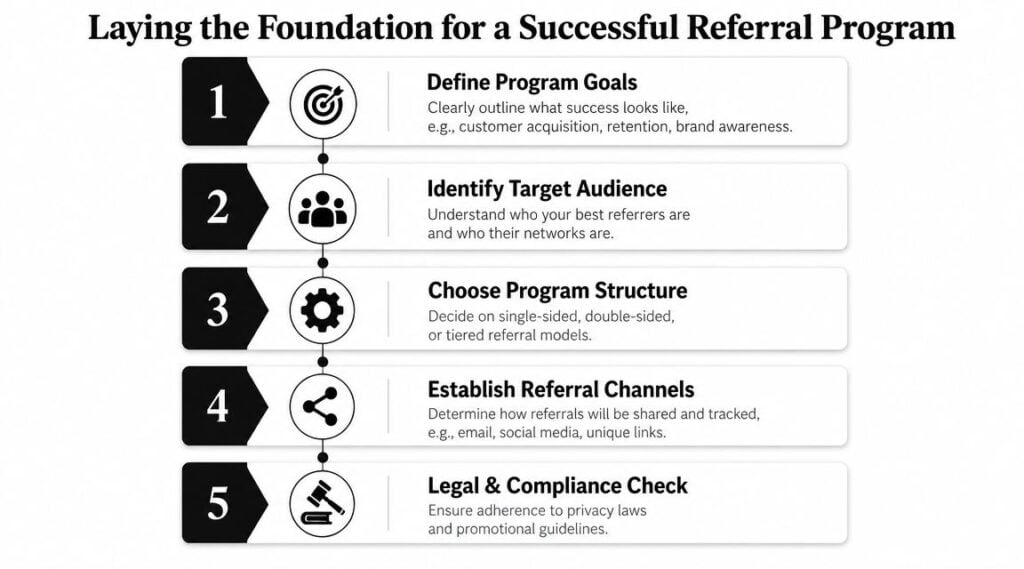
Start with one real goal
Set one primary goal first. Not five.
Use a simple S.M.A.R.T. filter. Make it specific, measurable, and tied to a timeline you can review. In membership referral programs, I usually see owners aiming at one of these:
- New member acquisition: You want more joins from a lower-friction channel than ads or affiliates.
- Higher-quality members: You care more about retention, engagement, and fit than raw signup count.
- Lower blended acquisition cost: You want referrals to take pressure off other channels.
- Renewal support: You want a program that strengthens member investment and community ties.
If your real goal is quality, don’t build the program like a race for invite volume. If your real goal is cash flow, don’t offer rewards with a long-delayed payback.
Know your economic guardrails
Before you choose rewards, write down three numbers from your own business:
- Average first payment
- Average gross margin on that payment
- Expected retention window for a healthy member
You don’t need a fancy finance model. You do need a rough sense of how much profit a new referred member creates, and when that profit arrives.
Practical rule: If you can’t estimate the marginal profit from a new member, you’re not ready to decide on a referral reward.
One of the best overlooked reminders here is simple. The reward has to stay below the marginal profit from the new member. If you skip that math, the program can feel successful while simultaneously losing money.
Pick your likely referrers before launch
A referral program does better when you target the first wave instead of opening it to everyone with no plan.
Start with members who have already shown signs of advocacy. That might include:
- Members who post wins: They’ve experienced value and can explain it clearly.
- Members active in the community: They’re invested, visible, and more likely to share.
- Members with peers in the same niche: They know people who resemble your ideal next member.
- Members who renewed or upgraded recently: Their timing is better than someone who just joined yesterday.
For a practical e-commerce angle on referral setup and offer structure, I like SmashPops’ Shopify referral insights. It’s useful because it pushes you to think through mechanics before you promote anything.
Decide what counts as a successful referral
This sounds obvious, but people skip it all the time.
Is the referral “successful” when someone clicks, starts a trial, becomes a paid member, stays past the first billing cycle, or renews? Your answer changes how you track rewards and how much risk you take on.
A membership owner with churn issues shouldn’t reward too early. A business with long sales friction may need an earlier milestone. There isn’t one universal rule. There is a right rule for your economics.
Designing Incentives That Actually Work
The reward is where overcorrection often happens.
They either offer something so weak that nobody cares, or they offer something so generous that every referred member becomes a margin problem. Good incentive design sits in the middle. It feels attractive to the member and sane on your P&L.
Why double-sided rewards keep winning
A lot of referral programs now reward both people involved. According to Impact’s referral marketing statistics roundup, 78% of consumer referral programs are double-sided. That makes sense for memberships, where trust and reciprocity matter.
If the member gets a perk and their friend gets a welcome benefit, the ask feels easier. You’re not asking someone to promote you for your benefit alone. You’re giving them a reason to help a friend make a decision with less friction.
That said, double-sided doesn’t automatically mean better for every membership.
Choosing the right reward type
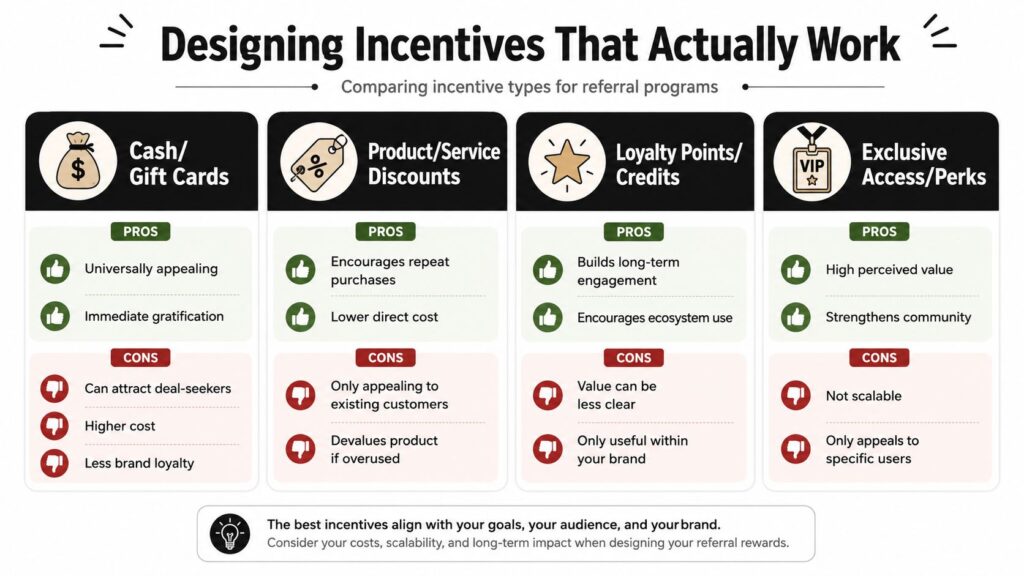
The reward has to fit your business model. Here’s how I think about the common options.
Account credit
This is my default for most memberships.
It keeps value inside your business, supports retention, and usually feels clean operationally. Members understand it fast. You also avoid the extra headache of cash payouts in the early stage.
Best when your members are already paying monthly or annually and would appreciate reduced future cost.
Cash or gift cards
Cash gets attention. It also changes the tone.
Use it carefully if your membership depends on shared values, participation, and identity. Cash can attract people who are good at gaming offers, not necessarily good at referring aligned members.
It can still work well if your audience is transactional by nature and your economics support it.
Free month or upgrade
This works well when your offer has obvious tier value.
A free month feels tangible. An upgrade can feel premium without creating the same direct cost as cash. It’s especially useful when you want to push current members deeper into the product.
Exclusive perks
These include bonus workshops, private office hours, early access, or status inside the community.
They can be strong in creator memberships because they feel special. The downside is operational complexity. If the perk creates manual work for you, it may not scale.
If you want a broad menu of ideas to spark your own offer design, Testimonial.to incentives is a handy reference point.
A lot of creators also pair referral rewards with an offer structure that already lowers entry friction. If you’re still deciding how members should first come in, this guide on free trials vs low entry fees for memberships is worth reading before you lock the referral incentive.
The math that keeps the program profitable
Here’s the simplest version.
Take the marginal profit you expect from a newly referred member over the period that matters to you. Then choose a reward that stays comfortably below that number.
Not right up against it. Comfortably below it.
Your rough thinking can look like this:
| Question | What you need to answer |
|---|---|
| What does a new member pay first? | The first collected payment after discounts |
| What portion of that is gross margin? | Revenue left after delivery costs |
| How long do solid members usually stay? | The period where referral payback matters |
| When do you reward? | Immediately after join, after first payment, or after a retention milestone |
A practical example without plugging in fake numbers: if your membership has thin margins and weak early retention, a big upfront reward is dangerous. If your membership has strong retention and low delivery cost, you have more room.
The best referral reward is rarely the most exciting one. It’s the one you can afford to keep offering for a long time.
What usually doesn’t work
I see the same mistakes over and over:
- Tiny rewards with big asks: Asking members to “share with three friends” for a minor perk usually dies on contact.
- Complicated tiers too early: Multi-step ladders sound smart but confuse people before you have baseline participation.
- Instant rewards before validation: If you reward on lead capture instead of qualified join, abuse goes up.
- Mismatch between brand and incentive: A premium learning community can cheapen itself with the wrong kind of reward.
Here’s a useful walkthrough to pair with your own incentive planning:

Start with one clean offer. Make it understandable in one sentence. Then earn the right to get fancier later.
Building the Referral Experience
The incentive gets attention. The experience gets action.
If members have to hunt for their link, copy awkward text, or wonder whether they’ll get credit, the program slows down immediately. Friction kills membership referral programs faster than weak promotion.

Give every member one obvious path
A good referral experience needs a home. That could be a member dashboard, billing area, or community sidebar. What matters is visibility and clarity.
The referral area should answer five questions right away:
- What do I get?
- What does my friend get?
- How do I share?
- When do rewards trigger?
- Where can I see my status?
That’s enough for many to decide whether to act.
Tracking matters just as much as design. Industry guidance recommends unique links or codes so each referral can be traced through invitation, click, purchase, and retention. That’s the practical reason Yotpo’s referral tracking guidance emphasizes unique codes and link-based attribution.
The copy should sound like a person, not a campaign
Most members won’t write referral messages from scratch. Give them swipe copy, but make it editable. Nobody wants to sound like they pasted a coupon blast into a private text.
Here are three simple templates.
Invitation email template
Subject: Thought you might like this
I’ve been part of [Membership Name] and thought of you because it’s been useful for [specific benefit].
If you want to check it out, here’s my link: [referral link]
If you join, you’ll get [friend benefit]. No pressure, but I think it could be a fit.
Short DM or social message
I’m in this membership for [audience type] and it’s been solid for [specific outcome]. If you want a look, here’s my link: [referral link]
Referred friend landing page headline
Join [Membership Name] through a member invitation and get [friend benefit]
Notice what’s missing. Hype. Long explanations. Weird urgency. Good referral copy sounds like one person helping another.
A lot of this overlaps with broader community design. If your membership still feels disconnected or passive, fix that first. This piece on forming a community is a good reminder that members share communities they identify with, not just communities they consume.
Add rules without making the program feel hostile
You do need guardrails.
Not because members are bad actors by default, but because unclear terms create disputes. Make the key rules visible near the referral dashboard and on the landing page.
A short rule set often covers enough:
- Reward timing: State when the reward is issued
- Eligibility: Clarify whether existing members can qualify as referred friends
- Self-referrals: Say they aren’t allowed if that’s your policy
- Refunds and cancellations: Explain what happens if the referred member churns immediately
- Manual review: Reserve the right to investigate suspicious activity
A clean rule page prevents more support headaches than an extra FAQ email ever will.
Launching and Promoting Your Program
A referral program doesn’t spread just because it exists. Members are busy. If the launch is quiet and the reminders disappear, participation drops off fast.
I usually prefer one of two rollout styles.
Soft launch or full launch
A soft launch works best when your setup is new, your automation is untested, or your audience gives a lot of feedback. Start with a small group of trusted members. Watch where they get confused. Fix the reward email, the landing page, the tracking logic, and the dashboard wording before you push it to everyone.
A full launch works when your systems are stable and your membership already responds well to announcements. This can create momentum because members see the program in multiple places at once.
If you’re unsure, soft launch first. Most problems in membership referral programs aren’t strategic. They’re operational.
What to promote after launch
You need recurring placement, not a single announcement.
Here are the touchpoints I like most:
- New member onboarding: Introduce the program after the member has had an early win, not on day one before they know the value.
- Member dashboard: Keep a persistent referral entry point where people already log in.
- Community posts: Mention the program during wins, launches, and milestone conversations.
- Email nudges: Send occasional reminders tied to real use cases, not random blasts.
- Success moments: Prompt members to refer right after they complete a course, renew, or post a testimonial.
If members only see the referral program during launch week, you don’t have a growth channel. You have an announcement.
Keep the economics in view while you promote. The reward should stay below the marginal profit from a new member. That sounds obvious, but it gets forgotten once launch excitement kicks in.
If you want to explain the program visually, short product videos can help members understand the flow faster than a long FAQ. For creative ideas on that side, you can explore AI video production and adapt the format to a member-facing walkthrough.
Measuring Success and Optimizing for Growth
A referral program can look healthy for months while losing money.
I’ve seen this happen more than once. Shares go up, invites go up, a few new members come in, and the dashboard creates a false sense of progress. Then you check 60-day retention, support volume, and reward costs. The program brought in members, but not profitable ones.
That’s why I measure referral programs like an acquisition channel tied to retention, not like a feel-good engagement feature.
Track the funnel, then connect it to margin
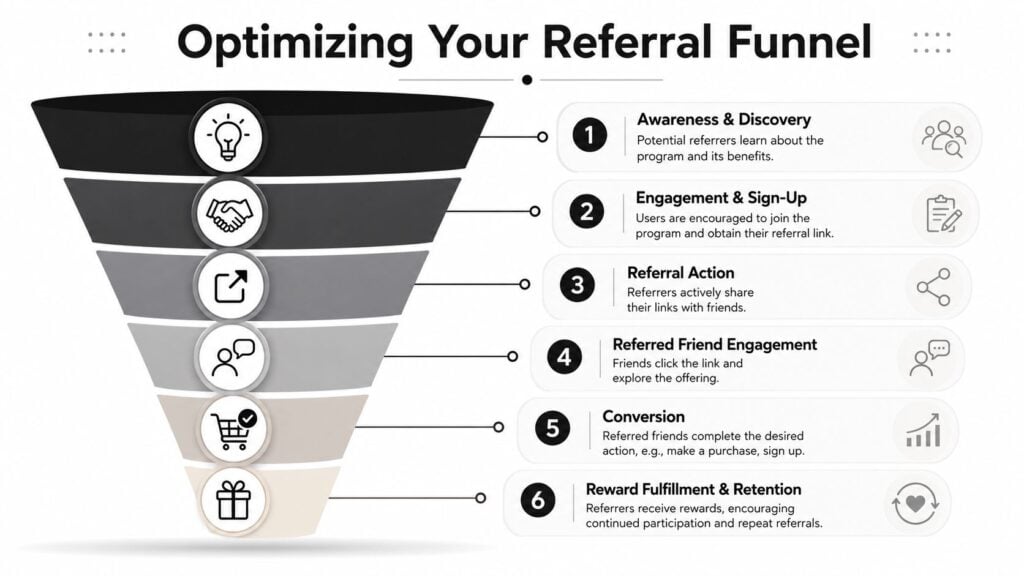
Start with the funnel. You need to know where referrals stall before you change incentives or rewrite copy.
A basic tracking stack should answer:
| Metric | What it tells you |
|---|---|
| Participation rate | How many members join the referral program |
| Share rate | How many participants send or post referrals |
| Referral conversion rate | How many referred visitors become members |
| Reward fulfillment rate | Whether rewards are being delivered cleanly and on time |
| Referred member retention | Whether referred members stay long enough to matter |
Those metrics are useful, but they are incomplete on their own. The key question is whether a referred member pays back the acquisition cost after reward expense, onboarding time, and churn risk.
Here’s the practical formula I use:
Referred member value = gross profit over the first meaningful retention window – reward cost – referral admin cost – added support cost
For some memberships, the right window is 30 days. For others, it is 90 days or the first renewal. Pick one window and stay consistent so your comparisons mean something.
Quality beats volume
Referral count is one of the easiest ways to fool yourself.
A smaller number of referred members who renew, participate, and fit your best customer profile will outperform a flood of low-intent signups. That is why I review referred-member behavior separately from the rest of the cohort. Do they complete onboarding? Do they show up in the community? Do they renew at the same rate as members from other channels?
Membership.io’s guidance on member referral programs points in the right direction here. The useful standard is fit, retention, and long-term value, not raw signup volume.
If referred members churn fast, the issue is rarely “we need more promotion.” Usually the problem sits in one of three places: the reward attracts bargain hunters, the messaging overpromises, or members are referring friends who like them but do not need the membership.
For the retention side after signup, this guide to membership site retention strategies is worth reading alongside your referral data.
Run small tests with clear pass-fail rules
Do not rebuild the whole program because one month looked soft. Change one variable at a time and define what improvement looks like before the test starts.
Good tests include:
- Reward wording: “Get a free month” versus “Earn account credit”
- Timing of the ask: After a member win versus inside a general newsletter
- Referral page headline: Outcome-focused versus community-focused framing
- Landing page simplicity: Short page versus page with FAQs and objections handled
- Prompt channel: Email, in-app message, or community post
Keep the test window long enough to include retention, not just clicks. A landing page version that lifts conversions but brings in weaker members can hurt profit even if the top of the funnel looks better.
I also read support tickets, chat transcripts, and member replies every time I review referral performance. Quantitative data shows where the drop happens. Member language usually tells you why. Comments like “I didn’t know if my friend qualified” or “I couldn’t find my link after logging in” are not minor complaints. They point to friction that lowers conversion and trust.
Membership referral programs produce the best results when you treat them like a unit-economics system. The winning version is not the one with the most shares. It is the one that brings in members who stay, contribute, and repay the reward cost with margin left over.