
Online Community Engagement Ideas
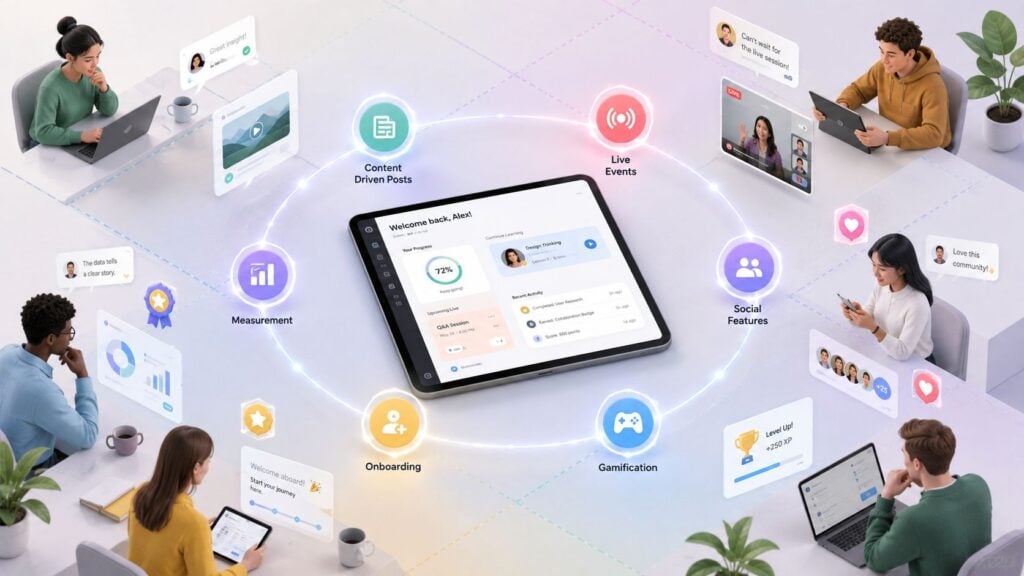
A quiet learning community usually looks busy on paper and empty in practice. Members join, watch a lesson, maybe download a resource, then disappear before they ask a question or meet anyone else. That’s the problem behind most online community engagement ideas, they need to give people a reason to act at the moment they feel stuck, curious, or recognized.
The strongest communities don’t rely on constant posting. They create timely prompts, repeated rituals, and a clear path from first login to deeper participation, which fits the old 90/9/1 pattern many practitioners still use as a planning baseline, where lurkers are the largest segment, a smaller group contributes occasionally, and a tiny group does most of the heavy lifting (Jisc community engagement ideas).
The ten ideas below follow the learner journey, from first interaction through collaboration, recognition, retention, and measurement. Start with one habit, define the behavior you want, and test whether it leads to more meaningful participation, not just more noise.
1. Live Q&A Sessions and Office Hours
Live Q&A works because learners don’t want more content when they’re confused, they want a fast path to clarity. A weekly or monthly office hour gives members a place to ask the question they’ve been sitting on for days, and that kind of direct access can do more for trust than another module ever will.

Make the session easy to join
The best version of this idea feels simple. Schedule two different times so members in different time zones can show up, send reminders 48 hours and 24 hours before the session, and keep the live window to 45 to 60 minutes so it stays focused. A pre-session form helps too, because it gives quieter members a low-pressure way to submit questions before the room fills up.
I’ve seen this work especially well in course communities where people need reassurance before they move to the next lesson. Circle.so communities often use weekly office hours, Kajabi creators run monthly Q&A sessions, and platforms that resemble MasterClass can pair live chat with on-demand lessons so learners don’t feel abandoned between sessions.
Practical rule: If a member has to hunt for the event link or guess what to ask, you’ve already lowered attendance.
Test it with one topic tied to a common pain point. If members show up, keep it. If they don’t, shorten the format, change the time, or ask for questions in advance before you judge the idea itself. For a promotion workflow, see the practical guidance on how to increase webinar attendance.
2. Discussion Boards and Forum Threads
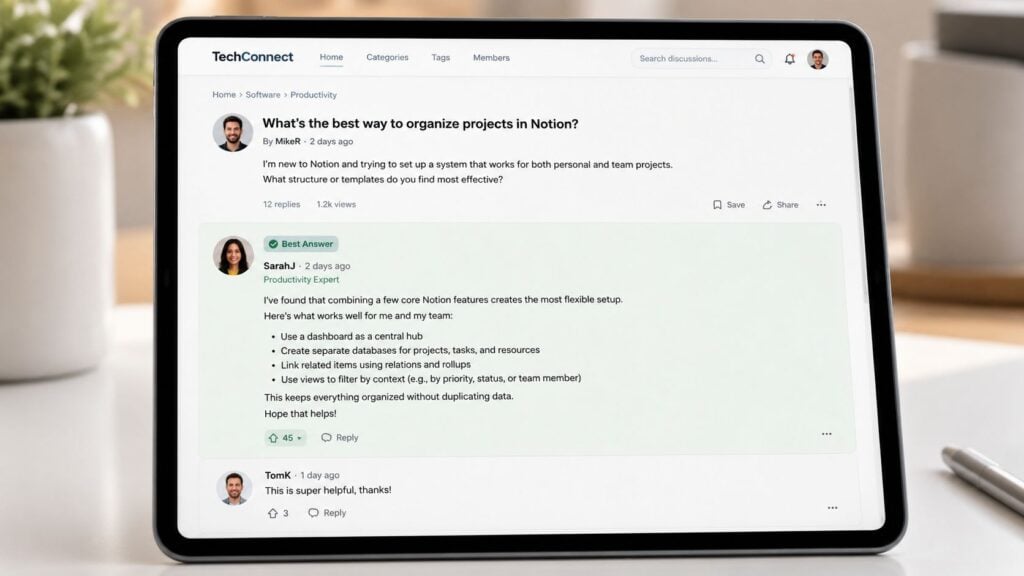
Forums still matter because they turn one person’s question into a searchable answer for the next twenty people. That’s a better long-term asset than a buried chat thread, especially for courses and memberships where the same problems keep coming back in slightly different forms.
Seed the first conversations
A dead forum usually isn’t a content problem, it’s a setup problem. Seed it with the exact questions members are likely to ask, split boards by topic so conversations don’t sprawl, and make sure an instructor or moderator replies to every first post in each category. Reddit’s education spaces, Mighty Networks cohorts, and Moodle-style LMS forums all benefit from that kind of early structure.
The most useful forums feel conversational and documented at the same time. New members can read old threads without feeling rushed, while experienced members can answer once and save themselves from repeating the same explanation in private messages later.
Public recognition helps here. When helpful members get called out by name, others notice that participation has value beyond the answer itself.
Try a small pilot with one board, one moderator, and five seed questions. If the board stays active for a few weeks, expand it slowly rather than opening five categories that nobody can keep warm. For a broader framework, the internal guide on community engagement best practices fits naturally alongside this approach.
3. User-Generated Content Challenges
Challenges work because they ask members to do something, not just react to someone else’s content. A design exercise, a writing sprint, or a project showcase pushes learners from passive consumption into visible work, which deepens retention and gives others something real to comment on.
Start small and make participation flexible
The strongest challenges begin with low stakes. A monthly prompt can ask members to share a draft, a screenshot, a short case study, or even a partial result, as long as the submission reflects the topic. That matters because many people won’t participate if they think their work needs to look polished enough for public praise.
Use clear examples and a simple rubric. Members should know what a strong submission looks like, what counts as participation, and whether voting or commenting also earns a place in the challenge. Design communities, writing groups, and fitness memberships all use this model well because the activity itself becomes the learning experience.
- Lower the entry bar: Ask for one artifact, not a full portfolio.
- Show examples: Members copy what they can see.
- Offer multiple roles: Let some people submit, others vote, and others leave feedback.
- Tie it to the curriculum: The challenge should feel like a useful extension of the lesson, not a random contest.
Start with a single themed challenge and watch how many members move from observers to contributors. If the response is thin, adjust the brief before assuming the audience isn’t interested. Often the issue is that the ask is too big, too vague, or too far from the lesson members just completed.
4. Exclusive Member Perks and Rewards Program
Perks work best when they reward behaviors that already help the community. Early access, resource drops, certification badges, and discounts can all make participation feel tangible, but only if members understand exactly what earns them access.
Keep the reward path visible
People don’t keep showing up for vague promises. They show up when the next step is clear, the reward feels reachable, and the value shows up soon enough to matter. That’s why a simple tier system usually beats a complicated pile of perks no one can remember.
Circle.so communities often use custom reward tiers and badges, Teachable instructors can watch engagement patterns in analytics, and Discord servers sometimes assign roles to active members. Each version works better when the rewards connect to visible behavior, like answering questions, attending sessions, or finishing a project milestone.
Rewards lose power when they feel like a hidden club. Make the path obvious, or members won’t bother walking it.
Rotate the perk menu every so often so the offer doesn’t go stale. A member who values recognition may want a badge, while another may care more about early access or a resource bundle, so let them choose when possible.
Run a short test with one or two perks before building a full program. If members respond, keep the structure lean and make the reward criteria public. If they ignore it, the issue might be the offer, not the audience.
5. Cohort-Based Learning Groups
A smaller cohort with clear pacing beats a large one that stalls for lack of structure. When members start together, check in together, and finish together, the course feels less like a library and more like a shared experience with a real social rhythm.
Use timing as part of the product
This model works especially well for learning that depends on discussion, accountability, or group problem-solving. Maven, Alt programs, and Reforge all use synchronized starts or fixed schedules to help members feel like they are part of a live class instead of a self-paced archive. For a practical breakdown of setup, see this guide to structuring a cohort-based course.
The trade-off is simple. A peer partner or small group helps people keep momentum, and a weekly check-in gives instructors a chance to spot who is slipping before they disappear. In many learning communities, that support makes the difference between completion and dropout.
A cohort does not need to be large to feel active. It needs enough people to create momentum and enough structure to keep them moving.
Keep the group size reasonable, add social time that is not tied to coursework, and reach out to anyone who falls behind before they assume they have missed their chance. That kind of intervention often matters more than perfect curriculum design.
Test one cohort with a fixed start date and a small peer grouping rule. If the room feels too quiet, the timing may be off. If it feels crowded, reduce the number of people and tighten the schedule.
6. Monthly Newsletters or Community Updates
A good newsletter keeps members connected even when they aren’t logging in every week. It acts like a shared memory for the community, a place to summarize what changed, who contributed, and what’s worth paying attention to next.
Use the inbox as a re-entry point
The inbox is often where inactive members come back to life. A concise update can highlight a strong discussion, a member win, a new resource, and one clear action they can take next. Circle.so communities, Substack-based learning groups, and Mighty Networks digests all lean on this idea because it reaches people where they already are.
Timing matters here. Send it on a consistent day and time so members learn to expect it, and lead with the most interesting or surprising moment, not the housekeeping. One clear call-to-action is enough, because too many competing asks usually reduce response.
If you feature member stories prominently, the newsletter becomes a recognition channel as well as a retention tool. People read about peers, see themselves in the community, and get a reminder that their own contribution could be next.
Try a short monthly version first. Track whether readers return to the platform after the send, then decide whether weekly is worth the extra work. Consistency beats volume in most community programs.
7. Expert Interviews and Guest Sessions
Guest sessions add energy because they bring in someone the community already wants to hear from. A strong interview can spark new questions, validate the value of the community, and give members a reason to attend live instead of waiting for a replay.
Choose guests who fit the audience level
The best guests aren’t just known, they’re relevant. Skillshare often brings in guest creators, Indie Hackers hosts founder interviews, and LinkedIn Learning features industry experts in specialized courses because those voices feel connected to the topic at hand. If the guest can’t speak at the right level for your audience, the session may sound impressive but still miss the point.
Briefing docs help a lot. Send the guest context on the audience, the likely knowledge gap, and the questions members have already submitted. Promote the session at least 2 to 3 weeks in advance so attendance isn’t left to chance.
A short guest talk can also become reusable content. One live session can seed a discussion thread, a newsletter summary, and a resource page, as long as you capture the material well.
Test the format with one expert who already has some credibility in your niche. If the audience responds, build a small guest calendar around topics that naturally match member needs.
8. Community Slack or Discord Channels
Real-time chat gives members a place to ask quick questions and talk like humans instead of submitting polished forum posts. That looseness matters for relationship building, especially in communities where people want some informal contact around the formal course structure.
Set the tone early
Slack and Discord work when the room feels usable, not chaotic. Clear channel guidelines, active moderation in the beginning, pinned resources, and regular instructor check-ins all help the space settle into a rhythm. Professional communities often use Slack for coordination, while course communities lean on Discord for cohort discussion because the pace feels more natural for live back-and-forth.
A quiet channel and a general channel solve different problems. One supports focus, the other supports casual conversation, and forcing every member into the same energy level usually creates drop-off.
When the space works, members answer one another before staff ever has to step in. That’s a strong signal that the community is starting to carry its own weight.
Start with a few channels, not a maze of categories. If activity stays manageable, add more only where members clearly need them.
9. Member Spotlight Features and Success Stories
Spotlights give members proof that participation leads somewhere. A strong feature makes people feel seen, while also showing newer members what progress can look like in a real community.

Recognize different kinds of wins
Don’t reserve spotlights for the biggest names. Highlight business growth, creative work, skill development, and career transitions so members can see themselves in the feature. Circle.so communities, Skillshare blogs, and creator communities often use this kind of recognition because it makes the community feel more human and more believable.
A simple nomination form helps members suggest one another without requiring staff to guess who deserves attention. Repurposing the story across email, social media, and the website also extends the value of the feature without creating new content from scratch.
Members pay attention when recognition feels earned and specific. Generic praise fades fast, but a real story sticks.
Start with one spotlight a month and keep the format short. The goal is to create visible momentum, not to turn every win into a long editorial project.
10. Collaborative Projects and Group Learning Activities
Group projects turn engagement into shared work. Members stop talking about ideas in the abstract and start solving something together, which is where a lot of the best learning happens.
Make the project structured enough to finish
Collaboration breaks down when the assignment is loose or the group is random. Match members intentionally, give them templates and tools, check in weekly, and let them present the final work to the broader community. Reforge-style strategy projects, product management mock builds, and writing anthologies all benefit from this structure because it gives the work a clear edge and a public finish line.
The output doesn’t need to be huge. A case study, a prototype, a lesson plan, or a group critique can be enough if it asks members to work together and think. What matters is that the task creates interdependence and a sense of shared mission.
Collaboration gets easier when people know what “done” looks like before they start.
Test one project with one small group before expanding it to the full community. If members like the format but struggle to coordinate, tighten the scope and add more templates. If the project works, it becomes one of the strongest retention tools in the whole community.
Comparison of 10 Online Community Engagement Ideas
| Item | Implementation complexity | Ideal use cases | Key advantages |
|---|---|---|---|
| Live Q&A Sessions and Office Hours | Medium, scheduling, streaming setup | Courses needing real-time support, launches | Real-time feedback and personal connection |
| Discussion Boards and Forum Threads | Low–Medium, platform + structure | Evergreen courses, global audiences, reference needs | Scalable peer-to-peer help and long-term archive |
| User-Generated Content Challenges | Medium, prompt design and judging | Creative courses, portfolio-building communities | Generates real work and social proof |
| Exclusive Member Perks and Rewards Program | Medium–High, tracking and tier design | Subscription memberships, long-term communities | Gamified incentives that boost loyalty |
| Cohort-Based Learning Groups | High, coordination and facilitation | Intensive skill programs, premium courses | Accountability and deeper peer learning |
| Monthly Newsletters or Community Updates | Low, content curation and schedule | Broad communities, low-login members | Direct reach to members and consistent touchpoints |
| Expert Interviews and Guest Sessions | Medium, booking and prep | Thought leadership, marketing-focused events | Fresh perspectives and authority by association |
| Community Slack or Discord Channels | Low–Medium, channel organization | Active communities, cohort support, quick Q&A | Real-time interaction and organic relationship building |
| Member Spotlight Features and Success Stories | Low–Medium, interview and production | Culture-building, marketing, retention efforts | Celebrates members and inspires others |
| Collaborative Projects and Group Learning Activities | High, project design and oversight | Applied learning, cohort programs, career-focused courses | Produces tangible outcomes and strong collaboration |
Build the Engagement Loop
The easiest way to start is to pair one low-friction habit with one deeper experience. A discussion prompt or newsletter can keep the room warm, then a live session or cohort project can give members a reason to invest more attention when they’re ready. That combination usually beats trying to launch five tactics at once and hoping something sticks.
Define the target behavior before you choose the tactic. Maybe you want first-time replies, repeat visits, attendance, completion, or stronger retention signals. Assign one owner, set a simple schedule, and give the test enough time to produce a real pattern, then review what changed without pretending every metric tells the same story.
The best communities also pay attention to timing. The 2025 benchmark data from Higher Logic found average monthly activity patterns that included 563 unique logins, 1,156 total logins, 68 contributors, and 163 discussion actions, along with clear seasonal swings that peaked in October and January and dipped in August and December (Higher Logic community benchmarks). That doesn’t mean every community should chase those same numbers, but it does show that engagement rises and falls in cycles, so your schedule matters.
You’ll get more value from a few repeatable rituals than from a long list of one-off experiments. That’s also why benchmark frameworks like the Community Roundtable’s 2% to 12% engagement range, plus activity, value, and reach, are useful for managers who want to measure more than vanity activity (Community Roundtable benchmarks). If you need a platform that supports that kind of repeatable workflow, LearnStream is a useful place to explore community practices, engagement ideas, and digital learning operations for educators, entrepreneurs, and instructional designers.
If you want a next step, choose one idea from this list, launch a small test this month, and document the result. Then read more about platforms that boost customer loyalty, compare your current setup, and decide whether your community needs better prompts, stronger recognition, or a more connected learning flow.