How to Find Niche Markets for Your Next Course

You’ve spent weeks outlining lessons, recording modules, and polishing your sales page. The topic matters to you, and the course looks solid. Then launch day arrives, and almost nobody buys.
I’ve made that mistake more than once. The problem usually wasn’t the camera, curriculum, or landing page. I had chosen a topic because I liked it, then assumed an audience would appear later. That assumption is expensive.
To find niche markets for a course, you need a repeatable process. Start with adjacency thinking, research the people behind the idea, size the opportunity, test willingness to pay, and score the evidence before writing a single lesson.
Why Most Course Creators Pick the Wrong Niche
A common failure pattern looks harmless at first. A creator notices a subject they understand, sees a few popular posts about it, and decides to build a complete course. The topic feels promising because the creator has knowledge and enthusiasm.
Months later, the course launches to a quiet email list and a handful of polite replies.
Interest from the creator isn’t the same as demand from buyers. A broad subject can attract attention without creating a clear reason to purchase. “Productivity for professionals” sounds useful, but it doesn’t tell you which professionals, what recurring problem they face, or what result they’d pay to achieve.
Personal expertise needs a market filter
Your experience still matters. It helps you teach with credibility, create better examples, and understand the learner’s context. It just shouldn’t be the only filter.
The stronger question is:
Which group has a repeated problem that I can solve through a focused learning experience?
That question changes the research. Instead of asking whether people like a topic, you look for the work they already struggle to complete. You examine the tools they use, the workarounds they’ve built, the advice they repeatedly request, and the mistakes that cost them time or money.
I once considered building a course for freelance creators who wanted to “grow online.” The audience sounded large, but the offer was impossible to position. A better direction emerged after narrowing the problem to a specific workflow, turning scattered content into a repeatable lead-generation system for one type of creator. The second idea had fewer possible buyers, but the message was far easier to understand.
Inspiration is a starting point, not proof
Market segmentation has been used long before online courses existed. Wendell R. Smith introduced the formal marketing term in 1956, while marketers had already used segmentation practices in the 1920s and earlier classification efforts appeared between 1902 and 1910. Psychographic and lifestyle-based segmentation expanded by the 1930s, showing that specialized markets developed from available data and distribution constraints, not from internet branding alone (the history of market segmentation).
For a course creator, the lesson is practical. A niche becomes more credible when you can describe the learner, their situation, their desired benefit, and their buying behavior with precision.
Use this playbook before you build:
- Generate through adjacencies: Look inside existing markets for workflow, compliance, integration, and role-specific gaps.
- Research real people: Interview a targeted group and compare their answers with search, pricing, and community evidence.
- Size the business: Separate the total market from the portion you can reach and capture.
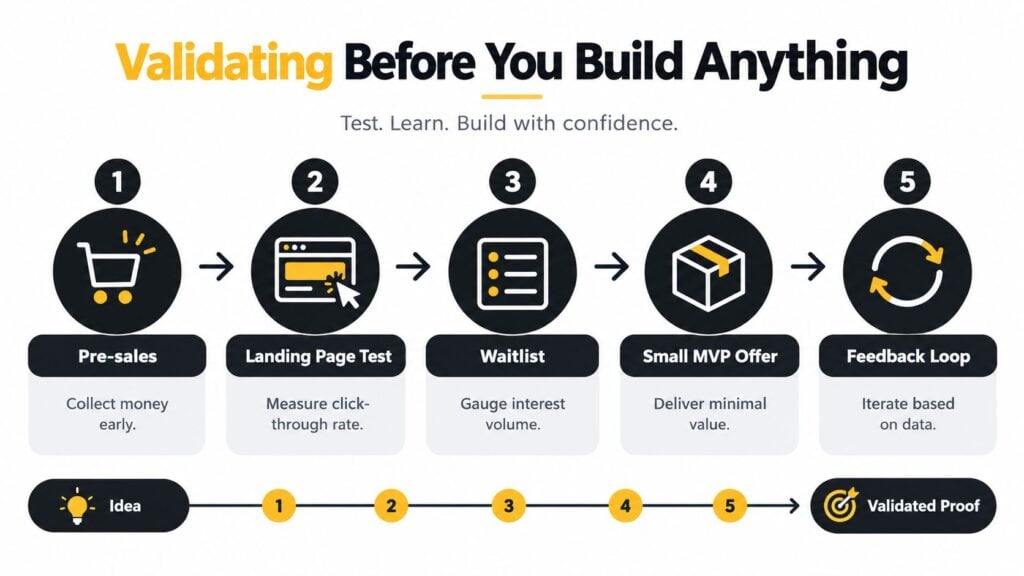
- Validate the offer: Use pre-sales, landing pages, waitlists, or a small paid version before producing the full curriculum.
- Score the opportunity: Make the decision based on evidence instead of attachment to an idea.
Your course can still begin with a subject you love. The subject needs to pass a market test before it becomes a business plan.
If you’re still shaping the broader education business around your idea, this guide to starting an online school can help you think through the operating model as well as the course topic.
What Actually Counts as a Niche Market
A niche market is a defined group of prospective buyers who share needs and are likely to respond in a similar way to a particular offer. That definition is more useful than calling any small audience a niche.
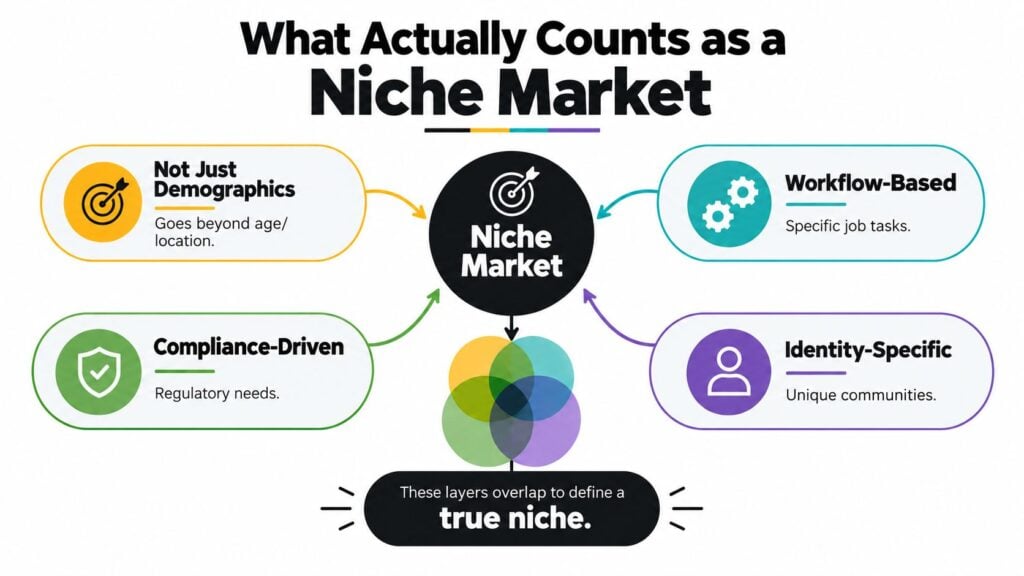
Age alone doesn’t create a strong niche. Neither does location, job title, or an interesting identity. A workable segment combines traits that affect the problem, the desired outcome, and the buying decision. Relevant filters can include age, income, lifestyle, benefits sought, and usage rate, alongside factors such as role, industry, tools, and level of experience (academic discussion of market segmentation).
Combine filters until the problem becomes visible
Start with a broad audience, then add filters that change what people need.
“Small business owners” is too broad for a course. Those owners work in different industries, use different tools, and face different constraints. “Independent consultants who sell high-value services, rely on referrals, and need a repeatable way to turn discovery calls into proposals” is much more actionable.
The second description gives you several research paths:
- Role: Independent consultants.
- Commercial context: High-value services.
- Current behavior: They already depend on referrals.
- Pain point: Their sales process lacks consistency.
- Potential learning outcome: A repeatable discovery-to-proposal workflow.
The filters don’t need to be demographic. Usage rate can be more useful than age. A course for heavy users of a particular platform may be stronger than a course aimed at everyone who has heard of it. Benefits sought can also separate buyers who want speed from those who want compliance, career advancement, or lower risk.
Apply the one-sentence niche test
Try completing this sentence:
I help [specific group] solve [recurring problem] so they can achieve [valuable outcome], and I can reach them in [specific communities or channels].
If you can’t describe the group, struggle, and gathering places in one sentence, the niche is still vague.
A useful niche might be: “I help instructional designers at small software companies build accessible onboarding courses that meet internal compliance requirements, and I reach them through professional communities, software forums, and specialist newsletters.”
That sentence gives you a learner profile and a course direction. It also reveals what to investigate. You can ask which accessibility requirements create friction, what software they use, who approves the training, and whether they already pay for outside help.
A weak niche would be “people who want better online learning.” It describes a broad interest rather than a shared commercial problem.
The strongest niche descriptions usually have overlapping layers. A role may have a specific workflow. That workflow may be shaped by regulations or an integration limitation. Those constraints create a sharper opportunity than a generic audience label.
Generating Niche Ideas Through Adjacencies
Generic brainstorming asks, “What course could I create?” Adjacency thinking asks, “Where does an existing market contain a problem that current education doesn’t package well?”
That shift creates better ideas because you aren’t starting with an empty page. You begin with a market that already has language, tools, communities, and complaints. Then you look for a narrow opening.
Vertical adjacencies
A vertical adjacency serves one industry inside a broad subject.
A general course on customer research could become customer research for independent healthcare practices, boutique accounting firms, or specialist manufacturing suppliers. The research principles may overlap, but the examples, vocabulary, regulations, and buying triggers change by industry.
The advantage is relevance. A learner is more likely to recognize their own situation in a course that uses familiar software, documents, and decisions.
The trade-off is that your market becomes narrower and your research must become deeper. You can’t rely on generic examples and expect the audience to connect the dots for you.
Use-case adjacencies
A use-case adjacency focuses on one job rather than a whole profession.
Instead of teaching “AI for marketers,” you could teach a specific team how to use AI to maintain product documentation, classify customer feedback, or prepare campaign briefs. The course becomes easier to evaluate because the buyer can picture the task they’ll complete.
This is especially useful for membership products. Members may return for templates, workflow updates, tool comparisons, and troubleshooting tied to one recurring job.
Audience adjacencies
An audience adjacency serves one role inside an existing customer group.
A broad market may include founders, managers, operators, assistants, and consultants. Each role has different authority, time constraints, and reasons to buy. A course for operations managers who need to connect several tools will feel different from one for founders who want a high-level implementation plan.
Specialization and AI-enabled workflows are creating new openings in this area. Recent niche trend coverage points toward agentic AI, precision medicine, circular-economy platforms, and specialized education as examples of markets where technical or operational pain can create focused opportunities (recent underserved niche-market discussion.)
I wouldn’t chase these labels by themselves. Instead, I’d investigate the work inside them.
Practical rule: Start with a market you understand, then list the painful jobs, missing integrations, compliance constraints, and repeated complaints inside it.
Write down the software people use. Read negative reviews. Search questions in Reddit, Quora, Amazon, and specialist forums. Look for the same complaint expressed by different people. A course opportunity often appears where a workflow is important enough to cause frustration but too specific for broad education companies to address.
You can also use a tool such as Trendlytic niche research tool to organize early niche ideas and explore market patterns. Treat the output as a discovery aid, not proof of willingness to pay.

My favorite exercise takes one market and creates three columns:
- Painful work: Tasks people repeat, delay, or complete badly.
- Tool gaps: Places where software doesn’t connect or users rely on manual workarounds.
- Constraints: Regulations, approval processes, budgets, or role boundaries that shape the solution.
Then I turn recurring items into course hypotheses. “Training for accountants” is a category. “A workflow course for small accounting teams that need to automate client onboarding without breaking document-control requirements” is a testable niche.
That kind of idea has a better chance of surviving beyond a short-lived consumer trend because it connects to work people must keep doing.
Researching Your Audience Without Guessing
Once you have a candidate niche, stop brainstorming and find the people behind it. A practical discovery sample starts with about 50 people, followed by interviews with 10 to 15 of them about unmet needs, workflows, and purchase triggers (niche research interview methodology).
The sample doesn’t need to come from one place. Search LinkedIn groups, professional communities, Reddit discussions, customer forums, event attendee lists, and the comment sections of specialist creators. Ask people who actively perform the work, not only people who say the subject sounds interesting.
Ask about behavior, not opinions
Avoid questions such as, “Would you buy a course about this?” People are generous with hypothetical approval. Their current behavior tells you more.
Ask:
- What part of this task takes the most time?
- What have you tried already?
- Which tools do you pay for?
- Where does the workflow break?
- What workaround have you built?
- What happens if the problem stays unresolved?
- Who approves spending on a solution?
- What would make you change your current approach?
Listen for specific language. If several people describe the same workaround, delay, or costly error, you may have a segment hypothesis. Capture their exact terminology because it can improve your landing-page copy and keyword research.
Don’t sell during the first conversation. Your job is to understand the job, the context, and the trigger that makes the problem urgent.
Pair interviews with market signals
Interviews can mislead you when you only speak with enthusiastic early adopters. After the conversations, check whether the problem appears outside your interview group.
Look at:
- Search terms and related questions.
- Competitor course prices and promises.
- Marketplace listings and review complaints.
- Reddit threads and specialist forum discussions.
- Repeated feature requests in software communities.
- The tools people already use to solve part of the problem.
Keyword research helps you understand language and discoverability. Competitor analysis shows whether people already spend money in the category. Reviews reveal where existing products disappoint buyers.
You can also examine long-run purchasing behavior rather than relying on one viral post or a temporary spike. A University of Chicago Booth analysis used Nielsen Homescan data covering 2004 to 2016, about 170,000 U.S. households, nearly 700 million individual transactions, and 118 product groups to study demand for niche products (University of Chicago Booth analysis of niche-product demand). That kind of repeated-purchase dataset illustrates why durable demand is easier to trust than a single burst of attention.
Interview enthusiasm is a lead. Repeated behavior, existing spend, and a clear buying trigger are stronger evidence.
I treat an idea as unproven when interviewees praise it but can’t name a current workaround, budget, search phrase, or decision-maker. Build an audience asset while researching, such as a focused email list, and use this guide to building an email list to support that process. Emails and replies won’t prove sales on their own, but they give you a better group for testing the offer.
Sizing the Opportunity With TAM, SAM, and SOM
A niche can be sharply defined and still fail to support the business you want. TAM, SAM, and SOM give you a practical way to separate theoretical demand from reachable revenue.
- TAM: The total market opportunity if every possible buyer could purchase.
- SAM: The portion that fits your geography, offer, channel, language, and capabilities.
- SOM: The share you can plausibly capture in the near term.
Course creators often stop at TAM because a large audience feels reassuring. SAM and SOM force harder questions. Can you reach these people? Can they afford the offer? Can you earn trust against existing alternatives? Can your delivery model serve them without creating a second full-time job?
A niche research example makes pricing economics clear. A niche with a $500 average order value needs about 2,000 customers to produce the same revenue that a $20 average order value niche needs 50,000 customers to generate (niche market sizing and pricing example).
Price changes the customer requirement
A high-ticket cohort course may work with a smaller reachable audience if the outcome is valuable and the buyer has spending authority. A low-priced self-paced course needs more buyers, stronger distribution, or a broader segment.
Memberships add another layer. A monthly offer may start with a lower entry price, but you need retention and continued usefulness. A one-time course can be easier to forecast, while a membership can support recurring revenue if the problem returns regularly.
Use this table as a planning reference, not as a forecast:
| Pricing Model | Average Value | Customers Needed |
|---|---|---|
| Premium course | $500 | 2,000 |
| Low-priced course | $20 | 50,000 |
The figures represent the same $1M revenue goal, and the underlying example comes from the sizing guide linked above. They don’t account for refunds, payment costs, taxes, delivery expenses, or the difference between bookings and collected revenue.
Build the model before the curriculum
Write down your revenue target, expected offer price, and required customer count. Then estimate the reachable audience inside your chosen channels. If your SOM assumption depends on reaching people you can’t identify or contact, the model isn’t ready.
Search volume and keyword competition can help you assess discoverability. Google Trends can show whether interest persists, while tools such as SEMrush can help compare keyword demand and competition. These signals don’t replace conversations or sales tests, but they help you reject ideas that have no visible path to discovery.
For broader context on the education market and business models, you can also review this guide to e-learning market size. Keep the central decision simple. Choose an offer price and customer count that your reachable niche can support before you commit to months of production.
Validating Before You Build Anything
Validation should create evidence before it creates a curriculum. A polished course can hide a weak offer because production quality makes the idea feel more real than it is.
Use small experiments that measure different parts of the buying process.
Match the test to the question
A landing page test measures whether the message attracts attention from the right audience. The page should name the segment, problem, outcome, format, and next step. Don’t judge it by visitors alone. Look at whether qualified people request more information or join the waitlist.
A waitlist measures interest and gives you permission to continue the conversation. Ask a useful qualifying question on the form, such as the person’s role, current workflow, or biggest obstacle. A large list with no context may be less valuable than a smaller list of people who describe the problem clearly.
A pre-sale measures willingness to pay. It is the strongest early test because the buyer accepts a real exchange rather than offering encouragement. Explain what they’ll receive, when it will be delivered, and what happens if the first version changes.
A small MVP offer lets you teach a narrow result before producing the complete experience. This could be a live workshop, office-hours package, short sprint, or limited cohort. You’ll learn which parts create progress and which parts only looked important in your outline.
Green light: People from the defined segment take a meaningful action, describe the same pain, and accept the proposed price or commitment.
A useful validation process combines demand signals, competitor density, and willingness to buy. If search interest exists but buyers don’t respond to a specific offer, the problem may be weak, poorly framed, or aimed at the wrong segment. If people buy but acquisition depends on one personal contact, your channel risk remains high.
Separate durable demand from a noisy response
Don’t let a vocal minority determine the business. Compare interview findings with search behavior, competitor offers, marketplace activity, and repeated complaints. A niche becomes more credible when several independent signals point toward the same job.
Structured segmentation also matters before testing. Define the learner through demographics, psychographics, firmographics, role, usage pattern, or another relevant combination. Otherwise, your test can attract a mixed audience whose needs don’t match the curriculum.
I prefer to run one focused experiment at a time. Change the audience, promise, price, or format only when you know what the previous test measured. If people click but don’t join, the page may need work. If they join but won’t pay, the offer or problem may not carry enough urgency. If they pay and participate, you have a reason to build the next layer.
Watch the video below for another visual explanation of the validation process.
The expensive mistake is skipping these tests because the audience feels interesting. You don’t need perfect certainty before starting. You do need enough evidence to avoid discovering basic demand problems after recording every lesson.
Your Niche Scoring Checklist and Next Steps
A scoring checklist turns an emotional decision into a comparison. Give each candidate niche a score from zero to five for every criterion, where zero means no evidence and five means strong evidence. Use the same standard for every idea.
- Clearly defined segment: Can you name the role, situation, need, and gathering places?
- Recurring pain: Do interviews, reviews, and community posts reveal the same problem?
- Willingness to pay: Has someone paid, pre-ordered, or taken a meaningful buying step?
- Accessible audience: Can you reach the segment through identifiable communities, search, partnerships, or email?
- Revenue fit: Does your TAM, SAM, and SOM model clear the customer count your offer requires?
- Distinctive angle: Do you have a workflow, industry, compliance, integration, or role-specific perspective?
A candidate can score well on pain and still fail on reach. An underserved group isn’t automatically a viable market if members are scattered, have no spending authority, or use channels you can’t access. Likewise, a crowded category can still contain a strong problem-specific submarket if your angle is concrete.
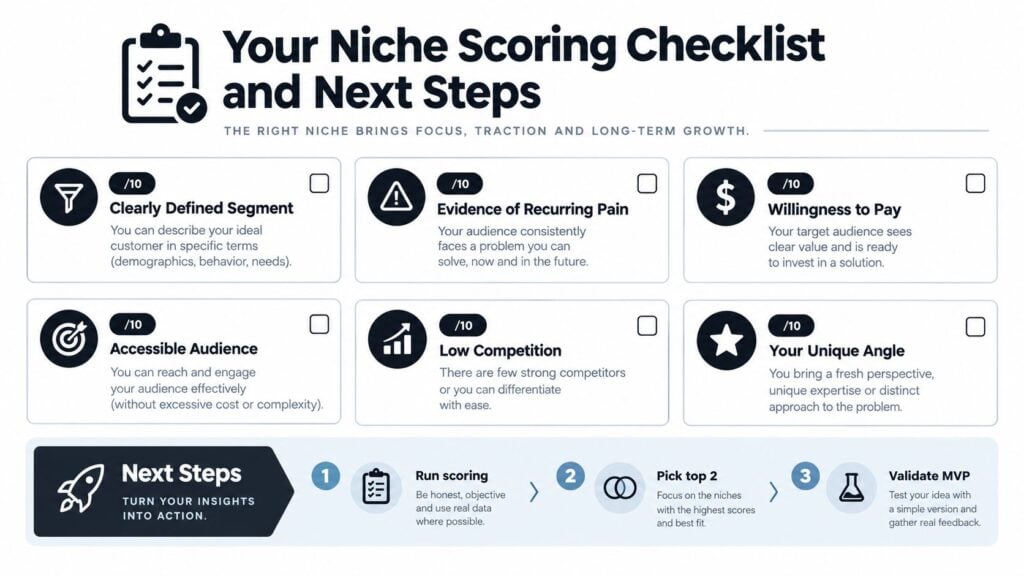
I’d move forward when the total reflects clear evidence across the categories, not when one exciting interview carries the idea. If a niche has weak payment evidence, run a pre-sale. If the audience is unclear, return to interviews. If the revenue model fails, change the offer or reject the idea.
Pick one adjacency this week. Find the people, study the workflow, test the message, and score the evidence before you write a lesson. That small research habit will save you from building another course that nobody asked to buy.
Choose one narrow market today and create a simple research sheet with the segment, recurring problem, current workaround, reachable channels, competing offers, and validation action. Interview your first prospects, invite them to a focused waitlist, and use their responses to decide whether your next course deserves to be built.