
Benefits of Microlearning That Actually Move the Needle
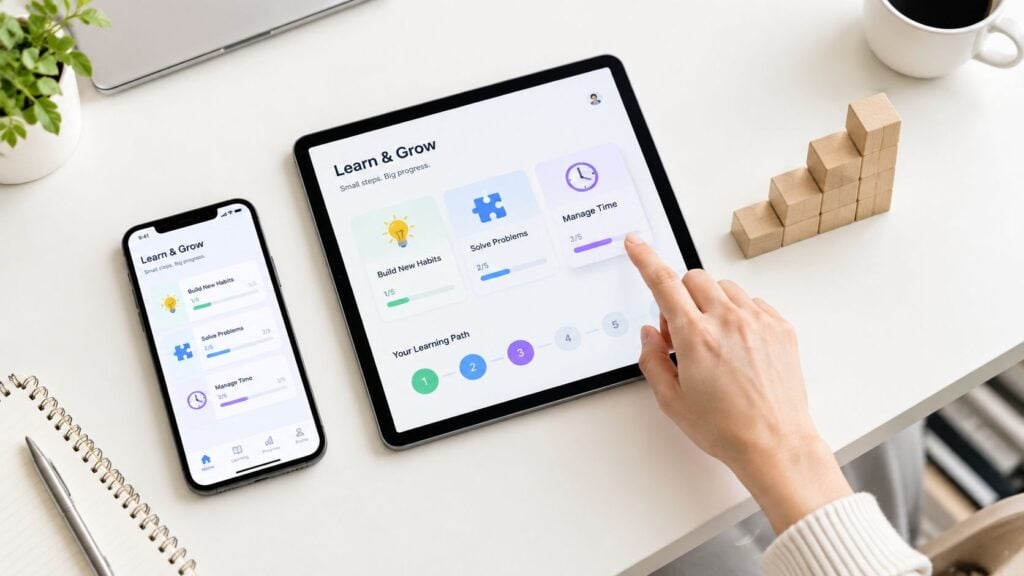
You’ve blocked out an hour for training, opened the first video, and then watched the clock more than the lesson. A meeting starts, a message arrives, and the forty-minute course remains half-finished in another browser tab. The next day, you remember the general topic, but not the steps you were supposed to use.
A different experience happens when a learner fits a focused lesson between meetings, completes it, answers a short question, and recalls the main idea the following day. That’s where the benefits of microlearning become practical. The format can reduce friction, support recall, and make learning easier to continue, but only when the short lesson has a clear job inside a larger learning path.
Why Microlearning Feels Different the First Time You Try It
I first noticed the difference while watching a learner work through a short training activity during an already crowded day. She had a few minutes before her next meeting, opened a lesson on her phone, completed a small scenario, and moved on without needing a large block of uninterrupted time.
The useful part wasn’t just that she finished. The next day, she could explain the decision the scenario had tested and apply the same reasoning to a new example. A longer course might have contained more background, but it would also have demanded more concentration at the exact moment she had the least available.
That contrast explains why microlearning feels different. A long-form course asks learners to protect a substantial period of time before they can make progress. A microlearning lesson gives them a defined starting point and a clear stopping point.
Shorter does not automatically mean better
Microlearning usually works as a focused learning unit, built around one concept, one skill, or one question. The lesson might use a short video, a card-based activity, a scenario, a quiz, or a brief exercise. The format is commonly associated with lessons lasting 5 to 15 minutes, as described in a review of microlearning interventions published by the International Journal of Educational Psychology.
That time range is useful because it creates a design constraint. You can’t squeeze an entire subject into a few minutes and expect learners to build deep understanding. You can, however, isolate a decision, demonstrate a procedure, test a misconception, or prompt a retrieval attempt.
The rest of the value comes from what happens around the lesson. Microlearning performs best when learners return to important ideas, practice them, receive feedback, and connect each unit to the next. Without those supports, a collection of short videos can become a content library that feels convenient but produces little lasting change.
Practical rule: Treat every microlearning lesson as one move in a learning path, not as a miniature course.
What Microlearning Actually Is and Why It Works
Microlearning is a short, focused learning experience designed to answer one well-defined need. A useful unit might teach a single software action, explain one policy decision, demonstrate one communication technique, or ask learners to solve one realistic problem.
The lesson can appear in an LMS, on a mobile device, inside an email sequence, or through a web platform. Delivery matters less than focus. If one lesson tries to explain a concept, introduce several exceptions, demonstrate a process, and assess unrelated knowledge, it has stopped functioning as effective microlearning.
The design logic behind the format
The 5 to 15 minute range gives creators a practical boundary, but the test is whether learners can complete the lesson with one clear outcome in mind. A short video with dense slides can overload attention just as easily as a long lecture. A well-designed activity may take longer than a video and still feel manageable because the learner knows exactly what to notice and do.
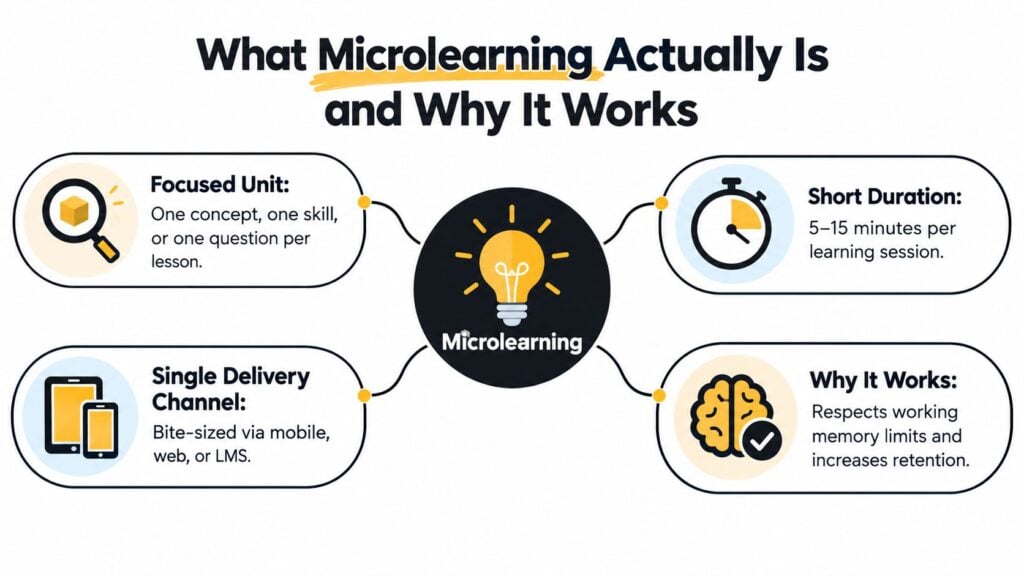
Working memory has limited capacity for new information. Learners need to select what matters, connect it to something they already know, and use it before the material fades. Microlearning helps by reducing the number of competing ideas presented at once.
Memory also weakens when learners encounter information once and never revisit it. A 2019 study on mobile microlearning explains that reintroducing content in smaller increments can support extended retention and reduce the effect of the Ebbinghaus forgetting curve.
The important distinction is that microlearning isn’t long content cut into smaller files. It’s a deliberate decision to reduce unnecessary information, set one objective, and create a manageable opportunity to think or act.
The Evidence-Backed Benefits That Matter Most
The strongest case for microlearning rests on more than learner preference. Research points to meaningful gains in retention and learning outcomes, while industry summaries point to stronger follow-through in corporate learning contexts.
A 2025 higher education meta-analysis found that microlearning significantly improved student retention. The pooled odds ratio was 1.87, with a 95% confidence interval of 1.45 to 2.41 and p < 0.001, meaning learners exposed to microlearning were about 87% more likely to be retained than learners in comparison groups. The same analysis found a standardized mean difference of 0.74, with a 95% confidence interval of 0.58 to 0.90 and p < 0.001, an effect commonly interpreted as medium to large for learning outcomes. The findings are reported in the 2025 meta-analysis on microlearning in higher education.
Completion creates a usable advantage
Industry summaries published in 2025 and 2026 report completion rates of about 80% for microlearning, compared with roughly 20% for long-form courses. The same summary reports training-time reductions of 45% to 80% in many corporate contexts without reduced comprehension. These figures come from the microlearning statistics summary published by BuildEmpire.
Completion is a practical outcome because unfinished training can’t support performance. A concise lesson can fit between work demands, which gives learners more opportunities to reach the assessment, practice activity, or next step.
Independent reporting also places microlearning completion at about 80%, compared with about 20% to 30% for long-form learning, and notes that lessons under 10 minutes tend to have the highest finish rate. See the 2026 microlearning trends overview from Makeheadway for that comparison.
| Outcome | Microlearning | Traditional E-Learning | Typical Reported Effect |
|---|---|---|---|
| Completion | About 80% | Roughly 20% for long-form courses | Higher follow-through |
| Training time | Often reduced by 45% to 80% in reported corporate contexts | Longer sessions | Faster access to core content |
| Retention | Positive, statistically significant effect in higher education research | Comparison baseline | Stronger recall under suitable design conditions |
| Learning outcomes | Standardized mean difference of 0.74 in one 2025 meta-analysis | Comparison baseline | Medium-to-large reported effect |
Retention depends on reinforcement
The evidence supports microlearning most clearly when the format helps learners revisit targeted knowledge. Short exposure alone can improve immediate recall, but spaced repetition and application are what help learners use the material later.
For course creators, that means measuring more than completion. Track whether learners can retrieve the idea after time has passed, complete a realistic task, and use the skill without opening the lesson again.
The Design Ingredients That Make Microlearning Stick
Short lessons succeed when the design manages mental effort and creates reasons to return. Three ingredients matter most: cognitive load management, spaced repetition, and purposeful review.
Cognitive load management starts with subtraction. Give each lesson one objective, one useful example, and one action. Remove background that learners don’t need yet, decorative animation, repeated explanations, and competing calls to action.
Space the return visits
Spaced repetition interrupts the natural loss of new knowledge. A lesson can introduce a process today, ask learners to recall it later, and then present a slightly different scenario after another interval. The point is not to replay the same video. The point is to make learners retrieve the idea when they’re beginning to forget it.
A simple design pattern might include a recap prompt on the following day, another question after a later interval, and an integrative activity that asks learners to combine several earlier ideas. The exact schedule should reflect the objective and the consequences of forgetting.
Make review cumulative
Purposeful review surfaces earlier content inside new work. A customer service lesson might revisit an earlier escalation rule while introducing a difficult conversation. A programming course might ask learners to use a previous function while solving a new debugging task.
The LearnStream guide to structuring microlearning content can help creators turn separate lessons into a connected sequence rather than a set of unrelated clips.
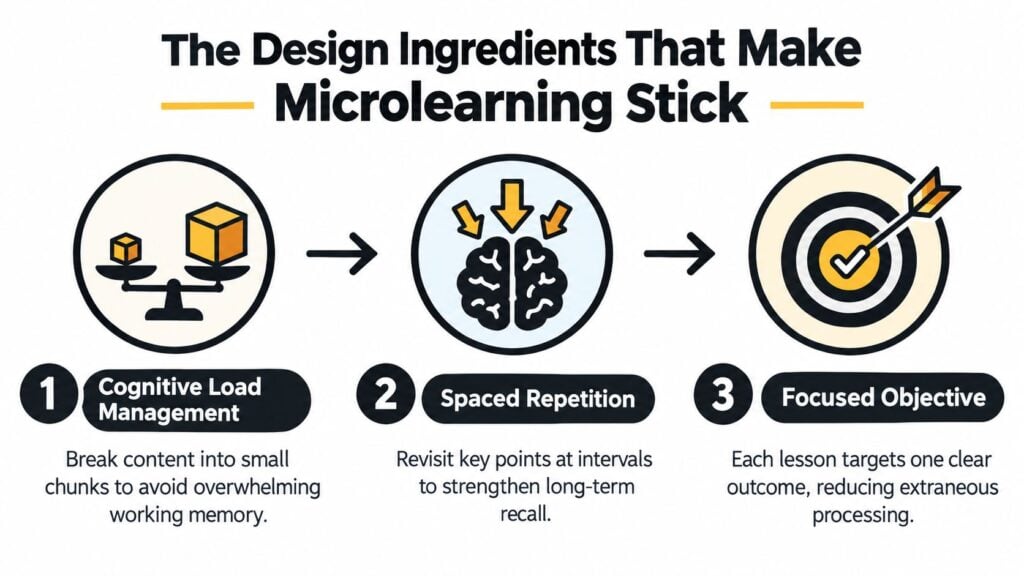
Recent review evidence identifies this distinction clearly. Microlearning gains appear strongest when the design uses cognitive load theory, spaced repetition, and periodic integrative review. Without those supports, the format may improve short-term recall more reliably than transfer or application, as discussed in the systematic review available through PubMed Central.
Real-World Use Cases Across Courses and Training
Microlearning fits situations where people need a small amount of information close to the moment of use. The best examples begin with a performance need, not a desire to divide an existing course into smaller files.
A sales team might use short role-play drills to practice one objection-handling move, then revisit the same skill in a new scenario later. An onboarding program might release one topic at a time through an LMS or email sequence, helping new employees learn tools, culture, and compliance without confronting a large information block on the first day.
Compliance training is another natural fit. A data privacy refresher can present a realistic situation, ask the employee to choose a response, and explain the consequence. A harassment prevention module can use a scenario to prompt recognition and action, while a longer workshop provides the discussion and policy context that a short activity can’t supply.
Course creators on platforms such as Teachable or Udemy can use short video chapters paired with a question or application prompt. The video explains one idea, the quiz tests retrieval, and the next lesson builds on the learner’s response. Creators who need examples of video formats for education, demonstration, or internal communication can also browse these video marketing examples from RemotionAI.
| Use Case | Audience | Typical Length | Delivery Channel | Primary Metric |
|---|---|---|---|---|
| Sales practice | Sales representatives | Short role-play drill | LMS or mobile prompt | Scenario performance |
| Onboarding | New employees | Single-topic lesson | Email, LMS, or mobile | Progress through the pathway |
| Compliance refresher | Employees | Under 10 minutes in reported examples | LMS or mobile | Completion and decision accuracy |
| Self-paced course | Independent learners | Short video plus quiz | Teachable, Udemy, or web platform | Completion and quiz performance |
The metric should match the use case. Completion makes sense for onboarding, but sales training needs evidence that learners can make a better decision in a role-play. A procedural software lesson may need a task check rather than another recall quiz.
When Microlearning Is the Wrong Tool
Microlearning is a strategy, not a universal default. Short lessons can create false confidence when learners recognize familiar information but haven’t practiced using it under realistic conditions.
Complex skill building is the clearest warning sign. Surgical training, advanced programming, and negotiation mastery require sustained practice, feedback, and adaptation. Fragmenting every part into isolated cards can hide the relationships between decisions and prevent learners from seeing how one action changes the next.
Deep conceptual learning can also suffer from excessive fragmentation. Economics theory, systems thinking, and other connected subjects often require a narrative arc. Learners need time to compare ideas, follow a chain of reasoning, challenge assumptions, and build a mental model that spans multiple parts of the subject.
Emotional and social topics need room
Emotionally loaded topics often need discussion and reflection. A quick compliance card may introduce a policy, but it can’t replace a facilitated conversation about ambiguity, power, harm, or the experience of reporting a problem.
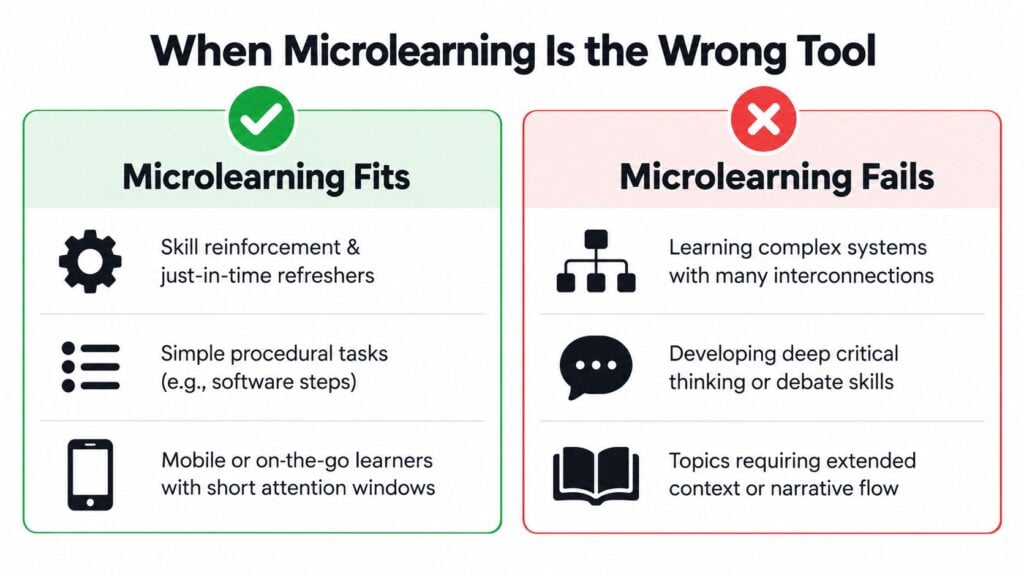
A blended design usually works better:
- Build the meaning: Use a workshop, cohort course, lecture, or extended reading for connected concepts.
- Practice the skill: Give learners projects, simulations, role-play, or supervised tasks.
- Reinforce recall: Use microlearning for reminders, retrieval questions, examples, and just-in-time refreshers.
- Check transfer: Ask learners to apply the idea in their real setting and review the result with a coach or manager.
Microlearning can maintain a skill after a longer experience has built it. It rarely creates mastery by shortening mastery itself.
The 2024 systematic review also points to uneven evidence across cognitive, behavioral, and affective outcomes, with inconsistent design quality and limited standardization. The broader lesson is to match the format to the outcome. Targeted knowledge, motivation, and completion may benefit strongly, while long-term transfer and complex skill development need more careful evaluation.
Design Best Practices for Microlearning That Performs
Start with the outcome, not the recording button. If the learner can’t demonstrate the objective after the lesson, the content probably contains too much explanation or the assessment doesn’t match the goal.
Use this working checklist while building:
- Write one observable objective: State what the learner will identify, choose, explain, or perform.
- Open with one problem: Begin with a question or situation the learner recognizes.
- Keep the session focused: Use the shortest length that allows the learner to understand, practice, and respond.
- Choose media selectively: Use video for demonstration, cards for reference, scenarios for decisions, and quizzes for retrieval.
- Write directly to the learner: Use clear second-person language and concrete instructions.
- End with action: Ask the learner to retrieve the main idea or apply it to a realistic task.
- Tag for reuse: Label the lesson by skill, role, topic, and difficulty so it can appear in later review.
A mobile-first layout needs concise text, visible controls, readable contrast, and a clear next step. If learners have to hunt for the question or scroll through a dense page, the small format loses its practical advantage.
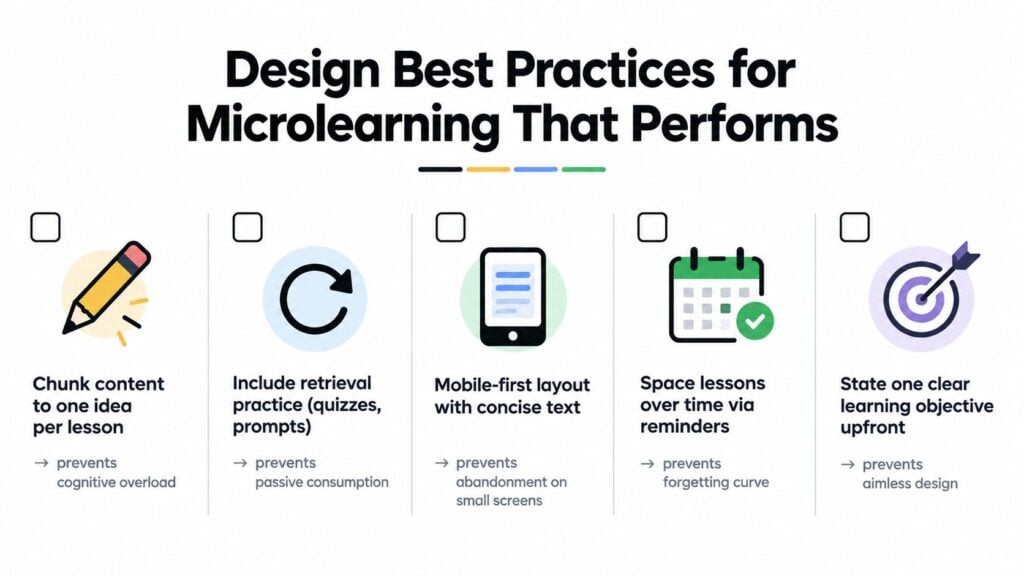
Two practices separate useful bursts from forgettable ones. First, test recall inside the lesson instead of relying on passive viewing. Second, place the activity inside a sequence with later review, practice, and feedback.
The LearnStream resource on microlearning best practices provides another practical reference for planning those elements. You can also use the video below as a prompt for thinking about how concise visual explanations might support a learning objective.
How to Decide if Microlearning Fits Your Goals
Before choosing the format, ask three questions.
Can the objective fit into one focused session? If learners need to identify a policy exception, complete a software step, or choose the right response to a common scenario, microlearning may fit. If they need to construct a complex mental model, reserve space for longer instruction.
Does the skill require sustained practice? If learners must perform, adapt, negotiate, create, or troubleshoot, short lessons can support practice, but they shouldn’t replace it. Pair them with projects, coaching, workshops, or simulations.
Will learners revisit the material? A one-time lesson has limited value for knowledge that needs to remain accessible. Plan reminders, retrieval prompts, cumulative review, and opportunities to use the skill.
Three yes answers suggest a strong case for microlearning. A mix of yes and no answers points toward blended learning. Three no answers mean another format may serve the objective better.
Measure the decision against learner behavior and performance. Track completion, delayed recall, task accuracy, learner questions, and evidence of on-the-job transfer. A training needs assessment, such as this training needs assessment template from LearnStream, can help you define the gap before selecting the delivery format.
The people who benefit most from microlearning need focused knowledge, flexible access, and repeated opportunities to retrieve what they learn. Build one lesson around one outcome, connect it to practice, and schedule review. That combination gives the benefits of microlearning a realistic chance to persist beyond the first completed module.
Choose one upcoming lesson or training topic and reduce it to a single observable objective. Build a short activity, add a retrieval question, schedule a later review, and measure whether learners can use the idea in practice. That small pilot will tell you more about whether microlearning fits your audience than a large content library built on assumptions.