
What Is the Curve of Forgetting & How to Beat It in

You launch a new course. Students are active, comments are rolling in, and the first few lessons feel like a win.
Then the drop-off starts.
People who looked excited on day one stop posting by the next week. They open fewer lessons. They ask questions that were already covered. A few disappear and never finish. If you run a membership or cohort, you can feel the energy drain almost in real time.
I’ve seen course creators misread this moment. They assume the content wasn’t strong enough, the audience wasn’t serious, or the price was wrong. Sometimes those things matter. A lot of the time, though, the underlying problem is simpler: learners forgot what they just learned, and your course wasn’t designed to catch that.
That Feeling When Student Engagement Vanishes
A pretty common pattern looks like this.
A student watches your module on positioning, feels clear and motivated, then leaves the platform to work on client tasks, family stuff, or the hundred other tabs open in real life. A few days later they return to your next lesson, but the previous one is fuzzy. They can’t fully connect the new idea to the old one. Progress feels harder than it should. So they hesitate.
That hesitation is expensive.
Once students feel behind, they stop raising their hand. They stop joining discussions. They stop finishing worksheets. In a corporate training setting, employees click through the next module without much confidence. In a paid course, customers start wondering whether the program is “for them” after all.
The problem usually starts before motivation drops
Most creators treat disengagement like a motivation issue first. Sometimes it is. But memory loss often shows up earlier.
A learner can be willing, interested, and still unable to keep moving because too much of the prior lesson faded. That creates friction in places creators don’t always notice:
- Lesson sequencing breaks down: Each new module assumes recall from the last one.
- Community quality drops: Students can’t contribute much if they don’t remember the framework.
- Application gets shallow: They repeat terms without using them well.
Practical rule: When learners go quiet, don’t only ask whether they care. Ask whether they can still retrieve what they need.
This is normal human memory, not proof your course failed
That’s where the curve of forgetting matters.
It gives you a way to explain why early enthusiasm often turns into silence. The issue isn’t that learning never happened. The issue is that learning doesn’t stay accessible on its own. Without reinforcement, retrieval gets harder fast.
Once you see that, the dashboard tells a different story. Low participation after a strong launch doesn’t automatically mean your offer is weak. It often means your design relies too heavily on one-time exposure.
That’s fixable.
What Is the Forgetting Curve Exactly
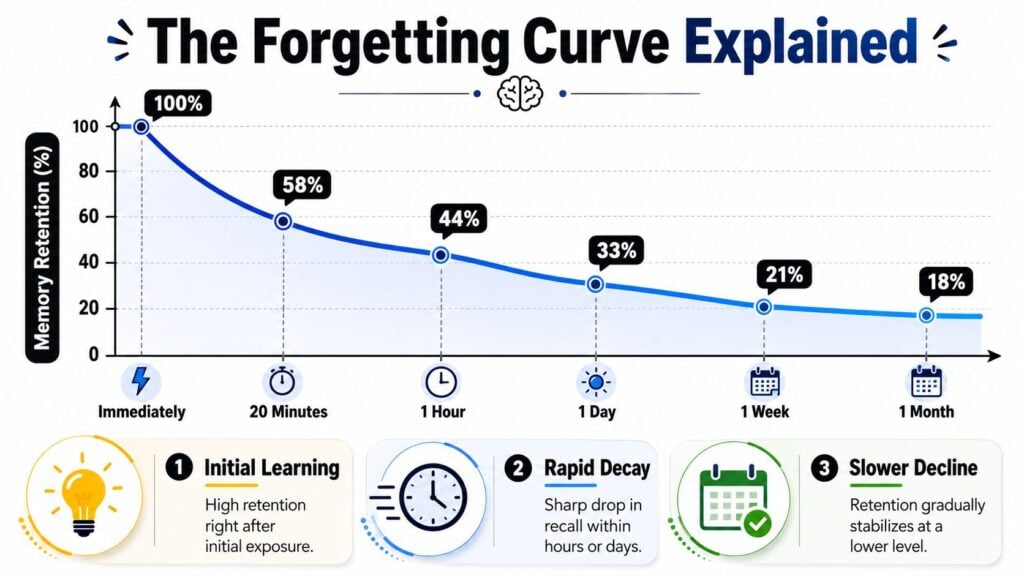
If you’re asking what is the curve of forgetting, the practical answer is this. It’s a model that describes how recall drops after learning if nothing brings that knowledge back into use.
The classic idea comes from Hermann Ebbinghaus. But for course creators, the historical detail matters less than the design implication. New knowledge is fragile. If students don’t retrieve it, use it, or revisit it, access to that knowledge fades.
A simple way to think about it is a leaky bucket. You pour in information during the lesson. Then time starts leaking it out. Review, practice, and application are how you refill or strengthen it.
Why the first day matters so much
The part most creators need to remember is the timing.
The literature on the curve consistently reports the steepest drop in retention in the first 24 hours, with roughly 50% of newly learned information often lost by then and up to 90% potentially gone within a week without reinforcement according to Intrepid Learning’s overview of the forgetting curve.
That one fact should change how you build courses.
If your whole learning experience is “watch video, move on,” you’re putting a lot of pressure on a single exposure. Most students won’t hold onto enough of the lesson for the next module to land cleanly. That’s why people say “I watched it, but I’m blanking now.”
The curve is a design signal, not trivia
For me, the value of this concept isn’t academic. It’s operational.
Once you understand the curve, you stop shipping lessons as isolated content assets and start building reinforcement into the experience. A lesson doesn’t end when the video ends. It ends when the learner can still retrieve and use the idea later.
If you want a broader view of how this fits into instructional design, these learning theories in practice help connect memory, reinforcement, and behavior in a more usable way.
A course that feels clear in the moment can still fail a week later if nothing prompts recall.
How Forgetting Hurts Your Course and Your Wallet
Memory decay doesn’t stay inside the lesson. It shows up in your business.

When people forget the material, they get slower. When they get slower, they feel stuck. When they feel stuck, they stop engaging with the product they paid for. That affects completion, reviews, renewals, referrals, and the overall credibility of your teaching.
I’ve seen this most clearly in courses with cumulative lessons. Module 4 assumes learners still remember the framework from Module 2. If they don’t, every lesson after that feels heavier. You end up with students saying the course is “dense” when the underlying issue is retrieval failure, not bad teaching.
The revenue hit is indirect, but very real
A weak retention design creates a chain reaction.
- Students doubt the product: They blame themselves at first, then they start blaming the course.
- Support requests increase: Questions pile up around ideas that were already taught.
- Testimonials get softer: Even satisfied buyers struggle to describe a transformation if they can’t recall key takeaways.
- Renewal logic weakens: In memberships, people keep paying for outcomes they can use, not libraries they forgot.
That’s why retention isn’t just a learning metric. It’s part of product performance.
For teams thinking about sustainable enrollment growth, this matters more than most launch advice admits. Marketing can bring in new students, but if learners don’t retain enough to progress and apply what they bought, growth becomes a treadmill.
What creators often optimize instead
A lot of course businesses spend energy on polish that doesn’t solve forgetting.
They upgrade slides. They add cinematic intros. They record longer lessons to “fully explain” the concept. They stuff the portal with bonus content. None of that guarantees that learners will still be able to use the material later.
A better lens is to look at each module and ask, “What will this learner still be able to do after some time passes?”
If you’re measuring course value through a business lens, this practical look at training ROI helps connect learner outcomes to actual returns.
A quick explainer can help if you need the big-picture business case for your team:

What works better than more content
The strongest courses usually feel lighter, not heavier.
They remind students of prior concepts before introducing new ones. They create tiny moments of retrieval. They ask for use, not passive recognition. They make it easy to re-enter after a gap instead of punishing learners for missing a few days.
That’s the kind of design that protects both learner momentum and revenue.
Actionable Strategies to Improve Learner Retention
If you want better retention, you don’t need a complete rebuild. You need a tighter system after the lesson ends.
Two methods do most of the heavy lifting in real courses. Active recall and spaced repetition.
Active recall asks learners to retrieve information from memory instead of re-reading or re-watching. Spaced repetition brings that retrieval back over time instead of cramming all review into one session. Together, they give students repeated chances to keep important ideas accessible.
Start with retrieval, not review
A common mistake is giving students more content when they need a prompt.
Instead of sending “here’s the replay,” send one question. Instead of posting a summary PDF first, ask students to write the framework from memory. Instead of opening a discussion with “thoughts?”, ask them to apply one concept to a real example.
I’ve seen tiny prompts outperform long recaps because they create effort. That effort matters.
Here are some ways to build active recall into a course:
- Use one-question email prompts: Send a short question the day after a lesson. Example: “What are the three pricing mistakes covered yesterday, and which one shows up in your own offer?”
- Add end-of-module blank-page tasks: Ask students to write what they remember before they reopen notes.
- Turn worksheets into retrieval tools: Put key terms on one side and ask for definitions or examples from memory.
- Use community prompts with constraints: Ask for one sentence, one screenshot, or one real-world application. Specific prompts get more responses.
For creators building this into online programs, this guide to spaced repetition in online courses is a useful companion to your course architecture.
Build a simple review rhythm
You don’t need complicated software to do this well. ConvertKit, Kit, Mailchimp, Circle, Slack, Discord, Notion, Teachable, Kajabi, Thinkific, and even plain calendar reminders can support retention if the prompts are well designed.
A simple schedule works better than a perfect one you never implement.
| Time After Learning | Action | Example for a “Pricing Your Services” Module |
|---|---|---|
| Same day | Ask for immediate recall | “Without reopening the lesson, list the pricing framework in your own words.” |
| Next day | Send a short quiz or prompt | “Which pricing mistake are you most likely to make, and why?” |
| A few days later | Prompt application | “Rewrite your current offer using the value-based pricing idea from the module.” |
| About a week later | Revisit through discussion | “Post your updated pricing statement and give feedback to one other student.” |
| Later in the course | Connect old learning to new learning | “Use the pricing framework when building your sales page in this module.” |
Field note: Retrieval should feel like part of the course experience, not homework piled on top of it.
Match the method to the kind of learning
Not every concept needs the same treatment.
If you’re teaching a reusable framework, keep bringing it back in different contexts. If you’re teaching a process, have learners perform it from memory in a live environment. If the content is language-heavy or terminology-heavy, a flashcard tool can help. For a nice adjacent example, [Gaeilgeoir AI is discussed elsewhere in this article’s broader theme], while for another domain-specific look at memory-driven instruction, these evidence-based strategies for Model UN show how repeated practice and application can support complex performance.
A few practical moves I’d use this week:
- Choose one key lesson: Not the whole course. Pick the module students most need later.
- Identify one retrieval point: A quiz, a community prompt, or an email question.
- Schedule follow-ups: Put them on your calendar or automate them in your email platform.
- Ask for use, not recognition: “Apply this to your offer” beats “Did this make sense?”
What usually doesn’t work
Some retention tactics look useful but don’t change much.
- Long recap videos: Students rarely watch them with enough attention to retrieve meaningfully.
- Huge resource libraries: More files often create more avoidance.
- Passive summaries: Nice for reference, weak for memory unless paired with use.
- One-time assessments: A single quiz at the end of a module doesn’t create durable access.
The best retention strategy is often small, repeated, and built into the flow learners already follow.
When to Rethink Fighting the Forgetting Curve
Most articles stop at “fight the forgetting curve.” I don’t think that’s enough.
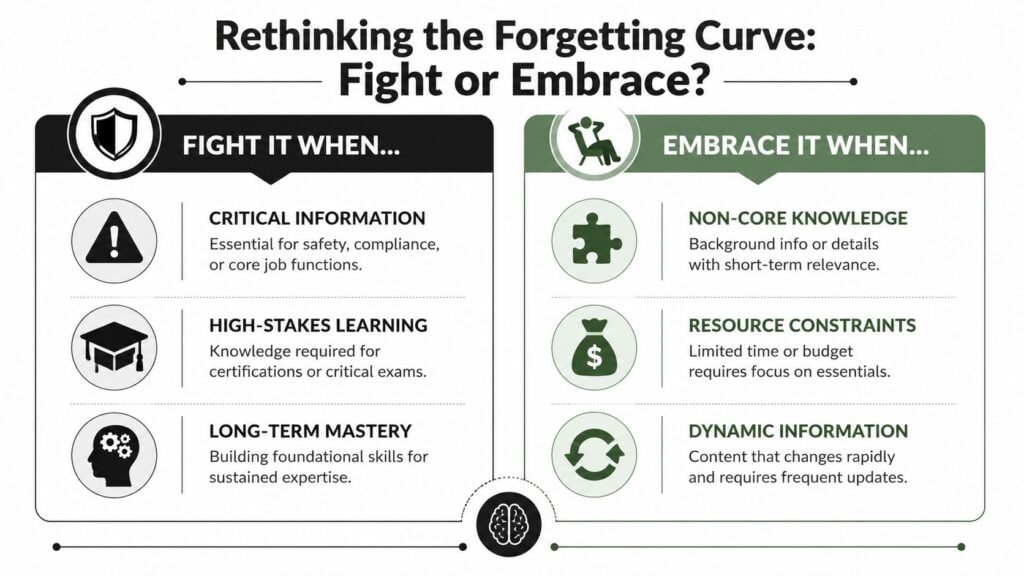
Sometimes the smarter move is to question whether long-term memorization should be the goal in the first place. That’s especially true in digital learning products where students can search, bookmark, prompt an AI assistant, or pull up a template the moment they need it.
The classic curve isn’t a universal law
At this point, the theory gets more useful, not less.
Most explanations treat the forgetting curve as a universal law, but the original Ebbinghaus data shows it is a specific experimental model. Forgetting depends heavily on factors like encoding strength, learning method, and prior knowledge, so a one-size-fits-all retention strategy is often ineffective, as discussed in this replication and analysis of Ebbinghaus-related forgetting research.
That lines up with what many course creators already notice. Some lessons seem to “stick” because students use them right away. Others disappear because they were only recognized, never practiced. Prior knowledge changes everything. So does task type.
A checklist for software settings, for example, doesn’t need the same memory strategy as a negotiation framework or a clinical protocol.
Fight it when recall must be fast and internal
There are clear cases where memorization matters.
- Critical knowledge: Safety rules, compliance steps, or procedures people need without hunting for a file.
- High-stakes performance: Exam prep, certification pathways, or time-sensitive decisions.
- Foundational models: Core frameworks students must carry into later lessons and real work.
If you teach negotiation, diagnosis, coaching, sales calls, or leadership conversations, the learner often needs the concept available inside the moment. In those cases, active retrieval and spaced practice are worth the effort.
For language learning, this is part of why tools built around retrieval loops can be so effective. If you want a concrete example in that space, this piece on Gaeilgeoir AI for language mastery is useful because it shows where repeated recall makes sense.
Don’t optimize every lesson for memory. Optimize the right lessons for performance.
Embrace just-in-time access when lookup is enough
Other content is better treated as performance support.
A software tutorial, a tax filing checklist, a troubleshooting guide, or a reference library inside a membership often doesn’t need to live fully in memory. The learner needs to solve a problem quickly and correctly. Searchability can matter more than recall.
When I audit course products, I often split content into two buckets:
| Content type | Better design priority |
|---|---|
| Core mental models, principles, communication frameworks | Internalization and repeated retrieval |
| Fast-changing details, tool settings, reference-heavy instructions | Search, templates, and quick refreshers |
That distinction saves creators a lot of wasted effort. Without it, they build every lesson as if students should memorize all of it. That creates bloated programs and unrealistic expectations.
A more modern question for course creators
There’s also a broader shift happening in how people learn now.
With searchable communities, AI summaries, internal knowledge bases, and on-demand refreshers, forgetting isn’t always a product failure. Sometimes it’s an acceptable trade-off. If a student can return, refresh fast, and complete the task well, the learning experience may still be excellent.
That’s a more strategic way to answer the question, “What is the curve of forgetting?” It’s not just a warning about memory loss. It’s a prompt to decide what learners need to carry with them, and what they only need to access when the moment arrives.
Turn Forgetting from a Flaw into a Feature
The curve of forgetting becomes much less intimidating once you stop treating it like bad news and start treating it like a design constraint.
People forget. That’s normal. Your job as a course creator isn’t to eliminate that reality. Your job is to decide where memory matters, where access matters, and how the product should support both.
The most useful way to think about it
If a lesson teaches a foundational idea students must use repeatedly, build for retention. Add recall prompts. Reuse the concept later. Ask learners to retrieve before they review. Make them apply the idea in a fresh setting.
If the lesson supports a task that can reasonably be refreshed on demand, build for speed and clarity. Use searchable transcripts, checklists, templates, short walkthroughs, and AI-friendly knowledge bases. Help people find what they need without friction.
That’s a more grounded approach than treating every program like a memory contest.
In an era of AI and just-in-time performance support, the key business question is no longer just how to prevent forgetting. It’s deciding whether the goal is long-term memorization or enabling task success with brief, on-demand refreshers, as explored in The Decision Lab’s overview of the forgetting curve.
A small change is enough to start
You don’t need to rebuild your flagship course this week.
Pick one module. Look for one spot where students probably forget something essential. Then add one support mechanism:
- A next-day email question
- A short retrieval quiz
- A discussion prompt that requires application
- A one-page refresher sheet
- A searchable resource for later lookup
That single move can change how the rest of the course feels.
What I’d do first
If I were improving a course quickly, I’d start with the module that enables everything else. Usually that’s the lesson containing the core framework, method, or language students need throughout the program.
Then I’d ask two questions.
- Does this need to be remembered later without help?
- If not, can students find and use it fast when they need it?
Those two questions are more useful than generic advice to “beat forgetting.”
The strongest learning products don’t just deliver information. They support performance over time. Sometimes that means helping learners remember. Sometimes it means helping them refresh fast and move forward with confidence.