How Much to Charge for a Membership Site: Pricing Framework
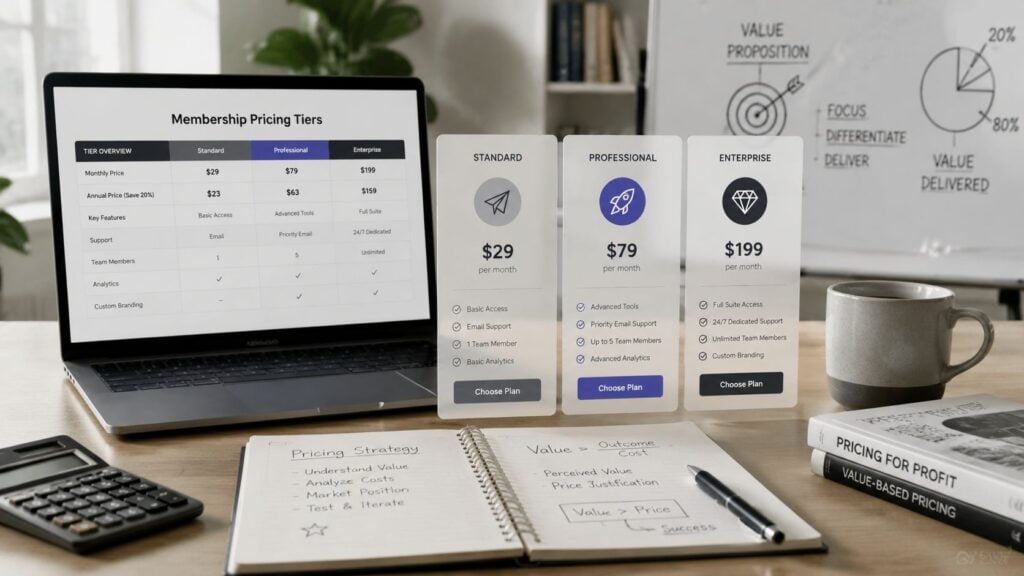
41.81% of membership sites charge between USD 25 and USD 49 per month, making that the most common starting bracket. Use it as a reference point, not as your final answer, because the right fee depends on who you serve, what members receive, and how consistently they use it.
You may already have the course outline, community idea, or member portal ready. Then the pricing page appears, and progress stalls. A low price feels safer, but it can leave you without enough margin to support members. A high price can communicate stronger value, yet it also demands a clearer promise and a better member experience.
The practical answer to how much to charge for a membership site comes from validation, not intuition. Start with the market baseline, ask prospective members what the offer is worth to them, and create tiers around meaningful buyer differences rather than adding random features to increasingly expensive plans.
The Real Paralysis Behind Choosing a Price
Most creators don’t struggle because they can’t do the arithmetic. They struggle because the price feels like a verdict on the whole business.
You’ve built lessons, planned discussions, or prepared live support. Now a single number seems capable of deciding whether people see the offer as valuable or ignore it. That pressure often leads to one of two weak choices. Some creators copy a competitor. Others choose a low figure because it feels less risky.
Neither approach tells you what your audience considers acceptable.
A useful baseline comes from a 2020 analysis of the subscription economy, which estimated the market at about USD 650 billion in 2020 and projected it to reach USD 1.5 trillion by 2025, implying roughly 18% compound annual growth. In the same analysis, 41.81% of membership sites charged USD 25 to USD 49 per month, while 19.21% charged USD 15 to USD 24 per month. The pricing analysis also found that 56.9% offered multiple pricing options, such as monthly and annual billing.

Treat the bracket as context
That mid-tier range is a useful place to investigate because it’s where the largest share of sites has historically clustered. It isn’t proof that every educational membership should use the same fee.
A community with light interaction may need a lower entry point. A membership that combines structured learning, feedback, and direct support may justify a higher price because members are buying guidance and access, not merely a content library.
Practical rule: Use market pricing to create a starting hypothesis. Let customer research decide whether your offer belongs below, within, or above that range.
Your positioning matters too. Pricing below the lower common brackets can make an offer feel disposable if the sales page doesn’t explain the outcome. Pricing above the most populated range requires evidence, such as expert access, accountability, specialized training, or organizational value.
Before publishing, compare how other subscription businesses present their plans and what they include. You can also check the pricing page for a practical example of how a software company communicates plan differences without forcing every feature into a separate tier.
The goal is to stop treating price as a guess you have to defend. Treat it as a working decision that you can test, measure, and refine.
How to Validate Pricing Before You Launch
A pricing page can look polished and still be built on an assumption. Before launch, I’d rather collect uncomfortable feedback than discover after launch that the audience likes the idea but won’t pay the proposed fee.
The most useful starting point is a Van Westendorp willingness-to-pay survey. The method asks potential buyers how they respond to four price perceptions:
- Too cheap: At what price would the offer seem so inexpensive that quality becomes doubtful?
- A bargain: At what price would it feel like a good deal?
- Getting expensive: At what price would it start to feel costly, even if still possible?
- Too expensive: At what price would you no longer consider buying?
Ask these questions about the complete membership, not an isolated feature. Someone may value a video library modestly but place a much higher value on feedback, community accountability, or access to a specialist.
Turn answers into a business model
Subscription pricing guidance recommends collecting at least 100 survey responses for meaningful results and creating 2 to 4 tiers around customer types rather than feature stacks. The value-based pricing workflow also recommends segmenting the answers and feeding them into a model that includes churn, conversion rate, and plan mix.
Segment the responses by factors that affect buying behavior:
- Experience level: Beginners may need a guided path, while advanced members may want access to specialists.
- Use case: A hobby learner and a professional applying the material at work don’t face the same value calculation.
- Support expectations: Some buyers want self-serve resources. Others need reviews, calls, or accountability.
- Purchasing authority: Individual buyers and organizations may evaluate the same membership through different budgets and approval processes.
Your financial model doesn’t need to predict the future perfectly. It needs to expose trade-offs. Test what happens if more members choose the lower tier, if annual billing becomes popular, or if support-heavy plans require more of your time.
Pricing by production cost alone usually misses perceived value. Competitor scraping has the same weakness because a competitor may serve a different segment, have different delivery costs, or bundle services you don’t provide.
If your membership includes a course, map the learning journey before you survey buyers. The guidance in this online course creation resource can help you define what members receive, which makes the pricing questions more concrete.
Validate first. Then test monthly and annual billing against retention data instead of choosing an arbitrary discount.
Why Tiers Should Match Buyer Segments
Feature stacking creates tidy pricing tables but often produces confusing decisions. A Basic plan may include forums, Pro may provide courses, and Premium may add everything else. The buyer still has to work out which plan fits their situation and whether each extra feature matters.
Value-based tiering starts with the person buying. A solo creator might need a clear curriculum and occasional feedback. A team leader may care about group access, progress visibility, and practical implementation. An organization may value support, shared resources, and a purchasing arrangement that fits internal use.
Historical willingness-to-pay research defines willingness to pay as the maximum price a buyer accepts for a service. It also explains why subscriptions can command value beyond individual usage, because recurring access separates payment from each additional use and reduces uncertainty around fluctuating prices. Research summarized in this membership pricing reference illustrates the point through an applied Amazon Prime Video study in India, which estimated an optimal annual price of INR 1,300, with an acceptable range of INR 1,000 to INR 1,500. The same market context showed around 10 million users in India, with only 40% paying directly and the remainder using bundled access.
Build plans around real jobs
The lesson isn’t to copy those prices. It’s to recognize that perceived value, budget comfort, and plan structure work together.
A simple segment-led structure might look like this:
| Buyer segment | Core reason for joining | Suitable offer design |
|---|---|---|
| Independent learner | Follow a proven path and access the community | Self-serve content with community participation |
| Practitioner or creator | Apply the material and get direction | Courses, feedback, and selected coaching |
| Team or organization | Help several people implement the knowledge | Shared access, support, and organizational resources |
The plans can still contain overlapping features. The distinction should come from the outcome and level of access, not from forcing a minor convenience into a higher tier.
For example, don’t make a replay archive the only reason to upgrade if every member needs the same learning experience. Instead, reserve personalized reviews or group implementation support for buyers who specifically need those services.
Buyers understand “a plan for independent learners” faster than “the plan with twelve extra features.”
Limit the number of choices to what your segments can distinguish. A smaller set of clear plans is easier to explain, sell, and support. It also gives you cleaner data when you later compare conversion and retention by segment.
Free Trials Versus Low Entry Fees
A free trial and a low entry fee attract different kinds of commitment.
A free trial removes the financial risk, which helps when buyers can’t understand the membership’s value from a landing page. A low entry fee asks for payment immediately, so it filters out people who are curious but unlikely to participate.
The evidence on trials is useful, but it needs careful interpretation. A benchmark report found a median free-to-paid conversion rate of 8% across products. It also found that free trials requiring a credit card converted at 30%, more than five times the rate of trials that didn’t require one. The conversion report provides the underlying benchmark.
That difference may reflect commitment, purchase intent, or the quality of the sign-up audience. It doesn’t mean every membership should force a card before access. Some audiences distrust that process, particularly when cancellation terms aren’t obvious.
Match the trial to the first valuable action
Trial timing matters because people often decide quickly whether a membership fits. A peer-reviewed field study found that trial users converted to paid subscribers in 23 days on average, with a median of 9 days and a standard deviation of 26 days. The field study shows why onboarding should lead members toward a meaningful result instead of opening a large content library.
Trial length also changes behavior. A large randomized field experiment found that a 7-day trial outperformed a 3-day trial for conversion and revenue, while longer trials increased adoption of the trial but delayed paid conversion. The randomized experiment supports testing a short trial that gives people enough time to experience the core promise.
Use this decision guide:
- Choose a free trial: When the value depends on experiencing the community, workflow, or teaching style.
- Choose a low paid entry: When the offer is easy to understand and casual browsing creates support costs.
- Use a card-required trial: When your audience accepts that checkout pattern and your cancellation process is clear.
- Use a shorter trial: When members can reach the first meaningful action quickly.
- Use neither: When a focused paid workshop or one-time product can validate demand before recurring billing.
A trial should have a path. Welcome members, direct them to one useful action, show them where support lives, and remind them what continues after the trial. A low entry fee needs the same clarity, because payment alone doesn’t create retention.
For a closer comparison of the two approaches, use this guide to free trials and low entry fees.
Launch Pricing and Founder Rates
A launch offer should reward early commitment without turning your eventual price into a guess. Set the standard rate from the value and delivery workload you expect once the membership is operating consistently. Then use the founder offer to test whether real buyers will pay for that version of the promise.
A sensible founding-member offer sits about 20% to 30% below the intended long-term price, with early subscribers grandfathered when the public price rises. This membership pricing guidance supports that approach because it gives initial members a clear reason to join while preserving room for future pricing changes.
The discount needs clear limits. Explain who qualifies, what early members receive, when the public rate changes, and whether the founder rate remains active while their subscription stays current. Those terms also help you distinguish genuine willingness to pay from signups driven only by urgency.
A practical launch sequence
- Set the intended standard price first. Define the complete offer and delivery requirements before calculating the founder rate.
- Create a limited early offer. The lower price compensates members for joining while the community, content library, and operating routines are still developing.
- Explain the transition. State when the public rate will change and whether existing members keep their original fee.
- Track plan behavior. Compare which tier attracts committed members, how quickly they use the offer, and whether annual buyers remain active.
- Raise prices for new buyers only. Grandfathering protects trust with early members while improving the economics for future signups.
Annual billing also deserves a deliberate test. One independent benchmark reported that 82% of annual members remained active after one year, compared with 35% of monthly payers. The membership pricing benchmark presents annual billing as a major retention lever.
That result does not make annual plans automatically superior. Some buyers need flexibility, and a large upfront payment can reduce conversions. Offer annual members a fair incentive, then check that the remaining margin can support the promised experience throughout the year.

A founder rate works best when members feel they are helping shape something worthwhile. Keep the terms visible, avoid artificial countdowns, and do not change the agreement after people join. Their feedback should guide product improvements, while their payment behavior helps validate whether the eventual price fits the buyer segment you want to serve.
Flexible Pricing Models Beyond Flat Rates
A flat monthly fee is easy to explain and easy to administer. That convenience makes it useful, but it doesn’t make it suitable for every membership.
Some audiences participate intensely for a short period, then return when they need a new module or project. Others want ongoing community access but don’t consume new lessons every month. Charging everyone the same way can create friction for light users while undercharging members who receive substantial support.
Recent consumer subscription survey findings indicate that 70% of consumers are open to usage-based pricing, 78% want pause-or-swap options, and 82% are more likely to subscribe when cancellation is easy. The consumer subscription survey points toward flexible commitment structures rather than rigid access rules.
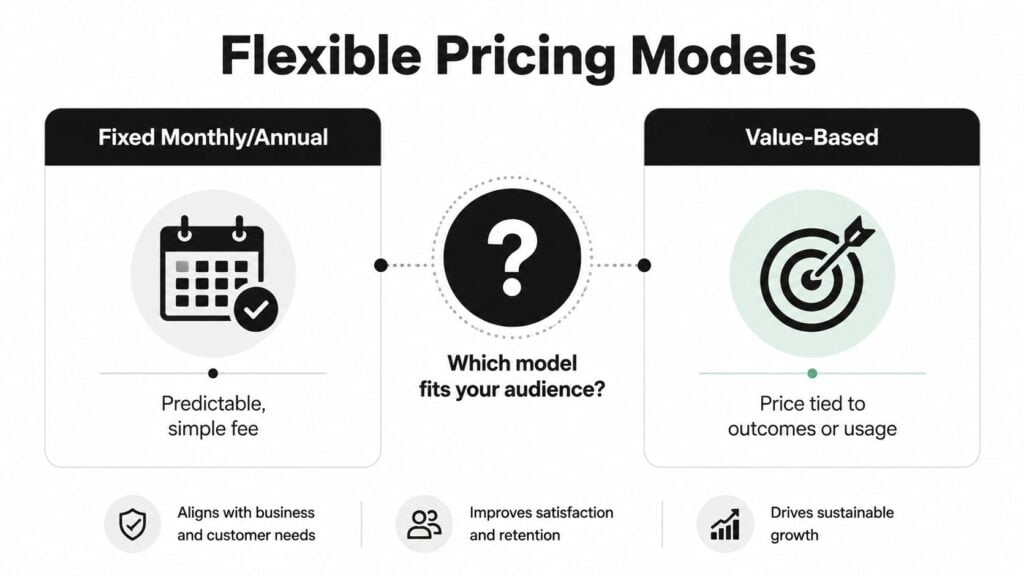
Choose the model that fits participation
Consider these options:
- Flat access: Best for a predictable library, active community, and regular publishing schedule.
- Usage-based access: Useful when members consume distinct services, credits, reviews, or sessions.
- Modular membership: Lets buyers choose a core community plan and add specialized learning or support.
- Pause-and-return: Helps members keep their account relationship when their schedule changes.
- Team or organization plans: Prices the membership around shared use, implementation, and support rather than individual content access.
The broader subscription market also shows tension between budget caution and demand for differentiated features. A recent streaming study reports that audiences are expanding monthly budgets and experimenting with ad-supported tiers, while nearly half expect annual plans to be discounted by almost 50% compared with monthly pricing. The streaming study also describes membership dues ranging from tens of dollars for individual professional tiers to five-figure organizational dues.
Those examples don’t establish a universal membership price. They show why audience and institutional value matter more than content volume alone.
Before choosing a hybrid model, check whether your systems can explain usage clearly and whether members can predict their bills. Confusing metering can damage trust faster than a simple flat plan. If you need a broader overview of billing structures, this guide to subscription pricing models offers useful context.
A billing tool such as RecurX pricing plans can also be part of the evaluation when you’re comparing recurring, flexible, or usage-sensitive structures.
A short explanation can help buyers choose:
Ask one question: Does this audience value unlimited access, or does it value a specific result delivered through selected services?
Use flat pricing when simplicity supports conversion. Add flexibility when participation patterns, support intensity, or buyer budgets make a single fee feel unfair.
Start by treating USD 25 to USD 49 per month as a market reference, then validate your own offer with willingness-to-pay research. Survey prospective members, segment the responses by buyer type, model monthly and annual scenarios, and launch with terms you can explain without hesitation. Choose a price and plan structure that lets you deliver a consistently valuable membership, then invite your first prospective members to review the offer and tell you which tier they’d buy.