Pricing and Plans for Courses: Models, Tiers and Trials

You’ve got the course recorded. The community is active. Then you open a blank pricing page and stall.
I’ve been there. Charge once and you worry you’ll give support forever for one payment. Charge monthly and you worry people will leave after month two. Charge yearly and the price looks scary.
Good Pricing and Plans decisions get easier when you rank each option by the money left after fees, refunds, and churn. That’s the lens I use in this post.
Pricing Models Compared at a Glance
Say you run a six week course with an active community. You’re deciding whether to charge once, monthly, or yearly.
A pricing model is the rule for when money changes hands and what the buyer gets back. Start with the comparison, then narrow it down.
| Model | How the buyer pays | Best fit | Main risk |
|---|---|---|---|
| One-time course fee | Single payment | Finite course with a clear outcome | No recurring revenue and support costs stay open |
| Monthly membership | Recurring monthly charge | Ongoing content, community and regular releases | Churn when the library feels static |
| Annual membership | Yearly prepayment | Loyal audiences who already stay for years | Buyers hesitate at the larger upfront amount |
| Tiered membership | Choice of two to four levels | Mixed audiences with different needs and budgets | Plan sprawl and confusing comparisons |
| Free trial | Free period, then paid plan | Products that show value within days | Trial users who never reach a useful milestone |
| Freemium access | Free tier with paid upgrades | Large audiences that are cheap to serve | Low paid conversion, median 2.4 percent |
| Cohort enrollment | Fixed-date group pays once | Live, facilitated programs | Revenue only arrives when a cohort fills |
What buyers already expect
Most buyers understand monthly billing right away. The 2025 InternetRetailing subscription analysis found monthly plans were offered by 80% of retailers with standard subscription programs, while only 20% offered yearly options.
That doesn’t mean you must lead with monthly. It means your page should make the monthly commitment easy to read, even if you also show an annual deal.
Currency matters too. The same analysis found 77% of global subscription plans were denominated in U.S. dollars. If you sell in dollars to learners in Europe or Asia, say so clearly and show the total commitment. Don’t make people guess.
Match the model to your delivery rhythm
Recurring payment works when buyers keep getting something. That could be new lessons, feedback, live calls, community access, or product improvements.
If you release material often, a membership fits your work. If your course ends in six weeks and little changes after that, a one time fee or cohort fee is more honest. Dividing a finished course into monthly charges usually creates refund requests and awkward support tickets.
I like a simple rule here. Pick one primary model that matches how often you release new material. Then pick one backup model for buyers who won’t commit to the first one.
For example, lead with monthly membership and keep a one time cohort seat for people who hate subscriptions. Or lead with a one time course fee and offer an optional paid community after graduation.
If you want a wider tour of recurring structures, my notes on subscription pricing models for memberships go deeper on the subscription side.
How to Build a Tier Ladder Step by Step
I think of a tier ladder like a restaurant set menu. The cheapest option gets people through the door. The middle option is the popular choice. The top option exists for diners who want everything.
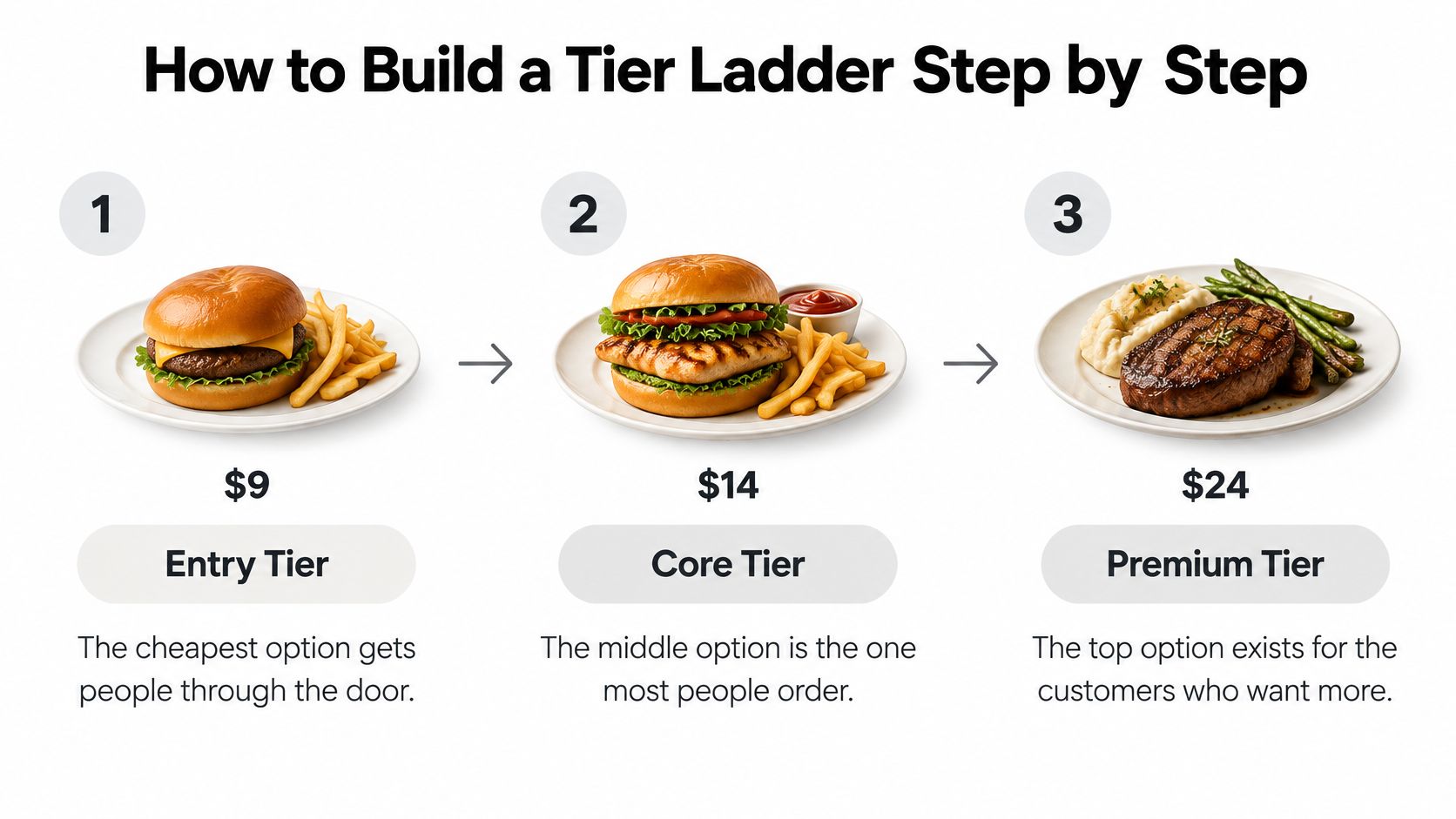
Build the ladder in order
List everything you deliver. Write down lessons, live time, feedback, templates, community, and support. Mark what each item costs you in hours and fees. The common mistake is pricing from features alone and forgetting your own time.
Name three buyer segments. A casual learner, a serious student, and a team or professional buyer is a useful starting set. If you can’t name who a tier is for, buyers can’t either.
Make the middle tier the default. Price it for the segment that fits your content best and can keep paying. Your core buyers should land here without much thinking. Coachful’s walkthrough on how to structure your coaching program fees is a helpful parallel if you sell coaching alongside courses.
Make the entry tier real. Give buyers a limited but useful product. Don’t ship a crippled trial that blocks the one lesson they came for. People remember that frustration longer than they remember a low price.
Put high touch value on top. Feedback, live access, reviewed projects, and credentials belong here because they cost you time. Keep seats or review slots capped so the promise stays deliverable.
Add the annual option with a sane discount. The ComparEdge annual discount report compared 560 software plans across 207 products and found a median discount for annual billing of 20%, with most categories between 16% and 25%. I start near 20% and show the monthly equivalent next to the annual total.
Check the ladder on the draft page. Three tiers is usually enough. Each tier should differ by one clear reason. If two tiers read the same except for price, merge them.
Practical rule: If you need a paragraph to explain why two tiers differ, they probably don’t differ enough.
The volume trap
The slip I see most is tiers that only differ by volume. More videos. More downloads. More templates.
Volume is weak because buyers can’t tell whether more material helps them finish. A better split is one outcome or service change per step. Self paced lessons at entry. Lessons plus community and live Q and A in the middle. Everything plus feedback and a credential review on top.
Read your draft aloud. If the only words that change between tiers are numbers, you’ve found the problem.
Value Metrics That Justify Each Tier
A value metric is the unit that scales with what the buyer gets. Pick the wrong one and a fair price starts to feel unfair.
I look at seven options for course based offers. Most pricing and plans pages only need one or two.
Metrics that can carry a tier
- Seats or team access: Works when a manager buys for a team and needs separate progress tracking. It backfires when a team shares one login and sees no reason to pay for more seats.
- Content depth: Works when advanced modules solve harder problems. It backfires when buyers compare your lesson count with free videos and judge by volume alone.
- Live sessions: Works when live time helps learners get unstuck. It backfires when time zones exclude a chunk of your audience and recordings feel like leftovers.
- Feedback hours: Works when reviewed work is the clear upgrade. It backfires when you don’t cap submissions and the top tier eats your week.
- Community access: Works when peers, accountability, and job leads carry real value. It backfires when the space is quiet and members pay to enter an empty room.
- Credentials or projects: Works when learners can show an assessed result to an employer or client. It backfires when the promise sounds like a job guarantee you can’t make.
- Support response time: Works for professional buyers who lose money when they’re blocked. It backfires when fast support becomes the main product and teaching takes second place.
What learners said they’d pay
Stated willingness to pay is useful, but it’s not a price tag. The demand curve study of online classes indexed by ERIC found students were willing to pay an average of $226.30 per course, while the estimated revenue-maximizing price premium was approximately $150.
That gap is the lesson. Push the price up and enrollment can fall enough to lower total revenue. I model it in plain terms. Expected revenue equals price multiplied by paid conversions. Then I test price points for each segment instead of looking for one magic number.
The same study also found willingness to pay increased with students’ work hours and decreased with commuting time. That fits what I see with busy professionals. Flexibility has economic value, so short lessons, audio versions, and catch up friendly live sessions can support a stronger tier.
Segment differences showed up too. Bachelor’s students were willing to pay more than associate-program students. The expectation of earning a better grade was the strongest distinguishing factor in course choice.
For your ladder, that points to outcomes over bulk. Tie the top tier to assessment, credentials, mentoring, or job relevant projects. Don’t promise a grade, a job, or income you can’t guarantee.
If you’re working through the logic behind charging for outcomes, I keep related notes on value based pricing for course tiers for reference.
Pick two metrics at most. A buyer should be able to say in one sentence why the next tier costs more.
Free Trials Versus Low-Entry Pricing Compared
This is the argument I hear most from creators. Seven days free, or a cheap first month?
There’s no universal winner. There is a fit question. How fast can a new member reach a result that feels worth paying for?
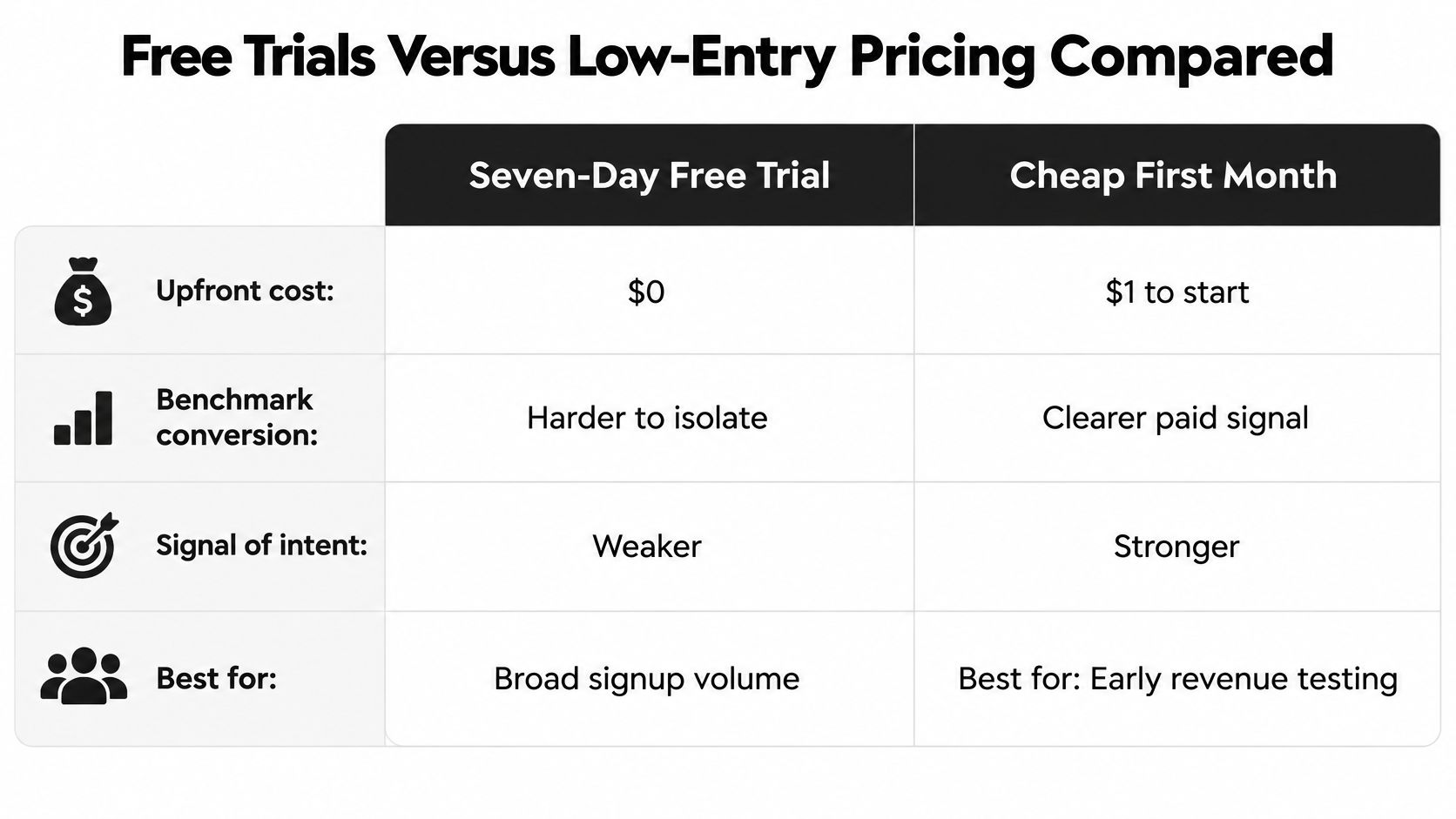
| Criterion | Free trial | Low-entry price |
|---|---|---|
| Upfront cost to buyer | Zero | Small fixed charge, such as €0.99 for six weeks |
| Benchmark conversion | 4.8 percent median trial-to-paid in 2026 SaaS data | 46.8 percent moved to full price after six weeks in one study, not directly comparable |
| Signal of commitment | Low, easy to abandon | Higher, because the buyer has already paid |
| Best fit | Products that show value within days | Products that need weeks to build a routine |
| Main risk | Trial users who never reach a milestone | Buyers who leave at the first full-price charge |
| Retention signal to watch | Activation during the first week | Subscribers still active after the first full-price billing |
A low entry offer with real retention numbers
A 2026 study in the Journal of the Academy of Marketing Science examined 2,434 users who joined a six week discounted subscription trial priced at €0.99. Unless users cancelled, the subscription automatically changed to the regular €12.99 monthly price after the trial.
After six weeks, 46.8% had successfully moved to the full-price plan. One month later, 36.5% of the original trial group remained subscribed, and 21.7% were still subscribed after 32 weeks.
Those later numbers matter more than signups. A cheap start can fill your list with people who vanish at the first normal charge. Judge the offer by who is still paying after that billing change.
Habits help, until they don’t
The same study’s habit findings reported that users who developed regular habits around the premium content were more likely to remain subscribed at the full price. The relationship was inverse U shaped, so extremely strong habits were associated with lower retention than moderate habits.
I read that as a pacing warning. Push daily streaks too hard and you may burn people out. A steady rhythm that fits a work week is the goal, with a first win early.
Benchmarks to keep you honest
The 2026 SaaS pricing benchmark report from UnlockSaaS stated that the median conversion rate from a free trial to a paid plan was 4.8%, while the median conversion rate from a freemium plan to a paid plan was 2.4%.
Treat those as comparison points, not promises. Your traffic source, price, and onboarding will move your result a lot. They also don’t compare cleanly with the €0.99 study, because those users had already paid something and knew the full price was coming.
My verdict by situation
Use a free trial when a learner can finish a module, attend a session, or get useful feedback within days. Keep it structured. Name the milestone on day one and remind people before billing starts.
Use a low entry price when your product needs several weeks to build a routine. A small payment filters out casual clicks and gives members a reason to show up.
Either way, watch retained subscribers after the first full price billing. Trial starts alone will flatter a weak offer.
Hidden Costs and the Real Price of Each Plan
Two plans sit side by side on a provider’s pricing page. One charges $99 a month flat. The other charges $39 a month plus 2% of every sale. A flat fee works like rent: it stays the same whether you sell a little or a lot. A percentage fee works like a commission: it grows with every sale. At $1,000 in monthly revenue the commission-style plan wins easily. At $20,000 the 2% slice alone tops the entire flat fee.
Buyers feel the same trick from the other side. The Telecompetitor report on hidden fees cited a consumer survey in which 88% of respondents believe advertised prices should include all fees, while 67% had switched or considered switching providers after encountering hidden or unexpected charges. A surprise line at checkout costs you trust and, often enough, the sale itself.
Costs I put in every comparison
- Payment processing: Card fees go to a third party on nearly every sale. They still reduce what you keep, so they belong in the math.
- Platform transaction charges: Some plans take a cut of each sale on top of processing. That cut often shrinks or disappears on higher tiers, so upgrades can pay for themselves.
- Taxes: Show whether tax is included or added at checkout. A surprise at the final step costs trust.
- Currency conversion: Cross-border sales can add conversion fees and payout delays. Check the provider terms for your payout country.
- Email and video limits: A cheap plan can trigger overage bills once your list or watch time grows.
- Add-ons and seat overages: Price every extra you expect to switch on.
- Refunds: Add a refund allowance to each tier. A plan that sells well but refunds often keeps less than it looks.
Run a break-even check
Take the same two plans and add card processing of 2.9% on both, since processing applies either way. Each total below combines the plan fee, the transaction fee and processing at four revenue levels. These are illustrative figures, so swap in the totals from each provider’s published terms, including likely add-ons and a refund allowance.
| Monthly revenue | Flat plan ($99/mo) | Percentage plan ($39/mo + 2%) | Cheaper option |
|---|---|---|---|
| $2,000 | $99 + $58 = $157 | $39 + $40 + $58 = $137 | Percentage plan |
| $5,000 | $99 + $145 = $244 | $39 + $100 + $145 = $284 | Flat plan |
| $10,000 | $99 + $290 = $389 | $39 + $200 + $290 = $529 | Flat plan |
| $20,000 | $99 + $580 = $679 | $39 + $400 + $580 = $1,019 | Flat plan |
The two plans trade places at $3,000 a month, where each totals $186. Below that line the percentage plan keeps more in your pocket. Above it the flat plan pulls further ahead with every sale, since its fee never moves.
That crossover is your upgrade point. Run the same math with real provider terms, then rank every plan by the money left after fees, refunds and churn at your next revenue level. The advertised monthly price alone will mislead you.
Testing Price Points and Forecasting Revenue
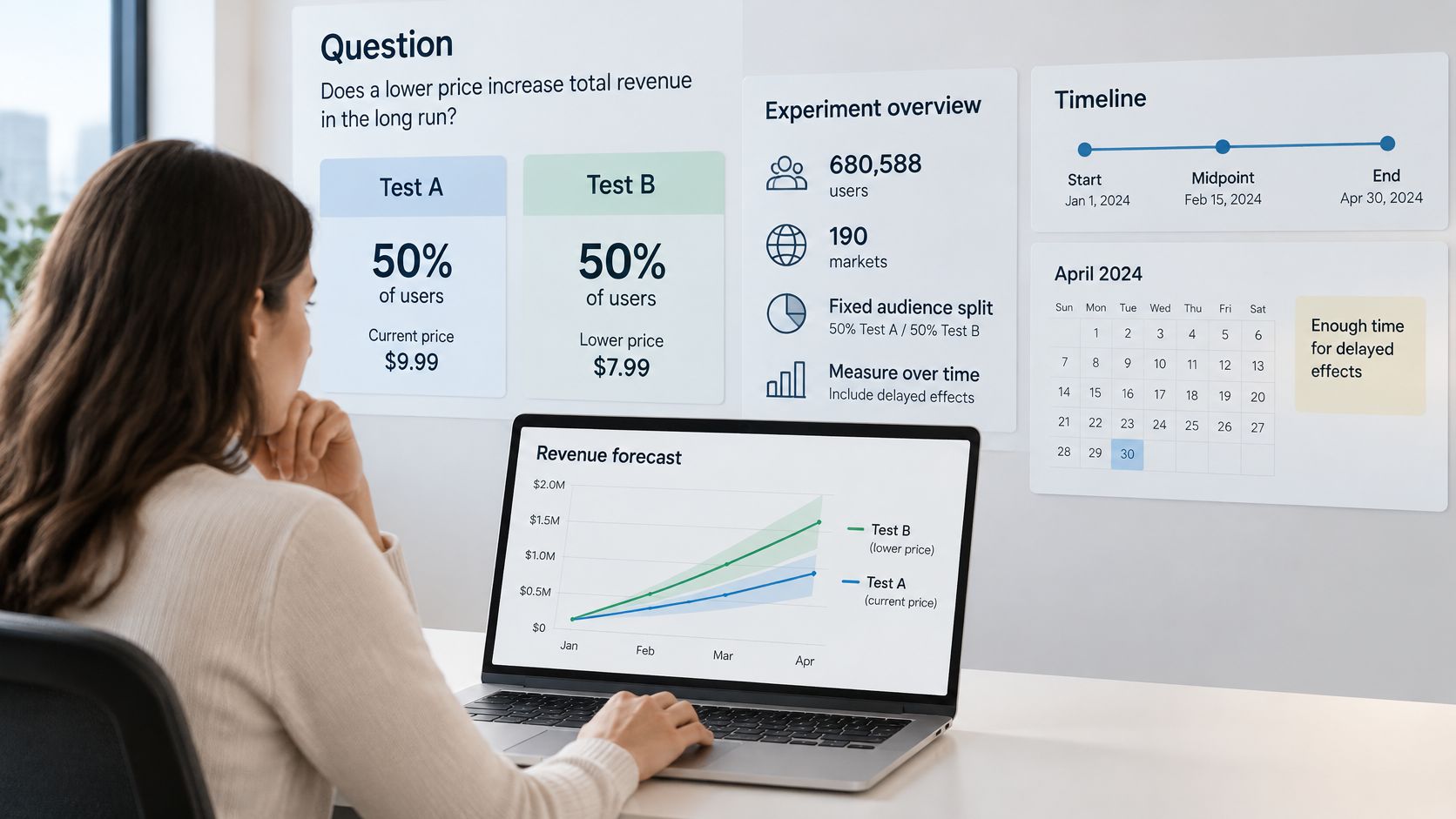
Every pricing test needs one clear question. Change the price, the trial length, or the tier contents. Don’t change all three and hope you’ll know what worked.
Keep the audience split fixed. Then wait long enough for delayed effects to show up.
Why trial starts can mislead you
A randomized field experiment indexed by PubMed involved 680,588 users across 190 countries and compared three day and seven day free trials in a freemium software model. Extending the trial increased trial adoption from 0.856% to 0.951%, an 11.098% relative increase.
Immediate conversion did not significantly improve. Longer trials increased delayed conversion instead.
That is why I don’t judge a trial on day seven signups alone. Extra free days can widen the funnel while pushing the payment decision later. If learners don’t finish a module, attend a live session, or get feedback, the extra time may only postpone a no.
Track each cohort by trial starts, activation, paid conversion at 30 and 60 days, retained subscribers, and lifetime value. For page level test mechanics, I use a similar discipline to split testing a course sales page, with one change per test.
A forecast you can fill in
- Count pricing page visitors each month. Use actual traffic where you have it.
- Multiply by the share who start a trial or enroll. Keep free and paid starts in separate rows.
- Apply the share who pay at 30 and 60 days. Delayed conversion belongs in the second column, not ignored.
- Multiply paid members by the net price for each tier. Use the price after processing fees, taxes you absorb, and a refund allowance. Don’t forecast from the sticker price.
- Subtract churn month by month for that same tier. A cheap tier with heavy churn may earn less than a smaller premium tier that stays.
- Add lifetime value per member. Multiply net monthly revenue per member by the average months members stay.
Here’s a worked example, labeled as an example only. Say 1,000 visitors see your page, 8 percent start a trial, and 20 percent of those pay at $30 a month. That’s 16 paying members and $480 in first month recurring revenue before you apply fees and refunds in the fuller sheet.
Put your own numbers beside it. Update the forecast each month with actual figures instead of hopes.
A forecast is useful when it shows net earnings per tier. A tier with lower signup volume can still win after fees and churn.
Retention, Pauses and Price Changes
People often stay longer when leaving is easy. That feels odd, but it changes how safe a subscription feels at signup.
The Business Wire report on the 2025 cancel anytime survey covered 1,454 consumers in the United States and United Kingdom and found 82% were more likely to subscribe when cancellation was easy. It also found 78% wanted the ability to pause or swap plans.
Price rises need the same care. In that survey, 90% noticed a price increase during the previous year and only 58% considered the increase justified.
Match the response to the reason
Voluntary churn from weak value is one problem. Temporary churn from money or time pressure is another. Locking both groups into the same save offer usually annoys everyone.
- Busy season: Offer a pause with a clear restart date. Keep progress and community history waiting.
- Budget squeeze: Offer a downgrade to a lower tier. Lower revenue now can beat a full cancellation.
- Failed card: Give a grace period and a plain payment update link. Don’t cut access on the first failed charge.
- Price rise: Send a clear notice before billing changes. State the new price, the date, and what members keep or gain.
- Left a few months ago: Send a reactivation offer tied to new material or a live cohort. A reason to return beats a random discount.
Measure the after effects
After any change, I watch reactivation rate, net revenue retention, refund requests, and support contacts. Trial to paid conversion alone won’t tell you whether a pause policy protected revenue.
Before you add a tactic, ask one question. Does this keep lifetime value higher than forcing a cancellation and trying to win the member back later?
If the answer is yes, an easy pause or downgrade is a retention strategy. It is also just decent treatment.
Confirm Your Pricing Before You Launch
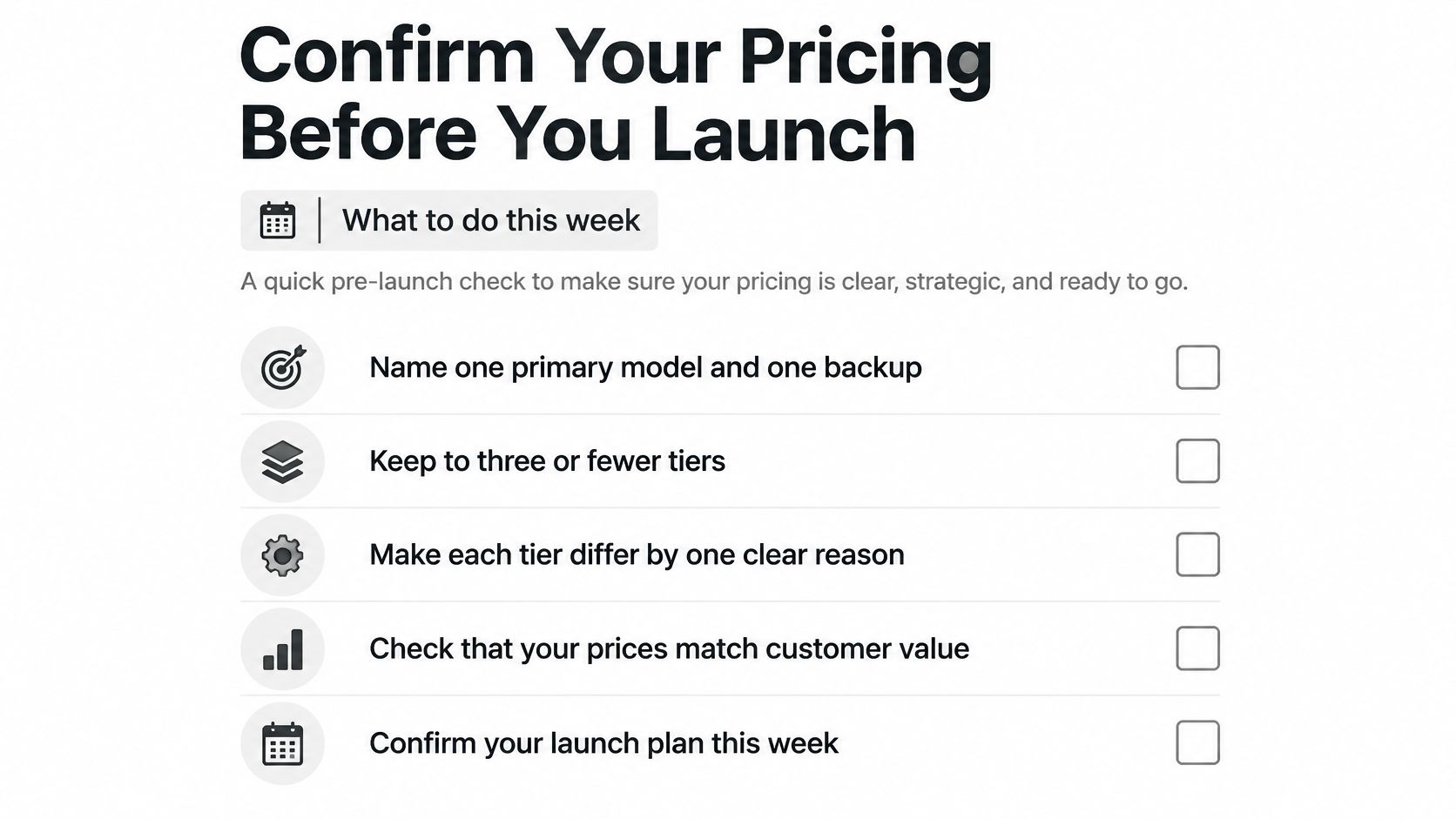
Keep this week simple. Name one primary model and one backup.
Stay at three tiers or fewer, with one clear reason for each step up. Set the annual discount inside the 16 to 25 percent range we used as a benchmark above.
Your short pre launch check
- Show the full buyer cost: Include fees, tax handling, and currency on the pricing page.
- Pick the entry offer by speed of value: Choose a trial or low entry price and set one milestone every new member must reach.
- Write the forecast: Fill the spreadsheet with net tier prices, refund allowance, and churn.
- Book the reviews: Schedule 30 day and 60 day checks for conversion, reactivation, and refunds.
LearnStream publishes guides on membership pricing, free trials, and low entry fees that can help when you’re comparing options. Treat every example here as a starting point, then let your own buyer data settle the argument.
Publish your pricing page draft to a small group of real buyers this week. Ask what confused them, what felt missing, and which tier they’d pick and why. Fix the top three questions, check the net numbers one last time, and launch to your full list with the 30 day review already on your calendar.