
Master Value Based Pricing Strategy for Online Courses

You’ve finished the lessons, polished the worksheets, and finally uploaded the last video.
Then the hard part shows up. You sit in front of the pricing box and freeze.
One creator in your niche charges a small one-time fee. Another charges a premium price for something that looks, at least on the surface, pretty similar. You start doing weird math in your head. Maybe you total up your software costs. Maybe you think about how many weekends you spent recording. Maybe you peek at competitor pages again and hope the answer will magically feel obvious.
I’ve seen this happen over and over with course creators and membership owners. The pricing stress usually comes from using the wrong reference point.
The strongest prices usually don’t come from your hours, your tools, or your anxiety. They come from the result your buyer cares about enough to pay for.
That Nagging Question How Much Should I Charge
A creator I know spent months building a course for freelance designers. She had templates, walkthrough videos, office hours, and a private community. The offer was solid. Her sales page was solid too.
But she changed the price constantly.
First, she tried a lower price because she was new. Then she raised it because a competitor charged more. Then she dropped it again because she worried people would say no. Nothing felt grounded. Every launch felt like a guess.
That’s the part that wears people out. Pricing starts to feel personal, almost like people are judging your worth instead of evaluating your offer.
Most course creators start in one of these places:
- Cost thinking because they want to make back what they spent
- Competitor thinking because it feels safer to copy the market
- Fear thinking because charging more feels risky
All three are understandable. None of them give you a stable pricing system.
Practical rule: If your price changes every time you look at someone else’s sales page, you don’t have a strategy yet.
A better anchor is value. That means pricing around the transformation your student gets, the problem they solve, the time they save, or the risk they avoid.
For educators, this is a big shift. You stop asking, “What should a course cost?” and start asking, “What is this result worth to the right learner?”
That question leads to a much clearer business. It also gives you a calmer way to make pricing decisions, especially if you sell a course, cohort program, membership, or training library.
What Value Based Pricing Really Means
The simplest way I explain value based pricing strategy is with coffee.
If a café used cost-plus pricing, it would add up the beans, milk, cup, labor, and a markup. If it used competitor pricing, it would check the café next door and stay close to that number.
Value-based pricing works differently. The café might charge more because it gives someone a quiet place to work, reliable Wi-Fi, and an hour of focus they can’t get at home. The ingredients matter, but the customer is paying for the experience and outcome.
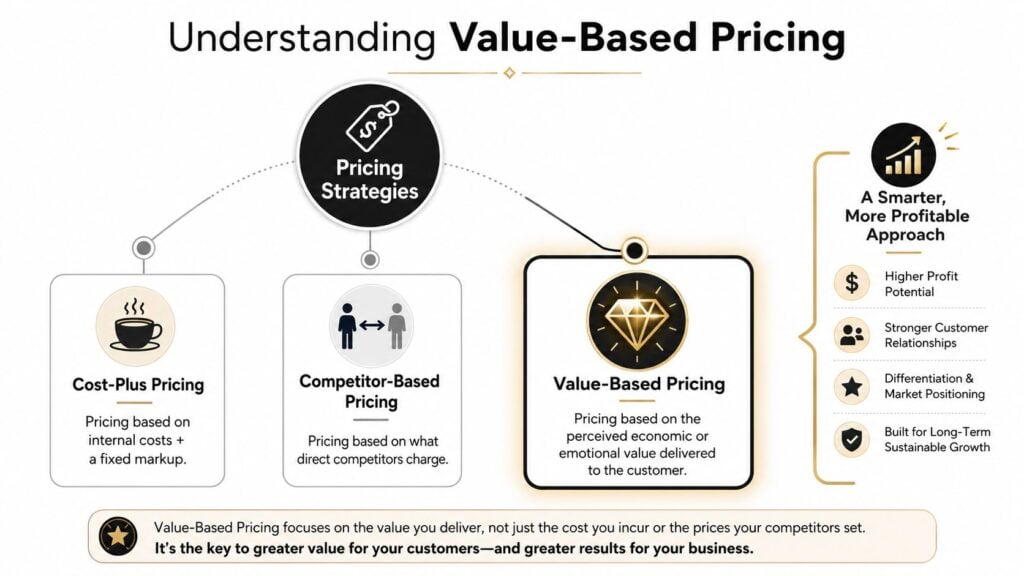
The real shift for online courses
For creators, this means your price shouldn’t start with your recording time or your editing bill.
It should start with the change your student wants.
If you teach job skills, the value may be getting hired faster, interviewing with more confidence, or avoiding months of confusion. If you run a membership for busy professionals, the value may be saved time, better systems, less stress, or more consistent progress.
That’s why value-based pricing became a central modern pricing discipline as companies moved away from cost-plus logic and toward willingness to pay and quantified outcomes, using methods like surveys, conjoint analysis, and Van Westendorp analysis to estimate what customers value, as explained by BillingPlatform’s guide to calculating value-based pricing.
What creators usually get wrong
A lot of people hear “value” and think it means sounding fancy on a sales page.
That’s not it.
Value is not vague inspiration. It’s the practical benefit someone gets after using your course or membership. In many cases, you can map it in plain language:
- Time saved from skipping trial and error
- Mistakes avoided because they follow a tested process
- Revenue potential if the skill helps them earn
- Stress reduced when they stop guessing
- Momentum gained because your structure helps them finish
If you teach software onboarding to teams, value might be saved staff time. If you teach parents how to plan meals, value might be less decision fatigue and smoother evenings. If you teach photographers how to book clients, value may connect to income opportunities and confidence during sales calls.
Why this feels more accurate than cost-based pricing
Your production cost and your customer’s result are rarely proportional.
Netflix is a useful analogy here. Most subscribers don’t think about the hosting bill for a show. They think about whether the service gives them enough entertainment, convenience, and choice to keep paying each month. The same logic applies to a course library or membership.
People buy progress. They rarely buy “modules” in isolation.
That’s why a value based pricing strategy usually creates better alignment. It pushes you to understand what your students want, then build and price around that.
When you do that well, pricing becomes less arbitrary and much easier to explain.
Why This Strategy Changes the Game for Creators
The biggest upside of value-based pricing isn’t just the number on your checkout page.
It changes how you design the offer, how you talk about it, and who it attracts.

Better-fit buyers usually respond better
When your offer is priced around a meaningful outcome, you tend to attract people who care about that outcome.
That matters for courses and memberships. Students who join because they want a real result are usually easier to serve than people who joined only because the price felt cheap. They read more carefully, show up with clearer expectations, and make stronger use of the material.
This also changes your messaging. Instead of filling your sales page with “30 videos” and “12 bonuses,” you focus on what those assets help someone do.
It gives you a cleaner way to improve the offer
Cheap pricing often hides weak positioning. Value-based pricing exposes it.
If people hesitate, you have a more useful question to ask. You don’t just ask whether the price is high. You ask whether the transformation is clear, believable, and important enough.
That usually leads to smarter improvements, such as:
- Sharper onboarding so students get an early win
- Better templates that remove friction
- Stronger support through office hours, feedback, or community
- Clearer segmentation so different buyers can choose the right tier
A mature approach to pricing also ties decisions to business health. For subscription businesses, a commonly used benchmark is a CLV:CAC ratio of 3:1 and churn in the 5%–7% range, while some businesses price 10%–30% above competitors when they can clearly prove differentiated value, according to Baremetrics on key metrics for value-based pricing.
For membership owners, that benchmark matters because it reminds you that pricing doesn’t live alone. It affects retention, expansion, and whether the offer feels worth renewing.
It builds confidence without turning you into a pushy marketer
This is the part creators don’t talk about enough.
Pricing gets easier when you can explain your logic to yourself.
You stop saying, “I hope this feels reasonable.” You start saying, “This is the result I help people get, and this is how I’ve packaged that value.”
That confidence shows up in your copy, your launch emails, and your sales calls.
A quick primer can help if you want to hear another perspective on communicating value in offers:

Why this works especially well for memberships
Memberships often look underpriced because creators focus on content volume.
But members usually stay for something else. They stay for accountability, curated guidance, updated resources, live access, momentum, and feeling supported. Those are value drivers, even when they don’t fit neatly into a spreadsheet.
That’s also why many membership owners benefit from separating entry access from premium access. Different members want different outcomes, and your pricing should reflect that reality.
Your Practical Framework for Setting a Value Based Price
This is the part I’d use if I were pricing a new course from scratch.
You don’t need a giant research team. You need a simple system and a willingness to listen carefully.
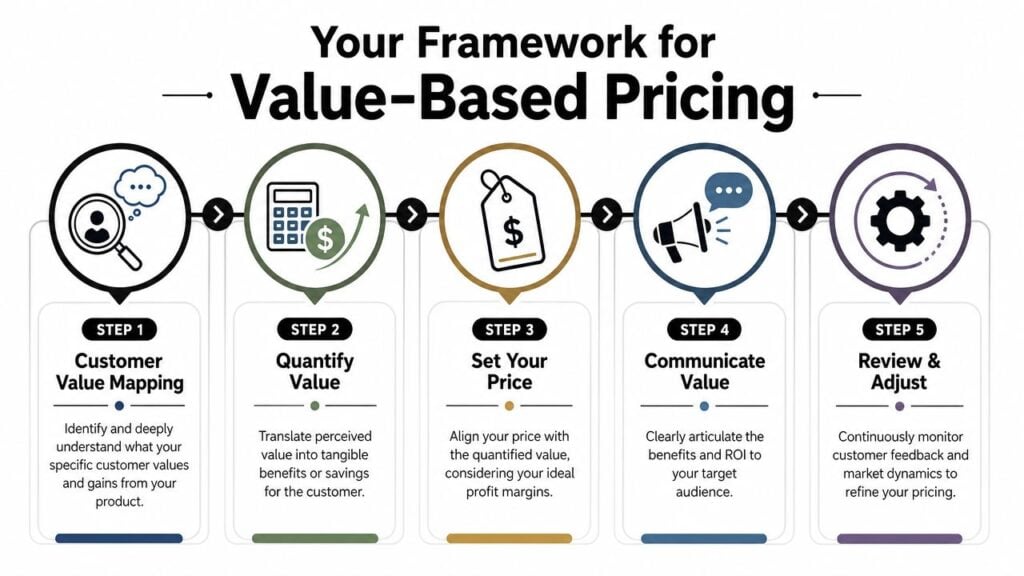
Step one, map the student’s before and after
Start with the learner, not the curriculum.
Write down who the offer is for, what they’re struggling with now, what they’ve already tried, and what “success” looks like in their words. If you have past students, use their language from emails, survey responses, DMs, and call notes.
A simple table helps:
| Student’s Current Pain Point | What They’ve Tried Before | Desired Outcome or ‘Dream Scenario’ | How My Course Helps Achieve That Outcome | Potential Monetary Value of Outcome ($) |
|---|---|---|---|---|
| Overwhelmed by client outreach | Free videos and random templates | Consistent client leads | Gives a repeatable outreach process and pitch templates | |
| Spending too much time planning lessons | Spreadsheets and scattered notes | Faster lesson prep | Provides planning systems and reusable frameworks | |
| Low course completion inside a team | Generic training portal | Better learner follow-through | Adds structured guidance and engagement checkpoints |
Don’t worry if the last column is hard to fill at first. Some offers are easier to quantify than others.
Step two, translate value into something more concrete
At this stage, creators often overcomplicate things.
You’re asking, “If this course works, what improves in the buyer’s life or business?” Sometimes the answer is direct income. Sometimes it’s time. Sometimes it’s avoided waste, avoided confusion, or avoided expensive mistakes.
Common ways to think about value:
Income-related value
If your course helps someone get clients, sell services, or improve retention, the value may connect to revenue.Time-related value
If your membership saves a manager or educator hours each week, that saved time has practical worth.Risk-related value
If your training helps a team avoid errors, compliance problems, or messy rework, that reduction matters.
BillingPlatform notes that many businesses map measurable outcomes to dollars by using examples like hours saved multiplied by wage rates or avoided losses from downtime or compliance failures in its value-based pricing framework for modern businesses. That same logic is useful for course creators, even in simpler form.
Quick gut check: If your sales page can’t explain the result in plain language, your price will always feel harder to justify.
Step three, research willingness to pay without asking the worst question
The worst question is “What would you pay for this?”
People usually answer that in a way that sounds careful, polite, or imaginary.
A better route is to ask about decisions and tradeoffs. For example:
Problem severity
“How costly or frustrating is this problem right now?”Past behavior
“What have you already bought, tried, or invested time in?”Alternative costs
“What happens if you don’t solve this in the next few months?”Feature importance
“Which parts of this offer would matter most when deciding to join?”
If you want a ready-made starting point, this SaaS pricing strategy survey from Formbricks is useful for structuring pricing conversations, even if your offer is a course or membership rather than software.
Step four, package the value into tiers
A single offer can serve different people badly. Tiers can fix that.
Someone may want self-paced access only. Another person may want feedback, office hours, community, or implementation help. Those are different value levels.
A good tier structure usually follows the buyer’s need for support, speed, or access. It should not feel like random feature stacking.
Try thinking in this format:
- Base tier for self-starters who want the core transformation
- Guided tier for learners who want feedback and structure
- Premium tier for people who want faster implementation, closer access, or team use
At this point, many creators finally see the point of a value based pricing strategy. You’re not just changing the number. You’re matching the offer to what different buyers value.
Step five, write the sales page around outcomes
If your pricing is value-based but your copy is feature-based, buyers will still feel friction.
Your page has to connect the dots clearly. That means leading with the problem, the desired result, the obstacles, your method, and the support that helps the student get there.
Helpful language often looks like this:
Before
“You’re spending too much time piecing this together on your own.”After
“You’ll follow a clear path with templates, examples, and support.”Why this offer is different
“This isn’t just information. It’s built to help you implement.”
That last part matters. Buyers rarely pay premium prices for information alone. They pay for movement.
How Value Based Pricing Looks in the Real World
A lot of pricing advice sounds sensible until you try to apply it to an actual offer.
So let’s make it concrete.
Example one, the career-focused course
Say you run a course for freelance writers who want better clients.
If you price it by effort, you might think about video hours, templates, your platform fee, and competitor pages. The result is usually a number that feels random.
If you price it by value, you frame the offer around the outcome. Better leads, stronger pitches, cleaner proposals, and more confidence in sales conversations. A buyer who believes your course can help them land stronger client work sees the purchase very differently.
That doesn’t mean you promise specific financial results unless you can support them. It means you position the offer around the practical transformation.
Example two, the parent membership
A meal-planning membership for busy parents may not sound like a premium product at first.
But the value isn’t the PDFs. It’s fewer stressful evenings, faster grocery decisions, less mental load, and a smoother weekly routine. That’s exactly why value-based thinking helps. It gets you to price the benefit, not the file format.
If you’re exploring other ways to build online course revenue, it helps to compare how different offer types create value beyond content alone.
Example three, the B2B training program
Now think about a course sold to teams. Maybe it teaches managers how to onboard staff or helps a company roll out internal training.
In that case, the buyer may care about saved staff time, smoother implementation, or better learner consistency. Team training often lends itself well to value-based pricing because the buyer is already thinking in operational terms.
In this context, enterprise-style packaging starts to make sense. You might offer different access levels, onboarding support, or admin features depending on the use case. If that’s your world, this guide on pricing a B2B online training program is worth reading alongside your own customer interviews.
The same course can feel expensive or obvious depending on how clearly the buyer sees the result.
Example four, the hobby course with emotional value
Not every course maps neatly to money.
A creative course on watercolor, songwriting, or pottery may deliver emotional value, identity, relaxation, or community. That still counts. People pay for enjoyment, confidence, creative expression, and a sense of progress all the time. Netflix, yoga studios, and hobby subscriptions prove that every day.
You still need clear positioning. The value may not be direct income, but it can still be strong and real.
Common Pitfalls and How to Sidestep Them
Value-based pricing is powerful, but creators trip over the same problems again and again.
Most of them happen when someone grabs the concept but skips the discipline.
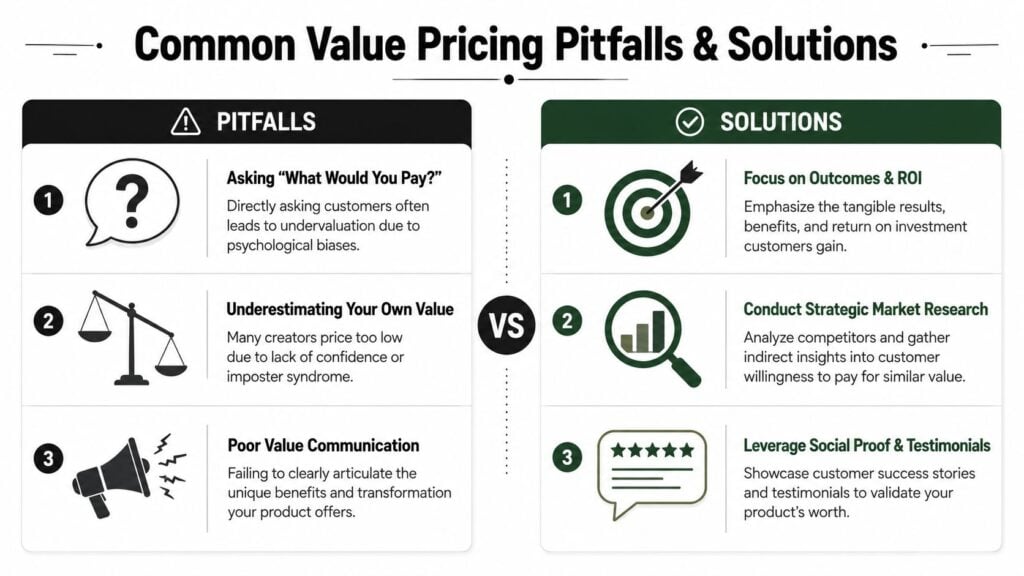
Asking what people would pay
This sounds smart, but it usually produces mushy answers.
People are much better at describing frustrations, priorities, and comparisons than naming an exact price in a vacuum. Ask about what they’ve tried, what the problem is costing them, what matters most in a solution, and what made them buy before.
That gives you context instead of guesswork.
Researching only your free audience
Your newsletter readers and Instagram followers can be helpful, but they aren’t always your best pricing sample.
Free audiences often include people who like your content but aren’t close to buying. If you only listen to them, you may shape pricing around the least committed part of your market.
Talk to buyers, former buyers, lost leads, and people actively trying to solve the problem. Those conversations are usually more useful.
Underpricing because confidence is shaky
This one is common with educators.
You know your material well, so the process feels obvious to you. That can make you underestimate how valuable your structure is to someone who’s still stuck. If your course helps people avoid confusion, wasted time, and repeated mistakes, that has value even if it feels simple from your side.
Reality check: Easy for you doesn’t mean unimportant for them.
Setting the price once and never reviewing it
Pricing needs a feedback loop.
For mature teams, value-based pricing works best as a closed-loop system where you translate perceived value into measurable metrics, then review pricing decisions against customer outcomes like CLV and churn on a recurring basis, often through quarterly audits and A/B tests to estimate elasticity, according to Vendavo’s explanation of value-based pricing systems.
For creators, that can look simpler:
- Review buyer feedback after launches and onboarding
- Watch retention patterns if you run a membership
- Track objections from sales calls, emails, and checkout abandonment
- Test adjacent prices instead of making dramatic jumps
If you run recurring offers, it also helps to study different subscription pricing models for memberships and digital products so your structure matches how customers experience value over time.
A price is a business decision, not a personality test. Treat it like something you can refine.
If you’ve been circling the same pricing question for months, start smaller than you think.
Talk to a few real buyers. Map the before and after. Tighten your offer around the result people care about most. Then choose a price that reflects that value more accurately than your old guess did.
That’s how a value based pricing strategy becomes useful. Not as a buzzword, but as a practical way to price courses and memberships with more clarity.