What Is a Cohort Program and How It Boosts Learning

A cohort program is a learning model where a group starts together, follows the same curriculum in a fixed sequence, and finishes together. Its defining advantage is dramatically higher completion, with cohort-based programs often reporting completion rates above 90%, compared with commonly cited rates below 10% for self-paced MOOCs.
You may have seen this contrast in your own teaching or learning. A self-paced course looks wonderfully flexible on day one. A learner signs up, watches the welcome lesson, and plans to return after work. Then a busy week arrives, the course slips down the priority list, and the unfinished lessons become easy to ignore.
A cohort changes the rhythm. Learners begin on a shared date, meet the same milestones, discuss the same assignments, and know that other people are moving through the material beside them. I’ve run both formats, and the difference usually shows up less in the quality of the lessons than in what happens after the first enthusiastic week.
Introduction to What a Cohort Program Really Means
At its simplest, a cohort program is a learning group that progresses through a common experience together. Members usually enter during the same enrollment window, follow a shared sequence, work toward the same goals, and complete the program within a defined period. The group may meet live, work asynchronously between sessions, or use a combination of both.
Think of a book club. Everyone reads the same chapters before a scheduled discussion. You might read at different speeds during the week, but the group has a common destination and a reason to keep going. A cohort course uses that same social rhythm for a more structured learning experience.
The model became especially valuable as online education expanded. Digital delivery made it possible to reach more learners, but purely asynchronous courses often left each person alone with the material. Cohort programs kept peer interaction, accountability, and instructor contact in the learning design. A widely cited summary of cohort-based learning reports 96% completion for altMBA, 98% to 100% for some Esme Learning cohort courses, and over 90% for Nomadic Learning programs (cohort-based learning statistics).
That comparison doesn’t mean every cohort will produce the same result. It does explain why course creators, professional educators, and training teams use the model when finishing matters as much as enrollment.
A simple learner example
Suppose Maya buys a self-paced course on instructional design. She has access to every module immediately, but no fixed point at which she must submit work. She understands the lessons, yet she keeps postponing the assignments.
In a cohort version, Maya starts with a group. The first week covers learning objectives, the next milestone involves an assignment, and a live discussion gives her a place to ask questions. Her classmates create useful pressure, while the instructor can spot confusion before it turns into withdrawal.
For learners who need flexibility, a cohort can feel restrictive. For learners who need a dependable routine, that same structure can be the feature that helps them finish. If you’re designing one, create opportunities for learners to exchange work, ask questions, and build relationships. A resource on peer group content can help you think through the community layer without treating discussion as an afterthought.
How Cohort Based Learning Actually Works
A cohort depends on three connected decisions. You choose what learners study together, when they move through it, and who stays with them during the experience. Remove one of those links, and you may still have a group course, but the program will feel less like a true cohort.
Core definition: A cohort program is a deliberately structured learning unit where members enter and complete a program in the same period, follow a common sequence of courses, and share a fixed set of learning experiences. (Higher-education cohort research)
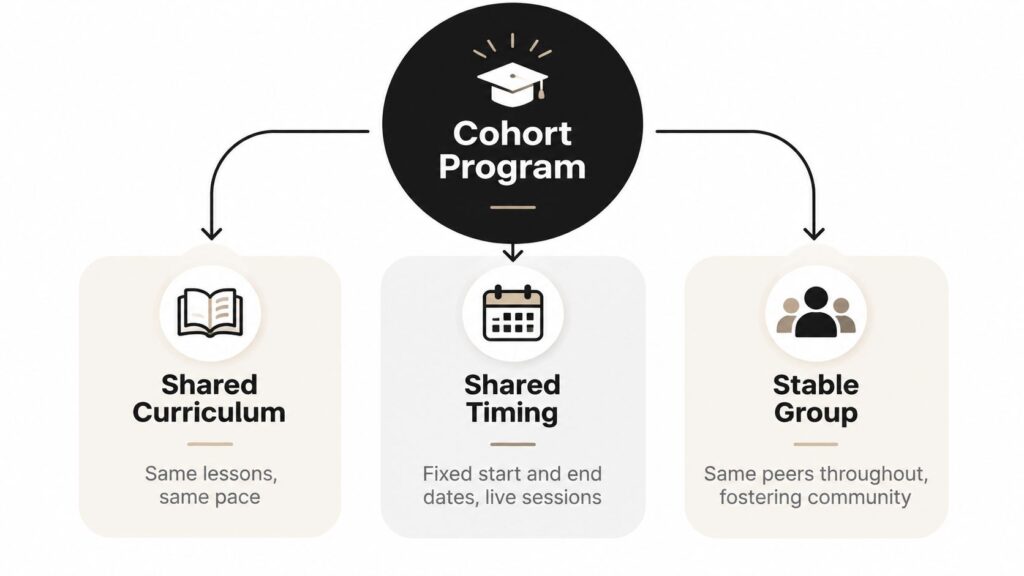
Shared curriculum
Everyone works from a common learning path. That doesn’t require identical answers or identical projects, but the lessons connect in a deliberate order. An introductory module prepares learners for a practical task, and that task gives them the foundation for the next module.
A creator might group lessons into a sequence such as:
- Learn the concept: Study the framework through a lesson, reading, or demonstration.
- Apply the idea: Complete an assignment using a real project.
- Discuss the result: Bring questions, decisions, or drafts to the group.
- Build on the work: Use feedback in the next stage.
This sequence gives learners a shared vocabulary. When someone asks about a problem, classmates generally know which idea or assignment is involved.
Shared timing
A cohort has a calendar. It might include a fixed start date, weekly deadlines, live workshops, office hours, or a final presentation. The schedule creates useful moments for contact, which matters because learners can disappear when every deadline is optional.
The calendar doesn’t need to be rigid in every detail. You can offer recordings, flexible submission windows, or an asynchronous discussion period while keeping the larger group on the same path.
Stable group membership
The same people continue through the program together. That stability makes it easier for learners to recognize each other’s strengths, give relevant feedback, and form habits of participation. A newcomer joining halfway through may contribute, but they won’t have the same shared history.
The group also performs real learning work. Learners review drafts, solve problems in pairs, compare approaches, and explain concepts to one another. Research on cohort models describes this intentional connection between curriculum, timing, and group membership as a way to create a learning community through shared milestones and interdependent tasks (cohort learning structure).
I think of the format as a guided train journey. Learners can look out the window at different things, but they leave the station together, stop at the same major points, and arrive with a shared experience.
Key Elements That Make or Break a Cohort Program
A cohort can have a start date and a group chat and still produce a disappointing experience. The design has to support the work learners are expected to do. Strong programs connect the schedule, teaching team, assignments, and peer activity instead of treating them as separate features.
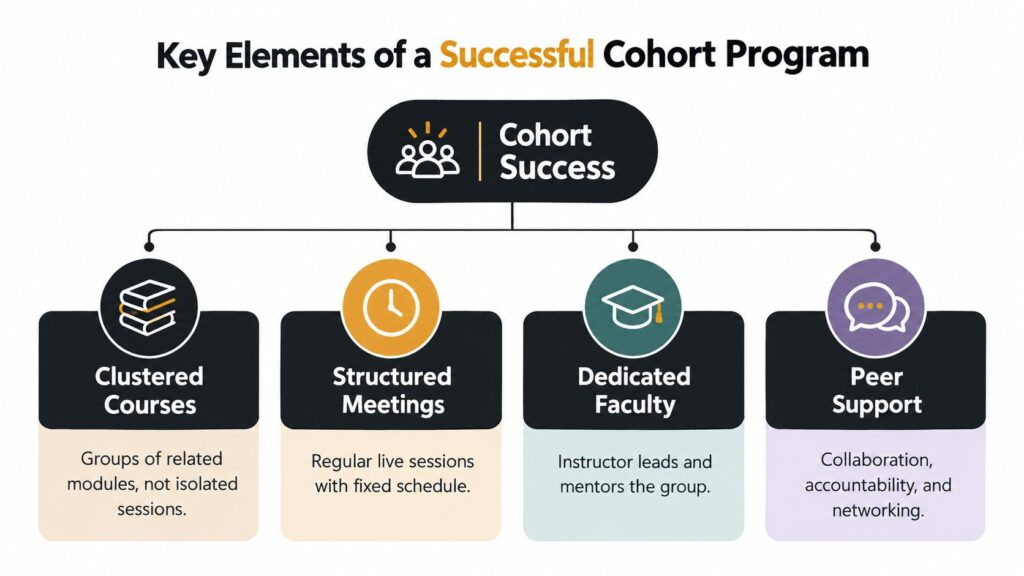
Clustered courses and milestones
Related lessons work better when they form a recognizable block. Learners can see how one topic supports the next, rather than treating every session as an isolated event. Shared milestones then give the group a common point for feedback and reflection.
A schedule people can actually follow
A structured meeting schedule creates momentum, but it also creates friction. A weekly live session may suit full-time professionals and still exclude someone working shifts or living in another time zone. Before setting the calendar, ask when your audience can reliably participate.
Faculty presence
The instructor does more than deliver content. They clarify confusing points, notice weak submissions, moderate discussions, and help learners decide what to do next. Dedicated faculty can make a structured course feel supported rather than merely monitored.
Peer support with a purpose
A community becomes useful when learners have a reason to interact. Peer review, paired practice, group problem-solving, and progress check-ins work better than a general invitation to “network.” For practical guidance on designing that layer, see this resource on building community in an online course.
A vocational technical certificate study identified six design elements in its cohort model, including block scheduling, a defined peer cohort, a limited number of dedicated faculty, embedded in-class peer support, faculty support, and active job placement assistance after completion. That study found higher completion and shorter time to completion for students in the cohort model (vocational cohort model study).
The tradeoff is real. Fixed pacing can reduce scheduling flexibility, and participants may face greater personal costs when they must attend at set times or complete work in a narrow window. Research also warns that outcomes depend on context. Learners may report stronger attitudes and satisfaction even when objective success measures don’t change (cohort learning outcomes research).
Design rule: Measure both completion and learner experience. A lively cohort that doesn’t help people finish needs redesign, and a high-completion program that leaves learners frustrated has its own problem.
Synchronous vs Asynchronous Cohorts and Hybrid Options
The word “cohort” doesn’t automatically mean every learner must sit in a live video call at the same time. The shared element can be a deadline, a project, a discussion cycle, or a sequence of milestones. The right amount of synchronicity depends on the work and on the lives of the people you’re serving.
| Model | Best For | Live Commitment | Flexibility |
|---|---|---|---|
| Synchronous cohort | Learners who benefit from immediate discussion, practice, and instructor feedback | Regular live sessions | Lower, because attendance follows a shared schedule |
| Asynchronous cohort | Global groups, shift workers, caregivers, and learners who need time-zone flexibility | Little or no required live attendance | Higher, while deadlines and group progress remain shared |
| Hybrid cohort | Programs that need live connection alongside independent work | Selected workshops, office hours, or group events | Moderate to high, depending on which sessions are required |
Synchronous cohorts
A synchronous design works well when learners need to practice together. Coaching, presentation skills, facilitation, discussion-heavy subjects, and collaborative projects can benefit from immediate interaction. The instructor can respond in the moment, and learners can build trust faster through repeated contact.
The cost is calendar pressure. A live schedule affects attendance, recording management, facilitation, and support. If your audience spans several time zones, one convenient meeting time may be convenient only for part of the group.
Asynchronous cohorts
An asynchronous cohort keeps the group moving through shared deadlines without requiring everyone to appear live. Learners might watch a lesson, submit a reflection, respond to peers, and complete a project within the same weekly window.
This structure works when the learning tasks need thought and practice more than instant conversation. It still needs active facilitation. Without reminders, feedback, and visible milestones, an asynchronous cohort can gradually become a self-paced course with a marketing label.
Hybrid cohorts
Hybrid delivery often gives creators the most practical balance. You can use a recorded lesson for core content, a live workshop for application, and a discussion space for questions that don’t require a meeting. If you’re deciding how much live time to include, this guide to synchronous and asynchronous learning offers a useful comparison framework.
I usually recommend making only the live activities that benefit from presence mandatory. A routine announcement can be recorded. A feedback clinic, role-play, or group critique may deserve the shared room.
Where Cohort Programs Shine in Real Life
A cohort earns its place when learners need to apply ideas with other people, not collect lessons. In professional upskilling, people studying project management, leadership, or instructional design can bring workplace situations to the group, compare possible responses, and test an approach between sessions.
Executive education uses the same structure for higher-stakes decisions. A participant can bring a real hiring decision to the group, hear how three peers handled similar situations, and revise the approach before the next session. That exchange gives the schedule a practical purpose. It may also justify the extra work of live facilitation when completing the work matters more than having unlimited flexibility.
Vocational training adds a different operational benefit. In the vocational study, the cohort model shortened time to completion because placement support was built into the calendar rather than offered as an optional service (vocational certificate cohort research). The lesson is broader than job training. A cohort can improve follow-through when the next action is scheduled, visible, and connected to the learner’s goal.
Creator-led courses and memberships can apply the model to launches, writing programs, business skills, language learning, and implementation challenges. A creator might open enrollment for a defined period, guide learners through weekly tasks, and finish with a portfolio review or group showcase. The shared deadline turns a loose intention into a sequence of actions.

Smaller groups can solve larger scheduling problems
Large groups are not automatically better. Micro-cohorts can keep discussion and accountability while making feedback easier to manage. They also help when learners begin with different levels of experience. You might group beginners for foundational practice, then bring several groups together for selected workshops.
Hybrid delivery and AI-supported personalization can adjust practice without removing the social structure. A learner may receive exercises suited to their level while sharing a project deadline and discussion space with the wider cohort.
Global audiences need the same flexibility. Every activity does not have to happen simultaneously. Enough shared work still matters, because learners can see progress made alongside other people without requiring one schedule for everyone.
How to Decide If a Cohort Model Fits Your Offer
The central business question is simple. Will shared pacing and facilitation help enough learners complete the work to justify the additional operational effort?
A cohort requires more than uploading lessons. Someone needs to manage enrollment, prepare the calendar, facilitate sessions, answer questions, review work, send reminders, and handle the points where learners fall behind. The creator also accepts a calendar constraint. You may earn less flexibility in exchange for a more supported experience.

Start with the learner’s problem
A cohort is a stronger fit when learners struggle with follow-through, need feedback on applied work, or benefit from practicing with peers. It may be a weaker fit when the audience has unpredictable schedules, wants permanent access, or needs to move through topics at very different speeds.
Use these questions before committing:
- Completion problem: Do learners enroll but fail to finish without external structure?
- Interaction problem: Will peer feedback or live practice improve the learning task?
- Facilitation capacity: Can you provide consistent teaching and support throughout the calendar?
- Schedule fit: Can most learners meet the proposed deadlines or live sessions?
- Outcome measurement: Will you track completion alongside satisfaction and quality of learner work?
Research on cohort retention supports the value of planned follow-up. A systematic review found an average retention rate of 73.5% across studies, with an average of 4.6 waves over 4.3 years. The same review reported that reminder letters improved retention by 12%, reminder calls by 5%, and repeat questionnaires by 12% (retention in population-based cohort studies). Educational cohorts aren’t identical to research panels, but the design lesson is useful. Repeated contact and scheduled checkpoints help people remain active.
Run a small test first
A micro-cohort lets you test the calendar, workload, onboarding, reminders, and discussion prompts before scaling. Keep the first version focused enough that you can observe where learners pause or disengage.
You can also compare the structure with a self-paced course system when deciding which delivery model belongs in your offer. LearnStream discusses self-paced delivery alongside tools such as drip scheduling and learner monitoring, which can help creators build structure without requiring every learner to attend live.
A useful threshold: Offer a cohort when the support, practice, and accountability solve a meaningful completion problem. Don’t add live sessions simply because the format sounds more engaging.
Final Takeaways on Choosing Your Cohort Path
A cohort program gives learners a shared route through a course. They start within the same period, follow a common sequence, encounter the same milestones, and learn with a stable group. The structure creates more opportunities for peer support and instructor intervention than a course that asks everyone to manage their own progress alone.
The strongest reason to choose the model is usually retention and completion. Cohort-based learning has been associated with completion rates often above 90%, while commonly cited self-paced MOOC completion rates sit below 10% (cohort learning completion data). Those figures don’t guarantee that your program will produce the same result. They do show why shared pacing deserves serious consideration when unfinished learning is your main challenge.
Before you launch, make three decisions:
- Define the shared experience: Choose the lessons, projects, and milestones everyone will follow.
- Choose the lightest workable schedule: Add live sessions where discussion or practice matters, then keep other work flexible.
- Measure the right outcomes: Track completion, participation, quality of applied work, and learner satisfaction together.
Pay attention to the people your format may exclude. Time zones, caregiving, shift work, disability, and uneven prior knowledge can all make a rigid schedule difficult. Micro-cohorts, recordings, asynchronous deadlines, and adaptive activities can preserve the community while reducing unnecessary pressure.
A good cohort feels structured because the design is intentional, not because every minute is controlled.
If you’re unsure, pilot a small group before rebuilding your entire course. Map the milestones, prepare your reminders, assign responsibility for facilitation, and ask learners where the schedule helped or hindered them. Then use that evidence to decide whether a full cohort, a hybrid experience, or a well-structured self-paced course serves your audience best.
Ready to test the idea? Choose one focused learning outcome, invite a small pilot group, set a shared start and finish date, and schedule the first milestone before enrollment opens. At the end, compare completion, learner work, and satisfaction, then use what you learn to shape the next version.