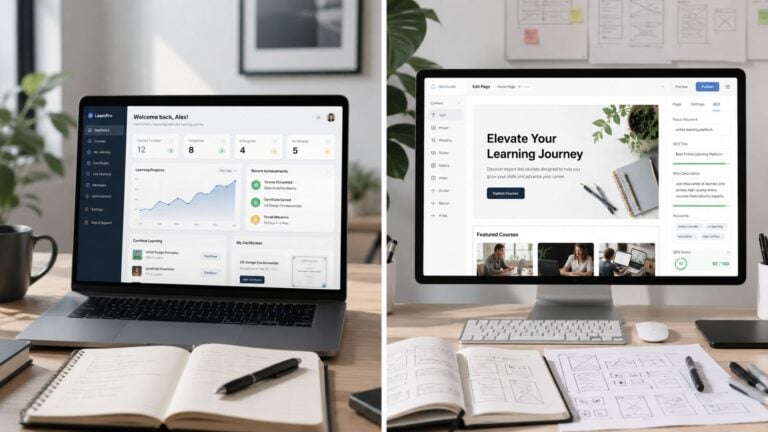
The 12 Best Instructional Design Templates to Use in 2026
I get it. You’re juggling a dozen projects, trying to keep subject matter experts happy, and a deadline is always just around the corner. Starting every course design from a blank page is exhausting and, frankly, a huge time-waster. That’s where a solid set of instructional design templates comes in.
These templates aren’t about cutting corners. They are a professional, proven starting point so you can focus your energy on what really matters, which is crafting an effective and engaging learning experience. Think of them as a structural foundation that speeds up the technical build, letting you pour your expertise into the content and activities.
Over the years, I’ve tested countless resources, from full-blown course starters in authoring tools like Articulate and Captivate to simple storyboard docs in Miro or SessionLab. Some were a game-changer for my workflow, while others were more trouble than they were worth. I’ve put together this comprehensive list to share the ones I truly believe can make a difference in your day-to-day work.
This article is your one-stop shop for finding the best instructional design templates for your specific needs. We’ll explore a variety of options, including:
- Authoring Tool Libraries: like Articulate 360 and iSpring Suite.
- Specialized Template Providers: such as ELB Learning and FasterCourse.
- Storyboarding & Planning Tools: including Miro, Boords, and Mural.
For each resource, I’ll provide a direct link, share screenshots, and break down the pros, cons, and best-use scenarios. My goal is to give you a clear, honest look at what’s available so you can stop reinventing the wheel and start building better courses, faster. Let’s find the right tools for your toolkit.
1. Articulate 360 – Content Library
The Articulate 360 Content Library is less of a repository of standalone files and more of a fully integrated ecosystem for its authoring tools, Storyline 360 and Rise 360. If you’re building courses within this environment, the library is an incredible resource for kickstarting development. I often turn to its prebuilt slide layouts and interaction templates in Storyline to avoid building common structures, like tabs or timeline interactions, from scratch.

This tight integration is the platform’s biggest strength. You can drop professionally designed course templates directly into Rise or add character sets and stock photos to Storyline without ever leaving the application. This makes it one of the most efficient sources for high-quality instructional design templates available, assuming you’re already an Articulate user. For those just starting out, understanding the fundamentals of a good course structure is key before jumping into templates. You can explore some core principles by reading more about instructional design for online courses to get a solid foundation.
Platform Breakdown
| Feature | Details |
|---|---|
| Best Use Case | Quickly building polished, interactive courses in Storyline 360 or Rise 360 without starting from a blank slate. |
| File Formats | N/A (Integrated directly into Articulate 360 apps). |
| Access/Pricing | Requires an Articulate 360 subscription (teams or individual plans available, starting around $1,399/user per year). |
| Key Advantage | The seamless workflow. Assets are continuously updated and drop directly into your projects, saving significant development time. |
| Primary Limitation | The cost can be a major barrier for freelancers or small teams, and the assets are locked within the Articulate ecosystem. |
2. iSpring Suite – Content Library (Suite Max)
For teams that live and breathe PowerPoint, iSpring Suite offers one of the fastest on-ramps to creating SCORM-compliant eLearning. Its Content Library, included with the Suite Max plan, is designed to work directly within the familiar PowerPoint interface. I find this approach incredibly efficient for subject matter experts who aren’t full-time instructional designers but need to produce high-quality training materials quickly.
The library is stocked with useful slide layouts, characters, and backgrounds that make a standard presentation feel like a purpose-built course.

The real power here is speed. You can build out an entire course using pre-made templates for title slides, timelines, and info-heavy layouts, then publish it as an interactive module without ever leaving PowerPoint. The included instructional design templates for quizzes and dialogue simulations are also quite solid. They let you add assessments and branching scenarios with minimal fuss. The cloud collaboration feature, iSpring Space, also makes it simple to share work and get feedback from stakeholders, which is a big plus for team-based projects.
Platform Breakdown
| Feature | Details |
|---|---|
| Best Use Case | Rapidly converting existing PowerPoint presentations into interactive SCORM courses or building new modules in a familiar environment. |
| File Formats | N/A (Integrated directly into the iSpring Suite PowerPoint add-in). |
| Access/Pricing | Requires an iSpring Suite Max subscription, which starts around $970/author per year. |
| Key Advantage | The incredibly gentle learning curve for anyone proficient with PowerPoint, allowing for very fast development cycles. |
| Primary Limitation | The authoring tool is Windows-only, which excludes Mac users, and the template designs can feel less modern than some competitors. |
Website: www.ispringsolutions.com
3. ELB Learning (formerly eLearning Brothers) – Asset & Template Library
ELB Learning, known for a long time as eLearning Brothers, is one of the original and most extensive template libraries out there. Its biggest differentiator is its massive cross-platform support. I’ve used it for projects in Storyline, Captivate, and even PowerPoint when a client needed a quick, editable solution. This makes it a go-to resource for teams or freelancers who work across different authoring tools and don’t want to be locked into a single ecosystem.

The library is packed with everything from full course templates and interactive scenarios to gamified quizzes and character packs. The sheer volume is impressive, and I find their themed “skins” are great for giving a project a quick visual facelift.
For those needing instructional design templates that can scale with a growing team using a variety of software, ELB Learning is a strong contender. The only caution I’d offer is to review templates carefully, as some legacy assets can feel a bit dated compared to newer designs.
Platform Breakdown
| Feature | Details |
|---|---|
| Best Use Case | Teams and individuals using multiple authoring tools (Storyline, Captivate, etc.) who need a single, versatile asset source. |
| File Formats | .story, .cptx, .pptx, .lectora, plus standard image and video files. |
| Access/Pricing | Subscription-based. Pricing often requires a direct quote from their sales team, especially for enterprise or team licenses. |
| Key Advantage | The breadth of support for different authoring tools is unmatched, providing excellent flexibility for diverse development needs. |
| Primary Limitation | The need to contact sales for pricing can be a hurdle for quick decisions, and some older assets might require visual updates. |
Website: www.elblearning.com
4. FasterCourse – Template Library
FasterCourse offers a focused library of modern, clean templates specifically for Articulate Storyline, Adobe Captivate, and Rise. I find their resources especially useful when a project requires a contemporary look without a lot of heavy rebranding. The templates are organized into consistent “families,” so if you download a scenario interaction, you can easily find a matching quiz or layout set, which keeps the visual design cohesive.

What really stands out is the value for Storyline and Captivate developers. Instead of a subscription, you can buy individual templates or a full library pass. This makes it accessible for freelancers or smaller teams. The one-click download and integration are straightforward.
For anyone tired of dated or overly corporate-looking assets, these instructional design templates provide a fresh, professional starting point. Their gamified quizzes and interactive scenarios are particularly effective for adding engagement without building complex logic from the ground up.
Platform Breakdown
| Feature | Details |
|---|---|
| Best Use Case | Acquiring modern, ready-to-use interactions, games, and layouts for Storyline and Captivate projects on a budget. |
| File Formats | .story, .cptx (direct downloads for authoring tools), plus Rise 360 block templates. |
| Access/Pricing | Individual templates, bundles, or a full-access library pass are available (e.g., full library access is around $599). |
| Key Advantage | High-quality, contemporary visual design and transparent, flexible pricing. A great value for the most popular authoring tools. |
| Primary Limitation | The catalog is smaller and more specialized than larger stock sites. Its main benefit is for Storyline and Captivate users. |
Website: fastercourse.com
5. eLearningArt – Instructional Design Templates & Storyboards
Unlike a fully integrated ecosystem, eLearningArt focuses on the foundational documents and assets that get a project off the ground. I frequently use their resources for the crucial planning phase, especially their storyboard and design document templates. They provide a solid, structured starting point that helps align stakeholders and clarify the visual and narrative flow before any development even begins. Their collection is specifically built for instructional designers, with assets sized and designed for common authoring tools.

The real value here is in rapid prototyping and visualization. Grabbing a pre-made character cutout and a background scene allows me to mock up a key interaction in minutes. This is far more effective in a kickoff meeting than a text-only description. When using these storyboards for multimedia content, precise script timing is crucial for syncing audio and visuals. Learning about mastering words to minutes can help perfect your narration timing.
The combination of practical documentation and ready-to-use visuals makes this a go-to for instructional design templates that support the entire project lifecycle.
Platform Breakdown
| Feature | Details |
|---|---|
| Best Use Case | Rapidly creating visual storyboards, design documents, and project blueprints before moving into an authoring tool. |
| File Formats | PNG, PPT, DOCX, and other common image and document formats. |
| Access/Pricing | Offers a mix of free templates and a paid subscription model (starts around $499/year per user) for their full asset library. |
| Key Advantage | The focus on foundational ID documents and helpful tutorials makes it great for both planning and practical application. |
| Primary Limitation | The library has fewer full-course templates compared to authoring-tool-native platforms, with a focus on assets over UI widgets. |
Website: elearningart.com
6. Instructional Design Central (IDC) – Template Package
While many template providers focus on visual assets for authoring tools, Instructional Design Central (IDC) zeroes in on the project management and documentation side of our work. It offers a downloadable package of practical, editable files that bring structure to the entire instructional design process. I find these templates invaluable for standardizing my workflow, especially when onboarding new team members or managing complex projects that require clear stakeholder communication.

This collection shines by providing the foundational documents that support a project from start to finish. You get everything from needs analysis forms and design document outlines to detailed storyboard templates and evaluation forms. Because they are Word and PowerPoint files, adapting them to your organization’s branding and specific project needs is straightforward.
These are the kinds of instructional design templates that help you organize your thoughts and align your team before a single slide is ever built in an authoring tool. This focus on process documentation is what makes IDC a unique and essential resource for serious instructional designers.
Platform Breakdown
| Feature | Details |
|---|---|
| Best Use Case | Standardizing the documentation process for ADDIE or SAM-style projects and improving stakeholder alignment. |
| File Formats | DOCX (Word), PPTX (PowerPoint), PDF. |
| Access/Pricing | Available as a complete digital download package or individual templates for a one-time purchase. |
| Key Advantage | The templates are purpose-built for core ID tasks like storyboarding and design documentation, speeding up administrative work. |
| Primary Limitation | This is not a library of visual or media assets. There are no integrations with e-learning authoring tools. |
Website: www.instructionaldesigncentral.com
7. Miro – Course/Learning Design Storyboard Templates (Miroverse)
Miro has become my go-to for the messy, collaborative beginning of any instructional design project. Its community-driven template library, the Miroverse, offers a fantastic collection of canvases for planning and storyboarding. Instead of a rigid, linear document, these templates provide a flexible visual space where my team and I can map out course structures, brainstorm activities, and design branching scenarios in real-time.

The power here is in co-creation. I can invite stakeholders and subject matter experts directly onto a board to contribute ideas, leave feedback with sticky notes, and collectively build the learning journey. For dynamic visual planning and teamwork, tools like Miro are among the best collaborative whiteboard apps available.
While these boards don’t produce a final eLearning file, they are invaluable planning artifacts. They ensure everyone is aligned before a single slide is built, providing some of the most useful instructional design templates for the critical planning phase.
Platform Breakdown
| Feature | Details |
|---|---|
| Best Use Case | Collaborative storyboarding, mapping learning journeys, and facilitating remote design workshops with SMEs and stakeholders. |
| File Formats | N/A (Online canvas). Boards can be exported as images (JPG, PNG) or PDFs for documentation and sign-off. |
| Access/Pricing | Free plan available with limited boards. Paid plans unlock advanced features and unlimited boards (starting around $10/user per month). |
| Key Advantage | The real-time, flexible collaboration is perfect for agile design sprints and getting early buy-in from project teams. |
| Primary Limitation | The templates are planning tools, not development assets. You cannot export them into a format for an authoring tool like Storyline. |
Website: miro.com/miroverse
8. Boords – Instructional Design & eLearning Storyboard Templates
Boords is my go-to when I need to get a storyboard in front of a stakeholder quickly and without fuss. It offers a set of beautifully clean, downloadable storyboard templates specifically designed for instructional and eLearning projects. These free PDFs are perfect for printing and sketching out ideas or for creating a clear, low-fidelity prototype to get early buy-in from subject matter experts. The focus is purely on the storyboarding phase, which is a critical, often-overlooked step in creating effective learning experiences.

While the downloadable templates are static, Boords also offers a cloud-based tool that takes storyboarding to the next level. You can use it to build out your boards collaboratively, add notes, and get sign-offs all in one place. I find this online version particularly useful for remote teams.
Its strength lies in its simplicity. This makes it one of the most accessible instructional design templates for clarifying visual and narrative flow before you ever touch an authoring tool. This dedicated approach helps ensure the instructional foundation is solid before diving into development.
Platform Breakdown
| Feature | Details |
|---|---|
| Best Use Case | Rapidly creating and sharing clean, professional storyboards for stakeholder review, especially in the early stages of a project. |
| File Formats | PDF (for free downloadable templates), or exportable formats from the online tool. |
| Access/Pricing | Templates are free to download. The optional online storyboarding tool has a free tier and paid plans starting around $29/month. |
| Key Advantage | The low-friction, professional-grade templates are free and instantly usable, promoting a structured approach to course planning. |
| Primary Limitation | It is not a course asset library or authoring tool. The free templates are static and require manual editing or printing to use. |
Website: boords.com
9. SessionLab – Instructional/E-Learning Storyboard Templates
SessionLab is my go-to when I need to move beyond just a content outline and start planning the actual learning experience, especially for workshops or blended learning. It’s primarily a facilitation and workshop planning tool, but its template library contains fantastic storyboard formats that are perfect for instructional designers. I’ve used its visual templates to map out entire modules, detailing activities, timing, and media elements in a clear, block-based format.

The platform’s strength is in its focus on the practical flow of a learning session. The real-world examples attached to many templates help me visualize how a structure works in practice, which is a huge help in avoiding common planning pitfalls. These are some of the most practical instructional design templates for anyone who needs to align online content with live facilitation. The ability to export a clean, visual plan for stakeholders is also a major bonus for getting buy-in before development begins.
Platform Breakdown
| Feature | Details |
|---|---|
| Best Use Case | Visually planning and storyboarding workshops, blended learning programs, and instructor-led training sessions. |
| File Formats | In-app templates; can be exported as PDF, Word, or text files for sharing. |
| Access/Pricing | Offers a free Basic plan with limited features. Paid plans with more templates and features start at $25/month per user. |
| Key Advantage | The focus on timing and activity flow is excellent for blended or live sessions, bridging the gap between content and delivery. |
| Primary Limitation | It’s a planning tool, not a content creation or media asset library. The templates are for structure, not for visual design assets. |
Website: sessionlab.com/templates
10. Adobe Captivate – Built-in Templates & Asset Library
Similar to Articulate, Adobe Captivate offers an integrated library of templates and assets directly within its authoring environment. For developers building software simulations or highly interactive, slide-based modules, Captivate’s built-in resources are a solid starting point. I’ve found its themes and ready-made slide layouts particularly useful for maintaining brand consistency across a project without having to design every element manually.

The All-New Captivate version doubles down on this by focusing on modern, responsive designs that work across devices from the get-go. This is a huge time-saver. While the included asset library is good, the real power comes if your team also has an Adobe Stock subscription, as the integration provides a massive pool of media.
For anyone already comfortable in the Adobe ecosystem, these instructional design templates feel like a natural extension of the workflow. Deciding on the right software is a big step, so comparing the best authoring tools for elearning is a wise move before committing to a platform.
Platform Breakdown
| Feature | Details |
|---|---|
| Best Use Case | Rapidly creating responsive, slide-based courses and software simulations, especially for those familiar with Adobe products. |
| File Formats | N/A (Templates and assets are integrated directly into the Captivate application). |
| Access/Pricing | Requires an Adobe Captivate subscription, with pricing typically around $33.99/month billed annually. |
| Key Advantage | Strong responsive design focus and seamless integration with the broader Adobe Creative Cloud and Adobe Stock (with a separate plan). |
| Primary Limitation | Steeper learning curve compared to PowerPoint-based tools, and potential compatibility issues when migrating legacy projects. |
Website: adobe.com/products/captivate.html
11. Mural – E-Learning Storyboard Template
Mural’s E-Learning Storyboard template isn’t a downloadable file but a collaborative digital canvas. I find it essential for the early, messy stages of course design, especially when working with subject matter experts or stakeholders who are spread out geographically. It provides a shared space to visually map out a course, module by module, using digital sticky notes, cards, and connectors. The structure is flexible enough for both ADDIE and SAM planning.

This template’s power lies in its real-time, workshop-like environment. You can drag and drop components to represent learning objectives, content types (like videos or quizzes), and assessments, all while your team contributes ideas simultaneously. It’s one of the best instructional design templates for co-creation and getting everyone on the same page before you even think about opening an authoring tool. The ability to export the final board as a PDF or image is also great for getting formal sign-off.
Platform Breakdown
| Feature | Details |
|---|---|
| Best Use Case | Collaborative storyboarding and planning workshops with remote or distributed teams. |
| File Formats | N/A (Online canvas). Exports available as PDF, PNG, and CSV. |
| Access/Pricing | A free plan is available with limitations. Paid plans are required for unlimited murals and advanced features, starting around $12/member per month. |
| Key Advantage | Facilitates real-time co-creation and visual brainstorming, keeping stakeholders aligned from the start. |
| Primary Limitation | The output is a planning artifact, not a functional course file. It also requires a Mural subscription for full functionality. |
Website: mural.co/templates
12. Thinkific & LearnWorlds – Course/Page Template Packs (for creators)
Thinkific and LearnWorlds shift the focus from individual content slides to the entire learner-facing experience. These platforms are designed for creators selling courses, so their templates are built to package, market, and deliver your content professionally. Instead of storyboard or interaction templates, you’ll find ready-made site pages, course catalogs, and sales funnels. I find them essential for reducing the friction between finishing the instructional design and actually getting the course to market.
These platforms provide a high-level structural framework. For instance, LearnWorlds offers an entire course design pack with 18 templates, while Thinkific provides themes that standardize the look of your landing pages and course player. This makes them a strong source for instructional design templates that address the business and user experience side of e-learning.
If you’re new to the commercial side, it’s helpful to understand the entire process. You can get a good overview by reading about how to create an online course to sell and then use these platforms to execute the plan.
Platform Breakdown
| Feature | Details |
|---|---|
| Best Use Case | Structuring the entire commercial course experience, from sales pages and site navigation to the final course delivery layout. |
| File Formats | N/A (Integrated directly into the Thinkific and LearnWorlds platforms). |
| Access/Pricing | Requires a subscription to either platform. Plans vary, often with a free or trial tier and paid plans starting around $36-$99/month. |
| Key Advantage | Drastically speeds up the go-to-market process by connecting instructional packaging with marketing and sales page creation. |
| Primary Limitation | The templates are bound to their respective platforms and are not portable. They focus on course packaging, not screen-level interactions. |
Website: learnworlds.com and thinkific.com
Top 12 Instructional Design Template Comparison
| Item | Target audience | Core features | Unique selling point | Price / access |
|---|---|---|---|---|
| Articulate 360 – Content Library | Storyline & Rise teams; professional e‑learning developers | Storyline/Rise templates, slide interactions, characters, stock media, Review360 integration | Deep, native integration with Storyline & Rise; frequent professional asset updates | Included with Articulate 360 subscription (paid; team pricing) |
| iSpring Suite – Content Library (Suite Max) | PowerPoint-centric teams (Windows) | PPT-based templates, skins, characters, backgrounds, iSpring Space cloud collab | Fast PowerPoint workflow for quick SCORM builds; lower entry cost | Suite Max subscription (Windows only; paid) |
| ELB Learning – Asset & Template Library | Mixed-authoring teams and enterprises | Templates for Storyline/Captivate/Lectora/PPT, gamified templates, large stock library, enterprise licensing | Broadest cross-tool coverage and enterprise/custom service options | Paid (enterprise quotes via sales) |
| FasterCourse – Template Library | Small teams using Storyline/Captivate | Consistent template families, games/quizzes, one‑click downloads, frequent releases | Clean, contemporary visuals with transparent pricing | Paid templates; occasional promotions |
| eLearningArt – Templates & Storyboards | Instructional designers; budget-conscious teams | Storyboards, slide layouts, character cutouts, ID documentation, tutorials | ID-focused assets and practical video guides for rapid prototyping | Free + paid assets; simple team licensing |
| Instructional Design Central (IDC) – Template Package | IDs focused on process, documentation, and governance | Word/PPT/PDF templates for ADDIE/SAM, storyboards, evaluation forms | Purpose-built documentation pack to standardize workflows | Immediate digital download; paid (individual or pack) |
| Miro – Miroverse Storyboards | Remote teams, SMEs, workshop facilitators | Collaborative storyboard canvases, branching templates, real‑time collaboration, exports | Excellent for co‑creation workshops and flexible design canvases | Many free templates; Miro account required; paid for advanced features |
| Boords – Storyboard Templates | IDs needing printable storyboards and SME review artifacts | Downloadable storyboard PDFs in multiple panel formats; optional cloud tool | Fast, low‑friction free storyboards with clean review-ready layouts | Free downloads; optional paid app for collaboration |
| SessionLab – Storyboard Templates | Facilitators and blended learning designers | Storyboard variants, activity timing blocks, real examples, export options | Practical, example-driven activity planning for workshops and blended learning | Freemium model; paid plans unlock full features |
| Adobe Captivate – Built-in Templates & Library | Teams in Adobe ecosystem; responsive-design projects | Built-in templates, themes, widgets, media assets, Adobe Stock integration | Strong responsive-design focus and Adobe workflow integration | Included with Captivate subscription (paid); Adobe Stock separate |
| Mural – E‑Learning Storyboard Template | Cross-functional remote teams and SMEs | Drag-and-drop storyboard components, sticky notes, voting, exports | Workshop-friendly collaboration features for co-creation and sign-off | Mural workspace required; paid plans for advanced features |
| Thinkific & LearnWorlds – Course/Page Template Packs | Course creators selling online programs | Landing page, course page, catalog and course layout templates; platform resources | Platform-bound templates that speed packaging and go‑to‑market (LearnWorlds has extra packs) | Included or add-on within platform plans; templates not portable |
Putting It All Together: Your Next Steps
Whew, that was a lot to cover. We’ve just walked through some of the best instructional design templates and asset libraries on the market, from the comprehensive suites in Articulate 360 and iSpring to the focused storyboard tools in Miro and Boords.
Hopefully, you now have a much clearer picture of the amazing resources available to you. The key isn’t to use all of them. You don’t need to feel like you need the most expensive subscription, either. The real goal is to find the right tool for the job at hand, something that slots into your workflow and makes your life easier.
How to Choose Your Perfect Template
Feeling a bit of analysis paralysis? That’s completely normal. Let’s break down how to make a decision without getting overwhelmed. The secret is to diagnose your biggest bottleneck first.
What’s the one thing that consistently slows you down or causes the most friction in your course creation process? Your answer points directly to the type of template you should try first.
Here are a few scenarios to get you thinking:
If you struggle with initial planning: Does staring at a blank document feel intimidating? Do you have a hard time organizing your ideas into a coherent flow? You should look at dedicated storyboarding and planning instructional design templates. Tools like Miro, Mural, or the templates from Instructional Design Central (IDC) are built for this exact purpose. They give you a visual structure to map out your entire course before you ever open an authoring tool.
If your courses lack visual polish: Maybe your content is solid, but the final product looks a bit homemade. Your learners deserve a professional, engaging experience. This is where a subscription-based asset library shines. A service like ELB Learning, Articulate 360’s Content Library, or FasterCourse can be a game-changer. They provide polished slide layouts, character packs, and interactive elements that can instantly elevate the look and feel of your projects.
If you’re a course creator focused on sales: Your challenge is different. You care about the learning content, but also about the marketing and presentation. You need templates that help you build high-converting sales pages and a seamless student experience. In this case, your focus should be on the page and course templates available within your specific platform, like Thinkific or LearnWorlds. These are designed to work perfectly within their ecosystem.
My Final Piece of Advice: Start Small
Here’s the most important takeaway I can give you. Don’t try to change your entire workflow overnight. That’s a recipe for frustration.
Instead, pick just one template from this list. Choose the one that seems like it could solve a real, immediate problem for you right now. Download it, sign up for the trial, or just start using the free version.
Apply it to your very next project, even if it’s a small one. See how it feels. Does it save you time? Does it reduce your stress? Does it help you produce a better result?
The whole point of using instructional design templates is to free up your time and mental energy. They handle the repetitive, structural work so you can pour more of your unique expertise and creativity into what truly matters: making your learning experience effective, engaging, and memorable for your students.
Now you have the map. Go make something awesome.