
What Is Task Based Learning?
You’ve probably seen this happen in your own course.
A learner watches a lesson, nods along, downloads the worksheet, and clicks the next button. They finish the module feeling productive. A week later, they are unable to use what they learned. They remember the topic, but not the skill.
That gap is where a lot of online courses find people dropping off.
I’ve found that learners stick much better when a lesson asks them to do something real instead of just consume information. That’s where task based learning becomes useful. For course creators, membership owners, and digital product educators, it gives you a practical way to make learning feel closer to a workshop than a slide deck.
If you’ve been wondering what is task based learning, the short answer is this: it organizes teaching around meaningful tasks that produce a clear result. The learner isn’t just hearing about the skill. They’re using it to complete something concrete.
Forget Lectures Let’s Get Things Done
A lot of online courses are built like neat little libraries. There are lessons, downloads, bonus videos, and maybe a quiz at the end.
The problem is that libraries are great for reference, but they’re not always great for transformation.
Say you teach email marketing. A traditional module might include a video on welcome sequences, a PDF on best practices, and a checklist of subject line tips. That’s helpful. But it still leaves the learner with a familiar question: “Okay, but what do I do now?”
A task based version changes the center of gravity. Instead of ending with information, the lesson points toward a job to complete. The learner’s task might be to draft a three email welcome sequence for a new subscriber using a provided brand scenario. Now the content has a purpose. The examples, templates, and mini lessons all support that task.
That shift matters because learners feel progress when they can point to an outcome.
Practical rule: If a lesson ends without the learner making, deciding, fixing, presenting, or submitting something, it’s usually easier for them to forget.
I think of this as the difference between watching a home workout video and finishing a workout session. One can feel useful. The other leaves you with proof you did the work.
For course creators, task based learning helps in a very grounded way:
- It gives lessons a clear destination so the content doesn’t feel like a long preamble.
- It creates natural engagement because learners are working toward an outcome, not just taking notes.
- It supports practical confidence since people leave with evidence of skill, even if the first draft is messy.
- It fits digital products well because tasks can happen inside a lesson, a cohort session, a community prompt, or a worksheet flow.
When people ask me what is task based learning, this is usually where I start. It’s a design choice. You build the lesson around something meaningful the learner must accomplish.
What Is Task Based Learning Anyway
A learner opens your course hoping to finally make progress on something real. By the end of the lesson, they have watched 18 minutes of video, highlighted a few smart-sounding ideas, and still have nothing they can use. That is the gap task based learning is built to close.
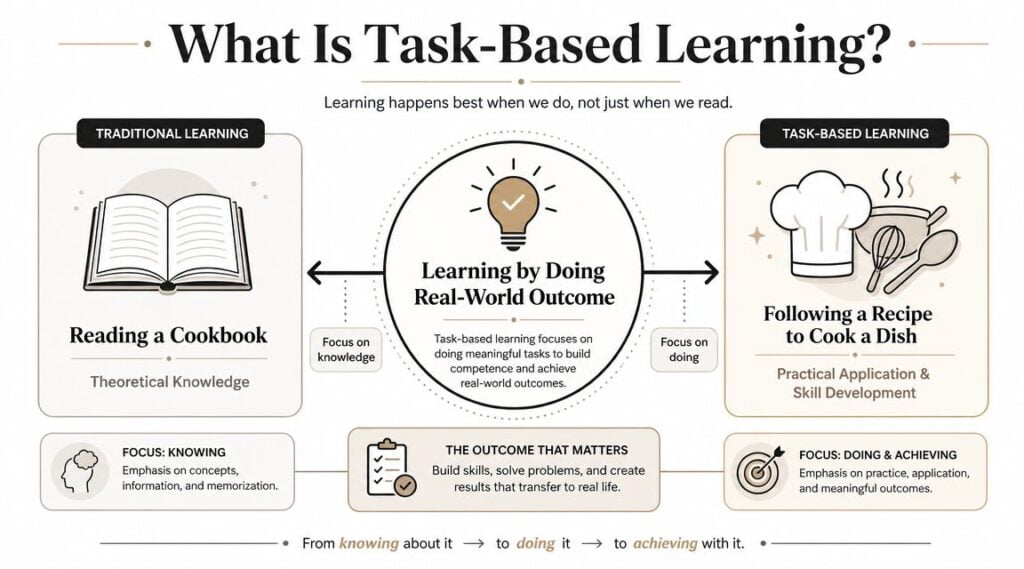
Task based learning organizes instruction around a concrete piece of work the learner must complete. The lesson is not just a place to receive information. It works more like a workshop bench. The content, examples, prompts, and feedback all support the learner in finishing a task that leads to a visible result.
A cooking class shows the difference clearly. Reading about knife skills, heat levels, and flavor balance can help. Cooking one meal from start to finish teaches those ideas in context. You chop, adjust, taste, and correct. The knowledge sticks because it is attached to action.
The core idea in plain language
In task based learning, the learner completes a meaningful task with a clear outcome, and the instruction supports that performance.
For an online course creator, this shift is practical. Instead of teaching “everything about client onboarding,” you might ask learners to build a client onboarding checklist for their own service. Instead of explaining email marketing in the abstract, you might have them draft a welcome email for a new subscriber segment. The learning happens while they make decisions, test ideas, and produce something usable.
That is also why task based learning overlaps naturally with discovery-based learning through doing real work. Learners do not wait until the end of the course to apply the material. Application is the lesson.
What counts as a task, and what does not
The word “task” can cause confusion because it sounds broad. A worksheet question, a reflection prompt, and a quiz item are all activities, but they are not automatically good tasks in the TBL sense.
A real task has a destination.
The learner must create, choose, solve, revise, record, map, categorize, or present something that resembles what they would do outside the lesson. In a membership for freelancers, a task could be “write a proposal for a hesitant lead using this inquiry form.” In a course for coaches, it could be “outline a 30 minute first session based on this client profile.” In a digital product for creators, it could be “turn your offer idea into a one sentence value proposition and a simple sales page section.”
Here is the simplest distinction:
| Approach | What the learner mainly does | What matters most |
|---|---|---|
| Traditional content lesson | Watches, reads, memorizes | Coverage of information |
| Task based lesson | Completes meaningful work | Quality and usefulness of the outcome |
Why online course creators should care
Task based learning started in language education, but the design pattern travels well because online learners usually want usable progress, not just exposure to ideas.
That matters even more in courses, memberships, and digital products. Your learners are often fitting lessons into a busy week and asking a practical question: “Can I use this today?” A task gives them an answer. It turns a lesson from a lecture into a work session with guidance.
A good task feels like a slice of real practice, not a school exercise dressed up with business vocabulary.
That is the part many course creators miss. They assume practical teaching means adding more examples. Often it means restructuring the lesson so the learner must do the kind of work the skill requires.
Why Task Based Learning Actually Works
A good task changes the learner’s posture.
Instead of sitting back and taking in ideas, they have to use those ideas to produce something. That small shift matters a lot in online learning. It turns a lesson into a guided work session, which is often what course buyers wanted in the first place.
For creators of courses, memberships, and digital products, task based learning works for a simple reason. It puts learning pressure in the same place real life does: on doing the work well enough to get a useful result.
Clear outcomes reduce drift
Online learners lose momentum fast when the goal is fuzzy. “Learn client onboarding” sounds helpful, but it does not tell someone what to do next. A task gives the lesson edges.
If you teach freelance writers, “draft a welcome email and a short onboarding questionnaire for a new client” is easier to start, easier to finish, and easier to review. The learner is not guessing what progress looks like. They can see it on the page.
That clarity helps in a very practical way:
- Attention improves because the learner has a defined target.
- Decision-making gets easier because they can judge each idea by whether it helps the task.
- Feedback becomes more useful because you can respond to real work, not vague understanding.
- Completion rates often improve because “finish this draft” feels more manageable than “master this topic.”
It works like giving someone a recipe while they cook, instead of handing them a lecture on flavor theory and hoping dinner appears.
Relevance increases effort
Adult learners usually stay engaged when they can connect a lesson to a real situation they care about. Tasks make that connection visible.
A creator in a membership for coaches may not feel excited about a lesson on intake forms. They usually care once the task becomes “build a first-session prep form you can send to your next client.” The same concept is now attached to use, not just explanation.
This also fits a broader learn-by-doing approach. If you want the wider context, this guide to discovery based learning shows why people retain more when they explore and apply ideas instead of only receiving them.
Context makes knowledge easier to remember
Knowledge sticks better when learners use it in a setting that resembles real performance.
That is one reason worksheets alone often fall flat in digital products. A worksheet can be useful, but only if it supports a meaningful action. Filling in boxes without a clear purpose feels like busywork. Completing a task with a visible outcome feels different. The learner can connect the concept, the decision, and the result.
For example, a course on offer creation could teach positioning frameworks for twenty minutes. Or it could ask learners to write a one-sentence value proposition for a specific audience, compare it against three criteria, and revise it once. The second approach gives the idea somewhere to live.
Small wins build confidence
Confidence rarely comes from hearing one more explanation. It usually grows from finishing something that felt slightly difficult.
That is especially important in online education, where learners often study alone and wonder whether they are doing it right. A completed task answers that question better than more theory can. They have evidence. They wrote the message, built the form, recorded the pitch, or revised the page.
Those small wins are the bricks. Over time, they become skill.
The instructor becomes a guide, not a broadcaster
This approach improves teaching, too.
Your job is no longer to carry the whole lesson through explanation alone. You set the task, provide examples, add constraints, watch where learners get stuck, and give feedback that helps them improve the next attempt. That role is often more useful in online courses than recording another long talking-head video.
In practice, that can look like templates, checklists, short demos, office hours, peer reviews, annotated examples, or quick Loom feedback. Different format, same principle. The learner learns by doing work that resembles the work they came to learn.
TBL vs Project Based and Problem Based Learning
People mix these up all the time, and the confusion makes sense. All three approaches ask learners to engage actively. All three can include collaboration, research, and discussion.
The difference comes down to scope, time, and where the learning pressure sits.
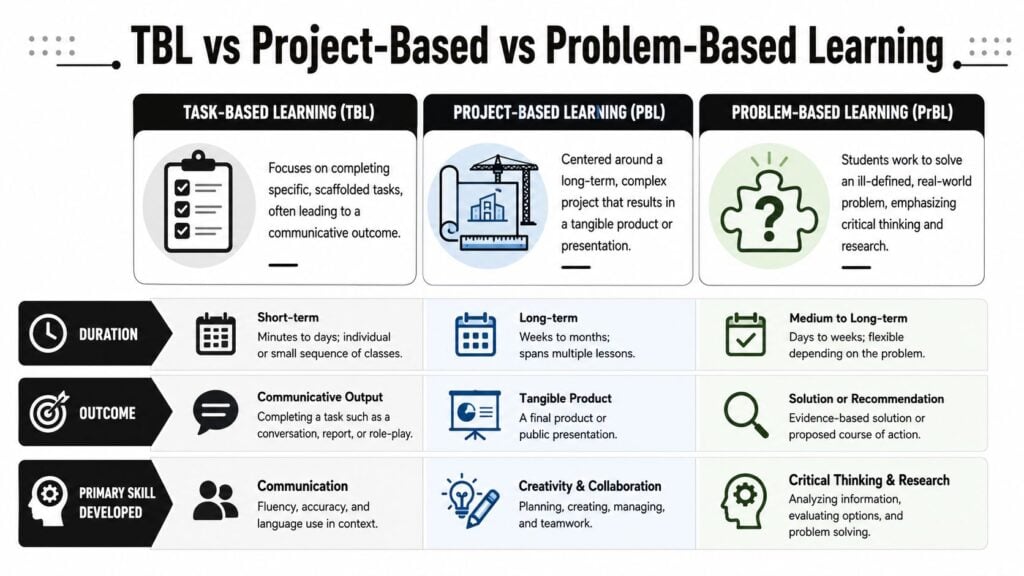
Task based learning is narrower and more focused
A task is usually a bounded piece of work with a clear outcome.
For example, inside a course for coaches, a task might be “write a follow-up message to a discovery call lead.” That’s specific. It can be prepared for, completed, reviewed, and improved in a relatively contained learning cycle.
Task based learning works well when you want learners to practice a real action repeatedly.
Project based learning is bigger and more layered
A project tends to run longer and involve multiple steps, decisions, and outputs. It often ends in a final product, presentation, or portfolio piece.
If the same coaching student were doing project based learning, the assignment might be “build your full lead nurture system.” That could include messaging, forms, automation, sales pages, and client journey mapping. It’s broader and usually more self-managed.
Problem based learning starts with a messy challenge
Problem based learning usually begins with an open-ended problem that doesn’t have one neat answer.
In a team leadership course, the problem might be “employee participation in weekly meetings is low and morale feels shaky.” Learners investigate, discuss causes, gather evidence, and propose solutions. The emphasis is often on analysis and reasoning.
A quick side by side view
| Model | Best used for | Typical outcome | Good example |
|---|---|---|---|
| Task based learning | Practicing a specific real-world action | Completed task or performance | Draft a sales email |
| Project based learning | Building something substantial over time | Final product or presentation | Create a full launch plan |
| Problem based learning | Investigating and solving a complex issue | Proposed solution or decision path | Diagnose a retention issue |
Which one should you choose
I usually choose task based learning when the learner needs repeatable performance.
If they need to get better at writing ad copy, running a feedback session, outlining a lesson, or debugging a function, tasks work beautifully. They’re easier to scaffold and easier to assess.
Choose project based learning when you want learners to integrate several skills into one larger build.
Choose problem based learning when value primarily lies in inquiry, diagnosis, judgment, and tradeoffs.
You don’t have to pick only one model for an entire course. A strong program often uses small tasks inside a larger project.
That mix is especially useful in memberships and cohort courses, where learners need both momentum and depth.
How to Design a Task Based Learning Module
Designing a task based learning module gets much easier when you stop asking, “What content should I cover?” and start asking, “What should the learner be able to do by the end of this lesson?”
That question usually leads you to a practical task.
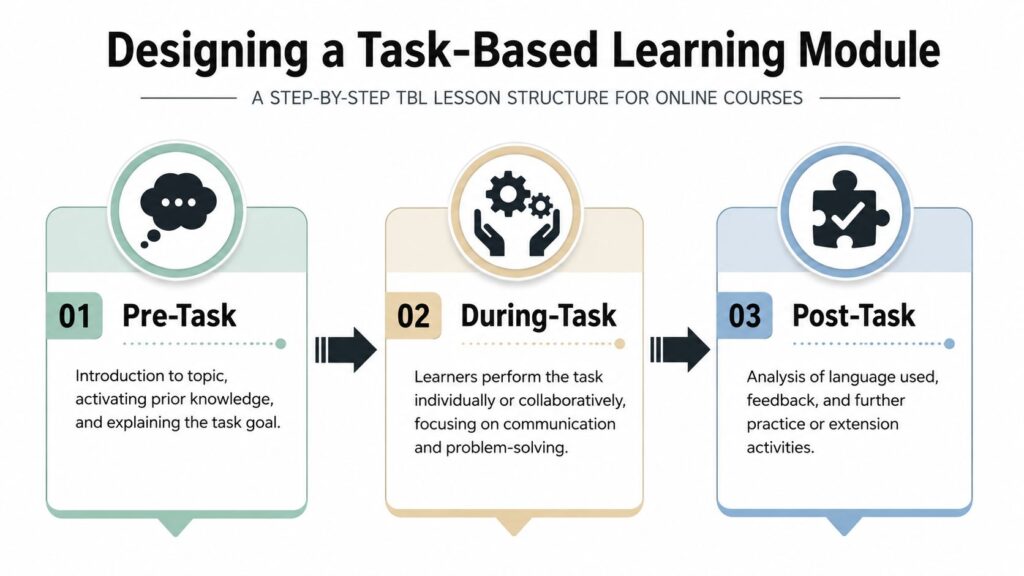
A widely used design pattern in task based learning is the pre-task → task → planning/reporting sequence. In this model, the pre-task stage prepares vocabulary, expectations, and goal clarity, the task stage asks learners to negotiate meaning while the teacher mainly monitors, and the planning or reporting stage helps learners share performance in a way that can build confidence and extend output, as described in this Bridge overview of task-based learning.
Start with the end task
Before you write slides or film anything, define the task in one sentence.
Examples:
- Email marketing course: Draft a three-email welcome sequence for a new subscriber.
- Nutrition membership: Build a one-week meal plan for a busy parent with limited prep time.
- Course creation workshop: Outline a mini-course with one promise, three lessons, and one action step per lesson.
If the task feels fuzzy, the lesson will too.
A good task usually has these qualities:
- It has a real-world shape so learners can imagine using it outside the course.
- It produces an outcome like a draft, plan, recording, mockup, checklist, or decision.
- It’s narrow enough to finish within the time and support you’re providing.
Build the pre-task support
This is the setup. You’re preparing people to succeed without doing the work for them.
For online courses, your pre-task might include:
- A short example that shows what a good final result looks like
- A checklist so learners know the criteria
- A mini lesson on one or two ideas they’ll need right away
- Starter materials such as a template, prompt pack, rubric, or scenario brief
If you need planning help here, I like using structured resources that force clarity. Teeachie’s lesson planning resource is a good example because it helps you map goals, activities, and pacing without overcomplicating the process.
Design shortcut: If your pre-task materials are longer than the task itself, you’ve probably drifted back into lecture mode.
A quick example for a branding course:
- Show two sample brand voice guides.
- Explain three tone dimensions the learner can use.
- Give them a client scenario and a simple template.
- Send them into the task.
Here’s a short walkthrough if you want a visual sense of how this structure works in teaching practice.

Run the task with restraint
This is the part many instructors overmanage.
During the task, learners should perform. In a self-paced course, that might mean independent work. In a cohort or membership, it could mean pair work, discussion rooms, shared docs, voice notes, or peer review.
Your role is to monitor, guide, and unblock. You’re not there to interrupt every five minutes with another lecture.
A few practical formats work well online:
| Format | Works well for | Example |
|---|---|---|
| Shared doc | Writing and planning tasks | Draft a launch outline together |
| Loom submission | Speaking and explanation tasks | Record a client pitch |
| Template worksheet | Structured first attempts | Build a lesson map |
| Community thread | Reporting and peer feedback | Post your draft and explain choices |
Use reporting to deepen the learning
This stage often gets skipped, which is a mistake.
When learners report, present, post, or reflect on what they produced, they become more aware of both strengths and gaps. In practical terms, they stop treating the task as private guesswork and start seeing it as communicative performance.
For course creators, the reporting stage can be simple:
- post your draft in the community
- upload your screen recording
- explain one decision you made
- compare your version with a model answer
- revise after feedback
That final move turns a task into a learning cycle, not just an assignment.
Task Based Learning Examples for Online Courses
Task based learning usually clicks for people. Once you see examples, it stops sounding academic and starts sounding usable.
The key is to design tasks that resemble what your learners want to do once the course is over. If you want more ideas for making those moments active, this guide to interactive learning pairs well with the same kind of practical design thinking.
Marketing course
Task: Write a three-email welcome sequence for a new subscriber who downloaded a free lead magnet.
Learning objective: practice audience awareness, sequencing, and call-to-action writing.
Pre-task support could include one sample sequence, a brand brief, and a fill-in template. The learner submits the three emails and explains why each one exists.
Graphic design course
A strong task here is to design a social media promo graphic from a client brief.
The learner has to interpret constraints, choose hierarchy, and produce a finished asset. That’s far more useful than only watching tutorials about typography rules.
Wellness or nutrition membership
Task: Create a seven-day meal plan for a specific person, such as a busy professional with limited weekday cooking time.
True skill isn’t only nutrition knowledge. It’s applying that knowledge within real-life constraints.
Coding bootcamp or beginner tech course
Ask learners to build a simple feature, such as a form validation flow or a filtered list interface, based on a short product requirement.
The outcome is observable. Either the feature works, partly works, or needs revision. That makes feedback much clearer.
Language or communication course
Task based learning has obvious roots here, but the digital course version can be very modern.
For example, learners could record a short self-introduction for a language exchange, respond to a prompt, and then revise after feedback. If you teach or support conversation practice, this practical guide for Korean learners shows the kind of real-world exchange context that makes task design much more concrete.
Course creator training
This niche is perfect for TBL.
Try tasks like these:
- Outline one module for a mini-course with a learner outcome and one action item
- Write one lesson page using a given content template
- Record a five-minute teaching segment and self-review it against a checklist
- Draft a community prompt that gets learners to share a work sample, not just an opinion
The best task examples feel small enough to finish and meaningful enough to matter.
That balance is what keeps learners moving.
Getting Started Tips and Common Pitfalls to Avoid
The easiest way to begin is not by rebuilding your whole course.
Take one lesson that currently ends with “reflect on this” and turn it into “create this.” That single shift will teach you a lot about task design.
What helps right away
A few habits make early experiments go much better:
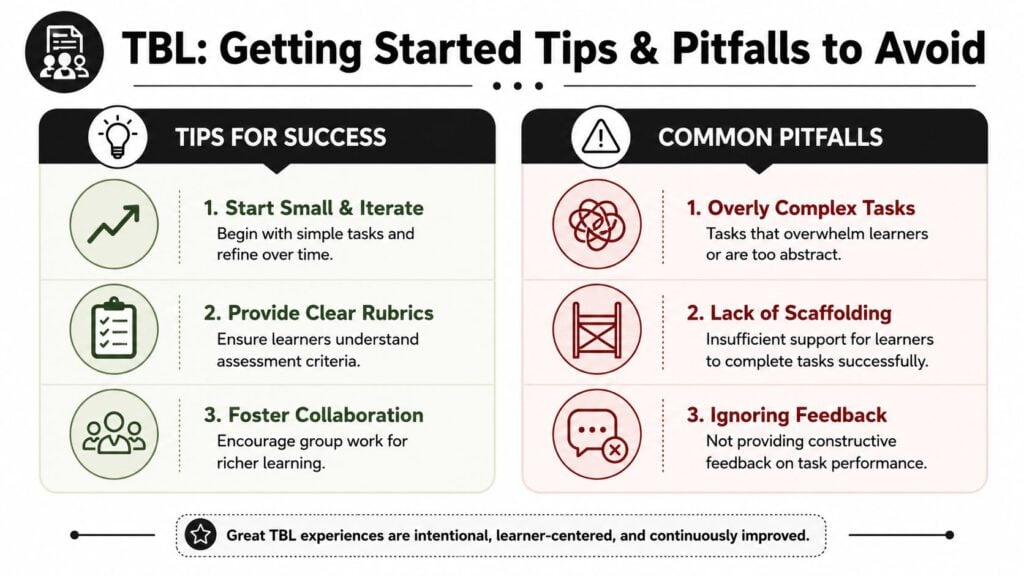
- Start smaller than you think because a short, finishable task beats an ambitious one that stalls halfway.
- Show a model outcome so learners can picture the level and format you expect.
- Assess completion and decision quality rather than obsessing over perfection on the first try.
- Build in reflection with a quick prompt like “What did you choose and why?”
If your audience includes adults balancing work and family, this overview of adult learning principles is worth keeping in mind when you choose task size, pacing, and support.
What to watch out for
The most common problem is overdesign.
Course creators often make the task too big, too abstract, or too under-supported. A learner can’t “build your full business system” in one lesson. They can create a lead magnet outline, a pricing draft, or a homepage wireframe.
Another issue is unclear instructions. If learners don’t know the deliverable, timeline, or success criteria, they spend energy guessing instead of learning.
A final pitfall is talking too much during the performance stage. Once the task starts, let the learner work. Help when needed, but don’t crowd the experience.
A task based lesson should feel guided, not controlled.
When people ask me what is task based learning, I usually end here. It’s a way to organize teaching around useful action. Done well, it gives learners momentum, confidence, and a clearer path from understanding to performance.