
Best Platform to Sell Digital Products in 2026

You’ve created the product, polished the sales page, and maybe even built an audience. Then you reach the checkout and discover that the platform takes a larger cut than expected, international buyers face payment problems, or students receive a clumsy download experience. Choosing the best platform to sell digital products can feel like a technical task, but the wrong choice affects your revenue, customer retention, support workload, and ability to grow.
My recommendation is direct. Sellfy is the strongest default for many digital product creators, Gumroad is useful for speed and direct-link sales, and Shopify is the better choice for a serious ecommerce operation that needs control. Course specialists and established education businesses may need a more dedicated learning platform. The right answer depends on your sales volume, product format, buyer geography, and tolerance for operational complexity.
Why Platform Choice Makes or Breaks Your Digital Business
A creator can spend days comparing storefront designs, course tools, email integrations, and payment options, then choose the wrong platform because the feature list looked impressive. The better question is how the system fits the business model.
For low-maintenance downloads sold to an existing audience, a large app ecosystem and complex catalog may add little value. A clean checkout, reliable delivery, sensible fees, and practical support for international orders matter more.
The cost extends beyond the subscription. Transaction fees, payment processing, paid add-ons, currency conversion, tax handling, and required advertising can change your margin. Marketplaces may provide discovery, but they reduce control over branding and customer relationships. Powerful ecommerce systems offer room to grow, while also demanding more setup and maintenance than a solo creator can justify.
Practical rule: Choose the platform that gives customers the fewest reasons to hesitate and gives you the fewest recurring operational problems.
Checkout friction deserves close attention. Buyers may abandon a purchase if the payment page feels unfamiliar, requests unnecessary information, performs poorly on mobile, or lacks their preferred payment method. Cross-border sales add more decisions, including supported currencies, tax collection, refunds, and payment disputes. Check those workflows before judging a platform by its monthly price.
The customer experience continues after payment. Course students need clear access, dependable lesson delivery, simple password recovery, and downloads they can find later. A platform that creates support tickets for routine access problems costs time even when every transaction succeeds.
Cash flow matters too. Time-to-payout, payment processing, tax automation, and delivery uptime may affect your business more than a low headline subscription price. Recent platform comparisons also examine hidden variables such as mobile checkout conversion and reliable delivery, rather than subscription price alone (2026 platform analysis).
Your platform is part of the product experience. It shapes how smoothly customers buy, how quickly they receive access, how you process refunds, and how easily you add subscriptions, bundles, or memberships later. Choose for your sales volume and buyer geography, not for the longest feature list.
The State of Digital Product Platforms in 2026
If your course launch suddenly attracts buyers from several countries, platform choice becomes an operating decision, not a storefront preference. Checkout performance, payment coverage, tax handling, and delivery reliability affect total cost of ownership more than a low subscription price.
The ecommerce platform market has consolidated around a small group of mature systems. Independent 2026 tracking across 84,000 ecommerce stores found Shopify powering 42.6% of stores, up from 31.8% in 2022, while WooCommerce held 24.6% and custom solutions held 9.4% (independent ecommerce platform tracking).
That concentration gives creators a practical signal. Established platforms have had time to improve checkout flows, integrations, hosting, security processes, storefront management, and customer access. Familiar payment environments can reduce hesitation, while connected tools support more than a basic payment button.
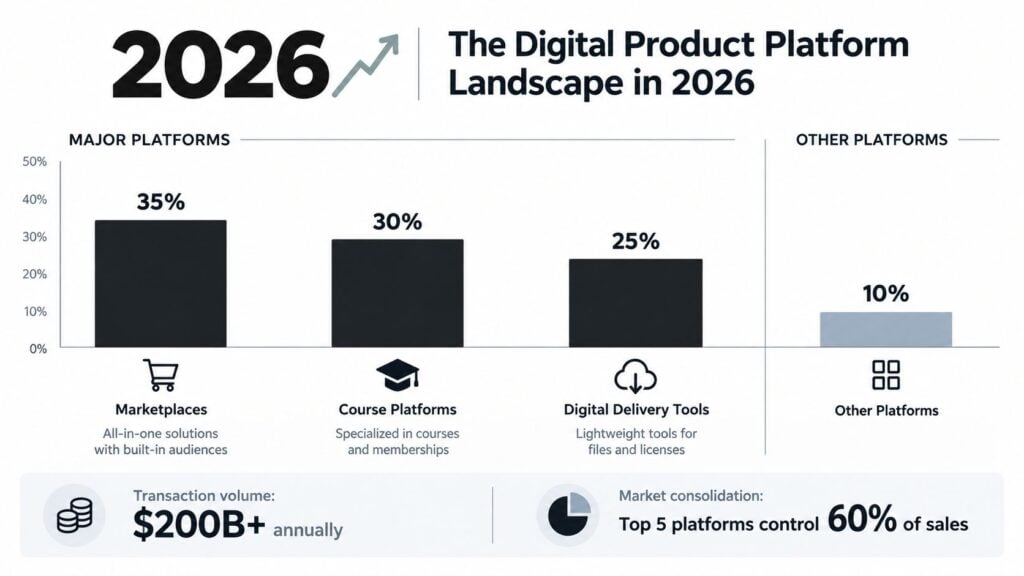
The broader category is substantial. Fortune Business Insights estimated the global ecommerce platform market at USD 11.55 billion in 2025, projected USD 13.92 billion in 2026, and forecast USD 61.83 billion by 2034, with a projected CAGR of 20.49% from 2025 to 2034 (Fortune Business Insights ecommerce platform research). The same source estimated regional shares of 34% for North America, 29% for Asia-Pacific, 27% for Europe, and 10% for the rest of the world.
A separate estimate projected global company spending on ecommerce platforms at USD 22.6 billion over the next 12 months, with the United States representing 37%, or about USD 8.4 billion, of that spend. These figures place digital product selling inside a major commercial infrastructure category, not a minor creator-tool niche.
Higher-revenue stores also cluster on established systems. Among stores above $635K, Shopify led with 38.4%, followed by Magento at 24.8% and custom solutions at 18.4% (store tracking data). That does not make Shopify the right choice for every creator. It shows that mature infrastructure earns trust when checkout, hosting, and storefront management must work together.
For a broader education-business perspective, Coachful’s guide to selling courses complements this analysis. Use it alongside your sales volume and buyer geography when judging platform fit.
Comparing the Top Platforms for Selling Digital Products
If you sell a few products each month, a percentage-based platform may protect your cash flow. Once sales become consistent, subscription cost, checkout friction, payment processing, app requirements, and cross-border tax handling matter more than the headline plan price. My core comparison is Sellfy, Gumroad, and Shopify. Etsy also deserves consideration when marketplace discovery matters, but limited brand and customer control make it a weaker long-term home for many businesses.
| Platform | Monthly Cost | Transaction Fees | Best For | Key Limitation |
|---|---|---|---|---|
| Sellfy | $29 to $159 per month | 0% platform transaction fees on paid plans | Digital products with a turnkey storefront | Subscription cost applies even during quiet sales periods |
| Gumroad | No monthly subscription on its free model | 10% flat platform fee, plus payment processing | Existing audiences and direct-link selling | Higher marginal cost as sales grow |
| Shopify | Monthly subscription | 2.9% + 30¢ payment processing, plus subscription | Full ecommerce control and customization | More setup, apps, and operational complexity |
| Etsy | No standard monthly subscription | $0.20 listing fee, 6.5% transaction fee, processing, and possible offsite advertising | Marketplace discovery for downloads | Limited customer and brand ownership |
Sellfy is my default recommendation for creators selling downloadable products, subscriptions, or creator-focused offers. Paid plans cost $29 to $159 per month with 0% transaction fees, according to this digital product platform fee comparison. That model works well when sales are steady enough to cover the subscription. You still pay card-processing and other business costs, but Sellfy does not take a percentage of each sale. For international buyers, confirm supported payment methods, currencies, and tax settings before committing. A smooth checkout can matter more than a small plan-price difference.
Gumroad is the fastest route from product idea to payment page. It fits creators with an existing audience, newsletter, or social following who can send buyers directly to a product page. Its free model charges a 10% flat platform fee, plus payment processing, so simplicity comes at a meaningful cost on every order. The Gumroad pricing information makes the trade-off clear: low fixed commitment, higher variable cost. Choose it for validation and early launches, not automatically as the permanent home for a high-volume catalog.
Shopify is the strongest option when you need a full ecommerce engine. It gives you control over merchandising, catalog structure, branding, integrations, and mixed product types. The trade-off is a larger operating stack. Shopify’s listed payment-processing example is 2.9% + 30¢, alongside the monthly subscription, and specialized digital delivery or course features may require extra apps. Review app costs, payment availability in each target market, and tax or VAT workflows before comparing Shopify with a simpler platform.
Use this decision rule:
- Choose Sellfy for a turnkey storefront and digital delivery without per-sale platform fees.
- Choose Gumroad for rapid launch when you already know where buyers will come from.
- Choose Shopify for customization, advanced merchandising, and a broader ecommerce system.
- Use Etsy selectively when discovery drives sales, while treating its fees and limited customer ownership as acquisition costs.
How to Choose the Right Platform for Your Situation
A creator with steady sales can lose margin through transaction fees, while an international seller can create support problems with weak tax and payout tools. Choose from your actual sales volume, buyer geography, and operating capacity, not from a platform’s feature page.
Start with your audience
If buyers already know you, a direct-link platform can keep the path to purchase short. Gumroad suits creators selling through an existing audience. Sellfy provides a fuller storefront and a more consistent customer journey. Shopify fits a branded site, content strategy, multiple channels, or a larger catalog.
Without an established audience, a marketplace may provide discovery. You give up some control and margin in return, so treat marketplace exposure as a customer-acquisition channel rather than your permanent business home.
Match the product to the delivery model
A PDF, template pack, audio file, or other download needs dependable file delivery and clear access instructions. A course requires lesson organization, student accounts, progress management, and a reliable learning environment. Memberships add recurring billing, protected content, cancellation handling, and ongoing communication.
Subscription sellers should examine failed-payment recovery and billing workflows before choosing a platform. A system that handles one-off downloads well may create avoidable retention and support work for recurring access. Review this guide to subscription billing software to understand the software layer behind recurring payments.
Decide how much control you need
Gumroad minimizes setup. Sellfy combines a storefront with creator marketing tools. Shopify offers the broadest control, but that flexibility brings more integrations, maintenance, and operational decisions.
Compare total cost of ownership, not just the monthly plan. Include payment-processing fees, app costs, support time, delivery reliability, tax tools, and the revenue lost when checkout creates friction. Evaluate payment-processing fees, delivery uptime, tax automation, and mobile checkout conversion before you commit. A lower subscription price can still produce a higher operating cost.
Check buyer geography before launch
International sales can expose problems that a domestic test order never reveals. Check supported currencies, local payment preferences, tax calculation, compliance tools, payout timing, refund handling, and the documents customers receive.
For cross-border sales, prioritize tax automation accuracy, time-to-payout, and compliance automation over theme design. Confirm who is responsible for tax collection, whether the platform supports your target markets, and how it handles refunds or payment disputes. These details affect margin, buyer confidence, and the support workload after launch.
Setting Up Your Platform for Success
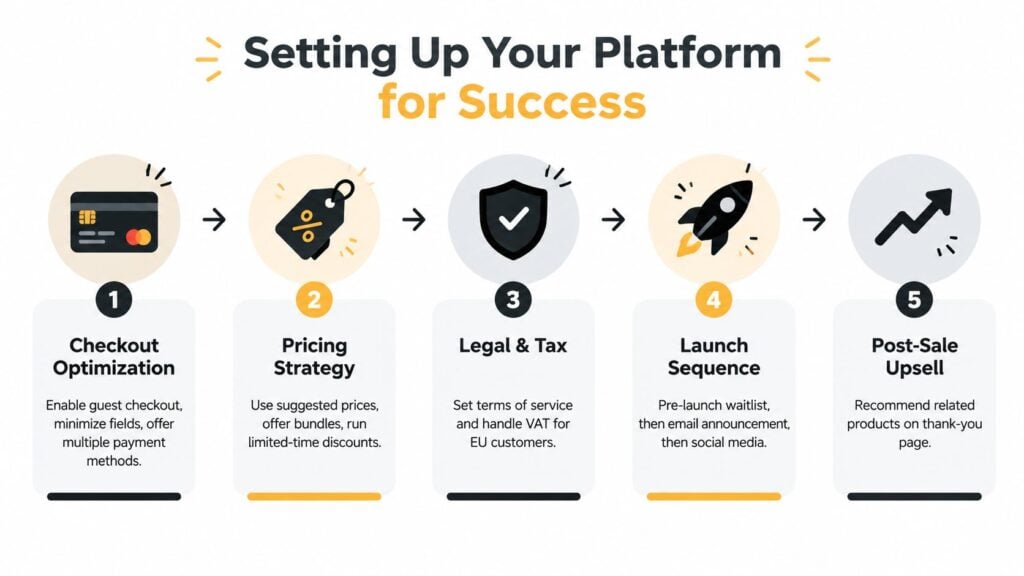
A polished sales page cannot rescue a rushed setup. Treat launch as an operating project. Test the buyer journey, define the commercial rules, and prepare support before promotion begins.
Remove unnecessary checkout friction
Put the product promise beside the payment action. Keep the form focused, test it on a phone, and explain exactly when and how access arrives. Enable the payment methods your buyers use instead of sending every customer through one route.
Run a complete test order. Check the payment confirmation, receipt, access email, download link, login process, refund route, and support address. Follow the journey from the first click to the product’s first use. Checkout friction costs more than a subscription upgrade when it turns ready buyers away.
Build the commercial rules before promotion
Set prices, bundles, discount logic, refund terms, and access conditions before announcing the offer. For recurring products, document cancellation and failed-payment handling so support staff can apply consistent rules.
International sellers must verify tax calculation, collection responsibility, refund treatment, dispute handling, payout timing, and the customer documents issued after purchase. Tax automation accuracy, payout timing, and compliance automation affect margin, cash flow, and buyer confidence. Review those controls against each target market, not just the platform’s headline plan.
Use this guide to plan and manage a digital learning offer before launch. It should complement, not replace, a market-by-market compliance check.
Protect the customer relationship during migration
If you are changing platforms, export customer records, product details, order history, and access data where the current provider permits it. Create a transition map showing which buyers retain access to each product. Keep old purchase instructions available until every customer receives clear replacement guidance.
Keep the old system running during the transition. Confirm new purchases, existing access, support emails, and refund requests in the new environment before shutting anything down.
During the first month, monitor failed payments, support questions, download problems, refund requests, and mobile checkout behavior. These signals expose operating costs that a polished dashboard hides. Fix recurring customer problems first, then improve the sales page.
Platform Recommendations by Creator Type
The best platform changes with the product and the operating model. My recommendations are deliberately situational.
Course creators
Choose a dedicated course platform when structured learning is central to the offer. Teachable, Podia, or Kajabi are more suitable than a basic download storefront because students need organized lessons, account access, and a dependable learning journey.
For an established education business with multiple offers, marketing automation, memberships, and coaching, Kajabi can justify its higher complexity and cost. For a smaller or simpler course operation, Podia is the more balanced choice. It keeps the experience unified without demanding the same level of infrastructure.
Membership owners
Memberships need more than recurring checkout. You’ll need protected content, clear renewal and cancellation workflows, regular communication, and a reason for members to continue using the service.
I’d choose Podia for a straightforward membership tied to courses, downloads, or coaching. I’d look at Kajabi when the membership sits inside a broader education business with multiple funnels and offers. If community interaction is the main product, evaluate the community experience separately from the payment layer.
A detailed comparison of Podia and Patreon for creators selling digital products can help clarify that distinction.
Download sellers
For templates, guides, workbooks, and other downloadable products, I’d start with Sellfy if sales are expected to be regular. Its paid plans remove per-sale platform fees while providing a turnkey storefront and creator-focused marketing features.
Gumroad remains a strong launch choice for a creator with an existing audience who wants to sell through direct links. Independent comparisons position Gumroad for existing-audience selling, Shopify for ecommerce control, and Sellfy for digital products with a built-in storefront and marketing stack (platform fit comparison).
Hybrid creators
If you sell downloads, physical products, subscriptions, and a broad catalog under one brand, Shopify is the strongest long-term option. Its app ecosystem and customization give you room to build a more advanced operation.
Don’t choose Shopify because it’s popular. Choose it when you’ll use its control. Otherwise, Sellfy or Podia will usually give a solo creator a cleaner setup with less maintenance.
Common Questions About Selling Digital Products Online
Should I use a marketplace or my own storefront?
Use a marketplace when discovery is your immediate priority and you don’t yet have reliable traffic. Use a standalone storefront when brand ownership, customer relationships, and long-term control matter more. Many creators use both, but keep the storefront as the primary business home whenever possible.
Is Etsy affordable for digital products?
Etsy can be easy to enter, but the fees can become significant. Sellers pay a $0.20 listing fee, a 6.5% transaction fee, payment processing of 3% plus $0.25 per transaction, and may also face offsite advertising fees. Some independent guides estimate that these combined costs can reach 20% to 25% of a sale in applicable situations (Etsy fee breakdown).
How should I handle refunds and support?
Write the refund policy before launch, make it easy to find, and state what happens to access after a refund. Set up one support address and a clear process for missing downloads, login problems, duplicate purchases, and billing questions.
Can any platform stop piracy?
No platform can remove every risk. Use protected delivery, customer accounts, sensible access controls, and clear terms. Focus on making legitimate access convenient, then respond quickly when customers report a problem.
When should I build a custom solution?
Build custom infrastructure only when your requirements exceed managed platforms. Examples include unusual access rules, complex integrations, specialized workflows, or deep control over data and checkout. Most creators should first validate the offer and sales process on a managed platform.
What should I optimize first?
Start with checkout completion, successful delivery, mobile usability, support response, and payout reliability. A beautiful storefront won’t compensate for payment failures or confused customers.
The clearest recommendation is this. Choose Sellfy for a focused digital product business, Gumroad for fast direct sales, Shopify for full ecommerce control, and a course platform for structured education. Compare total costs and buyer geography before you commit.
If you’re building or refining a course, membership, or digital product business, explore LearnStream’s practical guides on digital learning, monetization, and platform selection at learnstream.io. Use the framework above to audit your current platform, then choose the setup that protects more revenue and gives your customers a smoother path from payment to progress.