Learning Retention Rate Explained and How to Improve It

You launch a course. The first week feels promising. People sign up, watch the opening lessons, maybe even leave a few excited comments.
Then the drop starts.
Module two gets quieter. Quiz attempts slow down. By the time learners reach the middle of the program, you’re left wondering whether they learned anything or just clicked through the videos.
I’ve been there. It’s one of the most frustrating parts of course creation because the problem hides in plain sight. Completion can look decent. Feedback can sound positive. Yet a week later, many learners can’t recall the core idea you thought landed perfectly.
That’s where learning retention rate becomes useful.
It gives you a better read on what stuck after time passed. Not what people liked. Not what they finished. What they can still remember or use later.
For course creators, that matters for obvious learner reasons, but it also shapes the business side. When people remember and apply what you teach, they’re more likely to finish, recommend the course, renew a membership, and trust your next offer. If you want a related lens on learner follow-through, LearnStream’s guide to average online course completion rate and why it matters is a good companion read.
A lot of confusion starts because people talk about retention like it’s one universal benchmark. It isn’t. The number changes based on when you test, how you test, and what kind of memory you’re measuring.
That’s the key idea I want to pin down here.
Introduction Why Learning Retention Keeps Course Creators Up at Night
A familiar pattern shows up in almost every self-paced course. Learners feel motivated at the start, move quickly through the welcome material, and then lose momentum once the novelty wears off.
I’ve seen creators misread this in two ways. Some assume the content is too hard. Others assume learners are just busy. Sometimes both are true, but often the deeper issue is simpler. People were exposed to the material, but they didn’t retain enough of it to keep building on it confidently.
The week-one illusion
Week one can fool you.
A learner can watch three lessons in a row, answer an easy check-in question, and leave with the impression that they “get it.” But if you ask them the same question seven days later without notes, the result may look very different.
That gap matters because most courses are cumulative. If lesson four depends on lesson two, weak retention creates drag. Learners hesitate, rewatch, skip practice, or stop showing up.
Practical rule: If your learners need earlier ideas to succeed later, retention is part of product design, not a nice extra.
Why this metric matters more than it seems
Retention tells you whether your course creates durable learning or short-lived familiarity.
That distinction changes how you interpret your data:
- Completion rate shows whether people got through the material.
- Satisfaction shows how they felt about the experience.
- Retention rate shows whether the knowledge stayed available after time passed.
Those are different signals. I’ve had lessons that learners loved in the moment but forgot quickly because the lesson relied too much on passive watching.
When creators start tracking retention, they usually notice another important thing. A “bad” retention result doesn’t always mean the course failed. Sometimes it reveals that the course has no built-in review rhythm, no recall prompts, or no delayed checks.
That’s fixable.
What Learning Retention Rate Really Means
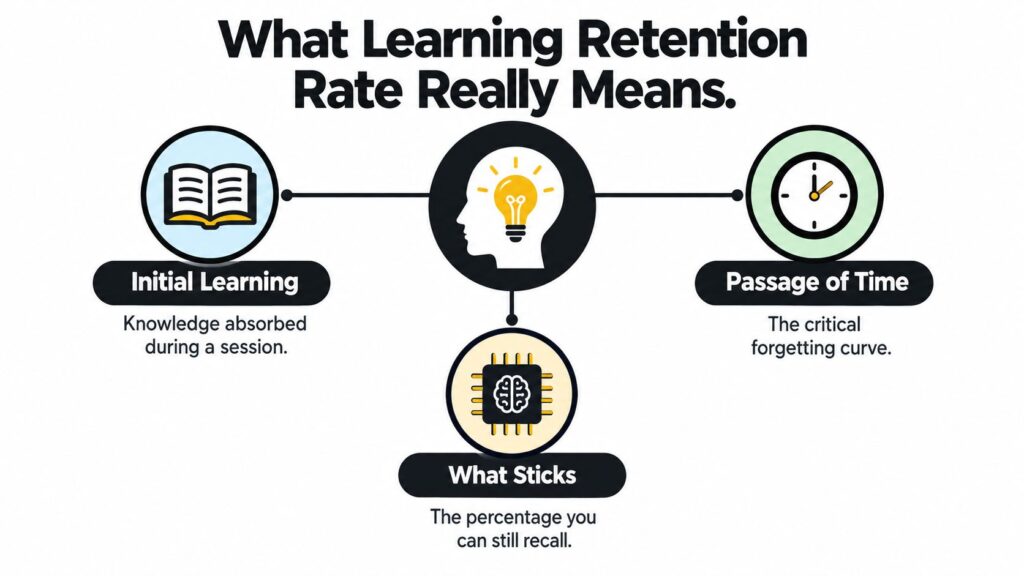
At its simplest, learning retention rate is how much of what someone learned is still available later.
Packing for a trip is a good analogy. At the start, you load everything into the suitcase. After a bumpy ride, opening and closing, and moving from place to place, some items are still there, some are buried, and some are missing altogether. Learning works in a similar way. Initial exposure is only the packing step.
What retention is and what it isn’t
People often mix up retention with other course metrics.
Retention is not the same as:
- Finishing a module
- Enjoying the presentation
- Recognizing a term when you see it again
- Feeling confident right after a lesson
It’s closer to this question: can the learner recall or apply the material after a delay?
That delay matters a lot. Hermann Ebbinghaus’s classic forgetting-curve work, first published in 1885, is still referenced because it showed a clear pattern. In later summaries of that research, retention measured as savings in relearning time fell to about 58% after 20 minutes, 44% after 1 hour, and roughly 34% after 1 day, before leveling near 21% after a month according to this summary of Ebbinghaus’s forgetting curve.
That’s why learners can feel solid right after a lesson and much shakier later.
Why the curve confuses people
The forgetting curve is often oversimplified. People hear one dramatic number and assume memory just collapses at a fixed rate.
It doesn’t work like that.
The useful takeaway is that forgetting tends to happen fast early on, then the decline slows down. Memory loss isn’t a straight line. That matters for course design because the timing of review becomes part of the teaching itself.
The first few days after learning are where many course creators either save the memory or lose it.
Retention is shaped by timing and measurement
Many course creators stumble at this stage.
If you test right after a lesson, you’re mostly measuring fresh exposure. If you test later, you’re measuring what survived. If you ask for simple recall, you get one type of answer. If you ask learners to transfer the idea to a new scenario, you get another.
So when someone asks, “What’s the retention rate for this course?” my honest answer is usually, “Retention of what, measured when, and how?”
That’s not nitpicking. It’s the whole game.
How to Calculate and Measure Learning Retention Rate
You don’t need a research lab to calculate a learning retention rate. A spreadsheet and a consistent testing method are enough.
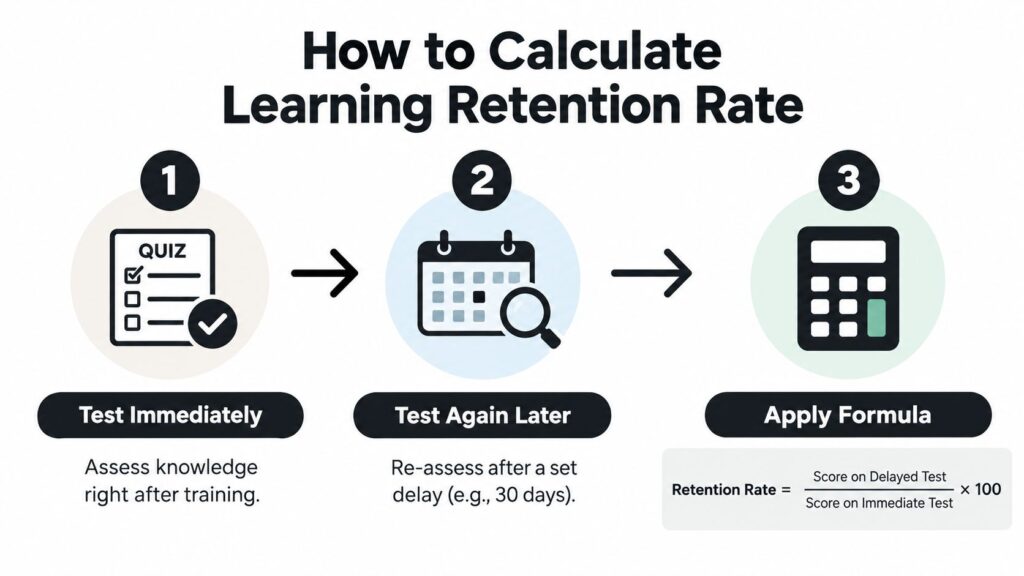
The simplest formula is this:
Retention Rate = (Score on Delayed Test / Score on Immediate Test) x 100
That formula won’t tell you everything, but it gives you a practical starting point.
A simple way to calculate it
Say a learner scores well right after a lesson. Then you give a delayed quiz later using comparable questions. You divide the later score by the earlier score and convert it to a percentage.
That gives you a retention rate for that learner on that topic under that testing condition.
You can track this at several levels:
- Per lesson for narrow skill checks
- Per module for grouped concepts
- Per cohort to compare one intake of learners against another
- Per assessment type so recall and transfer don’t get mashed together
If you’re already measuring training outcomes, LearnStream’s guide on how to measure training effectiveness is a useful companion because retention works best when paired with performance data.
Use delayed assessments, not just immediate quizzes
Immediate quizzes have value. I use them to confirm whether the lesson made sense in the moment.
But if you stop there, your numbers will usually flatter the course.
A delayed check is what makes the metric meaningful. That could be a recall prompt days later, a scenario-based question in the next module, or a low-stakes review email that links to a mini quiz.
Here’s a simple measurement setup I like:
Right after the lesson
Use a short check for comprehension.After a short delay
Ask learners to recall the idea without rewatching.After a longer delay
Ask them to apply it in context.
That last part matters because recall and transfer are not interchangeable.
Your method changes your number
A retention rate isn’t a fixed property of the course. It changes with the method.
Here are common methods and what each reveals:
| Method | What it captures | Main risk |
|---|---|---|
| Immediate multiple choice | Fresh recognition | Inflated scores from short-term memory |
| Delayed free recall | What learners can retrieve on their own | Can feel harder than the underlying understanding |
| Scenario application | Whether knowledge transfers to use | May reflect both memory and judgment |
| Cumulative module quiz | Whether earlier content remains accessible | Blends multiple topics together |
A lot of creators get nervous when delayed scores come in lower. I see that as useful. Lower delayed scores help you spot where the lesson failed to stick.
Keep the process simple inside your course stack
You can run retention tracking inside most LMS setups with basic tools:
- Quizzes: Use immediate and delayed versions with similar difficulty
- Email automations: Trigger a recall check after a set number of days
- Tags or segments: Group learners by cohort so you can compare outcomes
- Spreadsheets: Log immediate score, delayed score, quiz retries, and notes on lesson changes
Working habit: Pick one delay window first and stick with it. Consistency makes your numbers more useful than complexity does.
What Counts as a Good Learning Retention Rate
A lot of blog posts want to give you one magic benchmark here. I don’t think that helps.
A good learning retention rate depends on what you taught, who your learners are, and what your assessment asked them to do. A vocabulary recall quiz and a strategic decision-making scenario should not produce identical expectations.
Why one benchmark falls apart fast
The evidence doesn’t support the idea of one universal retention percentage.
A recent summary of learning-retention research notes that retention varies sharply by context, timing, and measurement method. The same source also points to a 2025 medical-education trial where spaced repetition produced better learning at 6 months, 58.03% vs 43.20%, and better knowledge transfer at 10 months, 58.33% vs 52.39% when compared with no repetition, as reported in this PubMed-indexed article on learning retention rate context and spaced repetition.
That’s useful for one reason in particular. It shows that the number depends heavily on the setup.
A better way to judge your own result
Instead of asking whether your retention rate is “good” in the abstract, ask whether it’s good for the kind of learning you’re measuring.
Use this table as a sanity check.
| Measurement Context | Typical Retention Pattern | What It Tells You |
|---|---|---|
| Immediate post-lesson quiz | Usually higher because the lesson is still fresh | Whether learners followed the lesson in the moment |
| Delayed recall check | Usually lower than immediate performance | Whether core ideas stayed accessible without prompting |
| Scenario-based application | May differ from recall results | Whether learners can use the knowledge, not just repeat it |
| Courses with built-in review | Often hold up better over time | Whether your design supports durable memory |
| Cross-course comparisons | Hard to compare directly | Whether you’re accidentally comparing different test conditions |
When I’d worry
I’d pay attention when learners show one pattern consistently. They perform well right after teaching, then struggle to retrieve even the big ideas later.
That usually points to design issues such as:
- Passive lessons with little recall practice
- No spaced review after the first exposure
- Assessments that reward recognition more than memory
- Modules that move on before the previous one settles
What counts as healthy is movement in the right direction under consistent measurement. If the delayed result improves after you add retrieval and review, that’s meaningful even if the raw number isn’t dramatic.
Proven Methods to Improve Learning Retention Rate
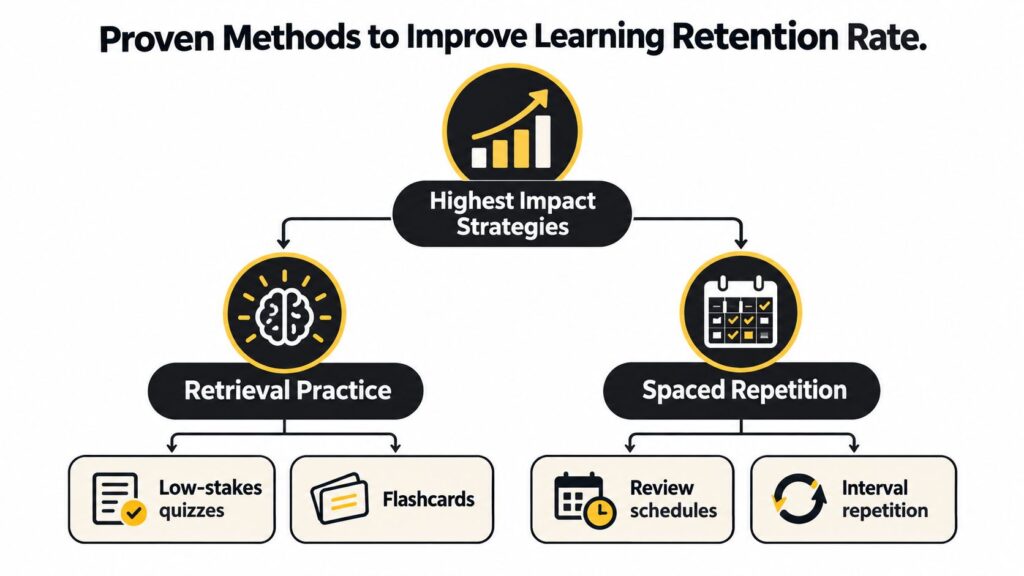
When I’ve needed to improve retention, two methods have done the heavy lifting again and again. Retrieval practice and spaced repetition.
They’re simple to describe, but they change how a course feels. The learner stops being a spectator and starts doing memory work.
Retrieval beats rereading
Retrieval practice means asking learners to pull information out of memory rather than just seeing it again.
This has strong support. In controlled studies, repeated retrieval during learning produced better long-term retention than repeated study, including a roughly 50% improvement in long-term retention scores versus elaborative concept mapping, with M = .67 vs .45; d = 1.50, reported in this research paper on retrieval practice.
That sounds technical, but the practical takeaway is straightforward. If you want durable memory, ask learners to recall.
A few easy ways to do that in a course:
- Low-stakes quizzes: Ask a few short questions at the end of each lesson without making them feel high pressure.
- Free-recall prompts: Add a box that says, “Before moving on, write the three main points from memory.”
- Flashcards: Good for vocabulary, formulas, frameworks, and definitions.
- Blank-page summaries: Have learners close the lesson and explain the idea in their own words.
Another concrete example comes from a RemNote summary of retrieval research. In one cited experiment, practicing retrieval once doubled long-term retention compared with reading the text once, raising retention from 15% to 34%, and repeated retrieval increased retention to 80%, according to this explanation of retrieval practice and spaced repetition.
Spacing makes memory last longer
Retrieval works even better when you spread it out over time.
A meta-analytic review found a strong advantage for spaced retrieval practice over massed retrieval practice with g = 0.74, which supports distributing practice rather than bunching it together in one sitting, as reported in this meta-analysis on spaced retrieval practice.
Here’s the practical version. Don’t ask learners to review the same concept five times in one session. Bring it back later.
This short video gives a good visual explanation of why spaced review works in real learning environments.
I’ve found spaced repetition especially useful in drip courses and memberships because the structure already unfolds over time. If you want a tactical guide for building that rhythm, LearnStream has a practical post on spaced repetition strategy in online courses.
Ways I’d build this into a course this week
You don’t need to rebuild your whole curriculum.
Try one of these:
For a video course
End each lesson with a recall prompt, then email a follow-up question later.For a cohort program
Start each live session with a no-notes review of the prior session.For a membership
Recycle earlier lessons into monthly review challenges.For a skills course
Ask learners to solve a new scenario using an older concept before introducing the next one.
The most memorable courses usually don’t add more content. They add better moments for remembering.
Tracking Retention With KPIs and Simple Templates
Improving retention gets much easier when you stop treating it as a vague teaching goal and start treating it like an operating metric.
I like pairing learning retention rate with a small set of supporting KPIs. Not dozens. Just enough to show where memory is holding and where the course flow breaks down.
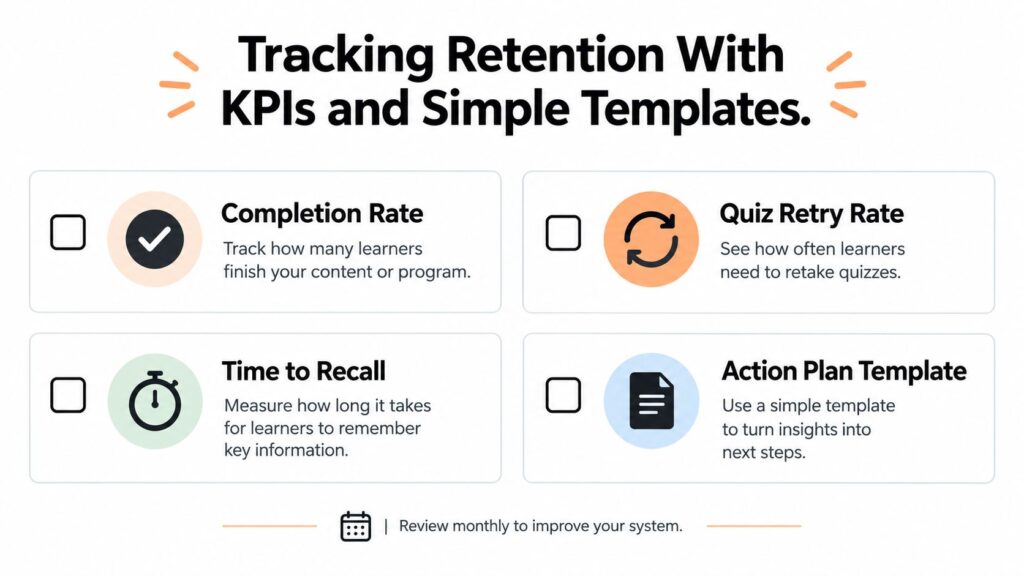
The KPIs worth watching
Retention on its own can feel blunt. These nearby signals give it context:
Completion rate
Helpful for spotting whether learners are even reaching the review points you built.Quiz retry rate
A high retry pattern can mean the check is too hard, the lesson is unclear, or learners need stronger reinforcement.Time to recall
This can be as simple as whether learners answer quickly from memory or need to reopen the lesson.Delayed assessment performance
This is the closest partner metric to retention rate itself.
If you also track creator-side business performance, resources on broader metrics for creators using taap.bio can help you think about retention in a wider audience and engagement system, not just inside the course shell.
A template that keeps the process manageable
You can run this with a basic spreadsheet.
I’d create one row per cohort and one set of columns per key module. Then log:
| Column | What to enter |
|---|---|
| Cohort name | The learner group or start month |
| Immediate score | Result from the first knowledge check |
| Delayed score | Result from the follow-up check |
| Retention rate | Delayed score divided by immediate score, then multiplied by 100 |
| Retry notes | Whether learners needed repeated attempts |
| Content changes | What you edited before the next cohort |
For timing, I like using 7, 30, and 90 day checkpoints as operating windows in my own tracking template because they force me to look beyond the launch-day glow. The exact windows can vary, but keeping them consistent matters more than making them fancy.
How to use the data without overcomplicating it
The value comes from monthly review.
Look for patterns like:
One module drops sharply later
Usually a cue to add retrieval prompts or simplify the explanation.Learners remember definitions but miss application questions
That often means you taught recognition, not use.Delayed scores improve after a content change
Keep the change and monitor the next cohort.
One option for organizing this inside a course platform is LearnStream, which publishes guidance around quiz tracking, spaced review, and learner progress workflows. A plain spreadsheet, Google Forms, Typeform, or your LMS quiz tool can work too.
Putting Your Retention Strategy Into Action
Most course creators don’t have a content problem. They have a memory design problem.
That’s good news because memory design can be improved.
If you take only one idea from this, make it this one. Learning retention rate is a moving target. It changes with timing, assessment style, and how often learners revisit the material. That’s why a single benchmark won’t tell you much on its own.
I’d start small.
Add one delayed recall quiz this week. Put it a few days after an important lesson. Compare that result with the immediate quiz score. If the gap is wide, don’t panic. You just found a place where the course can get stronger.
Then add one spaced review touchpoint.
Maybe it’s a recap email. Maybe it’s a short practice test. Maybe it’s a prompt at the start of the next module that asks learners to retrieve key ideas without notes.
Those small changes can reshape the learner experience because they turn forgetting from a hidden problem into something you can observe and improve.
The creators I trust most aren’t the ones with the slickest lesson videos. They’re the ones who check what learners still know later, then refine the course based on that evidence.
Do that consistently, and your course becomes easier to finish, easier to recommend, and much more useful in real life.
If your current course only tests understanding right after the lesson, your next move is simple. Add one delayed check, log the result, and build from there.